

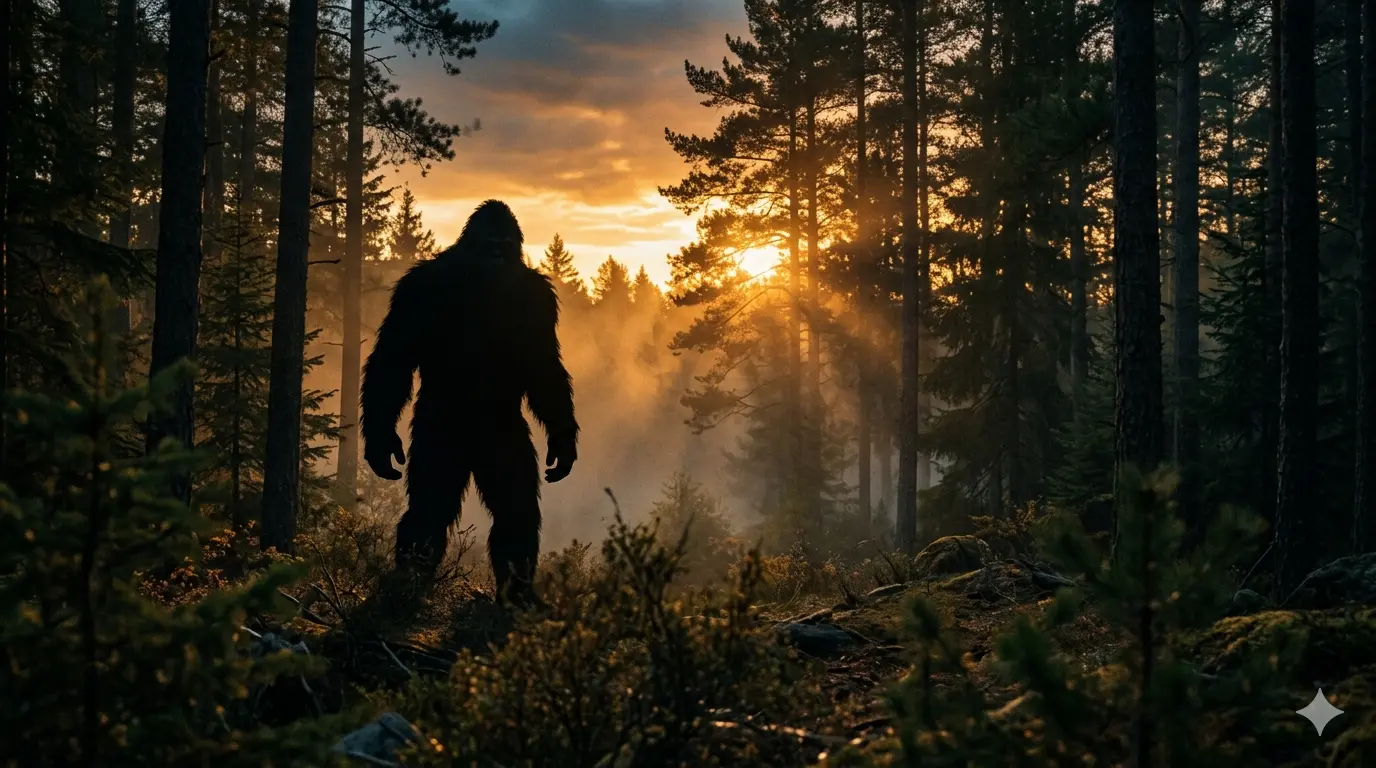
What Is Bigfoot — And Why Is He Watching You? Six Ohio Sasquatch Sightings in Four Days Put the Midwest on Notice
📡 BACKCOUNTRY PULSE Updated March 2026
Something moved through the woods of northeast Ohio in early March 2026. Between March 6 and March 12, the Bigfoot Society podcast received six separate reports of a large bipedal creature in wooded areas near Mantua and Garrettsville in Portage County — just miles from the Michigan border. National media picked it up.
The cryptid research community called it a flap — the largest cluster of Bigfoot sightings reported in one area in nearly fifty years.
Whether you’ve been following Sasquatch sightings for years or you’re asking what is Bigfoot for the very first time — this breakdown covers everything: the evidence, the science, the 2026 Ohio flap, what Michigan researchers have documented, and how to document a sighting yourself. For our full evidence deep-dive see the OTL Bigfoot Evidence Guide, and for a state-by-state BFRO data breakdown check our Top 10 Bigfoot States guide.
🦶 What Is Bigfoot? The Complete Answer
Bigfoot — also known as Sasquatch — is a large, bipedal, ape-like creature reported across North America for centuries. Descriptions are remarkably consistent across thousands of independent eyewitness accounts worldwide.
The typical description: a powerfully built, upright-walking figure standing between 7 and 10 feet tall, covered in dark hair, with enormous feet measuring 15 to 24 inches in length and a distinctive, rolling gait that differs from human walking.
📋 Bigfoot at a Glance: What Witnesses Report
- Height: 7–10 feet tall on average. Some Ohio 2026 witnesses described a figure approximately 10 feet tall with a shoulder width suggesting extreme upper body mass.
- Weight (estimated): 400–800 pounds based on track depth, stride length, and eyewitness comparisons to known reference points.
- Hair/coat: Dark brown to black, sometimes reddish-brown. Dense, full-body covering. No visible tail.
- Gait: Fully bipedal — walks upright like a human, not on all fours. Head turns at the shoulders rather than the neck in many accounts, a detail repeated independently across multiple Ohio 2026 reports.
- Footprints: 15–24 inch length, humanoid shape, flat foot with five toes. Dermal ridges (skin prints) documented in notable casts. Dr. Jeffrey Meldrum of Idaho State University holds over 300 footprint casts he cannot attribute to known species.
- Smell: Frequently described as a powerful, musky, garbage-like odor. Multiple Ohio witnesses noted the smell before seeing the creature.
- Sound: Wood knocking (striking trees), howls, guttural vocalizations, and infrasound reported in habituated areas. Audio evidence collected by BFRO researchers includes the famous “Ohio Howl.”
🌍 Bigfoot by Another Name: The Global Phenomenon
What most Americans call Bigfoot is part of a global pattern of large, bipedal, hair-covered creature reports that appear across nearly every continent:
- Sasquatch — the Salish Indigenous word meaning “woodland wildman,” used across Canada and the Pacific Northwest
- Yeti / Abominable Snowman — Himalayan foothills, Nepal, Tibet
- Almasty — Russia and Central Asia
- Yowie — Australia
- Skunk Ape — Florida and the American Southeast
- Dogman / Michigan Dogman — a distinct but related cryptid reported across the Midwest, with a high concentration of sightings in Michigan’s Wexford County and the Manistee National Forest area
🔬 Is Bigfoot Real? What the Evidence Says in 2026
This is the question that has divided researchers, scientists, and outdoor enthusiasts for generations. The honest answer is: no definitive proof exists.
But the volume, consistency, and geographic spread of the evidence makes a complete dismissal increasingly difficult for serious researchers. Here’s where the science actually stands.
🧬 The Scientific Evidence Landscape
Physical Evidence — Footprints
The most compelling physical evidence remains the footprint record. Dr. Jeffrey Meldrum, Full Professor of Anatomy and Anthropology at Idaho State University, is one of the few credentialed academics to formally study Sasquatch evidence.
His lab collection contains over 300 footprint casts. His analysis identifies anatomical pressure ridges and dynamic flexion patterns in a subset of casts that he argues could not be produced by known carving or hoaxing methods.
DNA Analysis — What Oxford Found
In 2014, geneticist Bryan Sykes at the University of Oxford led the first peer-reviewed genetic analysis of biological samples claimed to be from Bigfoot or Yeti — 37 usable samples from around the world. Every sample matched a known species: bears, horses, dogs.
Sykes noted this did not prove Bigfoot’s non-existence — only that none of the submitted samples were from an unknown primate. The study is widely cited by skeptics and acknowledged by serious researchers as the current state of the genetic evidence.
The Patterson-Gimlin Film
Filmed in 1967 at Bluff Creek, California, this 59-second film remains the most analyzed piece of alleged Bigfoot footage in existence. Biomechanics experts, including those at the University of British Columbia, have noted that the creature’s gait — particularly its knee flexion and foot placement — would be extremely difficult to replicate in a costume.
No hoax has ever been definitively proven, and no costume or mechanism capable of producing the film’s creature has ever been publicly identified.
Indigenous Oral History
Descriptions of Sasquatch-like creatures predate European contact in North America by centuries. Indigenous communities across the Pacific Northwest, the Great Lakes, and the Southeast maintain distinct oral traditions describing large, forest-dwelling humanoid beings.
These accounts are not derived from the post-1950s “Bigfoot” media phenomenon — they existed independently and were documented by anthropologists long before the modern cryptid era.
🚨 Bigfoot Sightings 2026: The Ohio Flap That Has Everyone Talking
In early March 2026, something triggered one of the most concentrated clusters of Bigfoot sightings in modern record. Cryptid sightings across the Midwest in 2026 have drawn more national media attention than any year in recent memory — and the Ohio flap is the reason why. Here is what was reported, in chronological order, from the Bigfoot Society podcast and corroborating regional media including Fox 8 Cleveland, NewsNation, and Cleveland 19 News:
A local researcher reported observing a 9-foot-tall, brown-haired figure standing approximately 120 yards away near State Route 44. Two encounters were reported from the same area this day.
An 8-foot figure with long arms and dark brown hair was reported. The witness said he heard footsteps and grunting before the encounter and discovered oversized muddy footprints at the site afterward.
Two hikers reported encountering a 10-foot Sasquatch on the trail. They described it grunting at them and turning its head at the shoulders — not the neck. An older woman in Windham independently reported a large hair-covered creature moving bipedally near the woods the same day.
A man letting his German Shepherd outside at 4 a.m. reported the dog lunging toward the woodline. The owner saw a large black shadow estimated at 8–10 feet tall crashing through the brush — described as “way bigger than a bear.”
The Bigfoot Society confirmed an 8th high-credibility report pushing further southeast. A dog reacted with visible distress near the woodline at a separate Trumbull County location.
🌲 Why Michigan Researchers Are Paying Attention
Portage and Trumbull Counties in northeast Ohio sit directly on Michigan’s southern border. MLive documented the connection explicitly. Michigan ranks among the top states nationally for reported Bigfoot sightings — with documented reports dating to at least 1957.
The Manistee National Forest, Wexford County, and the Upper Peninsula all have long track records in the BFRO database. If this flap represents seasonal movement, Northern Michigan’s spring thaw could put local researchers on high alert through April and May.
🌲 Bigfoot Michigan: What We Know From the Field
Michigan is not a fringe Bigfoot state. It has one of the most active sighting databases in the country with a documented history of credible reports going back decades.
The terrain makes Northern Michigan ideal habitat — dense forest, abundant water, low human population density, and seasonal isolation that limits access for large parts of the year.
🗺️ Michigan’s Bigfoot Hotspots
- Manistee National Forest: One of the highest concentrations of Michigan Bigfoot reports. Dense mixed hardwood and pine, criss-crossed by river systems including the Manistee River — exactly the kind of terrain BFRO researchers describe as ideal Sasquatch corridor.
- Wexford County / Cadillac area: Historically associated with Michigan Dogman sightings but also Bigfoot reports. The boundary between the two cryptids in this region is disputed among researchers.
- The Upper Peninsula: Remote, vast, and largely wilderness. Documented Bigfoot and Dogman reports from Marquette, Baraga, and Houghton Counties go back decades.
- Pere Marquette River corridor: We’ve spent considerable field time in this watershed. The riparian habitat is significant — large mammals including black bears use these corridors routinely. What’s occasionally reported here doesn’t match bear behavior.
🎥 Small Town Monsters — Heartland Sasquatch (Featuring JC Courtland)
Part of the Small Town Monsters Heartland Sasquatch documentary series
📸 How to Document a Bigfoot Sighting the Right Way
If you’re heading into the field — whether specifically for Sasquatch research or for camping, fishing, or hiking in known sighting areas — knowing how to document evidence correctly can make the difference between a credible report and a dismissed one.
Searches for Bigfoot sightings near me spike every spring as campers head into forest corridors across the Midwest. The BFRO’s field research standards are the benchmark for turning an encounter into usable Bigfoot evidence 2026 researchers can actually work with.
🎯 Field Documentation Protocol
If You See Something
- Stay calm and observe: Note height relative to a known object (tree, fence post), hair color, gait, direction of movement, and any sounds or smell. Most encounters last 3–10 seconds — use them.
- Film immediately: If your phone is accessible, start recording. Even shaky, poor-quality footage provides time reference and audio. Don’t zoom — keep the subject in frame with environmental context.
- Mark the location precisely: GPS coordinates beat compass bearings. Note the time, weather, lighting conditions, and your exact position.
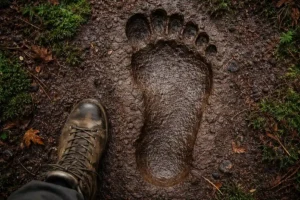
- Don’t disturb the area: If you find footprints, cast them before doing anything else. Photographs before, during, and after casting. Include a scale reference (boot, ruler, hand).
- Report to BFRO: Submit your report at BFRO’s geographic sightings database. Their investigators follow up on credible reports and add verified accounts to the publicly searchable database.
- Go prepared next time: If you’re heading into known Bigfoot territory deliberately, our How to Hunt Bigfoot: Essential Gear Guide covers the full field kit including thermal, audio, and night vision setups tested in Northern Michigan.
Footprint Casting Protocol
- Photograph prints from directly above with a scale reference
- Mix casting powder to a pancake batter consistency — not too thin
- Pour gently from the side, not directly into the print center
- Allow 45–60 minutes to cure before handling
- Label the cast with date, location, and GPS coordinates before it sets
🛒 Bigfoot Documentation Gear: Top 4
These are the four categories of equipment that serious Sasquatch researchers — including teams we’ve worked with — use in the field.
Browning Strike Force Pro X 1080 Trail Camera
24MP, no-glow IR, 120ft flash range, 100ft detection range with color view screen. The go-to passive documentation camera for serious field research.
Check on AmazonTOPDON TS004 Thermal Imaging Monocular
320×240 TISR, 256×192 IR resolution, IP67 waterproof, 11hr battery, wireless connection. Amazon’s #1 Best Seller in Night Vision Monoculars — detects heat signatures in complete darkness through dense forest.
Check on AmazonZoom H1n Handy Recorder
Built-in X/Y stereo mics, distortion-free recording to 120dB SPL, compact enough for any field kit. The BFRO standard for capturing vocalizations, wood knocking, and infrasound in the field.
Check on AmazonPerfect Cast Mold Casting Powder
Fast-curing, non-toxic, water-based casting powder — USA made. Ideal for preserving footprint evidence in the field. A correctly cast print becomes permanent physical evidence researchers can analyze.
Check on Amazon❓ Bigfoot FAQ: Your Top Questions Answered
What is Bigfoot and where does it come from?
Bigfoot — also called Sasquatch — is a large, bipedal, hair-covered creature reported across North America. The modern term “Bigfoot” dates to 1958 when a California newspaper used it to describe a series of giant footprints found at a construction site in Humboldt County. But the creature itself is far older in the record. Indigenous peoples across North America have oral traditions describing similar beings — woodland wildmen, forest guardians — that predate European contact by centuries. Today the BFRO database contains thousands of reports from every U.S. state and Canadian province.
Is Bigfoot real? What does the science say?
No definitive scientific proof of Bigfoot’s existence has been established. The 2014 Oxford University DNA study of 37 biological samples claimed to be from Bigfoot or Yeti found all matched known species — primarily bears. However, Dr. Jeffrey Meldrum, a tenured anatomy professor at Idaho State University, maintains that a subset of footprint casts in his collection display anatomical features that cannot be attributed to known hoaxing methods. The scientific community remains divided — most dismiss the phenomenon outright, while a minority of credentialed researchers argue the volume and consistency of evidence warrants formal study. The honest answer in 2026 is: unknown.
What happened with the Ohio Bigfoot sightings in 2026?
Between March 6 and March 12, 2026, the Bigfoot Society podcast documented six to eight independent reports of a large bipedal creature in Portage and Trumbull Counties in northeast Ohio — near the Michigan border. Witnesses described figures between 8 and 10 feet tall. The cluster was described by researchers as a Bigfoot “flap” — a concentrated burst of activity in a small geographic area — the largest reported since the 1970s. It was covered nationally by Fox News, NewsNation, and regional Ohio television. The Portage County Sheriff’s Office found no corroborating reports in their records. No photographs or video were produced by any of the witnesses.
Are there Bigfoot sightings in Michigan?
Yes — Michigan has one of the most active Bigfoot sighting records in the country, with documented reports dating to at least 1957. The Manistee National Forest, Wexford County, and the Upper Peninsula are among the most frequently cited areas. Michigan is also home to the Michigan Dogman — a distinct but related cryptid reported in the same forested corridors, particularly in Wexford County and areas surrounding the Manistee River. JC Courtland has field experience across this territory and has appeared in Small Town Monsters productions covering Michigan cryptid research.
What should I do if I see Bigfoot?
Stay calm. Observe as much detail as possible — height relative to nearby objects, hair color, gait, any sounds or smells. Start recording with your phone immediately if accessible, keeping the subject and its surroundings in frame. Note your exact GPS location, time, and weather. Do not approach. Do not disturb any footprints — photograph them with a scale reference first, then cast them with plaster of Paris if possible. Submit a formal report to the Bigfoot Field Researchers Organization (BFRO) at bfro.net. The more detail you can document at the time, the more useful your report will be to researchers.
📚 Resources
- → BFRO Geographic Database of Bigfoot Sightings — Searchable by state, county, and date. The most comprehensive verified Bigfoot sighting database in North America
- → Small Town Monsters — Award-winning independent documentary production company covering Bigfoot, the Michigan Dogman, and cryptid research across North America. JC Courtland has appeared in STM productions.
- → Western Washington University Library — Bigfoot & Cryptozoology Research Guide
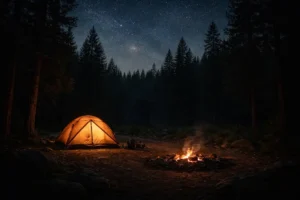
Whether Bigfoot is a relic hominid, a misidentified known species, a cultural phenomenon, or something science hasn’t categorized yet — the 2026 Ohio flap is a reminder that the question is far from closed.
Six independent reports in four days from a tight geographic corridor near the Michigan border is not nothing. Whatever is moving through those woods, it’s worth paying attention to.
Before any backcountry research expedition, make sure your safety fundamentals are solid — see our Camping Safety Tips for 2026 for the full field prep checklist.
This article was published by Outdoor Tech Lab in March 2026. Ohio sighting details sourced from Bigfoot Society podcast, Fox 8 Cleveland, NewsNation, Cleveland 19 News, and MLive. All sightings remain unverified by law enforcement.
OutdoorTechLab.com Disclaimer: Based on 20+ years of backcountry experience across Northern Michigan. OTL does not claim to confirm or deny the existence of Bigfoot or Sasquatch. All sighting reports referenced are sourced from named publications and researchers.


Leave a Reply