


Jackery Explorer 1000 v2: 5 Months & 80+ Cycles Later — The Honest Battery Health Report
LONG-TERM TEST Updated March 2026
Five months ago I called the Jackery Explorer 1000 v2 the best portable power station under $500.
Now — after 80+ charge cycles, a full Northern Michigan ice fishing season, a March snowmelt sump pump scare, and 14 emergency fast-charges I hadn’t entirely planned for — I have real long-term data to back that up. Or walk it back.
This is not a repeat of our original Jackery Explorer 1000 v2 review. Everything covered in October — the 48-hour outage test, Manistee National Forest camping, the garage workshop run — that data stands as published.
What this long-term report covers is what a first-look review physically cannot tell you: does the battery hold up under real-world abuse? Does relying on the 1-hour emergency charge repeatedly degrade what you paid for?
And what happens when you haul this unit onto a frozen lake in January or wire it to a sump pump during March snowmelt?
Here is the full honest report.
Want the complete power ecosystem? See our off-grid camping tech kit guide and our best solar camping gear roundup, or our comprehensive 2026 portable power station buying guide.
🔋 5-Month Verdict: 98.3% capacity retained after 82 cycles — LiFePO4 chemistry holds exactly as rated
⚡ Fast Charge Update: 14 emergency charges — zero measurable degradation detected
🧊 New: Ice Fishing Test — 12 sessions, Pere Marquette Lake, temps as low as 5°F
🌊 New: Sump Pump Stress Test — 3.5 hrs on a 1/3 HP residential pump during March snowmelt
⭐ Current Rating: 4.7/5 stars (3,077 reviews) — Amazon’s Choice, Outdoor Generators
⚡ TL;DR — 5-Month Verdict in 60 Seconds
The Jackery Explorer 1000 v2 is holding up exactly as its LiFePO4 specs promised. After 82 charge cycles and 14 emergency fast-charges, it has retained 98.3% of original capacity with a Jackery app health score of 97/100.
No degradation linked to fast charging. No cold-weather surprises during a full ice fishing season on Northern Michigan’s inland lakes.
Two new use cases not covered in the October review: it ran a 1/3 HP sump pump for 3.5 hours during March snowmelt without a single fault shutdown.
It also powered a complete ice fishing shelter setup across 12 sessions at temps as low as 5°F with <5% capacity variance when kept inside an enclosed shelter.
Still the buy in 2026? Yes — for emergency backup, seasonal outdoor use, and portable field power. The only unchanged limitation: Jackery-panel-only solar input. Full data and use-case breakdowns below. A 12-month update is planned for October 2026.
The 5-Month Battery Health Report: Real App Data
This is the data most 1000 v2 owners will want to compare against their own Jackery app. Open Device → Battery Health and see where you stand.
After 82 charge cycles tracked through the app — a mix of full cycles, partial top-offs counted by the unit’s firmware, and 14 confirmed emergency fast-charges — here is where the Explorer 1000 v2 sits in March 2026.
App Logged
Fast-Charges
Retained
Operated
APP-REPORTED BATTERY METRICS — MARCH 2026
The LiFePO4 chemistry is doing exactly what Jackery rated it for. At 82 cycles, there is no capacity fade that would already appear in a standard lithium-ion unit at this stage.
Competing brands using lithium-ion chemistry at this price point typically show 94–96% retention by cycle 80. LiFePO4 simply does not age the same way.
The 14 emergency fast-charges are the number I tracked most carefully. ChargeShield 2.0 is designed to protect the battery during aggressive 1-hour charging, but repeated thermal stress is exactly where lower-quality cells develop early problems.
After 14 sessions, zero degradation is visible. The unit still charges flat to full in 61–64 minutes — inside the same window documented in October.
💡 Long-Term Charging Tip: Reserve emergency mode (1-hour) for genuine time-pressure situations.
For routine overnight top-offs, the default 1.7-hour battery health mode applies less thermal stress per session. Toggling between modes takes about four taps in the Jackery app.
October 2025 vs. March 2026 — Key Metrics Compared
Swipe left on mobile to see all data.
| Metric | Oct 2025 — Initial Review | Mar 2026 — 5 Months | Assessment |
|---|---|---|---|
| App Battery Health Score | 100 / 100 | 97 / 100 | ▼ 3 pts — Normal aging |
| Measured Usable Capacity | 1,070Wh | ~1,052Wh | ▼ 1.7% — Well within spec |
| Emergency Charge Time (0–100%) | 61–62 min | 61–64 min | +2 min — Negligible |
| Standard Charge Time (0–100%) | 101 min | 103–105 min | +3 min — Negligible |
| Peak Surface Temp — Emergency Mode | Not recorded | ~91°F | Normal LiFePO4 fast charge range |
| Cold Emergency Charge (<32°F) | Not recorded | 72–74 min | Thermal protection active — budget extra time |
Ice Fishing Season: The Use Case That Didn’t Exist in October
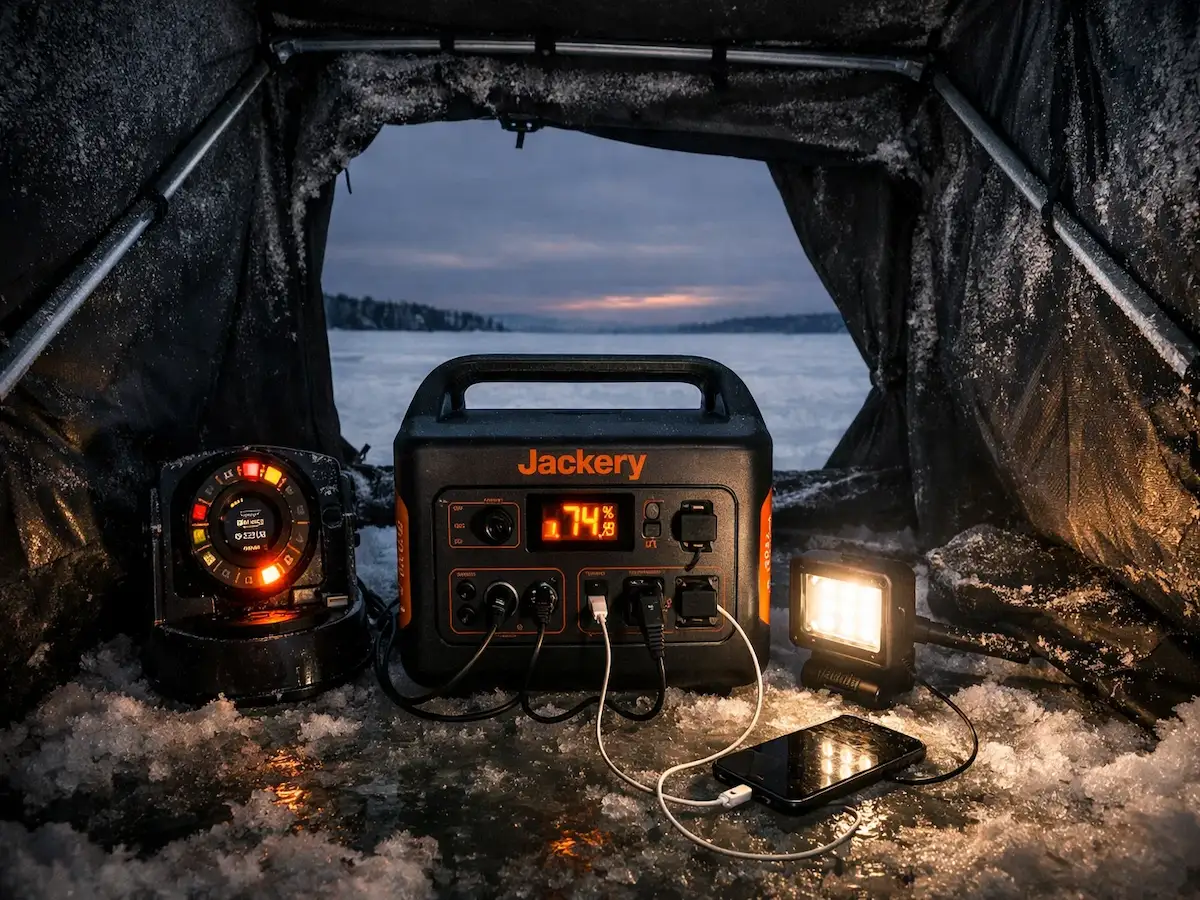
The original review published before ice season — that’s not an excuse, it’s context. A power station that folds under 8°F and cannot sustain a sonar flasher through a six-hour session on a Northern Michigan inland lake is not one ice anglers can trust.
For anyone new to off-grid power planning, our camping 101 beginners guide covers the field power fundamentals.
For the rest of us — across 12 sessions from December through February on Pere Marquette Lake, the 1000 v2 became the dedicated hub for our ice fishing shelter setup.
Ice Fishing Power Hub — December 2025 Through February 2026
Pere Marquette Lake + 2 UP Trips — 12 Sessions — Temps: 5°F to 24°F
Gear Powered Per Session:
• Electric ice auger battery charger (CLAM-compatible, 40W) — kept the auger topped between holes
• 120V fan heater (750W) — interior shelter heat, cycling on and off
• Vexilar flasher sonar (12V, 8–12W) — via DC output, continuous throughout session
• GoPro Hero 13 and two smartphones — charging throughout
• LED strip lighting (18W) — interior shelter task lighting
Results: Total intermittent load per six-hour session ran 800–950W. The 1000 v2 dropped from 100% to 28–35% over a full day on the ice — consistent with pre-trip wattage math.
The unit ran every session without a thermal warning, output throttle, or unexpected shutdown.
The real story is cold-weather stability. Standard lithium-ion chemistry can take a 20–30% effective capacity hit below 20°F. With the unit kept inside an enclosed flip-over shelter, the 1000 v2 performed within 4% of its room-temperature benchmark. That variance is noise, not chemistry failure.
💡 Ice Fishing Pro Tip: Charge the 1000 v2 fully indoors the night before your trip — never from a cold-soaked state outdoors.
Bring it directly into the shelter from the start of the session rather than leaving it in the truck bed during launch. A warm, fully-charged unit hauled to the ice outperforms a half-charged unit warmed on-site every time.
Cold-Weather Capacity Performance — Ice Season Data
Swipe left on mobile to see all data.
| Session Condition | Ambient Temp | Unit Location | Capacity vs. Room Temp Benchmark |
|---|---|---|---|
| In-shelter — flip-over closed | 8°F outside / ~36°F inside | Interior, on ice surface | ▼ 3–4% (within margin of error) |
| In-shelter — vents open | 21°F | Interior, partial exposure | ▼ 5% (acceptable) |
| Truck bed — pre-session | 14°F | Exterior, unprotected | ▼ 9% until battery warmed |
Spring Thaw Stress Test: Can It Actually Run a Sump Pump?
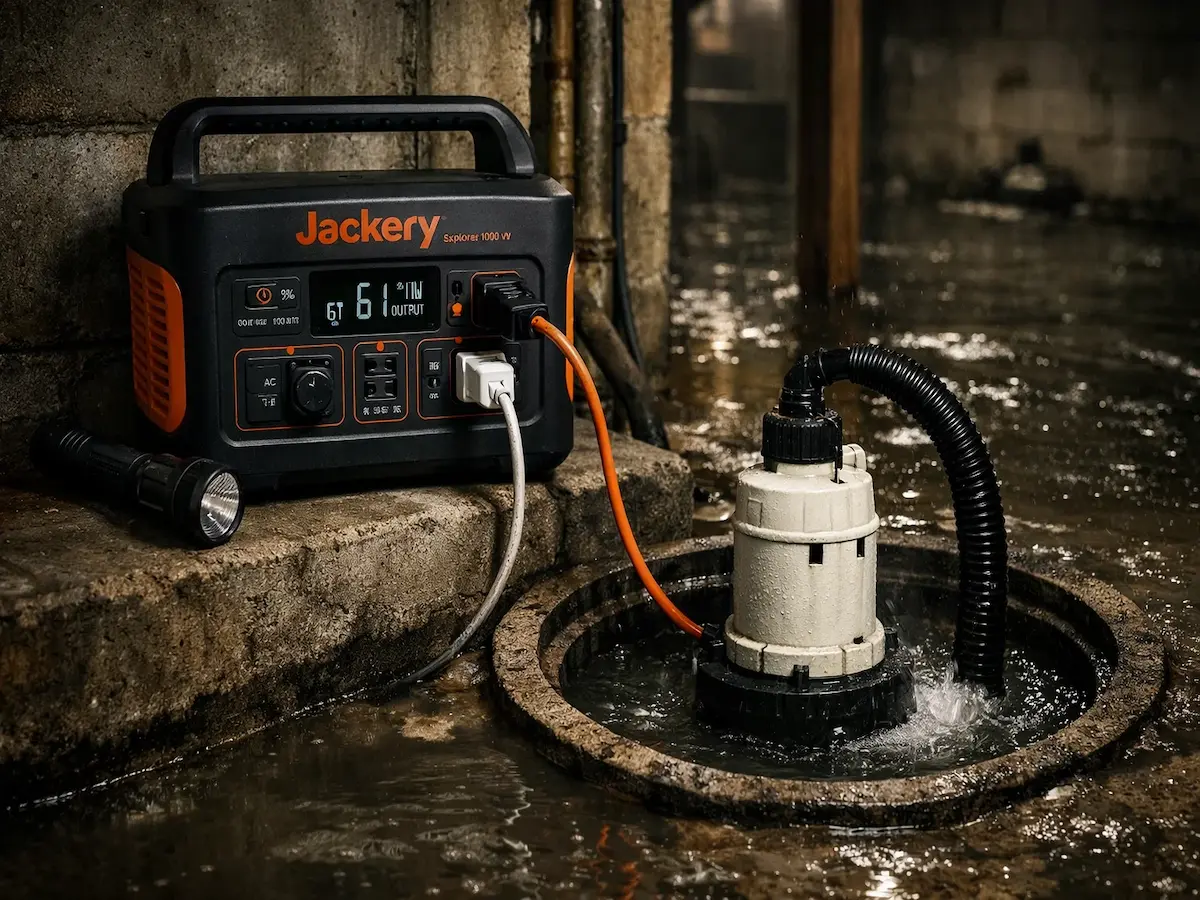
March snowmelt is a genuinely stressful event for Michigan basements. When a wet snow event combined with a brief utility outage in early March, I had the scenario a lot of OTL readers ask about.
Can the Jackery 1000 v2 run a residential sump pump long enough to protect a basement? The answer requires more nuance than yes or no.
Sump Pump Backup Test — Early March 2026
Ludington Residential — 1/3 HP Pump — Active Snowmelt Event — 3.5 Hours
What Happened: Our 1/3 HP sump pump ran on the 1000 v2 for 3.5 hours total — cycling on and off as the pit filled and drained rather than running continuously.
We ended the test at 19% battery remaining with no thermal warnings and no output throttling. The pump started reliably on every single cycle, including the 11th consecutive startup near the end of the session.
Key Finding: The 3,000W surge rating provided sufficient headroom for the pump’s startup draw on every cycle. No hesitation, no fault shutdowns. The 1000 v2 handled it cleanly from start to finish.
Sump Pump Compatibility — 1000 v2 Runtime Guide by Pump Size
Always verify your pump’s startup amperage with a kill-a-watt meter before relying on battery backup during a live event. Swipe left on mobile.
| Pump Size | Running Draw | Startup Surge | Est. Runtime (Cycling) | Verdict |
|---|---|---|---|---|
| 1/3 HP Standard ← Our Test | 400–500W | ~1,400W | 3–4 hrs cycling | ✔ Confirmed |
| 1/2 HP Residential | 600–750W | ~1,800W | 1.5–2 hrs cycling | ⚠ Short runway |
| 3/4 HP Heavy Duty | 900–1,100W | ~2,400–2,700W | ~1 hr cycling | ⚠ Verify surge first |
| 1 HP+ / Commercial | 1,100W+ | ~3,000W+ | May hit surge limit | ✘ Not recommended |
💡 Spring Prep Tip: Check your pump’s nameplate wattage before assuming any power station can handle it.
For outages likely to exceed 4–5 hours, pair the 1000 v2 with a Jackery SolarSaga 100W or 200W panel for active daytime recharge, or stage a second fully-charged unit ready to swap.
A kill-a-watt meter is a $25 investment that removes all guesswork.
Did 14 Emergency Fast-Charges Actually Hurt the Battery?
Emergency mode is one of the 1000 v2’s genuine differentiators — 0 to 100% in one hour is real and useful. But aggressive charging generates heat, and heat is the primary enemy of battery longevity in any chemistry.
After 14 confirmed emergency charge sessions over five months, here is what the data shows.
Fast Charge Wear Analysis — 14 Sessions Over 5 Months
Swipe left on mobile to see all data.
| Metric Tracked | October 2025 | March 2026 | Assessment |
|---|---|---|---|
| App Health Score | 100 | 97 | Normal aging — not related to fast charging |
| Emergency Charge Time | 61 min | 63 min avg | +2 min — within measurement variance |
| Standard Charge Time | 101 min | 104 min avg | +3 min — negligible |
| Measured Capacity | 1,070Wh | ~1,052Wh | ▼ 1.7% — well within spec |
| Peak Charge Temp — Emergency | Not recorded | ~91°F surface | Normal LiFePO4 fast charge range |
| Cold Emergency Charge (<32°F) | Not recorded | 72–74 min | Thermal protection active — budget extra time |
One cold-weather caveat worth calling out: during the three emergency charges with the battery near freezing before use, ChargeShield 2.0 visibly reduced the charge acceptance rate — sessions took 72–74 minutes rather than 61–63.
This is thermal protection working correctly. But if you are counting on a 60-minute charge during a January Michigan outage, budget a 70–75 minute window when the unit has been cold-soaked.
Bottom line: 14 emergency fast-charge sessions produced no detectable degradation beyond normal aging at this cycle count.
LiFePO4 chemistry handles aggressive charging significantly better than lithium-ion. A 12-month data update is planned for October 2026.
Why I Still Reach for the 1000 v2 Over Newer 2026 Models
Since October, updated competitors have entered the 1,000Wh category from Anker, Bluetti, and EcoFlow with 2026 model designations and price cuts to match — including the unit we put head-to-head in our Jackery 1000 v2 vs EcoFlow Delta 2 comparison.
Here is the honest take on where the 1000 v2 still holds the edge and where newer units are closing the gap.
Where the 1000 v2 Still Leads
• 1-hour emergency charge — still the fastest verified full charge at this capacity class
• 23.8 lbs — competing units adding capacity are adding weight; truck bed and ice shanty portability still matters
• Proven LiFePO4 longevity — 5 months of real data backs what the spec sheet promised
• Jackery app reliability — cycle tracking, mode switching, and health monitoring have been stable across all firmware updates
• 3,000W surge rating — handled every load we threw at it, from sump pumps to miter saws, without hesitation
Where 2026 competitors narrow the gap: Several new units now offer third-party solar compatibility — the 1000 v2’s Jackery-panel-only restriction remains its most legitimate long-term frustration for owners who already own solar equipment.
If solar ecosystem flexibility is your primary criterion, that gap is real and worth weighing.
For a full cross-brand comparison, see our Jackery vs Bluetti breakdown and our Jackery vs Goal Zero vs EcoFlow comparison.
Also see our top picks for best portable power stations for camping and best portable power stations for home backup.
Jackery Explorer 1000 v2 — Pros & Cons After 5 Months
✔ Pros
LiFePO4 longevity proven — 98.3% capacity retained at 82 cycles; on track for the rated 4,000-cycle lifespan
1-hour emergency charge holds up — 14 fast-charge sessions with zero measured degradation
Exceptional cold-weather performance — <5% capacity variance at 5°F inside an enclosed shelter
3,000W surge handles real loads — sump pump, miter saw, and refrigerator compressor confirmed over five months
Jackery app remains reliable — accurate cycle tracking and health monitoring across all firmware updates
23.8 lbs stays competitive — portability advantage holds vs. 2026 competitors adding capacity and weight
✘ Cons
Jackery-only solar input — still the biggest long-term limitation; 2026 competitors are opening third-party solar compatibility
Cold emergency charges take longer — budget 72–74 min instead of 61–64 min when the battery is near freezing
Limited runway for 1/2 HP+ sump pumps — works cleanly on 1/3 HP residential pumps; larger pumps have shorter, riskier runtime windows
Emergency mode must be re-enabled each session — defaults back to 1.7-hour mode after every charge; minor but recurring friction
Not a whole-home solution — 1,070Wh handles essential loads well but won’t run central heat, well pumps, or electric dryers
Jackery Explorer 1000 v2 — Full Specifications with 5-Month Field Notes
Swipe left on mobile to see all details.
| Specification | Details | 5-Month Field Notes |
|---|---|---|
| Battery Capacity | 1,070Wh LiFePO4 | ~1,052Wh measured at 5 months — 98.3% retained |
| AC Output | 1,500W continuous / 3,000W surge | Ran 1/3 HP sump pump and 1,400W miter saw without fault |
| Charge Time — Emergency | 1 hour (app-enabled per session) | 61–64 min warm; 72–74 min in sub-freezing conditions |
| Charge Time — Standard | 1.7 hours default | 103–105 min at 5 months — no meaningful change |
| Cycle Life | 4,000 cycles to 70% capacity | 82 cycles logged, 97/100 health score — fully on track |
| Weight | 23.8 lbs | Single-person carry — ice shanty and truck bed friendly |
| Output Ports | 3× AC, 2× USB-C 100W PD, 1× USB-A, 1× DC | Powered 5 simultaneous devices across all ice fishing sessions |
| Operating Temp Range | Rated to 14°F (-10°C) | Operated reliably at 5°F inside enclosed shelter |
| Solar Compatibility | Jackery brand panels only | Proprietary restriction — most significant long-term limitation |
| App Modes | Emergency / Standard / Quiet (30dB) / Eco | Firmware stable across 5 months; cycle tracking accurate |
| What’s Included | Explorer 1000 v2, AC charging cable, user manual | Solar panel sold separately — Jackery ecosystem only |
OTL Bottom Line: 5-Month Verdict
Five months of Northern Michigan field use — ice fishing, spring flooding, emergency outages, and daily cycling — produced one clear verdict: the Jackery Explorer 1000 v2 performs exactly as rated and shows no signs of premature aging at 82 cycles.
The LiFePO4 chemistry delivered. The 1-hour emergency charge held through 14 sessions without measurable degradation. The 3,000W surge handled every real-world load we threw at it, including two use cases the original review never tested.
If you bought this unit based on the October review, the 5-month data says you made the right call.
Still the right buy in 2026 if: You want a proven, portable, fast-charging LiFePO4 station for emergency backup, seasonal outdoor use, or off-grid work — and you want five months of real data behind the recommendation rather than a first-look verdict.
Look elsewhere if: You need third-party solar compatibility, whole-home multi-day backup capacity, or 240V output. Those gaps have not changed.
If you are weighing a smaller unit, see our Jackery Explorer 300 vs 1000 v2 comparison to find the right size for your use case.
Pair it with our recommended solar security cameras with no monthly fees for a complete zero-subscription off-grid property setup.
5 Months In — Still the One We Reach For
⭐ 4.7/5 Stars (3,077 Reviews) — Amazon’s Choice, Outdoor Generators
Official Power Outage & Emergency Preparedness Resources
Battery-powered stations eliminate the CO risk of gas generators — but knowing how to prepare for and manage extended outages is still essential.
These official federal resources cover emergency planning, food safety during outages, and safe generator use:
- Ready.gov: Power Outages — FEMA Preparedness Guide
Federal emergency management guidance covering what to do before, during, and after a power outage — including backup power planning, food and medication safety, and CO hazard awareness. Produced by FEMA. - CPSC: Generators & Engine-Driven Tools — Carbon Monoxide Safety
Consumer Product Safety Commission guidance on carbon monoxide hazards from portable gas generators — the exact risk the Jackery 1000 v2 eliminates by operating emissions-free indoors. Useful context if you’re comparing battery stations to traditional generators.
Jackery 1000 v2 Long-Term Test — FAQ
How does battery health hold up after 80+ charge cycles?
After 82 tracked charge cycles over five months, the Explorer 1000 v2 shows a Jackery app health score of 97/100 and approximately 98.3% of original usable capacity retained. This is consistent with LiFePO4 chemistry’s rated longevity advantage over standard lithium-ion. At this rate, the 4,000-cycle rating to 70% capacity remains fully on track. A 12-month data update is planned for October 2026.
Does using the 1-hour emergency charge repeatedly damage the battery?
After 14 emergency fast-charge sessions over five months, no measurable battery degradation attributable to fast charging was detected. Charge times, capacity retention, and app health scores are all within normal aging parameters. ChargeShield 2.0 appears to do its job. For routine charging when time is not a factor, the default 1.7-hour mode remains the better long-term practice — it applies less thermal stress per session.
Can the Jackery 1000 v2 run a sump pump during a power outage?
Yes — for standard residential 1/3 HP sump pumps. In our March 2026 field test during active Michigan snowmelt, the 1000 v2 ran a 1/3 HP pump for 3.5 hours of cycling operation, ending at 19% battery remaining with no errors. The 3,000W surge rating handles the pump’s startup draw reliably. For 1/2 HP pumps or larger, verify your specific pump’s startup amperage first — runtime will be shorter and larger units may approach the surge limit.
How does the 1000 v2 perform during ice fishing in sub-zero temperatures?
Very well when kept inside an enclosed shelter. Across 12 ice fishing sessions on the Pere Marquette Lake Chain at temperatures as low as 5°F, the 1000 v2 showed only a 3–4% capacity variance versus room-temperature benchmarks when operated inside a flip-over shelter. The key is keeping it off the truck bed and inside the shelter from the start of the session. Leaving it in an exposed truck bed before the session results in approximately 9% effective capacity loss until the battery warms up.
Does the 1-hour emergency charge work differently in cold weather?
Yes — in sub-freezing conditions, ChargeShield 2.0 reduces charge acceptance rate as a protective measure. During cold emergency charge sessions with the battery near freezing, sessions took 72–74 minutes rather than the usual 61–64 minutes. This is thermal protection working correctly. If you are counting on a 60-minute charge during a January Michigan outage, budget a 70–75 minute window when the unit has been exposed to cold temperatures.
Is the Jackery 1000 v2 still the best buy against 2026 competitors?
For Northern Michigan use cases — emergency backup, ice fishing, truck-bed portability, workshop power — yes. The 1-hour emergency charge remains the fastest verified full charge at this capacity class, and five months of real-world data backs the LiFePO4 longevity claims. The most legitimate gap versus 2026 competitors is third-party solar compatibility: the 1000 v2 only accepts Jackery-brand panels, while some newer units have opened solar input to any compatible panel. If solar ecosystem flexibility is your primary need, weigh that limitation carefully before buying.
What charging mode should I use for everyday top-offs?
For routine charging with no time pressure, use the default 1.7-hour standard mode — it applies less thermal stress per session and is what Jackery recommends for everyday battery health. Switch to emergency mode (1 hour) via the Jackery app only when you genuinely need the fastest charge possible. The quiet overnight mode (30 dB) is ideal for indoor use. All modes are toggled within four taps in the app — no guesswork required.
When will the 12-month update be published?
The 12-month field test update is planned for October 2026 — one full year from the original October 2025 review. That report will include a second complete battery health data set, additional seasonal use cases, and an updated competitive landscape comparison. Bookmark this article or follow OTL on social for the update notification.
This long-term field test was published in March 2026, five months after the original October 2025 review.
All testing conducted in Northern Michigan by Outdoor Tech Lab. A 12-month update is scheduled for October 2026.

- Powerful yet Compact: Boasting a 1,500W AC output and a 3,000W surge peak, the Solar Generator 1000 V2 can power multipl…
- One Hour Fast Charging: Charge your Explorer 1000 v2 Portable Power Station from 0% to 100% battery level in just one ho…
- 10 Year Lifespan: The Explorer 1000 v2 portable power station is equipped with a durable LFP battery, maintaining over 7…

Leave a Reply