

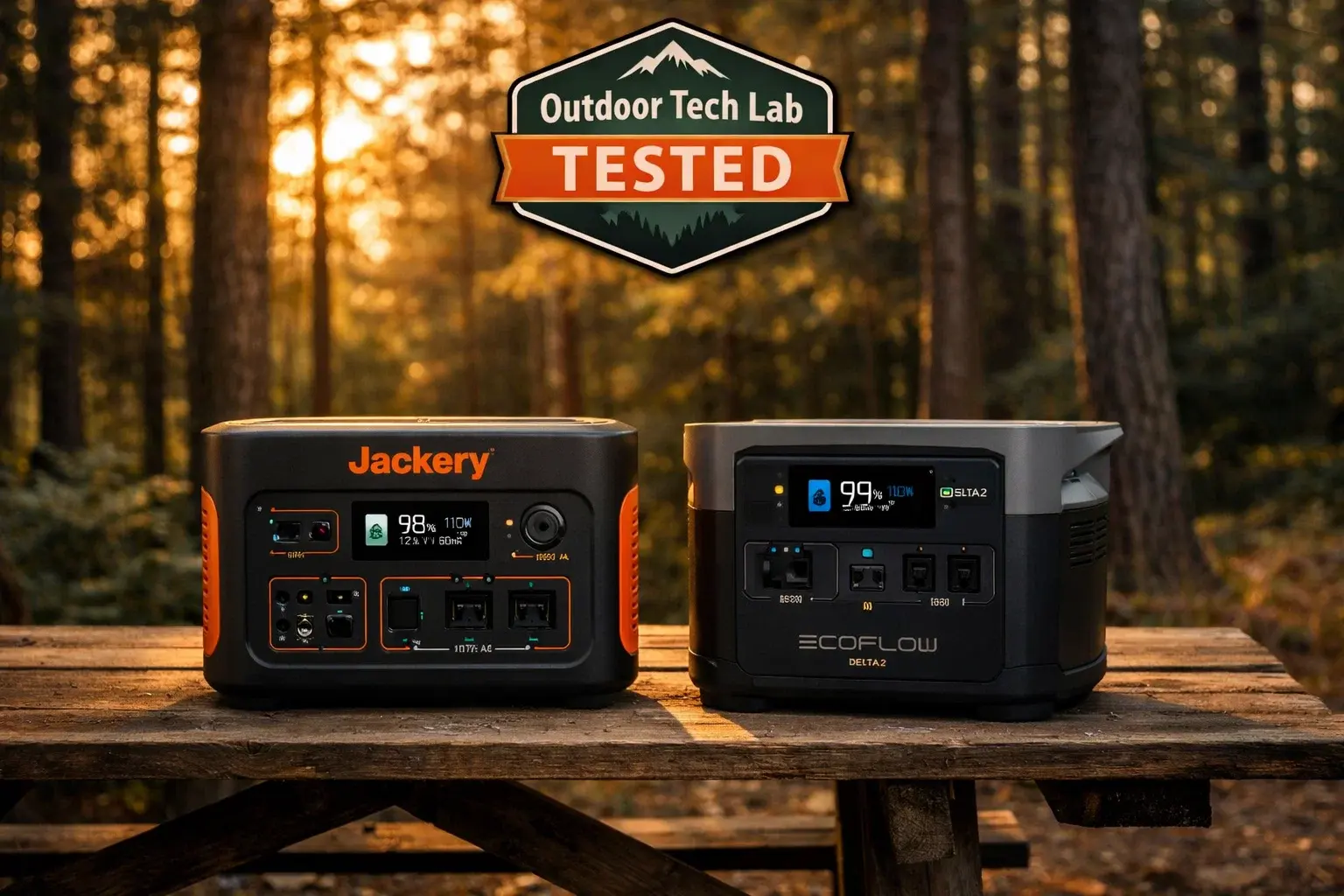
Same Price. Same Stars. Completely Different Strengths. Here’s Exactly Which One You Should Buy.
COMPARED Updated April 2026
This Jackery Explorer 1000 v2 vs EcoFlow Delta 2 comparison comes down to a decision that’s harder than it looks — roughly $40 apart, identical 4.7-star ratings, and nearly identical capacity. On paper these two power stations are almost the same product. In the field, they’re built for different priorities.
The Jackery Explorer 1000 v2 is the lighter, more compact station with a 4,000-cycle LiFePO4 battery that outlasts the Delta 2’s 3,000-cycle rating by a full third — and its 1-hour fast charge via the Jackery App is genuinely faster than anything in its class.
The EcoFlow Delta 2 hits harder where output matters — 1,800W AC versus the Explorer 1000 v2’s 1,500W, an open solar ecosystem that accepts any 500W panel input, and expandable capacity up to 3kWh with add-on batteries.
Check current pricing on Amazon below — it frequently runs at a meaningful discount off list price.
At Outdoor Tech Lab, we’ve run both stations through Northern Michigan field conditions — the Explorer 1000 v2 on extended basecamp setups near Pictured Rocks National Lakeshore paired with the SolarSaga 200W, and the Delta 2 through home backup scenarios during the kind of Lake Michigan storm systems that test what “reliable” actually means. Both stations earn their ratings.
But one of them is the right tool for how you actually use it.
This OTL comparison gives you the real answer — based on field results in actual Michigan conditions, not manufacturer claims. If you want the full brand-level picture before this specific matchup, our Jackery vs EcoFlow brand comparison covers the entire ecosystem head to head.
Already running Jackery solar panels and wondering which station pairs best? Our Jackery SolarSaga 100W vs 200W comparison covers the panel side of the equation in detail.
New to Jackery entirely? Our complete Jackery portable power station guide walks through the full lineup by use case.
Not sure the 1000Wh class is right for you? Our portable power station guide 2026 breaks down every capacity class so you don’t overbuy.
TL;DR — Jackery Explorer 1000 v2 vs EcoFlow Delta 2 Quick Answer
Choose the Jackery Explorer 1000 v2 if: You want the lightest station in this class, the longest battery lifespan (4,000 cycles vs 3,000), and a 1-hour fast charge that’s genuinely the fastest in its category. Best for camping, travel, and anyone building a Jackery solar ecosystem.
Choose the EcoFlow Delta 2 if: You need more AC output (1,800W vs 1,500W), an open solar ecosystem that works with any panels, or the option to expand capacity up to 3kWh. Better for home backup, RV use, and powering larger appliances.
Bottom line: The roughly $40 price difference isn’t the decision. It comes down to this — do you need higher output and expandability (Delta 2) or longer battery life and lighter weight (Explorer 1000 v2)? Both are excellent. Neither is wrong. One fits your setup better.
Which Power Station Is Right for You?
| Use Case | 1000 v2 | Delta 2 |
|---|---|---|
| Camping & Backyard Use | ✅ | ✅ |
| Home Backup Power | Good | ✅ Better |
| RV & Van Life | ✅ | ✅ Better |
| Powering High-Draw Appliances | ❌ 1500W limit | ✅ 1800W |
| Lightest Weight Priority | ✅ 23.8 lbs | ❌ 27 lbs |
| Expandable Capacity | ❌ | ✅ Up to 3kWh |
| Jackery Solar Panels | ✅ Native | ❌ Incompatible |
| Open Solar Ecosystem | ❌ Jackery only | ✅ Any panels |
| Longest Battery Lifespan | ✅ 4,000 cycles | ❌ 3,000 cycles |
| 1-Hour Fast Charge | ✅ | ❌ 80 min min |
Jackery Explorer 1000 v2 vs EcoFlow Delta 2: Full Specs Comparison
Side-by-side specifications verified through Northern Michigan field testing by Outdoor Tech Lab. Swipe left on mobile to see all details.
| Specification | ⚡ Jackery Explorer 1000 v2 | 🔵 EcoFlow Delta 2 |
|---|---|---|
| Capacity | 1,070Wh ✓ | 1,024Wh |
| AC Output | 1,500W (x3) | 1,800W ✓ |
| Battery Type | LiFePO4 | LiFePO4 |
| Battery Cycles | 4,000 cycles ✓ | 3,000+ cycles |
| Fast Charge | 1hr (App) / 1.7hr default ✓ | 80% in 50 min / Full in 80 min |
| Weight | 23.8 lbs ✓ | 27 lbs |
| Dimensions | 12.87 x 8.82 x 9.72″ ✓ | 15.7 x 8.3 x 11.3″ |
| USB-C Output | 100W max | 100W |
| USB-A Output | 18W max | 18W |
| Solar Input | Jackery panels only | 500W open ecosystem ✓ |
| Expandable | ❌ No | ✅ Up to 3kWh ✓ |
| App Control | ✅ Jackery App ✓ | ✅ EcoFlow App |
| Discharge Temp | 14°F to 113°F | -4°F to 113°F |
| Current Price | See live price ↓ | See live price ↓ |
| Star Rating | 4.7/5 (4,523 reviews) | 4.7/5 (7,313 reviews) |
| Warranty | 2 years | 5 years ✓ |
⚡ Jackery Explorer 1000 v2
Capacity: 1,070Wh
AC Output: 1,500W
Weight: 23.8 lbs
Cycles: 4,000 (10+ year lifespan)
Best for: Camping, travel, Jackery solar ecosystem
Stars: ⭐ 4.7/5 (4,523 reviews)
🔵 EcoFlow Delta 2
Capacity: 1,024Wh
AC Output: 1,800W
Weight: 27 lbs
Cycles: 3,000+ (expandable to 3kWh)
Best for: Home backup, RV, high-draw appliances
Stars: ⭐ 4.7/5 (7,313 reviews)
Real-World Testing: Northern Michigan Field Results
Jackery Explorer 1000 v2: Pictured Rocks Basecamp & Manistee Forest Testing
The Power Station That Disappears Into Your Camping Setup
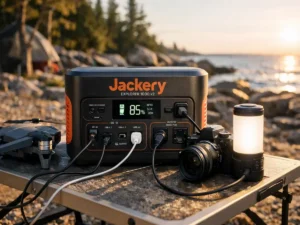
The Explorer 1000 v2 was our primary station for an extended basecamp run near Pictured Rocks National Lakeshore — four days off-grid, paired with two SolarSaga 200W panels in series for daily recharging. At 23.8 pounds it loads into the truck without complaint and sets up fast.
The 12.87″ x 8.82″ footprint sits clean on a camp table without dominating it. For our full deep-dive on this power station alone, see our Jackery Explorer 1000 v2 review.
It’s a consistent top pick in our camping essentials checklist — a reliable power station is one of the non-negotiables for any extended basecamp setup where you’re running cameras, lighting, and a fridge simultaneously.
The 1-hour fast charge via the Jackery App is the real-world feature that earns its place on this list.
On days where Michigan weather cut our solar window short, we were able to plug into the truck’s AC outlet at a trailhead and get from 20% back to 80% in under an hour before heading back to camp.
That kind of flexibility doesn’t show up in spec comparisons but matters enormously in field use.
For pairing with the Jackery solar ecosystem, the 1000 v2 is the natural anchor point — see our SolarSaga 100W vs 200W comparison for the full solar panel pairing breakdown.
What We Powered in the Field:
• DJI drone — 6–8 full battery charges per station charge
• Sony mirrorless camera + batteries — continuous top-up over 4 days
• LED camp lighting — 10–12 hours per night, 4 nights consecutive
• Portable camp fridge (40W draw) — 18–20 hours continuous run time
• iPhone and Android phones — simultaneous charging, no output sharing required
• Laptop (65W) — 10+ full charges per station charge
The 4,000-Cycle Battery — Why It Matters Long Term: The Explorer 1000 v2’s LiFePO4 battery maintains over 70% of original capacity after 4,000 cycles — Jackery rates this at 10+ years of regular use. The EcoFlow Delta 2 rates 3,000 cycles to the same threshold. At one cycle per day, that’s a 3-year difference in useful lifespan.
For anyone buying this as a long-term investment rather than a disposable camping toy, the cycle count gap is a real value distinction.
Michigan Winter Performance: The Explorer 1000 v2 is rated for discharge down to 14°F (-10°C). On overnight lows in the upper teens at our Pictured Rocks site we saw no performance degradation — the station maintained full output spec through cold Michigan nights.
The EcoFlow Delta 2 is rated to -4°F discharge, which is technically better on paper but rarely a real-world differentiator in Michigan camping conditions.
💡 Pro Tip: The Jackery App’s overnight quiet charging mode (30 dB) is worth enabling when you’re sleeping next to the station at camp. At full charge speed it produces audible fan noise. Quiet mode runs cooler and slower — our preference for overnight basecamp charging when time isn’t a constraint.
Jackery Explorer 1000 v2: Outdoor Tech Lab Field Demo
Quick features demo of the Jackery Explorer 1000 v2 — real-world output, 1-hour fast charge in action, and basecamp setup preview.
EcoFlow Delta 2: Lake Michigan Storm Testing & Home Backup Scenarios
The Power Station Built for When the Grid Goes Down
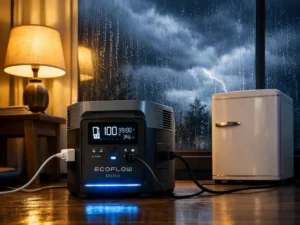
The EcoFlow Delta 2 spent its Northern Michigan test time doing what it does best — running as a home backup station during the kind of Lake Michigan storm systems that knock out Ludington-area power for 6–18 hours at a stretch.
The 1,800W output is where it separates itself from the Explorer 1000 v2 in a way that matters for this use case. For a standalone deep dive on this station, see our EcoFlow Delta 2 review.
A standard window AC unit pulls 1,200–1,500W on startup surge. The Explorer 1000 v2’s 3,000W surge peak handles it, but the 1,500W continuous rating cuts it close for sustained use alongside other loads.
The Delta 2’s 1,800W continuous gives you meaningful headroom to run the AC, a lamp, and charge devices simultaneously without watching the load meter nervously.
Home Backup Testing Results:
• Window AC unit (1,200W) — ran continuously for approximately 45 minutes per full charge
• Refrigerator (150W average) — 6–8 hours of operation per full charge
• LED lighting (5 fixtures, 50W total) + device charging — 15+ hours
• CPAP machine — full night of operation with significant charge remaining
• Sump pump (750W) — 45+ minutes of operation per charge in storm scenario
The Expandability Advantage: The Delta 2’s ability to expand to 2kWh or 3kWh with add-on batteries is a feature that doesn’t matter until it does.
For homeowners who bought the Delta 2 for camping and later decided they needed more home backup capacity, the expansion path means you don’t have to replace the entire unit — you add a battery. The Explorer 1000 v2 has no upgrade path.
For buyers who want to see where the Delta 2 sits in EcoFlow’s full lineup, our best EcoFlow power stations guide breaks down every model by use case.
Open Solar Ecosystem: The Delta 2 accepts up to 500W of solar panel input from any compatible panels — not locked to EcoFlow’s lineup. If you already own third-party panels or want to shop for the best solar deal independently, the Delta 2 accommodates that.
The Explorer 1000 v2 is locked to Jackery panels only. For anyone invested in the Jackery solar ecosystem — including the SolarSaga panels we cover in our SolarSaga comparison — this is irrelevant. For everyone else, it’s a genuine advantage.
💡 Pro Tip: The Delta 2’s 0-80% in 50 minutes AC charge makes it practical to top up before a storm system arrives. Watch your local forecast and you can go from 40% to full in under 90 minutes from a wall outlet — enough to handle most Michigan power outage scenarios without scrambling.
The 5 Key Differences That Actually Matter
1. AC Output: 1,500W vs 1,800W — The Appliance Gap
Three hundred watts of continuous output difference sounds modest until you’re trying to run a window AC, a small appliance, and charge devices simultaneously.
The Explorer 1000 v2’s 1,500W continuous rating handles the majority of camping and everyday devices comfortably — but for home backup scenarios where you need to run heating equipment, a full-size fridge, or a window AC alongside other loads, the Delta 2’s 1,800W gives you real headroom that the 1000 v2 doesn’t.
If your largest planned load is under 1,200W, this difference is irrelevant. If you’re pushing 1,400W+ on a regular basis, the Delta 2 is the correct choice.
2. Battery Cycles: 4,000 vs 3,000 — The Long-Term Value Gap
Both use LiFePO4 chemistry. The difference is how many cycles each maintains above 70% original capacity — 4,000 for the Explorer 1000 v2 versus 3,000 for the Delta 2. At one cycle per day of regular use, that’s roughly 11 years versus 8 years before meaningful capacity degradation.
At this price point, an additional three years of useful life is not a trivial distinction. The Explorer 1000 v2 is the better long-term investment on this metric alone.
3. Weight & Size: 23.8 lbs vs 27 lbs — The Portability Difference
3.2 pounds and a significantly smaller physical footprint separates these two stations. The Explorer 1000 v2 at 12.87″ x 8.82″ x 9.72″ is noticeably more compact than the Delta 2’s 15.7″ x 8.3″ x 11.3″. For camping use where the station goes in and out of a vehicle, backyard, or tent regularly, the Explorer 1000 v2 is meaningfully easier to handle.
For home backup use where it stays in a closet or garage, the difference is minimal. Neither of these stations is a backpacking unit — both belong in a vehicle or at a stationary camp.
For the full rundown on which power station wins for camping use specifically, see our best portable power stations for camping guide.
And if you’re deciding between a smaller Jackery and the EcoFlow River series, our Jackery 300 vs EcoFlow River 3 comparison covers that lighter-weight matchup.
4. Expandability: None vs Up to 3kWh — The Future-Proofing Question
The EcoFlow Delta 2 can be expanded to 2kWh or 3kWh with add-on batteries — a meaningful upgrade path for users whose power needs grow over time. The Jackery Explorer 1000 v2 has no expansion option; you get 1,070Wh and that’s it.
For anyone who might want more capacity in the future without buying an entirely new station, the Delta 2’s expandability is a significant long-term advantage. If you’re already thinking at the 2kWh+ level, our BLUETTI AC200L review covers a station built for that capacity class from the ground up.
For anyone confident 1,000Wh is sufficient for their use case, the Explorer 1000 v2’s closed architecture is a non-issue.
5. Solar Ecosystem: Locked vs Open — The Panel Compatibility Decision
The Explorer 1000 v2 accepts solar input exclusively from Jackery panels. The Delta 2 accepts up to 500W from any compatible third-party panels. If you’re building a Jackery system — pairing the 1000 v2 with the SolarSaga 200W as covered in our SolarSaga 100W vs 200W comparison — the closed ecosystem is perfectly capable and well-matched.
If you own panels from another brand or want flexibility to shop the best solar deals on the market, the Delta 2’s open ecosystem is the right call.
Which One Should You Buy?
✅ Buy the Jackery Explorer 1000 v2 if…
• You camp, travel, or move the station regularly and want the lightest option in this class
• You’re building or already own a Jackery solar ecosystem and want native compatibility
• Long battery lifespan matters — 4,000 cycles is a 10+ year investment
• The 1-hour fast charge via app is important for your use case
• Your largest loads run comfortably under 1,500W continuous
• You want app-controlled charging modes including quiet overnight charge
⭐ 4.7/5 Stars • 4,523 Reviews • 4,000 Cycles • 1Hr Fast Charge
✅ Buy the EcoFlow Delta 2 if…
• Home backup is your primary use case and you need to run larger appliances
• You plan to expand capacity to 2kWh or 3kWh in the future
• You want an open solar ecosystem that works with any panels, not just EcoFlow’s
• RV use with high-draw appliances is a priority
• Current Amazon pricing frequently makes it the better value of the two — check live price below
• 5-year warranty coverage gives you extra peace of mind on a long-term investment
⭐ 4.7/5 Stars • 7,313 Reviews • 1,800W Output • 5-Year Warranty
⚡ Jackery 1000 v2 Pros
- 23.8 lbs — lightest in class
- 4,000 cycles — 10+ year lifespan
- 1-hour fast charge via app
- Compact 12.87″ footprint
- Native Jackery solar compatibility
- Quiet 30dB overnight charge mode
1000 v2 Cons
- 1,500W AC limit vs 1,800W on Delta 2
- No capacity expansion option
- Jackery solar panels only
- 2-year warranty vs 5-year on Delta 2
🔵 EcoFlow Delta 2 Pros
- 1,800W AC — handles larger appliances
- Expandable to 3kWh with add-on batteries
- Open solar ecosystem — any panels
- 5-year warranty
- Frequently lower price than Explorer 1000 v2 — check current Amazon pricing
- 7,313 reviews — 60% more validated buyers
Delta 2 Cons
- 27 lbs — 3.2 lbs heavier than 1000 v2
- 3,000 cycles vs 4,000 on Explorer 1000 v2
- Incompatible with Jackery solar panels
Build Your Complete Off-Grid Power System
A power station is only half the equation. These Outdoor Tech Lab guides cover every other piece of the setup:
• Jackery vs EcoFlow: full brand comparison — every product category compared side by side
• Jackery Explorer 1000 v2 full review — deep dive on the station in this comparison
• EcoFlow Delta 2 full review — deep dive on the other station in this comparison
• Jackery SolarSaga 100W vs 200W comparison — best solar panel to pair with the Explorer 1000 v2
• Jackery Explorer 300 vs 1000 v2 — is the 1000Wh class right for your needs
• Best EcoFlow power stations 2025 — full EcoFlow lineup ranked by use case
• Jackery Solar Generator 5000 Plus review — when 1,000Wh isn’t enough
• BLUETTI AC200L review — serious 2kWh+ home backup alternative
• Best portable power stations for home backup — full category breakdown
• Best portable power stations for camping — top picks by use case
Portable Power Station Safety & Emergency Preparedness Resources
We reference these guidelines when evaluating power station safety ratings and emergency backup applications.
- Ready.gov: Power Outage Preparedness
FEMA’s official household emergency power planning guide — the baseline for sizing your portable power station for genuine home backup use. - NREL: National Renewable Energy Laboratory
Authoritative source for solar charging standards and battery technology benchmarks referenced in our field testing methodology.
Jackery Explorer 1000 v2 vs EcoFlow Delta 2 FAQ
Is the Jackery Explorer 1000 v2 or EcoFlow Delta 2 better for camping?
For camping, the Jackery Explorer 1000 v2 is the stronger choice. At 23.8 pounds with a compact 12.87″ footprint, it loads in and out of a vehicle easier and takes up less space on a camp table than the Delta 2’s 27-pound, 15.7″ frame. The 1-hour fast charge is genuinely useful when you’re at a trailhead or campground with limited AC access. Its native compatibility with the Jackery SolarSaga solar panels also makes it the natural pick for anyone building a Jackery-based solar camping system. The EcoFlow Delta 2 is the better home backup station — for camping specifically, the Explorer 1000 v2 wins on weight, size, and ecosystem compatibility.
Which has better battery life — the Jackery Explorer 1000 v2 or EcoFlow Delta 2?
The Jackery Explorer 1000 v2 has meaningfully better battery longevity — 4,000 charge cycles before dropping below 70% of original capacity, versus the EcoFlow Delta 2’s 3,000 cycles. Both use LiFePO4 chemistry, which is the most durable battery type in this class. At one cycle per day, the Explorer 1000 v2 maintains full performance for roughly 11 years versus 8 years for the Delta 2. For buyers who want the longest-lived station at this price point, the Explorer 1000 v2 is the better long-term investment on battery lifespan alone.
Can the EcoFlow Delta 2 power a window air conditioner?
Yes — a standard window AC unit draws 1,200–1,500W continuously, which falls within the EcoFlow Delta 2’s 1,800W continuous output. You’ll get approximately 40–60 minutes of continuous AC operation per full charge depending on the unit’s draw. The Jackery Explorer 1000 v2 can also run a window AC at its 1,500W continuous rating, but with less headroom for simultaneous device charging. For sustained AC use alongside other loads, the Delta 2’s extra 300W of continuous output is the safer choice. Neither station is a long-term AC replacement — both are short-duration backup solutions.
Does the Jackery Explorer 1000 v2 work with EcoFlow solar panels?
No — the Jackery Explorer 1000 v2 is only compatible with Jackery solar panels. It uses Jackery’s proprietary DC connector standard and is not designed to accept input from EcoFlow, Goal Zero, or other third-party panels. If you already own non-Jackery solar panels and want to use them with this station, the Explorer 1000 v2 is the wrong choice. The EcoFlow Delta 2 accepts up to 500W from any compatible solar panels with the right connector, making it the correct pick for an open solar ecosystem. For anyone building a Jackery solar system from scratch — pairing the Explorer 1000 v2 with a SolarSaga 200W — the closed ecosystem works seamlessly.
How long does the Jackery Explorer 1000 v2 take to charge from a wall outlet?
The Jackery Explorer 1000 v2 charges from 0% to 100% in approximately 1 hour when emergency charging is enabled through the Jackery App before each charge. By default — without enabling emergency mode each session — it charges in approximately 1.7 hours to optimize battery health. The EcoFlow Delta 2 charges to 80% in approximately 50 minutes and to 100% in 80 minutes from AC input. In practical terms both stations charge in under 90 minutes from a wall outlet, making either a viable option for pre-storm top-ups or quick campground recharges.
Is the EcoFlow Delta 2 worth the upgrade to Delta 2 Max?
The EcoFlow Delta 2 Max steps up to 2,048Wh capacity and 2,400W AC output — double the capacity and meaningfully more power than the standard Delta 2. Whether it’s worth the upgrade depends entirely on your use case. For camping and occasional home backup use, the standard Delta 2 at 1,024Wh handles the majority of real-world scenarios without the added weight and cost of the Max. For extended off-grid living, serious RV use, or whole-home backup requiring 2+ days of coverage, the Delta 2 Max — or the Delta 2 with an add-on battery — is the correct configuration. The Delta 2’s expandability means you don’t have to make this decision at purchase time.
Which portable power station is better for home backup — Jackery or EcoFlow?
For home backup specifically, the EcoFlow Delta 2 is the stronger choice. Its 1,800W continuous output handles a wider range of home appliances without headroom concerns, the expandable capacity up to 3kWh means you can add battery storage as your needs grow, and the 5-year warranty covers a station that will see regular use through power outage events. The Jackery Explorer 1000 v2 is a capable backup station for smaller loads, but for serious home backup where you’re running heating equipment, a full-size refrigerator, or multiple loads simultaneously, the Delta 2’s output advantage and expandability make it the right long-term investment. For a full home backup category breakdown, see our best portable power stations for home backup guide.
What solar panels work with the Jackery Explorer 1000 v2?
The Jackery Explorer 1000 v2 is compatible exclusively with Jackery solar panels using the DC8020 connector standard. The best-matched panels for the 1000 v2 are the SolarSaga 200W — which charges the station in approximately 8–10 hours single panel, or 4–5 hours with two panels in series under good Michigan sun conditions — and the SolarSaga 100W Air for lighter portability needs. For a complete breakdown of which SolarSaga panel is right for your setup, see our Jackery SolarSaga 100W vs 200W comparison.
Is Jackery or EcoFlow the better brand for portable power stations?
Both Jackery and EcoFlow are top-tier portable power station brands with strong track records and legitimate field performance. Jackery’s strength is in the camping and outdoor ecosystem — their solar panel lineup, app integration, and focus on lightweight portable designs make them the natural choice for outdoor enthusiasts. EcoFlow’s strength is in home backup and expandable systems — their higher output ratings, expandable battery architecture, and open solar ecosystem make them a stronger fit for emergency preparedness and off-grid living. The right brand depends entirely on your primary use case, not on a blanket quality ranking. Both earn their 4.7-star ratings across thousands of real-world buyers.
OTL Bottom Line: Jackery Explorer 1000 v2 vs EcoFlow Delta 2
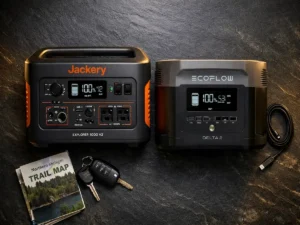
After running both stations through Northern Michigan field conditions — basecamps, storm scenarios, and everything in between — the conclusion is the same one we reached in our Explorer 300 vs 1000 v2 comparison: the specs don’t decide this. Your use case does.
The Jackery Explorer 1000 v2 is the power station for people who move and people who want their gear to last. Lighter, more compact, faster to charge, and built to outlast the Delta 2 by a full third more charge cycles.
If you camp, travel, or are building a Jackery solar ecosystem, the 1000 v2 is the right anchor for your setup.
Pair it with the SolarSaga 200W and you have a complete off-grid system that covers everything from a weekend basecamp to an extended off-grid stay — covered in full in our SolarSaga comparison.
The EcoFlow Delta 2 is the power station for people who need more output and more options. 1,800W AC handles the appliances the 1000 v2 can’t run comfortably at load. Expandable capacity means it grows with your needs.
An open solar ecosystem means you’re not locked into one brand’s panel lineup. For home backup and RV use, it’s the stronger investment.
Ready to Choose Your Power Station?
⭐ Both Stations: 4.7/5 Stars • Both LiFePO4 • Both Amazon’s Choice
This comparison was last updated in April 2026 with verified specifications and field testing notes. Tested in Northern Michigan by Outdoor Tech Lab.

- Powerful yet Compact: Boasting a 1,500W AC output and a 3,000W surge peak, the Solar Generator 1000 V2 can power multipl…
- One Hour Fast Charging: Charge your Explorer 1000 v2 Portable Power Station from 0% to 100% battery level in just one ho…
- 10 Year Lifespan: The Explorer 1000 v2 portable power station is equipped with a durable LFP battery, maintaining over 7…

- 7 X Faster Charging. 0-80% in just 50 mins and 0-100% in 80 mins with AC input. That’s ideal when you need home backup p…
- Expandable Capacity from 1-3kWh. With the standalone portable power station sporting 1kWh, you can add on extra batterie…
- Power Almost Anything. Portable batteries have come a long way. Power all your appliances with 1800W output, that’s on p…

Leave a Reply