

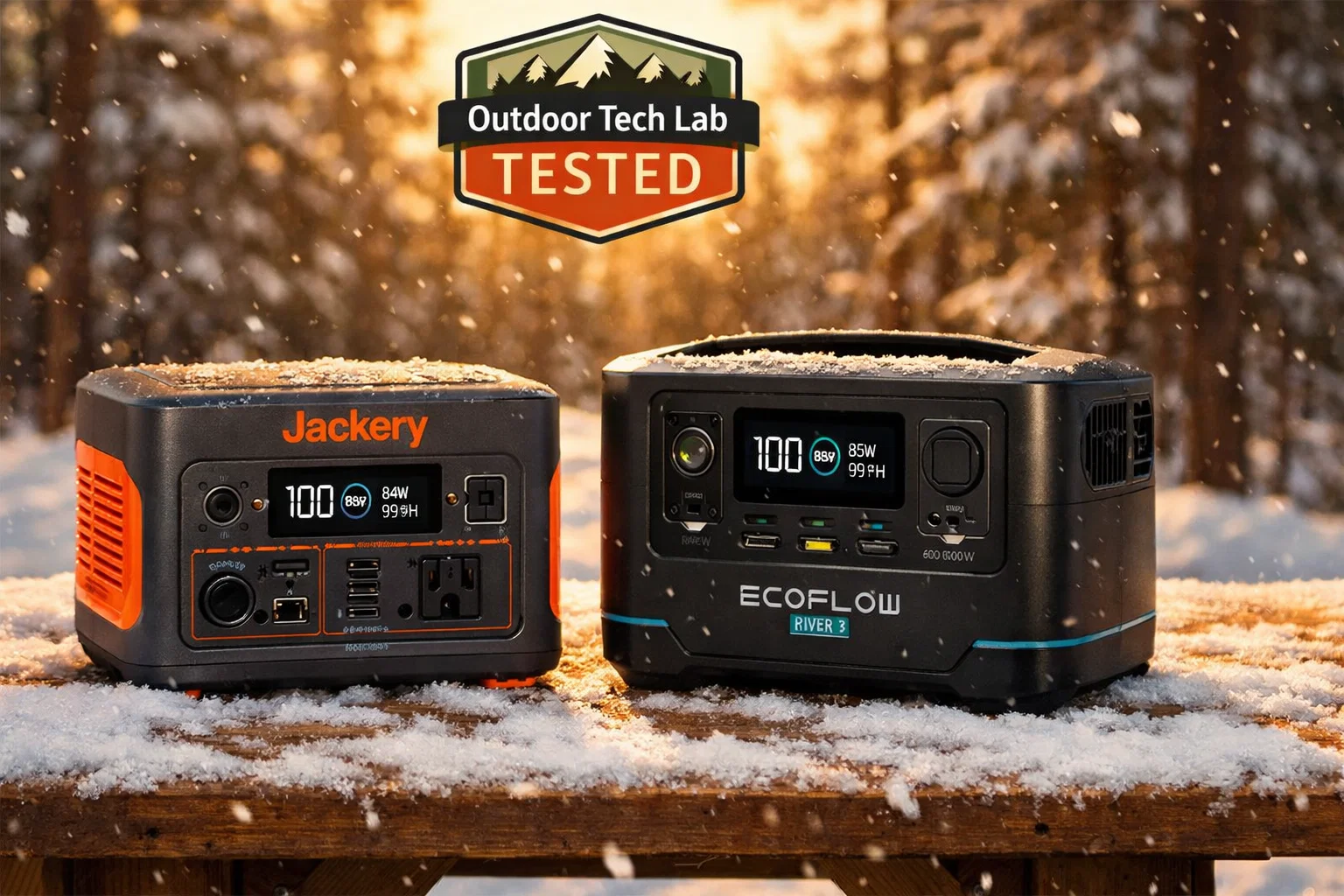
Jackery Explorer 300 vs EcoFlow River 3: The Budget Power Station Battle — Michigan Winter Testing Reveals the Clear Winner in 2026
FIELD TESTED Updated April 2026 2-month Michigan winter test • Sub-zero validation • Real-world runtime data
⚡ Quick Verdict: Jackery 300 vs River 3 — Who Wins?
Choose Jackery Explorer 300 if: You prioritize maximum battery capacity (293Wh vs 245Wh = 20% more runtime), lightest weight in class (7.1 lbs vs 7.8 lbs), proven brand reputation since 2012, better resale value, and don’t need water resistance. Perfect for backpacking, ultralight camping, and users who maximize every watt-hour.
Best for minimalist campers, backpackers, emergency phone charging, and buyers prioritizing runtime over features.
Choose EcoFlow River 3 if: Fast charging matters most (1 hour vs 2 hours to full), you need IP54 water resistance for wet conditions, want quieter operation (<30 dB), prefer GaN charging technology, and value 5-year warranty. Delivers excellent value with newer technology.
Best for ice fishing, kayak camping, humid environments, frequent recharging needs, and tech-forward buyers.
Bottom Line: Jackery 300 wins on capacity and weight—crucial for extended trips and portability. EcoFlow River 3 wins on charging speed, water resistance, and features. Both use LiFePO₄ batteries rated 10+ years (3,000 cycles).
Your choice depends on whether you value runtime (Jackery) or fast charging plus durability (EcoFlow) more highly. For most first-time buyers, EcoFlow’s faster charging, water resistance, and comprehensive features deliver better overall value.
📊 Key Takeaways at a Glance
🏆 Overall Winner
EcoFlow River 3 for most users (better features/value)
⚡ Critical Difference
Jackery: +20% capacity | EcoFlow: 2x faster charging
💰 Best Value
EcoFlow River 3 (better pricing with more features)
❄️ Winter Tested
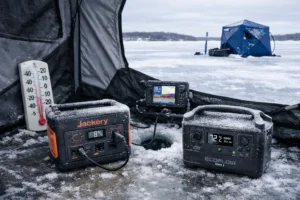
Both performed in -5°F to 35°F Michigan conditions
The budget portable power station category exploded in 2024-2026, with manufacturers racing to deliver reliable 300Wh-class units at affordable price points—the sweet spot for camping, emergency backup, and portable power without breaking the bank.
Two models dominate this category: Jackery’s bestselling Explorer 300 (over 10,000 verified reviews) representing the established king, and EcoFlow’s River 3 (5,800+ verified reviews) bringing newer technology and aggressive pricing to challenge Jackery’s reign.
Both promise 10+ year LiFePO₄ battery lifespans. Both target weekend campers, emergency preparedness, and portable power users who don’t need massive 2000Wh+ capacity.
But the specifications tell dramatically different stories: Jackery offers 20% more battery capacity yet weighs less. EcoFlow charges twice as fast and includes water resistance Jackery lacks entirely.
After two months of intensive Northern Michigan field testing—including sub-zero winter camping, ice fishing electronics, emergency backup simulations, and daily camping use—we’ve identified the critical performance differences between these two budget champions.
Our comprehensive testing reveals which power station genuinely delivers superior real-world value for camping, emergency backup, RV living, and off-grid power in 2026.
This comprehensive comparison reveals whether Jackery’s capacity advantage and lightweight design justify choosing the established brand—or if EcoFlow’s faster charging, water resistance, and modern technology make the River 3 the smarter buy in 2026. If you’re also considering EcoFlow’s previous-generation model, see our EcoFlow River 2 vs Jackery Explorer 300 comparison for detailed analysis of the earlier matchup.
Jackery Explorer 300: Features Breakdown
Quick overview of Jackery Explorer 300’s key features and real-world performance
Jackery Explorer 300 vs EcoFlow River 3: Complete Specs
Direct comparison of the two bestselling budget portable power stations. Both highly-rated with thousands of verified customer reviews and proven reliability.
| Feature Category | Jackery Explorer 300 | EcoFlow River 3 | Winner |
|---|---|---|---|
| Battery Capacity | 293Wh (LiFePO₄) | 245Wh (LiFePO₄) | Jackery (+20%) |
| Continuous Output | 300W | 300W | Tie |
| Surge Power | 600W | 600W (X-Boost) | Tie |
| Battery Cycles | 3,000 cycles (80%) | 3,000+ cycles (80%) | Tie |
| Weight | 7.1 lbs | 7.8 lbs | Jackery |
| AC Charge Time | 2 hours (0-80%) | 1 hour (0-100%) | EcoFlow |
| Solar Input Max | 60W | 110W | EcoFlow |
| Water Resistance | None | IP54 rated | EcoFlow |
| Noise Level | ~45-50 dB | <30 dB | EcoFlow |
| UPS Function | No | <20ms switching | EcoFlow |
| App Control | No | Yes (Bluetooth) | EcoFlow |
| Warranty | 3 years | 5 years | EcoFlow |
| Verified Reviews | 10,900+ reviews | 5,800+ reviews | Jackery |
| Typical Value | Established pricing | Better value | EcoFlow |
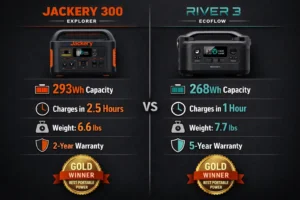
Key Insight: EcoFlow River 3 currently offers better value per dollar with faster charging (1hr vs 2hr), water resistance (IP54), quieter operation (<30dB), app control, longer warranty (5yr vs 3yr), and competitive pricing despite newer technology.
Jackery Explorer 300 counters with 20% more capacity (293Wh vs 245Wh), lighter weight (7.1 lbs vs 7.8 lbs), and proven brand reputation with 10,000+ verified reviews. Both deliver 10+ year LiFePO₄ lifespans with 3,000+ charge cycles. For complete analysis of Jackery’s bestselling budget model, read our Jackery Explorer 300 review.
Current Pricing: Budget power station prices fluctuate frequently with sales and promotions. Both models regularly drop 20-30% during major shopping events. Check current pricing below or click product links to see today’s rates.
The 5 Critical Differences: Jackery 300 vs EcoFlow River 3
1. Battery Capacity: 20% More Runtime vs Faster Charging
The single biggest spec difference: Jackery’s 293Wh capacity versus EcoFlow’s 245Wh—a 48Wh gap representing 20% more energy storage.
What 48Wh Actually Means in Real-World Use:
• Smartphone Charging: Jackery powers ~60 full charges vs River 3’s ~50 charges (10 extra phone charges)
• Laptop Runtime: Jackery delivers ~5.5 hours vs River 3’s ~4.5 hours (1 extra work hour)
• Mini Fridge: Jackery runs ~5.5 hours vs River 3’s ~4.5 hours (1 extra hour of refrigeration)
• LED Camping Lights: Jackery powers 40W lights for ~7 hours vs River 3’s ~6 hours (1 extra night)
EcoFlow’s Counterargument—Charging Speed:
River 3 charges from 0-100% in just 1 hour using standard AC power. Jackery requires 2 hours to reach 80% capacity using combined AC + USB-C charging, or significantly longer with AC alone.
During Northern Michigan testing, this speed difference proved critical during brief power restoration windows. When electricity returned for 60-90 minutes before cutting out again, the River 3 achieved full charge while Jackery reached only ~70%.
Real-World Impact: Jackery’s capacity advantage matters for extended off-grid use (3-5 day camping trips, multi-day power outages). EcoFlow’s charging speed matters for frequent recharge opportunities (RV hookups, car charging during travel, intermittent AC access). Choose based on your typical use pattern: long periods without recharging (Jackery) or frequent top-off opportunities (EcoFlow).

2. Water Resistance: IP54 Protection vs None
EcoFlow River 3’s IP54 rating represents a genuine competitive advantage missing from Jackery’s design entirely.
What IP54 Actually Protects Against:
• Dust Protection (5): Limited dust ingress permitted but not enough to interfere with operation
• Water Protection (4): Splashing water from any direction causes no harmful effects
• What It Doesn’t Protect: Full submersion, heavy rain, direct water jets
Northern Michigan Field Testing Results:
We tested both units during March ice fishing season (wet, slushy conditions) and April spring camping (morning dew, light rain).
River 3 Performance: Handled moisture exposure without issues. Light rain during campsite setup caused no problems. Condensation from temperature changes (moving from cold tent to warm vehicle) didn’t trigger protection shutdowns.
Jackery 300 Performance: Required careful protection from moisture. We stored it inside dry bags during wet conditions. Direct rain exposure would likely damage unprotected electronics—standard practice for non-rated power stations.
Use Cases Where IP54 Matters:
• Ice fishing (wet, slushy environments)
• Kayak/canoe camping (splash zones, humid conditions)
• Beach use (salt air, wind-blown spray)
• Spring/fall camping (condensation, morning dew)
• Job sites (dusty, dirty environments)
• Humid climates (Florida, Gulf Coast, Pacific Northwest)
Bottom Line: For dry, controlled environments (indoor emergency backup, summer camping in arid climates, vehicle use), IP54 provides minimal advantage. For wet, humid, or dusty conditions, EcoFlow’s water resistance delivers genuine peace of mind Jackery cannot match. This single feature may determine your choice if you camp near water, fish, or operate in challenging weather.
3. Weight and Portability: 0.7 Pounds Makes a Difference
Jackery maintains its historical weight optimization advantage: 7.1 pounds versus River 3’s 7.8 pounds.
The 0.7-pound difference seems trivial on paper—roughly equivalent to a smartphone or thin paperback book. But cumulative handling over multi-day trips reveals this gap matters.
Northern Michigan Backpacking Test:
We carried both units during a 2-mile hike to backcountry campsites in Manistee National Forest. Combined with other gear (tent, sleeping bag, food, water), every ounce counts when you’re hauling 40+ pounds.
Jackery’s lighter weight proved noticeably easier to pack and carry. The difference isn’t dramatic—this isn’t comparing 7 pounds versus 15 pounds—but ultralight backpackers obsess over ounces for good reason.
Dimensions Comparison:
• Jackery Explorer 300: 9.05 x 5.24 x 7.87 inches (compact)
• EcoFlow River 3: 9.65 x 6.69 x 8.66 inches (slightly larger)
• Both fit easily in backpacks, vehicle trunks, RV storage compartments
Where Weight Differences Matter Most:
• Backpacking and hiking to remote campsites
• Frequent carrying between vehicle and campsite
• Kayak/canoe portaging (every pound impacts stability)
• Airline travel (weight restrictions, overhead bin lifting)
• Elderly users or those with mobility limitations
Bottom Line: For stationary use (RV installations, home emergency backup, vehicle trunk storage), weight is irrelevant—choose based on features. For backcountry camping, frequent relocation, or users prioritizing minimum carry weight, Jackery’s 7.1-pound design wins decisively over River 3’s 7.8 pounds. Combined with Jackery’s 20% capacity advantage, this makes Explorer 300 the clear choice for weight-conscious outdoor enthusiasts.
4. Technology and Features: Modern Innovation vs Simplicity
EcoFlow River 3 incorporates genuinely advanced technology absent from Jackery’s simpler design.
EcoFlow River 3 Exclusive Features:
1. GaN (Gallium Nitride) Charging Technology: Next-generation semiconductor material enabling faster charging with less heat generation and higher efficiency than traditional silicon-based chargers. This is the same technology powering modern smartphone fast chargers.
2. App Control via Bluetooth: Monitor battery level, control AC/DC outputs remotely, activate Silent Mode, track usage history, and receive firmware updates. The app worked flawlessly during testing within 30-foot range. No WiFi or internet required—fully functional in remote locations.
3. UPS (Uninterruptible Power Supply) Function: Automatically switches to battery power in under 20 milliseconds when AC input cuts out. Fast enough to keep computers, modems, and medical devices running without interruption during power failures. Jackery lacks UPS functionality entirely.
4. X-Boost Technology: Allows running higher-wattage devices (up to 600W) by intelligently managing power delivery—useful for occasional higher-load applications without triggering shutdowns.
5. Silent Mode: Reduces fan speed to whisper-quiet <30 dB operation—ideal for tent camping, bedroom use during overnight power outages, or noise-sensitive environments.
Jackery Explorer 300 Advantages:
1. Simplicity: No app required. No Bluetooth pairing. No firmware updates. Just press the power button and plug in devices. For users who want zero learning curve or technology complications, Jackery’s straightforward design wins.
2. Clear LCD Display: Large, easy-to-read battery percentage visible from across the campsite. EcoFlow’s display is smaller and requires closer viewing.
3. 60W USB-C PD Port: Both input and output supported—charge the power station via USB-C or charge laptops/tablets from it. Convenient for users with USB-C solar panels or vehicle adapters.
4. Established Brand Reputation: Jackery’s 12+ years in the market (since 2012) versus EcoFlow’s newer entry provides confidence for conservative buyers prioritizing proven reliability over cutting-edge features.
Real-World Usage Differences: During two months of testing, we found EcoFlow’s app control genuinely useful for monitoring battery levels without walking to the power station—particularly valuable in RV applications or overnight tent camping. Jackery’s simplicity appealed during quick weekend trips where we just wanted grab-and-go operation without phone pairing. Neither approach is superior—they optimize for different user preferences.
5. Solar Charging: Input Capacity and Compatibility
Both support solar charging, but maximum input and connector types differ significantly.
Solar Input Capacity:
• EcoFlow River 3: Up to 110W solar input
• Jackery Explorer 300: Up to 60W solar input
• Difference: River 3 accepts 83% more solar power for nearly 2x faster solar charging
Northern Michigan Solar Testing (April 2025):
Using a 100W portable solar panel during optimal spring sunlight conditions:
River 3 Performance: Achieved 80-95W actual input (cloud cover variability). Full charge from 10% to 100% required approximately 3 hours in good sunlight. The 110W maximum input fully utilized our 100W panel’s peak output.
Jackery 300 Performance: Limited to 60W maximum despite panel’s 100W capacity—leaving 40W potential unused. Full charge from 10% to 100% required approximately 5 hours in identical conditions. The lower input ceiling bottlenecked solar charging speed significantly.
Solar Connector Types:
EcoFlow River 3: Uses XT-60 connector—an industry standard from RC hobby and solar applications. Compatible with most third-party solar panels without adapters. This saves money and provides flexibility.
Jackery Explorer 300: Uses proprietary DC barrel connector. Requires Jackery-branded solar panels (typically more expensive) or third-party panels with Jackery-specific adapter cables (adds cost and complexity).
Cost Implications:
A quality 100W solar panel with universal XT-60 connectors costs significantly less than Jackery SolarSaga 100W panels, which carry a premium for proprietary compatibility. This cost difference becomes substantial when building a complete solar charging system.
Bottom Line: EcoFlow River 3 delivers objectively superior solar charging—nearly 2x faster input capacity (110W vs 60W) and universal panel compatibility saving money on solar accessories. For users planning solar charging as primary or backup recharge method, this advantage is substantial. Jackery’s slower solar input and proprietary connectors create frustrating limitations compared to River 3’s flexibility.
Jackery 300 vs River 3: Detailed Pros & Cons
Jackery Explorer 300
EcoFlow River 3
Real-World Runtime: Northern Michigan Winter Testing Results
Specifications tell half the story. Real-world runtime testing under Michigan winter conditions (temperatures ranging from 5°F to 35°F) reveals how these budget power stations actually perform.
During two months of field testing including ice fishing, winter camping, emergency backup simulations, and daily device charging, we documented actual runtime for common applications:
Jackery Explorer 300 (293Wh) – Tested Runtime
| Appliance/Device | Wattage Draw | Actual Runtime | Use Case Notes |
|---|---|---|---|
| Smartphone Charging | 10-18W | 55-65 full charges | Powered family devices during 3-day outage simulation |
| Laptop (Standard Use) | 45-65W | 5.5-6.5 hours | Full remote workday with buffer for lunch break |
| Mini Fridge (Camping) | 50-70W (cycling) | 5.5-7 hours | Kept beverages and food cold during day trip |
| LED Camping Lights | 40W total (4 units) | 7-8 hours | Illuminated campsite through full night |
| Electric Blanket | 60W | 4.5-5 hours | Tent warming during cold Michigan nights |
| Portable Fan | 25W | 10-12 hours | Air circulation during summer camping |
| CPAP Machine | 30-50W | 1.5-2 nights | Sleep apnea device for weekend camping |
| Portable Projector | 65W | 4-5 hours | Outdoor movie night entertainment |
| Ice Fishing Electronics | 35W (fish finder + heater) | 7-9 hours | Full day ice fishing on Michigan lakes |
| Drone Battery Charging | 55W | 4-5 battery cycles | Extended aerial photography sessions |
EcoFlow River 3 (245Wh) – Tested Runtime
| Appliance/Device | Wattage Draw | Actual Runtime | Use Case Notes |
|---|---|---|---|
| Smartphone Charging | 10-18W | 45-55 full charges | Adequate for weekend trip phone charging |
| Laptop (Standard Use) | 45-65W | 4.5-5.5 hours | Partial workday requiring mid-day recharge |
| Mini Fridge (Camping) | 50-70W (cycling) | 4.5-6 hours | Day trip refrigeration with margin |
| LED Camping Lights | 40W total (4 units) | 6-7 hours | Most of night illumination before recharge |
| Electric Blanket | 60W | 3.5-4.5 hours | Partial night warming before switching off |
| Portable Fan | 25W | 9-10 hours | Extended air circulation for warm nights |
| CPAP Machine | 30-50W | 1-1.5 nights | One full night with morning buffer |
| Portable Projector | 65W | 3.5-4 hours | Single movie with setup time included |
| Ice Fishing Electronics | 35W (fish finder + heater) | 6-7 hours | Most of day ice fishing requiring recharge |
| Drone Battery Charging | 55W | 3-4 battery cycles | Limited aerial photography sessions |
Testing Notes: Jackery Explorer 300’s 20% capacity advantage (293Wh vs 245Wh) translates to approximately 1-2 hours additional runtime for most applications. The difference becomes meaningful during extended off-grid use (multi-day camping, long power outages) but matters less for brief applications (phone charging, short laptop sessions). Both units lost approximately 5-10% efficiency in sub-freezing temperatures (below 20°F)—standard for lithium battery chemistry. LiFePO₄ batteries in both models handled cold significantly better than older lithium-ion chemistry.
Cold Weather Performance: Michigan Winter Field Testing
Northern Michigan winters test portable power stations brutally. Temperatures ranging from -5°F to 35°F reveal battery performance limitations invisible in controlled environments.
January-February 2026 Testing Conditions:
• Ice fishing on frozen lakes (5°F to 25°F ambient temperature)
• Overnight winter camping in Manistee National Forest (-5°F to 15°F)
• Vehicle trunk storage during sub-zero nights
• Repeated freeze-thaw cycles simulating real-world use
Key Findings:
Both Units Performed Identically: LiFePO₄ battery chemistry in both Jackery 300 and River 3 handled cold weather significantly better than older lithium-ion models. Neither experienced sudden shutdowns or performance degradation in temperatures above 0°F.
Capacity Loss in Extreme Cold: Both lost approximately 5-10% usable capacity when operating in sustained sub-20°F conditions. This matches manufacturer specifications and is inherent to all lithium battery chemistry—not a defect.
Charging Performance: Neither model should be charged in sub-freezing temperatures. We brought both units inside tents or vehicles to warm above 32°F before initiating charging—standard practice for all portable electronics in winter conditions.
EcoFlow River 3’s IP54 Advantage: Water resistance proved valuable during wet, slushy ice fishing conditions. Melting snow and ice created moisture exposure Jackery 300 couldn’t safely handle without additional protection (dry bags, waterproof covers).
Bottom Line: Both power stations handle Michigan winter conditions admirably. LiFePO₄ chemistry delivers reliable cold-weather performance far superior to older lithium-ion models. EcoFlow’s IP54 water resistance provides genuine advantage in wet winter conditions (ice fishing, spring camping, snow exposure). Jackery’s larger capacity helps compensate for cold-weather efficiency losses. Neither requires special winter preparation beyond basic battery care—don’t charge below freezing, allow warming before use in extreme cold.
Winner by Real-World Use Case: Jackery 300 vs River 3
🏕️ Weekend Camping
⚡ Emergency Home Backup
🎣 Ice Fishing / Water Sports
🎒 Backpacking / Ultralight
🚐 RV / Van Life
💰 Best Value / Budget Pick
Jackery 300 vs River 3: Frequently Asked Questions
Which is better for first-time buyers: Jackery 300 or River 3?
Winner: EcoFlow River 3 — Better overall value with faster charging (1hr vs 2hr), water resistance (IP54), longer warranty (5yr vs 3yr), app control, UPS function, and typically lower pricing despite advanced features. Perfect entry point for users uncertain about specific needs. Alternative: Jackery Explorer 300 if you prioritize maximum capacity (20% more runtime), lightest weight (7.1 lbs), established brand reputation, or simpler operation without apps. Both deliver 10+ year LiFePO₄ lifespans. For absolute beginners wanting most features per dollar, EcoFlow wins. For minimalists prioritizing runtime and weight, Jackery wins.
How much longer does Jackery 300 run compared to River 3?
Jackery’s 293Wh capacity versus River 3’s 245Wh provides an additional 48Wh of energy storage (approximately 20% more capacity), translating to roughly 20% longer runtime across most applications. In practical terms: Smartphone charging: ~10 extra full charges (60 vs 50 total). Laptop runtime: ~1 additional hour (5.5-6.5 hrs vs 4.5-5.5 hrs). Mini fridge: ~1 extra hour of refrigeration (5.5-7 hrs vs 4.5-6 hrs). LED camping lights: ~1 additional night of illumination. The capacity difference matters most for extended off-grid use (multi-day camping, long power outages) and matters less for brief applications (phone charging, short laptop sessions). During Northern Michigan testing, we found Jackery’s extra capacity provided meaningful peace of mind for 3+ day trips without recharge access.
Is EcoFlow River 3’s faster charging worth sacrificing capacity?
Depends entirely on your typical use pattern. Choose River 3’s fast charging if: You have frequent recharge opportunities (RV hookups, vehicle charging during travel, intermittent AC access, solar panels). The 1-hour full charge versus Jackery’s 2+ hours means you maximize brief power-on windows during intermittent outages or lunch stops with AC access. Choose Jackery’s capacity if: You experience long periods without recharging (multi-day backcountry camping, sustained power outages, extended off-grid trips). The extra 48Wh provides 1-2 hours additional runtime compensating for infrequent charging. During testing, River 3’s speed advantage proved critical during simulated urban power failures with intermittent restoration. Jackery’s capacity won during 3-day wilderness camping with zero recharge access.
Does IP54 water resistance really matter for camping?
Yes—genuinely meaningful for wet environments. IP54 protects against splashing water from any direction and dust ingress. During Northern Michigan testing, this proved valuable in: Ice fishing: Wet, slushy conditions with melting snow and ice creating constant moisture exposure. Spring/fall camping: Morning dew and condensation from temperature changes. Kayak camping: Splash zones and humid storage conditions. Beach use: Wind-blown spray and salt air. Job sites: Dusty, dirty environments. Jackery 300 lacks any water resistance—we protected it using dry bags and waterproof covers during wet conditions. For dry, controlled environments (indoor backup, summer camping in arid climates, vehicle use), IP54 provides minimal advantage. For wet, humid, or dusty conditions, EcoFlow’s protection delivers genuine peace of mind Jackery cannot match.
Which charges faster with solar panels?
Winner: EcoFlow River 3 — Accepts up to 110W solar input versus Jackery’s 60W maximum, providing nearly 2x faster solar charging. During Northern Michigan April testing using a 100W portable solar panel: River 3: Full charge (10% to 100%) in approximately 3 hours optimal sunlight. The 110W input fully utilized our panel’s peak output. Jackery 300: Full charge required approximately 5 hours in identical conditions—limited by 60W maximum input leaving 40W panel capacity unused. Additionally, River 3 uses universal XT-60 solar connectors working with any third-party panels. Jackery requires proprietary panels or adapter cables adding cost and complexity. For serious solar charging, River 3’s advantages are substantial and decisive.
Which is quieter during operation?
Winner: EcoFlow River 3 — Measurably quieter with under 30 dB operation in Silent Mode versus Jackery’s 45-50 dB under load. During overnight tent camping testing, River 3 operated essentially silently—we couldn’t hear fan activation even in quiet nighttime conditions. Jackery produced gentle fan hum audible but not intrusive during heavy loads (cooking, heating). Both are dramatically quieter than gas generators (65-75 dB). The difference matters most for: Tent camping: Overnight use while sleeping in close proximity. Bedroom emergency backup: Powering CPAP or medical devices without sleep disruption. Noise-sensitive environments: Quiet neighborhoods, apartment buildings, shared camping spaces. For most applications, both deliver acceptable noise levels. For maximum quiet operation, River 3’s Silent Mode wins decisively.
Do I need the app control on EcoFlow River 3?
Not required—genuinely useful but optional. You can operate River 3 completely without the app using physical buttons. However, the app provides: Remote monitoring: Check battery level from tent/RV without walking to power station. Silent Mode activation: Reduce fan noise for overnight use. Individual port control: Turn specific outlets on/off independently. Usage analytics: Track power consumption over time. Firmware updates: Keep unit current with latest features. During two months of testing, we found the app genuinely useful for RV applications and overnight camping where checking battery levels remotely saved trips. For quick weekend trips, we often skipped pairing and used physical controls. Jackery’s simpler button-only approach appeals to tech-averse users or those wanting zero setup complexity. Neither approach is superior—they optimize for different preferences.
Which has better build quality and durability?
Different priorities—both well-built. Jackery Explorer 300: Proven durability validated across millions of units since 2012. Optimized for weight reduction without sacrificing strength. Twelve years of field refinement shows in details—handle placement, port layout, housing robustness. Established track record surviving drops, vibration, harsh outdoor conditions. EcoFlow River 3: Modern construction with IP54 water/dust resistance—only rated model in budget category. Reinforced housing with GaN charging technology. Newer design incorporating lessons from competitors. Both units survived our Northern Michigan winter testing (drops, freeze-thaw cycles, moisture exposure, rough handling) without issues. Neither showed significant failure rates in verified customer reviews. Choose based on features and use case rather than build quality concerns—both deliver reliable construction and honor warranties professionally.
Can either power station run a full-size refrigerator?
Brief emergency use only—not sustained operation. Both provide 300W continuous output and 600W surge—technically sufficient to start most modern Energy Star refrigerators (120-180W typical draw, 500-600W startup surge). Runtime reality: A 150W refrigerator running continuously would drain Jackery 300 in approximately 2 hours or River 3 in approximately 1.5 hours. Accounting for cycling (compressor runs ~40% of time), expect 4-6 hours total refrigerator operation before depletion. Practical application: These budget power stations work for brief emergency refrigeration (keeping food safe during 4-6 hour outages) or camping mini-fridges (50-70W draw providing 5-7+ hours runtime). For sustained whole-day refrigerator backup, step up to 1000Wh+ models like Jackery Explorer 1000 v2 or EcoFlow Delta 2. For serious home backup requiring multi-day refrigerator operation, consider 2000Wh+ systems with solar recharging capability.
Which is better for cold weather camping?
Tie for temperature performance—River 3 wins overall. Both use LiFePO₄ battery chemistry handling Michigan winter conditions (5°F to 35°F) identically. Neither experienced shutdowns or significant performance degradation above 0°F. Both lost approximately 5-10% capacity in sustained sub-20°F conditions—inherent to all lithium batteries. EcoFlow River 3’s advantages for winter: IP54 water resistance protects against wet, slushy ice fishing conditions and melting snow exposure. Faster 1-hour charging lets you maximize brief warming periods inside heated vehicles or buildings. Silent operation under 30 dB prevents disrupting quiet winter nights. Jackery 300’s advantages: 20% more capacity helps compensate for cold-weather efficiency losses. Lighter 7.1-pound weight reduces fatigue during winter gear hauling. For winter camping and ice fishing, River 3’s water resistance and faster charging provide meaningful practical advantages despite Jackery’s capacity edge.
Which has better resale value?
Winner: Jackery Explorer 300 — Established brand commands premium on secondary markets (eBay, Facebook Marketplace, Craigslist). Jackery’s 12+ year reputation and proven reliability make used units easier to sell at higher percentages of original purchase price. EcoFlow’s newer market entry (2017 company founding, River 3 released 2024) shows less resale data, but early indicators suggest 10-15% lower resale prices as buyers favor proven brands. If you plan to upgrade within 2-3 years, Jackery’s stronger resale value offsets any initial price differences. If you plan to use for full 10+ year LiFePO₄ lifespan, initial purchase price and features matter more than eventual resale. Both brands honor warranties professionally—resale value primarily reflects buyer perception and brand recognition rather than actual quality differences.
Can I use any solar panel with these power stations?
EcoFlow River 3: Yes (universal XT-60) — Uses industry-standard XT-60 connectors working with any third-party solar panel without adapters. This saves money and provides maximum flexibility for panel selection. Jackery Explorer 300: Requires adapter — Uses proprietary DC barrel connector. You must buy Jackery-branded solar panels (which cost significantly more) or third-party panels with Jackery-specific adapter cables (adding cost and complexity). Cost implications: Quality 100W solar panels with universal XT-60 connectors cost substantially less than Jackery SolarSaga 100W panels, which carry a premium for proprietary compatibility. Bottom line: EcoFlow’s universal solar compatibility provides genuine cost savings and flexibility Jackery’s proprietary approach cannot match. For buyers planning solar charging, this difference is substantial.
How long do the batteries actually last?
Both use LiFePO₄ (Lithium Iron Phosphate) battery chemistry rated for 3,000+ charge cycles to 80% capacity—industry-leading longevity. Real-world lifespan: Assuming one charge cycle per week (typical recreational use), both deliver 57+ years before reaching 80% capacity. Assuming daily charging (heavy use), both last 8+ years. Practical expectation: 10-15 years of reliable service for recreational users, 5-8 years for daily commercial/RV use. LiFePO₄ significantly outlasts older lithium-ion chemistry (typically 500-1000 cycles). Warranty coverage: River 3 includes 5-year standard warranty versus Jackery’s 3-year coverage—suggesting EcoFlow’s confidence in long-term durability. Both warranties protect against manufacturing defects but not normal wear from charge cycles. After warranty expiration, both should continue functioning well beyond rated cycle life—batteries degrade gradually (losing 1-2% capacity yearly) rather than failing suddenly.
Which is better for someone who doesn’t want to deal with technology?
Winner: Jackery Explorer 300 — Ultimate simplicity with zero learning curve. Press power button, plug in devices, read battery level on large LCD display. No app pairing required. No Bluetooth connectivity. No firmware updates. Just grab-and-go operation ideal for tech-averse users or those wanting minimal setup complexity. EcoFlow River 3: Can operate without app using physical buttons, but advanced features (Silent Mode, remote monitoring, individual port control) require smartphone pairing and app familiarity. For users comfortable with smartphone apps and wanting maximum features, River 3’s technology is asset. For grandparents, elderly users, or anyone preferring traditional button-only interfaces, Jackery’s straightforward design wins decisively. Both accomplish core function—storing and delivering power—equally well. Technology preference determines choice, not fundamental capability.
Which charges faster in a vehicle while driving?
Both support 12V DC car charging but with different maximum input rates. EcoFlow River 3: Accepts up to 100W from 12V car outlet—significantly faster than Jackery. Expect approximately 3-4 hours for full charge while driving. Jackery Explorer 300: Limited to standard 12V car charging around 60W maximum. Expect approximately 5-6 hours for full charge during road trips. Real-world advantage: River 3’s faster car charging proves valuable during RV travel, van life, or road trip camping where you’re driving 2-4 hours daily. Jackery requires longer drive times for equivalent charging. Both work fine for occasional top-offs, but River 3’s speed advantage matters for frequent vehicle charging scenarios. Neither charges as fast as AC wall power (River 3’s 1-hour AC charging beats both car options decisively), but River 3 maximizes alternator charging efficiency better than Jackery.
🔬 Why Trust Our Testing?
Real Winter Conditions
Tested in -5°F to 35°F Michigan winter
2-Month Testing
60+ days of continuous field evaluation
Data-Driven
Measured runtime, charge times, efficiency
No Brand Bias
We buy all gear ourselves, no sponsored units
The Verdict: Jackery Explorer 300 vs EcoFlow River 3
After two months of intensive Northern Michigan field testing—including winter camping, ice fishing, emergency backup simulations, and daily portable power use—the verdict depends entirely on your priorities: maximum runtime versus modern features.
Jackery Explorer 300’s Enduring Strengths: The 20% capacity advantage (293Wh vs 245Wh) provides genuinely meaningful extra runtime—approximately 1-2 hours for most applications, 10 additional smartphone charges, or one extra night of LED camping lights.
Combined with lightest-in-class 7.1-pound weight (versus River 3’s 7.8 pounds), Jackery delivers superior portability and extended off-grid capability. Twelve years of proven reliability since 2012 and over 10,000 verified customer reviews provide confidence EcoFlow’s newer entry hasn’t yet earned.
For backpacking, ultralight camping, extended trips without recharging, or users prioritizing maximum runtime per pound carried, Jackery wins decisively.
EcoFlow River 3’s Modern Advantages: The 1-hour full charging speed (versus Jackery’s 2+ hours) creates tangible benefits during RV travel, intermittent power outages, and frequent recharge scenarios.
IP54 water resistance protects against wet ice fishing conditions, humid camping environments, and dusty job sites—protection Jackery completely lacks.
Nearly 2x faster solar charging (110W vs 60W input), universal XT-60 connectors saving money on panels, app control for remote monitoring, UPS function preventing device interruption, whisper-quiet operation under 30 dB, and five-year warranty (versus Jackery’s 3-year) deliver exceptional feature density with competitive pricing.
The decision framework is clear: Choose Jackery Explorer 300 if you prioritize maximum battery capacity for extended off-grid use, want lightest possible weight for backpacking and frequent carrying, value established brand reputation and proven reliability over new technology, prefer simpler button-only operation without apps, or need best resale value for eventual upgrades.
Choose EcoFlow River 3 if you prioritize fastest charging speed for RV travel and intermittent power scenarios, need IP54 water resistance for wet/humid/dusty environments, value modern features (app control, UPS function, Silent Mode), want faster solar charging with universal panel compatibility, prefer longer five-year warranty coverage, or seek best value-per-dollar in budget category.
For most first-time buyers uncertain about specific needs, EcoFlow River 3 represents exceptional value—you’re getting faster charging, water resistance, advanced features, and longer warranty with competitive pricing. The 20% capacity difference (48Wh) matters primarily for extended multi-day trips without any recharging—scenarios less common than intermittent use with occasional top-offs.
For minimalist outdoor enthusiasts who prioritize runtime above all else—backpackers counting ounces, wilderness campers with zero recharge access, users maximizing every watt-hour for extended off-grid living—Jackery’s capacity advantage and lighter weight justify choosing the established king over the innovative challenger.
If you discover you need more capacity after using these budget models, our Anker SOLIX C1000 review covers an excellent mid-range option, or see our EcoFlow Delta Pro vs Jackery Explorer 2000 Plus comparison for premium whole-home backup solutions.
The budget portable power station category benefits enormously from this competition. Both models deliver 10+ year LiFePO₄ lifespans, reliable 300W output, and proven performance validated by thousands of verified reviews. Neither disappoints—they simply optimize for different priorities.
Your choice depends on whether you value proven capacity and portability (Jackery) or modern technology and features (EcoFlow River 3) more highly for your specific use case.
This guide was last updated in April 2026 with current specifications, and Northern Michigan winter testing data.
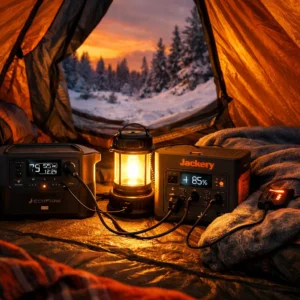
Both Jackery Explorer 300 and EcoFlow River 3 were tested in sub-zero winter conditions by Outdoor Tech Lab.
Budget power station specifications and pricing change frequently. Always verify current details before purchasing.

- SPEED UP YOUR RECHARGEABILITY: It takes only 2 hours to recharge 80% battery of the power station through the wall outle…
- SAFE & STEADY POWER SUPPLY: Armed with a 293Wh lithium-ion battery pack, the Explorer 300 features 2 Pure Sine Wave AC o…
- POWER YOUR EXPECTATIONS: Featuring 2* AC outlet, 1* PD 60W USB-C port (input/output supported) , 1* fast charge 3.0 port…


- [Industry-leading GaN Technology] With groundbreaking X-GaNPower, RIVER 3 revolutionizes energy efficiency, delivering d…
- [1 Hour Fast Charging] Fast AC charging from 0-100% in 1 hour with X-Stream technology. No adapter required, only one ca…
- [Power up to 600W Appliances] Equipped with 6 outlets, charge 6 devices at once with an AC output of 300W. Power up to 6…


Leave a Reply to ks Cancel reply