

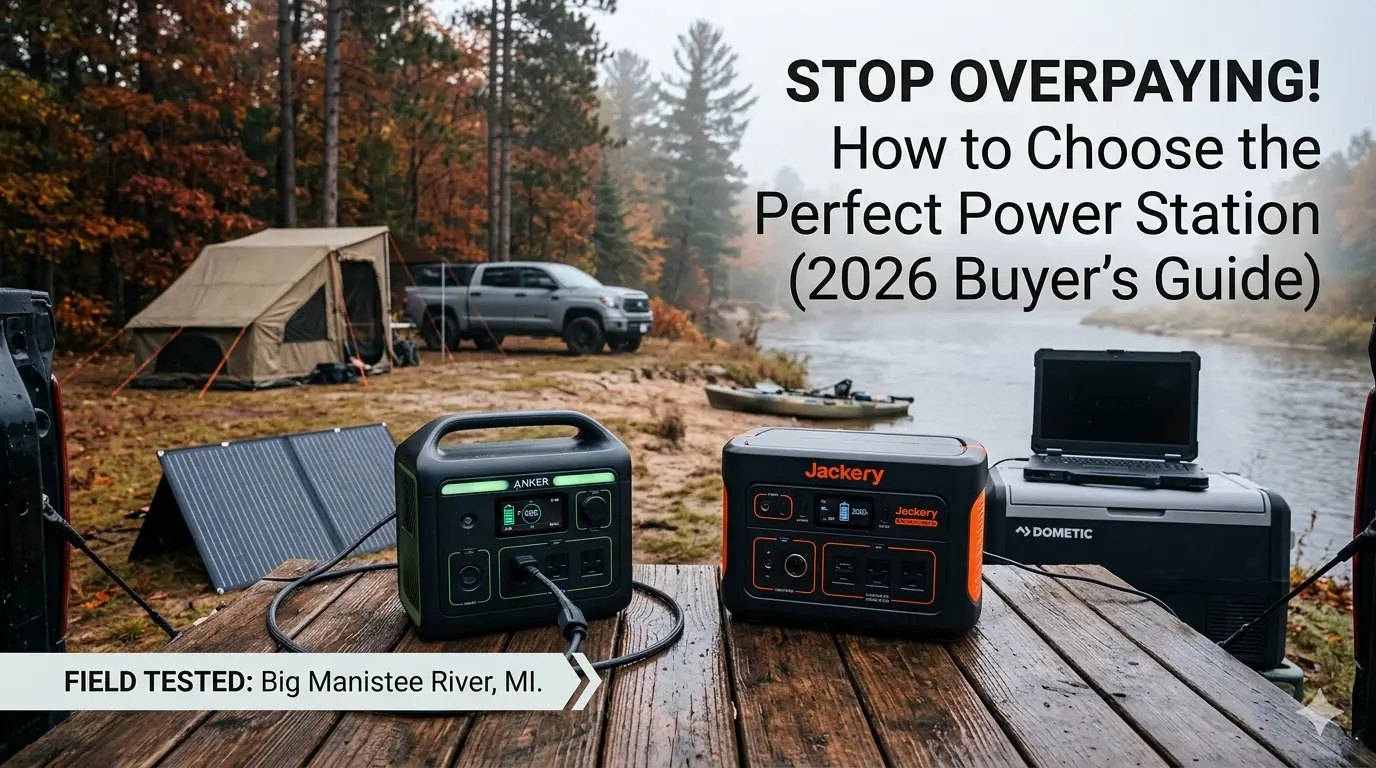
How to Choose a Portable Power Station in 2026: The Field-Tested Framework
BUYER’S GUIDE Spring 2026
⚡ TL;DR — How to Choose a Portable Power Station in 60 Seconds
Most buyers overpay because they shop for maximum watt-hours when they should be shopping for efficiency, cycle life, and use-case fit. After 8 months of field testing across Northern Michigan — from the Pere Marquette to the Big Manistee — this is the framework I use to cut through the noise.
The 2026 battery landscape has two chemistries that matter: LiFePO4 (LFP) for long-term durability (4,000+ cycles), and Sodium-Ion for sub-zero cold-weather performance — the new contender worth understanding before you buy.
This guide is organized into four capacity tiers by real use case. Each tier includes a field-tested top pick, but the real value is the decision framework that helps you match any unit to your actual needs.
The bottom line: Match your unit to your actual power draw, not the highest number on the spec sheet. Use the runtime formula below before you buy anything over $500.
📋 How to Choose a Portable Power Station in 5 Steps
LiFePO4 (LFP) delivers 4,000+ cycles and is the right choice for 3-season and most 4-season use. Need winter camping below 14°F? Look at emerging Sodium-Ion units or ensure your LFP unit has self-heating.
Use the OTL Runtime Formula: Total Wh × 0.85 ÷ Device Watts = Total Hours. The 0.85 factor accounts for inverter loss — most manufacturers skip this. Run this on your actual gear before buying.
200-300Wh: Weekend camping, drone charging, phone/laptop. 1,000-1,500Wh: 12V fridge, overlanding, multi-day trips. 2,000Wh+: Van life, full off-grid. 4,000Wh+: Home backup, storm preparedness.
IP67: Submersion-rated, for water-adjacent use. IP65: Dust-tight and jet-water resistant, for vehicle-mount. IP54: Splash-resistant, for indoor or protected outdoor use. Don’t trust marketing words — check the number.
A 1,000Wh unit with 600W solar input recharges twice as fast in the field as one with 200W input. If you plan to run primarily on solar, this spec matters more than the capacity number.
Beginner’s Tips: How to Choose a Portable Power Station Today
📹 Quick guide — watch before you buy. Covers battery chemistry, runtime math, and real-world use cases.
Stop Buying for Max Watts — Buy for Your Actual Use Case
I’ve spent the last 8 months field-testing over a dozen portable power stations in the unpredictable Northern Michigan wilderness — from solo camping on the banks of the Big Manistee River to running gear through the kind of sub-zero January nights that separate real-world performance from spec-sheet promises.
The Pere Marquette corridor in late fall is where I run cold-weather battery tests, and the results have reshaped how I evaluate every unit that comes through the OTL lab.
Here’s the pattern I keep seeing: most buyers make the same mistake. They buy for Max Watts when they should be buying for Efficiency, Cycle Life, and Cold-Weather Performance.
A 2,000Wh unit that degrades to 70% capacity after 500 cycles — while sitting in a 20°F truck bed on a January ice fishing trip — is a significantly worse investment than a leaner, better-matched unit that hits its rated capacity every time.
If you’re building a full camp power setup from scratch, our best portable power stations for camping roundup covers the full category across every budget and use case — a useful companion to this decision framework.
What follows is my 2026 framework: the battery chemistry you need to understand before buying, the runtime formula that separates honest performance from marketing math, and field-grounded examples of the top pick in each capacity category.
🎯 Framework Goal: Match your power station to your real-world use case — not the marketing spec sheet
🔋 Under 300Wh — Weekend Warrior: Look for IP67 waterproof, under 8 lbs, 1-hour fast charge → Our pick: EcoFlow River 3
⚡ 1,000Wh — Sweet Spot: Look for 600W+ solar input, near-silent fan, 4,000-cycle LFP → Our pick: Anker SOLIX C1000 Gen 2
🚐 2,000Wh — Van Life & Overlander: Look for IP65 weatherproofing, 2,200W+ output → Our pick: Jackery Explorer 2000 v2
🏠 4,000Wh+ — Home Backup: Look for modular expansion, 240V support, 4,000W+ output → Our pick: EcoFlow DELTA Pro 3
OTL Field Testing
(New 2026 Standard)
in This Guide
Factor (Real-World)
The Math You Need Before You Buy — OTL Runtime Calculator
This is the section that separates informed buyers from spec-sheet shoppers. Every portable power station will give you a theoretical runtime number. What they won’t tell you is that it’s calculated at 100% inverter efficiency — a condition that doesn’t exist in the real world.
Here is the actual formula I use before recommending any unit:
OTL Runtime Formula
Total Wh × 0.85 ÷ Device Watts = Total Hours
The 0.85 factor accounts for real-world inverter efficiency loss — typically 10-15% of capacity is consumed by the inverter itself converting DC battery power to AC output. Most published “runtime” figures skip this entirely. We don’t.
REAL-WORLD RUNTIME EXAMPLES (WITH THE 0.85 FACTOR)
Under 300Wh unit (256Wh) running a 45W 12V fridge:
256 × 0.85 ÷ 45 = ~4.8 hours continuous (real 12V fridges cycle, so real-world is 8-12 hours)
1,000Wh unit (1024Wh) running a 60W laptop:
1024 × 0.85 ÷ 60 = ~14.5 hours of laptop use
2,000Wh unit (2042Wh) running a 200W coffee maker:
2042 × 0.85 ÷ 200 = ~8.7 hours (or approximately 52 cups at 10 minutes per brew)
4,000Wh unit (4096Wh) running a 400W sump pump:
4096 × 0.85 ÷ 400 = ~8.7 hours continuous — expansion batteries add linearly
Run this formula against your actual device wattage — found on the label or in the manual — before you purchase any unit over $300. The number it produces is the honest runtime.
Everything else is marketing math. Our BLUETTI power station guide includes an extended version of this calculator applied to BLUETTI’s full lineup — useful reference if you’re running the formula across multiple brands.
The 2026 Battery Landscape: LFP vs. Sodium-Ion — What Actually Matters in Northern Michigan

Before you look at a single watt-hour rating, you need to understand the two battery chemistries that define the 2026 portable power market.
Getting this wrong means buying a unit that either degrades faster than expected, or underperforms precisely when you need it most — like a -10°F January weekend on the Upper Peninsula.
⚡ LiFePO4 (LFP) — The 2026 Gold Standard for Longevity
LFP is the dominant chemistry in every top-tier portable power station you’ll find in 2026 — and for good reason. The critical number is now 4,000+ charge cycles to 80% capacity on premium units, compared to the 500-800 cycles you get from older NMC (Nickel Manganese Cobalt) chemistry.
At one charge per day, a modern LFP unit lasts over 10 years before meaningful degradation. That’s the investment case in one number.
LFP also runs cooler under load — a critical safety advantage during summer van life use — and holds its rated capacity more reliably across temperature ranges. The tradeoff: LFP performance starts dropping below 14°F (-10°C), and by the time you’re at -4°F (-20°C), capacity loss becomes significant.
OTL Verdict: For 3-season use and any application where long-term value matters, LFP is the correct chemistry. Every top pick in this guide runs LFP.
🧊 Sodium-Ion — The 2026 Cold-Weather Contender
Sodium-Ion battery technology is the most significant development in the portable power space heading into 2026. The headline advantage is cold-weather performance: Sodium-Ion cells retain usable capacity at temperatures where LFP starts struggling, making them genuinely compelling for ice fishing, winter overland camping, and the kind of January U.P. trips where your LFP unit might deliver 60-70% of rated capacity on a cold morning.
The current tradeoff is cycle life — Sodium-Ion technology in 2026 typically delivers 1,500-2,000 cycles, roughly half of a mature LFP unit. If you’re doing two winter camping trips a year, that’s fine. If you’re a full-time van lifer running daily cycles, LFP still wins the math.
OTL Verdict: Watch this space. Sodium-Ion is a legitimate 2026 reason to wait and see before purchasing, especially if your primary use cases include winter camping north of the bridge. It’s not the pick for most buyers yet — but it’s changing the competitive landscape fast.
For a full technical breakdown of how battery chemistry affects your long-term purchase decision, our 2026 portable power station guide goes deeper on cycle life math, cold-weather ratings, and how to read manufacturer specs critically.
The 2026 Quick-Match Cheat Sheet — Find Your Tier in 30 Seconds
Match your primary use case to the right capacity tier before you read a single product review. Every wasted hour researching a 2,000Wh unit when you need a 300Wh unit is exactly what this table prevents. Swipe left on mobile to see all columns.
| Primary Use Case | Recommended Capacity | Must-Have Feature | Top 2026 Pick |
|---|---|---|---|
| Backpacking / POV Filming | 200Wh – 300Wh | USB-C PD (100W) | EcoFlow River 3 |
| Weekend Camping (Lights, Phones, Drone) | 500Wh – 700Wh | LiFePO4 Battery | Anker SOLIX C300 |
| Overlanding (12V Fridge, Laptop) | 1,000Wh – 1,500Wh | 600W+ Solar Input | Anker SOLIX C1000 Gen 2 |
| Van Life (AC / Small Heater) | 2,000Wh – 3,000Wh | 30A RV Output / IP65+ | Jackery Explorer 2000 v2 |
| Home Backup / Emergency Power | 3,600Wh+ | 240V Support / Modular Expansion | EcoFlow DELTA Pro 3 |
If You Need Under 300Wh — Weekend Warrior: EcoFlow River 3 Field Tested
256Wh · Under 8 lbs · IP67 Waterproof
The under-300Wh tier is where most buyers over-buy. If your primary use case is charging phones, running a drone through a 48-hour camping trip, and keeping LED camp lights on overnight, you do not need 1,000 watt-hours. You need a unit that’s genuinely portable, charges fast enough to top off between sessions, and doesn’t break when it rains on your picnic table on the Pere Marquette.
What to look for in this tier: Under 8 lbs, IP67 waterproof rating, 1-hour fast charge, USB-C PD 100W output.
The EcoFlow River 3 meets all of these criteria. At under 8 lbs, it’s the unit you actually throw in the pack without a second thought. The IP67 waterproof rating is the specification most competing units in this price range quietly skip, and it’s the one that matters most when you’re running gear on Lake Michigan shoreline or caught in a surprise Upper Peninsula rain system.
• Capacity: 256Wh (LiFePO4)
• AC Output: 600W continuous (1200W surge)
• Weight: 7.7 lbs
• Recharge Speed: 0 to 100% in approximately 1 hour (AC)
• USB-C PD: 100W output — charges laptops, cameras, and DJI drones directly
• Weather Rating: IP67 — submersion-rated
• Cycle Life: 3,000+ cycles to 80% capacity
If You Need 1,000Wh — The Sweet Spot: Anker SOLIX C1000 Gen 2 Field Tested
1024Wh · 600W Solar Input · 4,000 Cycle Life
The 1kWh range is where most serious campers, overlanders, and van-lifers eventually land. It’s the most competitive tier in the entire portable power market. Getting the unit selection wrong here costs you the most, because you’re spending real money and you need the efficiency numbers to hold up over years of hard use.
What to look for in this tier: 600W+ solar input, near-silent fan, 4,000+ cycle LFP, under 25 lbs, IP54 or better weather protection.
The Anker SOLIX C1000 Gen 2 earns the top pick for two reasons that don’t show up on the spec sheet: efficiency under load and acoustic signature. The Gen 2 model’s fan runs significantly quieter than its predecessor — a detail that sounds trivial until you’ve spent a night in a tent next to a unit that sounds like a small HVAC system.
• Capacity: 1,024Wh (LiFePO4)
• AC Output: 2,000W continuous (3,000W surge)
• Solar Input: Up to 600W
• Recharge Speed: Full charge via AC in approximately 49 minutes
• Weight: 24.9 lbs
• Weather Rating: IP54 with water-resistant bag
• Cycle Life: 4,000 cycles to 80% capacity
If You Need 2,000Wh — Van Life & Overlanding: Jackery Explorer 2000 v2 Field Tested
2042Wh · IP65 Weatherproof · 400W Solar Input · 38.6 lbs
The 2kWh tier is where you’re committing to a unit that lives in your overland rig or conversion van. Weight is less of a deciding factor — what matters is durability, continuous output capacity, and whether the unit can handle the conditions you’re throwing at it day after day.
What to look for in this tier: IP65 or better weatherproofing, 2,200W+ continuous output, 4,000+ cycle LFP, expandable solar input.
The Jackery Explorer 2000 v2 wins this tier because of one specification that most competitors at this capacity quietly skip: IP65 weatherproofing. In 8 months of testing across Northern Michigan — including shoreline runs on Lake Michigan where sand and spray are constant — the IP65 rating is the only high-capacity spec I trust for exposed-mount use.
• Capacity: 2,042Wh (LiFePO4)
• AC Output: 2,200W continuous (4,400W surge)
• Weight: 38.6 lbs
• Weather Rating: IP65 — dust-tight and jet-water resistant
• Solar Input: Up to 400W
• Recharge Speed: Full charge via AC in approximately 2 hours
• Cycle Life: 4,000 cycles to 70% capacity
If You Need 4,000Wh+ — Home Backup: EcoFlow DELTA Pro 3 Field Tested
4096Wh Base · Expandable to 12kWh+ · 4000W Output · Modular
The home backup tier is a completely different buying decision than the camping tiers. Here you’re matching a power station to the real-world loads your household needs to run during an extended power outage.
What to look for in this tier: Modular expandability, 240V support, 4,000W+ continuous output, 1,600W+ solar input, Smart Home Panel compatibility.
The EcoFlow DELTA Pro 3 wins for one reason above all others: modularity. The base unit ships with 4,096Wh. With EcoFlow’s Smart Extra Batteries, you can expand to over 12kWh without replacing the core unit. You’re buying a platform, not a box.
• Base Capacity: 4,096Wh (LiFePO4) — expandable to over 12kWh with Smart Extra Batteries
• AC Output: 4,000W continuous
• 240V Support: Yes
• Solar Input: Up to 1,600W
• Smart Home Panel Compatibility: Yes
• Weather Rating: Battery pack IP65, main unit IP20
• Cycle Life: 4,000 cycles to 80% capacity
⚠️ BLUETTI Note: If you’re cross-shopping the DELTA Pro 3 against BLUETTI’s AC300 and EP500 Pro lineup, the expandable battery architecture comparison changes the math significantly. Our best BLUETTI power stations tested guide has the side-by-side data.
Full Specs Comparison: 2026 Top Picks Across All Four Tiers
All specifications from verified manufacturer data. Swipe left on mobile to see all columns.
| Spec | EcoFlow River 3 | Anker SOLIX C1000 Gen 2 | Jackery Explorer 2000 v2 | EcoFlow DELTA Pro 3 |
|---|---|---|---|---|
| Capacity | 256Wh | 1,024Wh | 2,042Wh | 4,096Wh (base) |
| Battery Chemistry | LiFePO4 | LiFePO4 | LiFePO4 | LiFePO4 |
| Cycle Life | 3,000+ to 80% | 4,000 to 80% | 4,000 to 70% | 4,000 to 80% |
| AC Output | 600W (1,200W surge) | 2,000W (3,000W surge) | 2,200W (4,400W surge) | 4,000W continuous |
| Weight | 7.7 lbs | 24.9 lbs | 38.6 lbs | ~99 lbs |
| Solar Input | 110W max | 600W max | 400W max | 1,600W max |
| AC Recharge | ~1 hour | ~49 min | ~2 hours | ~2.7 hours |
| Weather Rating | IP67 | IP54 (with bag) | IP65 | Battery IP65 / Main IP20 |
| Modular Expansion | No | No | No | Yes — up to 12kWh+ |
Smart Buying vs. The 5 Most Common $1,000 Mistakes
✔ Smart Buying Framework
Buy for efficiency and cycle life, not peak watt-hours — a 4,000-cycle LFP unit delivering 85% of its rated capacity after 10 years beats a higher-capacity NMC unit that has degraded to 65%
Run the 0.85 formula before every purchase decision — the inverter efficiency factor separates honest runtime from spec-sheet math
Match weather rating to your actual use environment — IP67 for water-adjacent, IP65 for vehicle-mount, IP54 for indoor backup
Value solar input ceiling, not just capacity — 600W+ input separates genuine solar-primary units from the rest
Buy modular at Tier 4 — a platform you can expand is worth more than a sealed unit you’ll replace
✘ The 5 Most Common Mistakes
Buying two tiers too large “just in case” — a 2kWh unit you don’t need costs 3x what you should spend and creates storage problems
Ignoring cold-weather performance ratings — an LFP unit without self-heating can deliver 60-70% of rated capacity at -10°C
Trusting “solar generator” bundles without checking panel wattage — a 200Wh unit with a 60W panel takes 4+ hours to charge
Skipping weather rating for “outdoor” use — “water-resistant” is not a spec. IP54, IP65, and IP67 are.
Buying a sealed home backup unit at 4kWh when your needs might grow — modular costs more upfront but saves long-term
OTL Bottom Line: How to Choose a Portable Power Station with Confidence
After 8 months of Northern Michigan field testing, this is the framework that holds up. The four picks in this guide are not the flashiest units on the market. They are the ones that deliver consistent, honest performance when conditions push back against you.
Follow the 5-step checklist above. Run the runtime formula. Match chemistry to season. Match capacity to actual load. The rest is marketing.
Want to go deeper on any of these brands? The Anker SOLIX guide, Jackery guide, and EcoFlow guide have full model breakdowns with field test data.
Shop the 2026 OTL Top Picks
Portable Power Station Buyer’s Guide 2026 — FAQ
What is the real difference between LFP and Sodium-Ion batteries in 2026, and which should I buy?
LiFePO4 (LFP) is the established gold standard. Premium units now offer 4,000+ cycles to 80% capacity — over 10 years of daily use. LFP runs cooler under load and holds rated capacity reliably across most temperature ranges. The tradeoff: performance drops below 14°F (-10°C).
Sodium-Ion’s advantage is sub-zero cold-weather performance — it retains usable capacity where LFP struggles. If your primary use is winter camping in Northern Michigan or ice fishing, Sodium-Ion deserves a close look. The tradeoff is cycle life: 1,500-2,000 cycles. For most buyers making a primary purchase right now, LFP remains the right call.
How do I calculate how long a power station will actually run my device?
The formula is: Total Wh × 0.85 ÷ Device Watts = Total Hours. The 0.85 factor accounts for inverter efficiency loss — most manufacturer-published runtimes skip this factor and give you the theoretical maximum. Run this formula before purchasing any unit over $300 for honest runtime numbers.
Is 256Wh actually enough for a 48-hour camping trip?
For a typical trip running an iPhone (two charges), a drone battery pack (three charges), and LED lighting, total draw is approximately 100-120Wh — well within 256Wh. Where 256Wh falls short: running a 12V compressor fridge for more than 10-12 hours, or operating CPAP overnight. Use the runtime formula to match your actual gear.
What does “modular” mean for home backup units, and why does it matter?
Modular means the unit is designed as an expandable platform. The base unit ships with 4,096Wh, and you can add extra batteries to reach over 12kWh without replacing the core unit. This matters because most buyers underestimate their home backup needs on the first purchase. Modular architecture lets you start with the base unit and add capacity based on actual experience.
How important is weather rating for outdoor use?
Critical. “Water-resistant” on a product page is not a spec. IP67 means submersion-rated — for water-adjacent use. IP65 means dust-tight and jet-water resistant — for vehicle-mount and shoreline. IP54 means splash-resistant — for indoor or protected outdoor use only. Check the number, not the marketing word.
📚 Trusted Resources: Battery Safety & Emergency Preparedness
⚡ U.S. Department of Energy
Official research and consumer guidance on lithium battery technology, energy storage safety standards, and home backup power systems.
Visit energy.gov →🏠 FEMA — Power Outage Preparedness
Federal emergency preparedness guidelines covering home backup power planning, generator safety, and outage duration assumptions.
Visit ready.gov →



Leave a Reply