

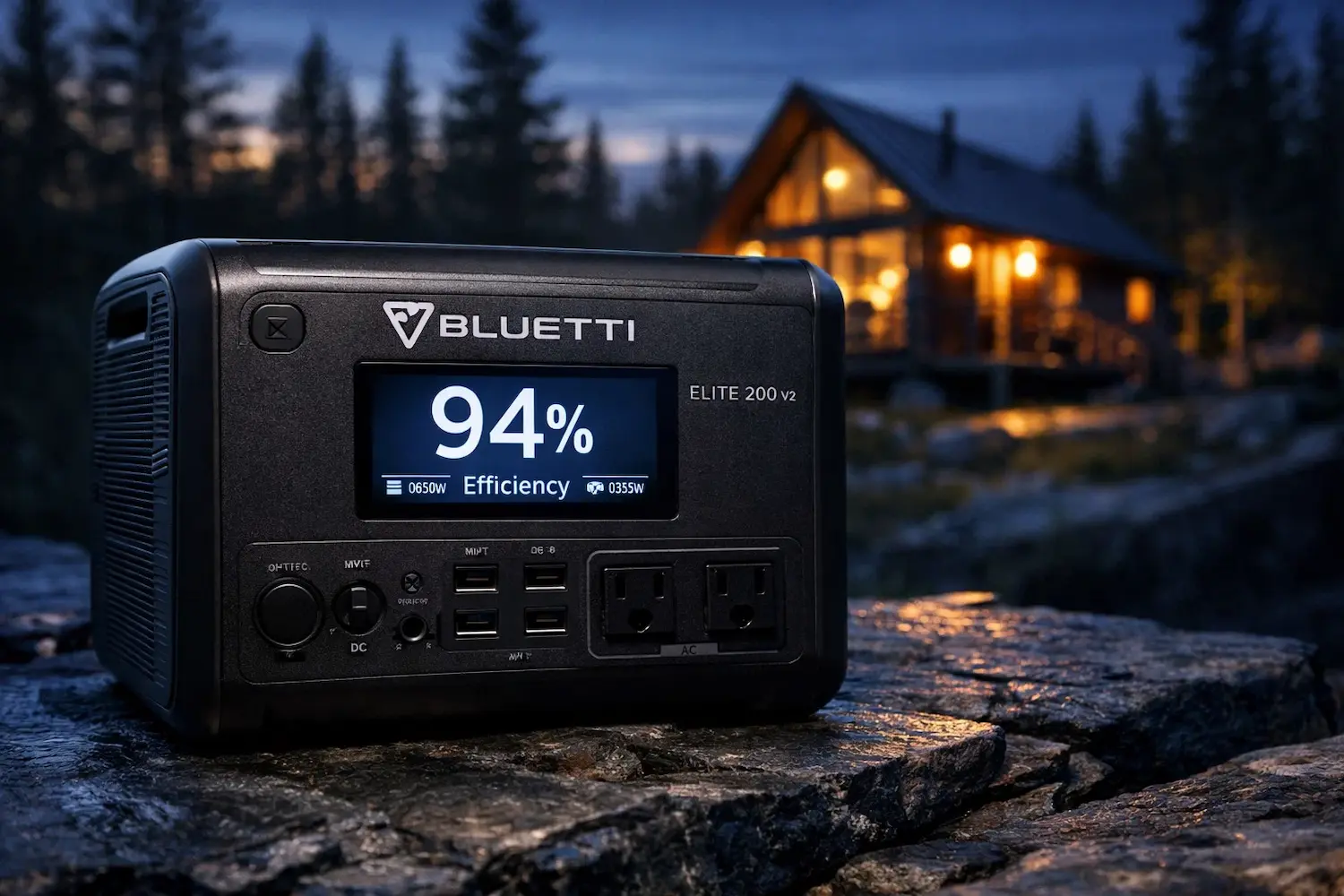
Bluetti Power Station LiFePO4 Technology: Battery Chemistry, Cycle Life & Specs Explained
TECH DEEP-DIVE Updated March 2026
highest among the models covered in this guideEvery Bluetti power station in the current lineup — from the pocket-sized BLUETTI Elite 10 all the way up to the flagship Apex 300 — is built on LiFePO4 battery technology. That single decision drives the pricing, cycle life ratings, safety claims, and long-term value across the entire catalog.
Most buyers scan past “LiFePO4” on a spec sheet. That’s a mistake — because the chemistry determines how many years you own a unit before capacity meaningfully degrades, how safely it operates indoors during an outage, and what the station actually costs per year once you run the total ownership math against competing brands still using standard lithium-ion cells.
This guide breaks down exactly what LiFePO4 means for a Bluetti power station: the battery chemistry fundamentals, the two cell tiers within the lineup, how cycle life ratings translate to real years and dollars, and how the charging mode systems in the Elite and Apex series interact with long-term battery health.
If you’re still sizing a system, our 2026 portable power station guide covers capacity calculations and wattage requirements before you get to chemistry comparisons.
For field-tested performance across the full Bluetti lineup, see our complete Bluetti power station field test and comparison.
This article is the technology layer underneath those results.
🔋 Chemistry: LiFePO4 (Lithium Iron Phosphate) — used across all current Bluetti portable power station models
⚡ Two Cell Tiers: Automotive-grade LFP (Elite 100 V2, Elite 200 V2, Elite 300, Apex 300) at 6,000+ cycles vs. standard LFP at 2,500–3,500 cycles
🏆 Flagship Certifications: CNAS-certified cells with 33 independent testing standards across the premium tier
🔌 App-Selectable Charging Modes: Turbo / Standard / Silent across Elite series; TurboBoost on Apex 300
🛡️ Indoor Safety: Zero emissions, no ventilation required — safe for homes, RVs, tents, and medical environments
⚡ TL;DR — The Bluetti LiFePO4 Advantage in 60 Seconds
LiFePO4 uses an iron-phosphate cathode instead of the nickel or cobalt compounds in standard lithium-ion cells. That structural difference delivers higher thermal stability, longer cycle life before capacity degrades, and a flatter discharge curve — meaning consistent voltage output throughout a session rather than declining power as the battery depletes.
Within Bluetti’s lineup, standard LFP powers most entry models at 2,500–3,500 cycles. Automotive-grade LFP — found in the Elite 100 V2, Elite 200 V2, Elite 300, and Apex 300 — is rated at 6,000+ cycles with CNAS-certified independent testing behind it. That tier difference is the most important spec to understand before choosing a model.
The cost reality: LFP costs more upfront. Over a realistic ownership timeline, it consistently delivers a lower cost per year than the Li-ion alternatives it replaces. The full math is below.
What Is LiFePO4? The Chemistry Behind Every Bluetti Power Station
LiFePO4 stands for Lithium Iron Phosphate. It is a rechargeable battery chemistry that uses iron phosphate (FePO₄) as the cathode material — as opposed to the nickel, cobalt, or manganese compounds found in NMC and NCA lithium-ion chemistries used in most consumer electronics and earlier-generation portable power stations.
The cathode material determines nearly everything a power station buyer cares about: how many times the battery can fully charge and discharge before capacity drops below useful levels, and how it behaves thermally under stress.
It also determines how consistently the unit delivers voltage through a session, and how long it retains real-world usable capacity across years of ownership.
The iron-oxygen bond in iron phosphate is stronger and more thermally stable than the bonds in nickel- or cobalt-based cathodes. In practical terms this means the cathode does not release oxygen when overheated — and oxygen release is the core mechanism behind thermal runaway, the heat cascade responsible for lithium-ion battery fires. LFP’s thermal runaway threshold sits substantially above that of standard lithium-ion, which is the direct basis for the indoor safety advantage Bluetti cites across the lineup.
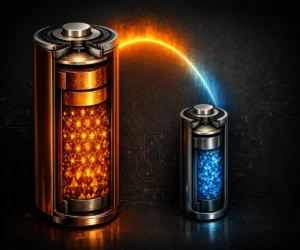
A second practical benefit is the discharge curve. Standard Li-ion cells deliver decreasing voltage as they deplete — power quality degrades as the session progresses. LFP maintains voltage near its nominal level through approximately 80% of a discharge cycle before the drop becomes pronounced.
For a power station running a CPAP machine overnight, a refrigerator during an outage, or sensitive electronics in the field, that consistent output voltage is the difference between a device running cleanly and one that faults or resets as the battery approaches low charge.
The known tradeoff is energy density: LFP stores less energy per kilogram than NMC or NCA. This is why LFP-based power stations are heavier for a given capacity than competing Li-ion units.
Bluetti addresses this directly in the Elite 300 — independently certified by Frost & Sullivan as the world’s smallest 3kWh portable power station — and in the Elite 200 V2, which packages 2,073.6Wh in a form factor 40% more compact than its prior-generation equivalent.
💡 Terminology Note: LFP and LiFePO4 refer to the same chemistry — the abbreviations are interchangeable across all Bluetti product listings. All current Bluetti models use one of two LFP cell tiers covered in the next section.
Premium LFP Tier
Elite & Apex Flagship
Standards — CNAS
Elite 300 & Apex 300
Bluetti Power Station LFP Cell Tiers: Standard vs. Automotive-Grade
Not all LiFePO4 cells are manufactured to the same specification. Within the LFP category, automotive-grade cells and standard-grade cells share the same base chemistry but differ in manufacturing tolerances, quality binning, and independent verification.
Bluetti uses both tiers across its current lineup — knowing which tier a given model uses is the single most important specification comparison in the entire catalog.
Standard LFP powers the entry and mid-range models — the AC2A, EB3A, Elite 30 V2, AC180, and AC200L. These cells deliver 2,500–3,500 cycles to 80% capacity, equating to 7–10 years of daily-use lifespan. That is still 3–4× the longevity of standard lithium-ion cells used in competing brands at similar price points.
Automotive-grade LFP is used in the Elite 100 V2, Elite 200 V2, Elite 300, and Apex 300. On the Elite 200 V2 and Apex 300, these cells are CNAS-certified and validated against 33 independent testing standards.
The cycle life rating across this tier reaches 6,000+ cycles to 80% capacity, with a 17-year rated daily-use lifespan. Bluetti’s 2nd-generation LFP cells in the Apex 300 deliver the same CNAS-certified 33-test standard as the Elite 200 V2.
What CNAS certification means in practice: CNAS — China’s National Accreditation Service for Conformity Assessment — accredits testing laboratories to ISO/IEC 17025 international standards.
CNAS-certified testing means cell validation was conducted at an independently accredited third-party laboratory, not self-reported by the manufacturer. This provides independent verification of cycle life, thermal performance, and safety claims that cannot be directly confirmed by buyers before purchase.
Bluetti Full Lineup — LFP Cell Tiers by Model (2026)
Swipe left on mobile to see all columns.
| Model | Capacity | AC Output | Cell Tier | Rated Cycles | Daily-Use Lifespan |
|---|---|---|---|---|---|
| Apex 300 | 2,764.8Wh | 3,840W continuous / 7,680W Power Lifting | Auto-Grade LFP CNAS-Certified |
6,000+ | ~17 years |
| Elite 300 | 3,014.4Wh | 2,400W / 4,800W Surge | Auto-Grade LFP | 6,000+ | ~17 years |
| Elite 200 V2 | 2,073.6Wh | 2,600W continuous / 3,900W Power Lifting | Auto-Grade LFP CNAS-Certified |
6,000+ | ~17 years |
| Elite 100 V2 | 1,024Wh | 1,800W / 3,600W Power Lifting | Auto-Grade LFP | 6,000+ | ~16–17 years |
| AC180 | 1,152Wh | 1,800W / 2,700W Surge | Standard LFP | 3,500+ | ~9–10 years |
| AC200L | 2,048Wh (exp. 8,192Wh) | 2,400W / 3,600W Power Lifting | Standard LFP | 3,000+ | ~8 years |
| Elite 30 V2 | 288Wh | 600W / 1,500W Power Lifting | Standard LFP | 3,000+ | ~8 years |
| AC2A | 204Wh | 300W / 600W Power Lifting | Standard LFP | 3,000+ | ~8 years |
| EB3A | 268Wh | 600W / 1,200W Surge | Standard LFP | 2,500+ | ~6–7 years |
For most buyers using a Bluetti station for weekend camping, seasonal emergency preparedness, or RV travel, standard LFP models deliver reliable performance well within spec across any realistic ownership period.
At 50–150 full cycles per year, even 2,500-cycle standard LFP cells represent decades of practical use. The automotive-grade distinction matters most for buyers cycling a unit daily, using it as dedicated home backup, or maximizing long-term cell investment.
For a hands-on field comparison between Bluetti models and competing brands across Northern Michigan winter conditions, see our Jackery vs. Bluetti portable power station comparison.
The Cycle Life Math: What 6,000 Cycles Means in Real Years and Dollars
Cycle life ratings are the most important long-term value spec for a power station purchase and the most consistently misread. Here is how to translate the number on the spec sheet into actual ownership math.
One complete charge cycle = one discharge from 100% to 0% and back to 100%. Partial charges count proportionally — charging from 50% to 100% counts as approximately 0.5 cycles. The battery accumulates cycle count regardless of usage pattern.
How the 17-Year Rating Is Derived
The math is direct: 6,000 cycles ÷ 365 days/year = 16.4 years, rounded to 17. That calculation assumes one full charge-discharge cycle every single day — the maximum possible cycling frequency.
Most buyers cycle far less than that. A unit used for camping and emergency backup might complete 50–150 full cycles per year. At 100 cycles annually, the 6,000-cycle automotive-grade battery in the Elite 200 V2 or Elite 300 would take 60 years to exhaust its rated life to 80% capacity. The 17-year figure is a floor under daily maximum use, not a ceiling for typical seasonal or emergency use.
CYCLE LIFE — BLUETTI LFP TIERS VS. STANDARD LI-ION
💡 Buyer’s Math: Divide the purchase price by rated cycle life to get cost-per-cycle for any unit you’re comparing. A lower-priced Li-ion unit at 600 cycles carries a significantly higher cost per cycle of use than an LFP unit at 3,000+ cycles — the upfront price gap reverses quickly under real ownership timelines.
Bluetti Charging Modes: Speed, Battery Care & Silence
The Elite series and Apex 300 include app-selectable charging modes that let users optimize for maximum speed, long-term battery health, or minimum operating noise. Understanding when each mode is appropriate directly affects both practical usefulness and longevity across years of ownership.
Elite 200 V2 — Charging Mode Comparison
Specifications from verified manufacturer data. Swipe left on mobile.
| Mode | AC Input | Time to 80% | Full Charge | Noise | Best Used When |
|---|---|---|---|---|---|
| TurboBoost (Dual AC+DC) |
Combined | 50 minutes | ~2 hours | Audible fan | Fastest possible recharge — outage just cleared |
| Turbo Mode | 1,800W AC | ~1 hour | ~1.5 hours | Audible fan | Fixed departure window — time-sensitive recharging needed |
| Standard Mode | Up to 1,440W | ~96 min | 1.6 hours | Reduced | Everyday routine — best for long-term battery health |
| Silent Mode | 800W AC/Solar | — | 3 hours | 16–30dB 45% quieter |
Overnight, medical, solar-primary charging |
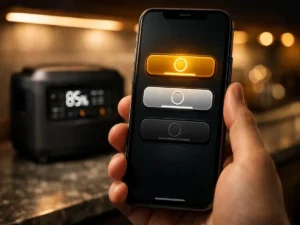
Standard Mode for everyday use: Higher charging current generates more heat per session. LFP’s thermal tolerance is substantially higher than Li-ion, but lower charge rates still apply less cumulative thermal stress across years of ownership. Standard Mode is the manufacturer’s recommendation for routine charging for exactly this reason.
Silent Mode for solar and overnight: At 16–30dB — 45% quieter than the typical 30–50dB of stations at full charge speed — Silent Mode is the correct choice for enclosed sleeping spaces, medical environments, and all-day background office use. It also pairs naturally with solar panel input, where 800W aligns with realistic panel output under real-world rather than peak-spec conditions.
Apex 300 TurboBoost: The Apex 300 uses a 2,000W TurboBoost fast charging system capable of reaching 80% in 45 minutes. The BLUETOPUS AI-BMS — Bluetti’s second-generation adaptive Battery Management System — actively manages thermal load during aggressive charging, applying real-time adjustments rather than fixed charge curves.
Flagship Model Specs: Elite 200 V2, Elite 300 & Apex 300
Three Bluetti portable power stations anchor the automotive-grade LFP tier and represent the technology at its highest current implementation. Each targets a distinct use profile — the Elite 200 V2 for premium home and camping backup, the Elite 300 for compact high-capacity power, and the Apex 300 for maximum output and whole-home versatility.
For detailed field tests of the mid-tier automotive-grade model and the expandable standard LFP option, see our BLUETTI Elite 100 V2 30-day field test and our BLUETTI AC200L review with Northern Michigan winter and RV testing.
⚡ Bluetti Elite 200 V2 — Flagship LFP Technology
• Capacity: 2,073.6Wh LiFePO4 — CNAS-certified automotive-grade cells, 33 testing standards
• AC Output: 2,600W continuous (HyperWatt) / 3,900W Power Lifting
• Cycle Life: 6,000+ cycles to 80% — 17-year daily-use lifespan
• Fastest Charge: 0–80% in 50 minutes (TurboBoost dual AC+DC)
• UPS Switchover: ≤15ms — protects computers and sensitive electronics through live outage events
• Standby Draw: 10W — 3× lower than comparable stations
• Ports: 4 AC outlets, up to 9 simultaneous devices
• Solar Input: Up to 1,000W — full charge in 2.4 hours with 1,000W of panels
• Compactness: 40% more compact than prior-generation equivalent
• Weight: 53.35 lbs | Voltage: 120V AC pure sine wave
▶ OTL Field Video
🏕️ Bluetti Elite 300 — World’s Smallest 3kWh Portable Power Station
• Capacity: 3,014.4Wh LiFePO4 — automotive-grade cells, 6,000+ cycles (automotive-grade tier; CNAS certification not listed for this model)
• AC Output: 2,400W continuous / 4,800W surge power
• Cycle Life: 6,000+ cycles to 80% — 17-year rated daily-use lifespan
• Fastest Charge: 0–80% in 70 minutes maximum
• UPS Switchover: ≤10ms
• RV-Ready: Dedicated TT-30 outlet and 12V/30A DC port — adapter-free RV connection
• Certification: Frost & Sullivan verified — world’s smallest 3kWh portable power station
• Compactness: Nearly 59% smaller than traditional large power stations at this capacity
• Weight: 58 lbs | Voltage: 120V AC
• Power Source: Solar / AC / Car / Lead-acid / Generator
The Elite 300 targets buyers who need genuine 3kWh capacity in a package compact enough for RV storage and single-person loading. The 4,800W surge rating handles resistive high-draw loads — kettles, space heaters, electric skillets — that exceed the continuous AC output. The TT-30 RV outlet enables direct shore power connection without adapters, which is a practical differentiator for full-time RV users.
🔱 Bluetti Apex 300 — Maximum Output & Dual-Voltage Power
• Capacity: 2,764.8Wh LFP — CNAS-certified 2nd-gen cells, 33 extreme tests, 17-year lifespan
• AC Output: 3,840W continuous / 7,680W Power Lifting (Surge) — highest in Bluetti lineup
• Dual Voltage: Simultaneous 120V and 240V output — powers RV ACs, electric dryers, EV chargers without compromises
• Ports: 6 AC outlets, 14 total versatile ports
• Cycle Life: 6,000+ cycles to 80%
• Fast Charge: TurboBoost 2,000W — 0–80% in 45 minutes; BLUETOPUS AI-BMS
• UPS Switchover: ≤10ms | Silent Operation: 22dB
• Solar Input: 2,400W built-in, expandable to 6,400W
• Expandable: Parallel 2–3 units (5.5–8.3kWh); expandable to 58kWh with B300K battery modules
• Black Start: Can restart from fully depleted state
• Weight: 66.14 lbs | Voltage: 120V (AC) / 240V simultaneous
The Apex 300 occupies a distinct position in the Bluetti lineup: it is the only current model offering simultaneous 120V/240V output, making it viable for loads that require 240V — window AC units, certain power tools, EV Level 2 charging adapters.
The 7,680W Power Lifting rating and 14-port configuration position it for whole-home essential circuit backup and demanding off-grid work sites.
The BLUETOPUS AI-BMS is Bluetti’s second-generation adaptive battery management system, which applies real-time thermal and charge rate adjustments based on cell state rather than fixed charging curves — a meaningful distinction from standard BMS implementations at this class.
Flagship Three — Side-by-Side Spec Comparison
All specifications from verified manufacturer data. Swipe left on mobile.
| Spec | Elite 200 V2 | Elite 300 | Apex 300 |
|---|---|---|---|
| Capacity | 2,073.6Wh | 3,014.4Wh | 2,764.8Wh |
| AC Output (Continuous) | 2,600W | 2,400W | 3,840W |
| Surge / Power Lifting | 3,900W Power Lifting | 4,800W Surge | 7,680W Power Lifting |
| AC Outlets | 4 | — | 6 |
| Total Ports | 9 devices | — | 14 |
| Cycle Life | 6,000+ to 80% | 6,000+ to 80% | 6,000+ to 80% |
| Lifespan (Daily Use) | 17 years | 17 years | 17 years |
| Cell Certification | CNAS-Certified | Auto-Grade LFP No CNAS certification |
CNAS-Certified (2nd Gen) |
| UPS Switchover | ≤15ms | ≤10ms | ≤10ms |
| Fast Charge (0–80%) | 50 min (TurboBoost) | 70 min max | 45 min (TurboBoost) |
| Silent Operation | 16–30dB | — | 22dB |
| Dual Voltage (120V/240V) | No | No | Yes — Simultaneous |
| RV Outlet (TT-30) | No | Yes + 12V/30A DC | — |
| Expandable Capacity | No | No | Up to 58kWh (B300K) |
| BMS | AI-Optimized BMS | — | BLUETOPUS AI-BMS (Gen 2) |
| Standby Draw | 10W | — | — |
| Weight | 53.35 lbs | 58 lbs | 66.14 lbs |
| Power Source | Solar/AC/Car/Lead-acid/Generator | Solar/AC/Car/Lead-acid/Generator | Solar/AC/Car/Lead-acid/Generator |
Bluetti Power Station LiFePO4 — Pros & Cons
✔ Pros
6,000+ cycle rated lifespan — automotive-grade LFP in Elite 200 V2, Elite 300, and Apex 300 is rated for 17 years of daily use; 3–4× longer than standard Li-ion alternatives
Indoor safe — zero emissions — LFP chemistry produces no combustion byproducts; no ventilation required in homes, RVs, tents, or enclosed spaces
CNAS-certified independent testing — third-party accredited laboratory validation on Elite 200 V2 and Apex 300 cells, not manufacturer self-reporting
App-selectable charging modes — Turbo, Standard, and Silent modes let users optimize for speed, battery longevity, or noise level across different scenarios
Fast UPS switchover — ≤15ms (Elite 200 V2) and ≤10ms (Elite 300, Apex 300) protects computers and sensitive electronics through live outage events
Power Lifting for high-draw resistive loads — enables heaters, kettles, and cooking appliances above the continuous inverter rating across all flagship models
Multiple charging inputs — Solar, AC wall, car/12V, lead-acid generator across all models; Apex 300 supports up to 6,400W expanded solar input
✘ Cons
Higher upfront cost than Li-ion competitors — LFP’s longevity advantage is a long-term investment; buyers with short-term budget constraints will find lower initial prices on Li-ion alternatives
Weight penalty vs. Li-ion — lower energy density of LFP means flagship models (53–66 lbs) are heavier than same-capacity Li-ion competitors; two-person carry recommended for extended distances
Power Lifting is resistive loads only — 3,900W–7,680W Power Lifting ratings do not apply to inductive motor loads; sump pumps and compressors require verification against continuous output and startup surge specs separately
Cold-weather capacity reduction — all lithium chemistries including LFP experience some capacity reduction in sub-freezing conditions; keeping units inside an insulated enclosure rather than exposed to ambient cold minimizes the variance
Elite 200 V2 not expandable — fixed 2,073.6Wh capacity; buyers who may need more capacity later should consider the AC200L (expandable to 8,192Wh) or the Apex 300 (expandable to 58kWh)
Not a whole-home solution at base capacity — the Elite 200 V2 and Elite 300 handle essential circuits well during outages; central heat, well pumps, electric dryers, and HVAC require the Apex 300’s 240V output or dedicated whole-home battery systems
OTL Bottom Line: Bluetti Power Station Buying Decision
LiFePO4 is the technology foundation every Bluetti power station is built on — and the battery chemistry is the direct reason these units carry the cycle life, safety, and longevity claims they do.
Understanding the two cell tiers, how cycle ratings translate to real ownership years, and when each charging mode is appropriate is what makes the purchasing decision clear rather than confusing.
The automotive-grade tier — Elite 100 V2, Elite 200 V2, Elite 300, Apex 300 — represents the top of what current LFP technology delivers in portable power stations. CNAS-certified cells, 6,000+ cycle ratings, 17-year lifespans, sub-15ms UPS protection, and Power Lifting capability across the full lineup.
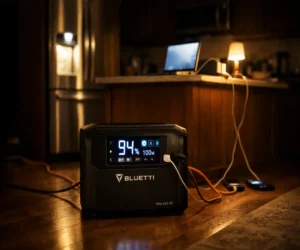
For buyers who need the highest output in the lineup, the Apex 300’s 3,840W continuous and 7,680W Power Lifting with simultaneous 120V/240V output is in a separate class.
For maximum capacity in the most compact footprint, the Elite 300’s Frost & Sullivan-certified 3kWh-in-smallest-package claim is the relevant differentiator.
For the proven flagship LFP technology with CNAS certification and TurboBoost charging in a 2kWh package, the Elite 200 V2 remains the reference point.
For field-tested real-world performance across the full lineup — runtimes, cold-weather results, and model-by-model buying recommendations — see our complete Bluetti power station tested field comparison.
Shop the Automotive-Grade LFP Lineup
📚 Official Resources
LiFePO4 battery stations operate emissions-free indoors, but thorough emergency preparedness planning and an understanding of the safety landscape for all generator types remains essential for any household backup power strategy.
- CPSC: Generators & Carbon Monoxide Safety — Consumer Product Safety Commission
Official U.S. Consumer Product Safety Commission guidance on carbon monoxide hazards from portable gas generators — the exact risk that LFP battery stations eliminate by operating with zero emissions indoors. Essential context for any household evaluating battery backup vs. traditional generator options. - U.S. Department of Energy: Battery Storage for Solar Energy Systems
The U.S. Department of Energy’s overview of battery storage technology for residential solar and backup power systems — covers how battery storage integrates with solar panels, key considerations for sizing, and the role of home battery backup in grid resilience. Directly relevant to Bluetti’s solar-charging compatible lineup.
Bluetti Power Station LiFePO4 — FAQ
Which Bluetti power station offers the highest power output?
The Apex 300’s 7,680W Power Lifting is the highest among the models covered in this guide. It also delivers simultaneous 120V and 240V output — the only Bluetti model to do so — which makes it compatible with loads requiring 240V such as certain RV air conditioners, power tools, and EV charging adapters. If you need the highest output on a continuous basis without 240V, the Elite 200 V2 at 2,600W continuous and 3,900W Power Lifting is the flagship in that tier.
How do Bluetti solar generators charge devices?
Bluetti power stations support multiple simultaneous charging inputs and outputs. On the input side, all flagship models accept Solar, AC wall power, car/12V DC, lead-acid generator, and external battery input — the specific wattage limits vary by model.
On the output side, devices connect via standard AC outlets (120V pure sine wave), USB-C, USB-A, and 12V DC ports. The Apex 300 adds 240V output and the Elite 300 includes a TT-30 RV outlet for direct RV appliance connection.
The BLUETTI app manages charging mode selection and monitors input and output simultaneously. For solar charging: the Elite 200 V2 accepts up to 1,000W solar input for a full charge in approximately 2.4 hours with optimal panels; the Apex 300 accepts up to 2,400W built-in solar input, expandable to 6,400W.
What does LiFePO4 mean in a Bluetti power station?
LiFePO4 stands for Lithium Iron Phosphate — a battery chemistry that uses an iron-phosphate cathode instead of the nickel or cobalt compounds in standard lithium-ion cells. The iron-phosphate structure is more thermally stable, delivers significantly more charge-discharge cycles before capacity degrades, and maintains more consistent output voltage throughout a session. All current Bluetti power stations use LiFePO4 chemistry. LFP is an abbreviation for the same chemistry and the terms appear interchangeably across product listings.
What is the difference between the Elite 300 and the Apex 300?
Both are automotive-grade LFP models with 6,000+ cycle ratings, but they target different use profiles.
The Elite 300 (3,014.4Wh) is built around compact high-capacity storage — independently certified as the world’s smallest 3kWh portable power station, with a dedicated TT-30 RV outlet and 12V/30A DC port for adapter-free RV connection.
The Apex 300 (2,764.8Wh) prioritizes maximum power output and versatility — 3,840W continuous, 7,680W Power Lifting, simultaneous 120V/240V output, 6 AC outlets, 14 total ports, expandable to 58kWh, and BLUETOPUS second-generation AI-BMS.
For RV owners who need the most compact 3kWh option, the Elite 300 is the pick. For maximum output, dual voltage, or whole-home backup that may need expansion, the Apex 300 is the stronger choice.
How long does a Bluetti power station battery last?
It depends on the model’s cell tier. Automotive-grade LFP models — Elite 100 V2, Elite 200 V2, Elite 300, and Apex 300 — are rated for 6,000+ cycles to 80% capacity, translating to approximately 17 years of daily use. Standard LFP models in the lineup range from 2,500 cycles (EB3A) to 3,500 cycles (AC180), equating to roughly 7–10 years of daily use. At typical recreational or emergency-preparedness cycling rates of 50–150 full cycles per year, even 2,500-cycle standard LFP models represent decades of practical ownership life.
What is Bluetti Power Lifting and how is it different from surge rating?
Power Lifting is Bluetti’s inverter mode for resistive loads that exceed the continuous output rating. The Elite 200 V2’s 3,900W Power Lifting allows resistive appliances — heaters, kettles, hair dryers — to draw above the 2,600W continuous rating. The Apex 300’s 7,680W Power Lifting is the highest in the lineup.
Power Lifting is designed specifically for resistive (non-inductive) loads. It is not a substitute for surge capacity on inductive motor loads such as pumps or compressors, which draw high startup current in a different electrical pattern.
When evaluating compatibility with a motor-driven device, use the continuous output rating and verify the device’s startup amperage separately from the Power Lifting spec.
Is a Bluetti power station safe for indoor use during a power outage?
Yes — completely. LFP battery stations produce zero emissions and require no ventilation. They are fully safe for use in homes, RVs, tents, and enclosed spaces with none of the carbon monoxide risk associated with gas generators.
The Elite 200 V2’s Silent Mode (16–30dB) and the Apex 300’s 22dB silent operation make them viable in bedrooms and medical environments.
UPS switchover at ≤15ms (Elite 200 V2) or ≤10ms (Elite 300, Apex 300) means connected devices are protected through a live outage event without interruption.
Which Bluetti model should I choose for RV use?
The Elite 300 is the most RV-specific model in the current lineup — it includes a dedicated TT-30 outlet and 12V/30A DC port for direct adapter-free shore power connection to RV appliances. At 3,014.4Wh in a Frost & Sullivan-certified smallest-3kWh package, it balances capacity and transportability for RV storage.
For RV owners who also need 240V for RV air conditioners or who want expandable capacity, the Apex 300 — with simultaneous 120V/240V output and expansion to 58kWh — is the more capable option.
For a detailed field test of the AC200L — the expandable standard LFP option with its own RV-tested performance data — see our full AC200L review on OutdoorTechLab.com.
This technology guide was published in March 2026. All specifications sourced from verified manufacturer data for current Bluetti power station models.
Published by Outdoor Tech Lab — independent outdoor gear testing and reviews from Northern Michigan.


Leave a Reply