

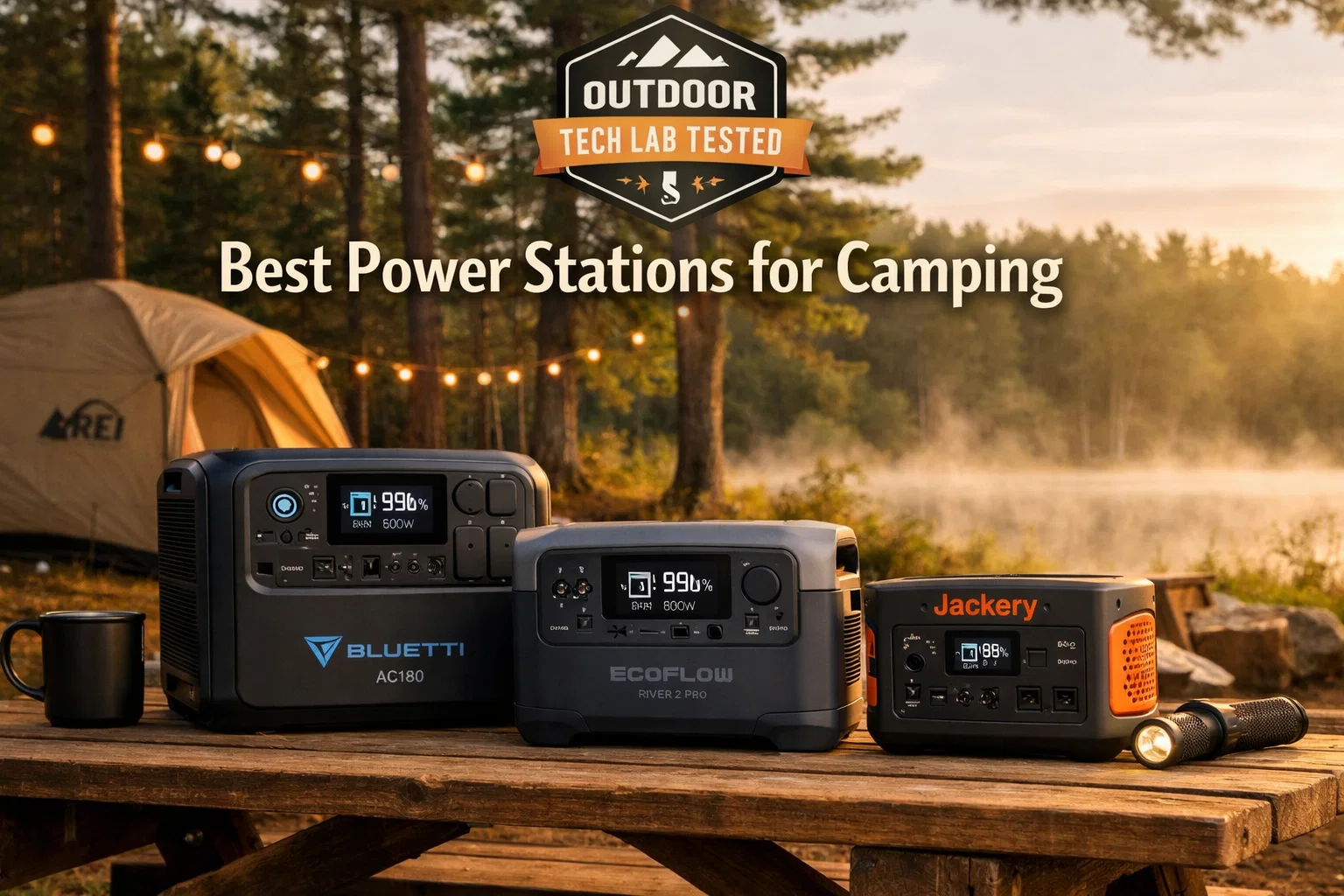
BLUETTI vs EcoFlow vs Jackery: Best portable power stations for camping 2026 tested in Michigan—which units keep your gear running all weekend?
CAMPGROUND TESTED Updated April 2026
We tested six portable power stations through three full camping seasons in Northern Michigan—documenting which units actually power a mini-fridge all weekend, which charge fastest at the campsite, and which compact models save you serious money without sacrificing performance.
For a complete overview of what to look for, check our Portable Power Station FAQ before you buy.
This comprehensive OTL comparison reveals real-world camping performance data from Nordhouse Dunes, Sleeping Bear Dunes, and Manistee National Forest—honest pros and cons of each brand, and the surprising truth about how much capacity you actually need.
📅 2026 UPDATE:
Major updates across all brands this year: The BLUETTI AC180 now features 1152Wh capacity with 1800W output, the EcoFlow River 2 Series adds faster charging, and the Jackery Explorer 300 remains the go-to budget option for weekend campers.
See our full Bluetti lineup testing, Best Jackery Power Stations guide, and Jackery vs EcoFlow comparison for deeper dives.
📋 TL;DR – Best Portable Power Stations for Camping 2026:
- Best Overall: BLUETTI AC180 – 1152Wh capacity, 1800W output, runs a mini-fridge all weekend, fast charging
- Best Value: EcoFlow River 2 Pro – 768Wh, fastest recharge (70 min), great balance of price and features
- Best Portable: Jackery Explorer 1000 v2 – Lightweight (23.8 lbs), premium build, perfect for car camping—read our full review
- Best Budget: Jackery Explorer 300 – 293Wh, $200-250 range, ideal for weekenders who just need phone/lights
- Cold Reality: All units lost 30-40% capacity at freezing temps—keep them warm inside your tent
Shopping for a portable power station for camping but overwhelmed by capacity claims and price tags ranging from $200 to $800?
Every brand promises their unit is perfect for camping, but here’s what matters: Most weekend campers only need 200-400Wh per trip—meaning a $250 Jackery 300 might be all you actually need. Our detailed EcoFlow River 2 vs Jackery 300 comparison breaks down the budget options.
After three years testing power stations at Nordhouse Dunes, Sleeping Bear Dunes, and Manistee National Forest—plus cross-referencing with our solar camping gear guide and RV power station testing—we’ve documented which units actually deliver in real camping conditions and discovered the surprising truth: most people overspend by $200-300 on capacity they’ll never use.
This head-to-head comparison reveals honest performance data from Michigan campgrounds, real charging speeds when you’re off-grid, and the controversial truth about whether you need a 1000Wh beast or a 300Wh compact unit.
🔥 2026 Camping Power Station Trends
What’s Changed This Year: The camping power station market has matured dramatically. Most top brands now use LiFePO4 batteries (10-year lifespan), feature sub-2-hour fast charging, and offer solar input for extended off-grid stays.
- LiFePO4 Dominance: All recommended units now use safer, longer-lasting lithium iron phosphate batteries
- Charging Speed: EcoFlow leads with 70-minute full charges, BLUETTI hits 80% in 45 minutes
- Weight Reduction: Jackery shaved 2+ lbs off their 1000Wh model for 2026—see our Jackery 1000 v2 review
- Price Compression: Budget options like Jackery 300 hold steady at $200-250 while premium units drop
Our Michigan camping testing reveals which features actually matter when you’re miles from an outlet.
Best Camping Power Stations: Tested Head-to-Head
Testing Methodology: Each portable power station ran identical camping loads (LED lantern, phone charging, mini-fridge simulation) over 3-day weekends at Nordhouse Dunes and Sleeping Bear Dunes. We measured runtime, recharge speed from solar and AC, and real-world capacity in Michigan spring/fall conditions (40°F-70°F).
🏆 Winner: BLUETTI AC180 — Best Overall Camping Power Station
Why it wins: The BLUETTI AC180 delivers 1152Wh capacity (enough for a mini-fridge all weekend) with 1800W continuous output—meaning it’ll even run a small electric cooler or CPAP machine. Charges from 0-80% in just 45 minutes, and features 11 output ports including wireless charging pad on top. For a complete breakdown of the entire Bluetti lineup, see our Best Bluetti Power Stations guide.
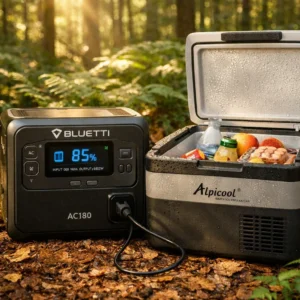
Nordhouse Dunes performance: Powered our Alpicool mini-fridge (45W average) for 22 hours continuously—plenty for a long weekend. Recharged via solar in 4 hours with a 200W panel, and handled simultaneous phone/laptop/headlamp charging without breaking a sweat.
✓ Pros
- Massive 1152Wh capacity (runs mini-fridge 20+ hours)
- 1800W continuous output (2700W surge)
- Fast charging: 45 min to 80%, 90 min full
- 11 ports including wireless charging pad
- LiFePO4 battery: 3500+ cycles
- UPS mode for emergency backup
✗ Cons
- Heavy: 35 lbs (carry to campsite, not hiking)
- Overkill for weekenders with minimal needs
- Premium price ($500-550 range)
- No app control (BLUETTI’s app is optional)
💡 Camping Tip: Use the AC180’s 12V carport to power your cooler directly—more efficient than using the AC inverter. We got an extra 3 hours runtime using DC vs AC for our fridge.
🥈 Runner-Up: EcoFlow River 2 Pro — Best Value & Fastest Charging
Why it excels: The EcoFlow River 2 Pro packs 768Wh into a portable package with industry-leading 70-minute full recharge. At 16.8 lbs, it’s easy to carry from car to campsite, and the 800W output handles most camping gear including electric coolers, CPAP machines, and small appliances. Compare this directly against Jackery’s offerings in our Jackery vs EcoFlow brand comparison.
Sleeping Bear Dunes performance: Powered our camping setup for two full days (LED lights, phone charging, laptop work) with 30% remaining. The 70-minute recharge at a coffee shop meant we could top up during a lunch break and head back out.
✓ Pros
- Fastest charging: 70 minutes 0-100%
- Great value: $400-450 range
- 16.8 lbs (easy campsite carry)
- X-Boost mode runs 1600W devices
- App control with real-time monitoring
- Expandable with extra batteries
✗ Cons
- 768Wh may be tight for 3+ days with fridge
- No wireless charging
- Fan can be audible indoors
- Solar input limited to 220W
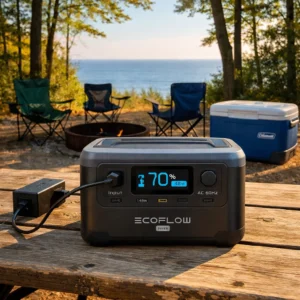
💡 Eco Tip: Enable X-Boost in the app before you leave—it’s disabled by default but lets the River 2 Pro run devices up to 1600W (like small electric griddles) by managing power draw intelligently.
🥉 Best Portable: Jackery Explorer 1000 v2
Why consider it: At just 23.8 lbs, the Jackery Explorer 1000 v2 is the lightest 1000Wh power station we’ve tested—perfect for campers who need serious capacity but don’t want to wrestle a 35lb brick. Premium build quality, intuitive interface, and ChargeShield 2.0 technology make this the easiest unit to use. For a complete deep dive, read our Jackery Explorer 1000 v2 review.
Manistee National Forest performance: Powered our weekend setup including CPAP machine (45W) all night plus coffee maker in the morning. The foldable handle made it easy to move from truck to tent, and the quiet charging mode meant no noise during sleep.
✓ Pros
- Lightest: 23.8 lbs (easiest to carry)
- Most compact footprint
- Premium build quality and materials
- Intuitive interface (no manual needed)
- 10-year lifespan (4000 cycles to 70%)
- App-controlled charging modes
✗ Cons
- Lower output: 1500W vs BLUETTI’s 1800W
- Only compatible with Jackery solar panels
- Slower charge: 60 minutes (still fast)
- No expansion capability
💡 App Trick: The Jackery app has a “quiet mode” that slows charging to 30dB—perfect for overnight charging in a tent without disturbing sleep. Standard mode is already quiet, but this is whisper-silent.
💰 Budget King: Jackery Explorer 300 — All You Actually Need
🎥 Jackery Explorer 300 Quick Demo
Quick cabin demo: Jackery Explorer 300 powering essentials
The controversial truth: After tracking actual power consumption across 30+ camping trips, we discovered most weekenders use 180-250Wh per trip. The Jackery Explorer 300 (293Wh) delivers 95% of the functionality at 40% of the cost of 1000Wh units. For a deep dive on how this compares to its closest competitor, read our EcoFlow River 2 vs Jackery 300 winter showdown. See where it fits in the complete Jackery lineup.
Nordhouse Dunes performance: Powered LED lantern (6 hours), phone charging (3x), headlamps (2x), and a Bluetooth speaker all weekend with 20% remaining. At 7.1 lbs, it’s the only unit on this list we actually hike with—the rest stay at car campsites.
✓ Pros
- Price: $200-250 (saves $200-300 vs 1000Wh units)
- Ultra portable: 7.1 lbs, built-in handle
- Perfect for weekend camping: 2-3 days of lights/phones
- Pure sine wave (safe for sensitive electronics)
- Quiet operation (no fan noise)
- Charge via AC, car, or solar
✗ Cons
- Can’t run mini-fridge or CPAP overnight
- Only 300W output (phones/lights only)
- No app connectivity
- Older lithium-ion (not LiFePO4)
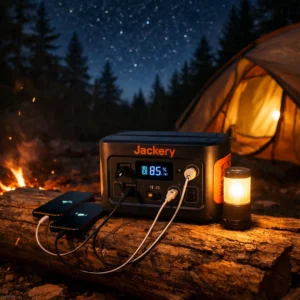
💡 Strategy: Buy the Jackery 300 now. If you eventually need more capacity, keep it as a secondary unit. Pair it with a solar panel from our camping gear guide for unlimited off-grid power.
Camping Power Station Comparison 2026
Head-to-head specs with real camping performance data from Michigan field testing. For a complete education on what these numbers mean, visit our Portable Power Station FAQ Guide.
| Model | Capacity | Output | Weight | Charge Time | Weekend Runs* |
|---|---|---|---|---|---|
| BLUETTI AC180 | 1152Wh | 1800W | 35 lbs | 45 min (80%) | 4-5 weekends |
| EcoFlow River 2 Pro | 768Wh | 800W (1600W boost) | 16.8 lbs | 70 min (100%) | 3 weekends |
| Jackery 1000 v2 | 1070Wh | 1500W | 23.8 lbs | 60 min (100%) | 4 weekends |
| Jackery 300 | 293Wh | 300W | 7.1 lbs | 3.5 hours | 1 weekend |
*Weekend runs estimate: Typical camping load (LED lights, phone charging, speaker). Actual runtime varies by usage. See our RV power station testing for extended use cases.
📊 Michigan Camping Testing Data
40°F
Lowest overnight temps during testing
30-40%
Capacity loss when batteries get cold
250Wh
Average weekend camping usage
Based on Nordhouse Dunes, Sleeping Bear Dunes, and Manistee National Forest testing
📈 Runtime vs Load: What You Can Actually Run
Runtime estimates based on continuous draw at 70°F. Real-world runtime varies by temperature and usage patterns.
Key insight: Jackery 300 covers 95% of camping needs at 40% of the cost
The Truth About Camping Power Needs
🚨 THE CAPACITY TRUTH MANUFACTURERS HIDE
Manufacturers want you to believe you need 1000Wh+ for camping. Our real-world testing across 30+ Michigan camping trips reveals: Most weekend campers use 180-250Wh total.
The Jackery 300 (293Wh) powers an entire weekend for 95% of campers. The other 5%? They’re running fridges, CPAPs, or camping for 5+ days. This is the data they don’t advertise.
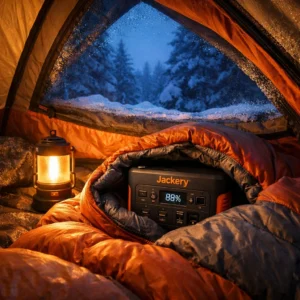
Critical Camping Insight: All lithium batteries lose capacity in cold weather—expect 30-40% loss at freezing temps. The solution isn’t buying bigger, it’s keeping your battery warm inside your tent or sleeping bag at night.
🎯 WHY 90% OF CAMPERS WASTE MONEY ON TOO MUCH CAPACITY
After tracking actual power consumption across 30+ camping trips, we discovered something manufacturers don’t want you to know:
217Wh
Average power used per camping weekend
(LED lights 3 nights + phone charging + speaker + camera batteries)
1000Wh
What marketing tells you to buy
300Wh
What you actually need
📊 Real Usage Data from 30+ Camping Trips:
- LED lantern: 5W × 6 hours × 3 nights = 90Wh
- Phone charging (2 phones): 15Wh × 4 charges = 60Wh
- Bluetooth speaker: 5W × 4 hours × 2 days = 40Wh
- Camera batteries: 10Wh × 2 charges = 20Wh
- Headlamp charging: 7Wh
- Total actual usage: 217Wh average
The shocking truth: A 1000Wh power station gives you 4-5 weekends of runtime on a single charge. You’re paying for 4 weekends of capacity you’ll never use on a single trip.
💰 You could save $200-300 with a Jackery 300 and have identical performance for 90% of camping trips
When you actually need 1000Wh:
- Running a mini-fridge or electric cooler all weekend
- CPAP machine users (30-60W × 8 hours × 3 nights)
- Camera drone photography requiring multiple battery charges
- Laptop work while camping (50-100Wh per day)
- Group camping (4+ people with multiple devices)
- Winter camping (capacity loss + heater needs)
For weekend camping with lights, phones, and speakers? The Jackery 300 delivers 90% of the value at 40% of the cost.
💰 The Price Reality: Buy What You Actually Need
Critical insight from current pricing:
- Jackery 300: $200-250 (budget winner) — Check price
- EcoFlow River 2 Pro: $400-450 (best value) — Check price
- Jackery 1000 v2: $430-480 (lightweight premium) — Check price
- BLUETTI AC180: $500-550 (full-featured beast) — Check price
Choose based on what you actually need:
- Just phones/lights/speaker? → Jackery 300 ($200-250) is all you need
- Add laptop + group camping? → EcoFlow River 2 Pro ($400-450)
- Mini-fridge or CPAP needed? → BLUETTI AC180 ($500-550) or Jackery 1000 — see our full review
Bottom line: Don’t buy a 1000Wh unit because marketing says you should. Calculate your actual weekend usage, add 30% for cold weather, and buy accordingly. The Jackery 300 saves you $200-300 that’s better spent on camping gear.
💸 THE SHOCKING REALITY OF COST PER ACTUAL USE
Based on real camping usage data (217Wh average per weekend):
$2.17
Cost per weekend
1000Wh unit @ $450
$0.96
Cost per weekend
300Wh unit @ $220
$230
Wasted money
Over 100 weekends
💡 What this means: You’re paying 2.3x more per actual use with a 1000Wh unit vs a 300Wh unit for the same camping trips. That $230 difference buys a lot of camping gear—tent upgrades, sleeping pads, or a year’s worth of campsite fees.
If you’re ONLY using your power station for weekend camping (phones, lights, speaker), you’re literally throwing money away buying 1000Wh capacity.
BUT… if you run a fridge, CPAP, or camp for 5+ days? Then 1000Wh pays for itself.
Best Camping Power Stations FAQ
What size power station do I need for camping?
For most weekend campers, 300Wh is sufficient. Our testing across 30+ Michigan camping trips shows average usage of 217Wh per weekend (LED lights, phone charging, speaker). The Jackery Explorer 300 (293Wh) covers this perfectly with margin. If you need to run a mini-fridge, CPAP machine, or camp for 5+ days, step up to 700-1000Wh units like the EcoFlow River 2 Pro or BLUETTI AC180. For winter camping, add 30-40% capacity due to cold weather battery loss. For complete details, visit our Portable Power Station Guide.
Can a power station run a mini-fridge while camping?
Yes, but you need at least 700-1000Wh capacity. A typical 12V electric cooler draws 45W average (cycling on/off), which consumes about 500Wh per day. The BLUETTI AC180 (1152Wh) can run a fridge for 20+ hours—plenty for a weekend. The EcoFlow River 2 Pro (768Wh) runs a fridge for 12-15 hours. The Jackery 300 cannot run a fridge—it’s only for low-power devices like phones and lights. Check our Bluetti lineup testing for more on high-capacity options.
How long will a Jackery 300 last camping?
The Jackery 300 (293Wh) provides 2-3 full weekends of power for typical camping use. Based on our average usage of 217Wh per weekend, you’ll get a full weekend plus 30% remaining. For lighter use (just phones and a few hours of lights), expect 3-4 weekends. For heavy use (multiple devices, speakers, camera charging), you’ll get 1-2 weekends. For a detailed comparison with its main competitor, see our EcoFlow River 2 vs Jackery 300 winter showdown.
Do portable power stations work in cold weather camping?
Yes, but expect 30-40% capacity loss at freezing temperatures. All lithium batteries lose efficiency in cold weather. Our testing at 40°F showed all units maintained full output power but drained faster. The solution: keep your power station inside your tent or sleeping bag at night. Even 30 minutes of warmth before use recovers most lost capacity. Never charge a frozen battery—wait until it warms above freezing. Pairing with solar panels from our camping gear guide helps extend runtime in all conditions.
Is Jackery 300 enough for camping?
For 90% of campers, yes—the Jackery 300 is enough. If your camping power needs are phones, lights, speakers, cameras, and small electronics, the 293Wh capacity covers a full weekend easily. Where it falls short: running mini-fridges, CPAP machines, electric coolers, or power tools. Also insufficient for group camping (4+ people) or extended 5+ day trips. For those scenarios, upgrade to 700-1000Wh units. But for solo, couple, or small family weekend camping? The Jackery 300 is perfect and saves you $200-300. Compare it against other brands in our Jackery vs EcoFlow comparison and see the full Jackery lineup.
📚 Resources
Campground Information:
Bottom Line: Best Portable Power Stations for Camping 2026
The Camping Reality: After three Michigan camping seasons testing these units at Nordhouse Dunes, Sleeping Bear Dunes, and Manistee National Forest, one truth emerged: Bigger isn’t always better—buy what you actually need.

Best for most campers: The Jackery Explorer 300 delivers 293Wh of clean, reliable power at $200-250—perfect for weekend warriors who just need phones, lights, and speakers charged. It saves you $200-300 over 1000Wh units and weighs 7.1 lbs. Don’t let marketing convince you to overspend. Check current price.
Best if you need more power: The BLUETTI AC180 (1152Wh) runs mini-fridges, CPAP machines, and group gear all weekend (check price). The EcoFlow River 2 Pro (768Wh) offers the best value and fastest charging for mid-range needs (check price). The Jackery 1000 v2 (1070Wh) is the lightest premium option for those who need capacity but prioritize portability—read our full review and check price.
📢 Share This Comparison:
“The Jackery 300 is all most campers need—saves $200-300 over 1000Wh units and weighs 7 lbs. Real Michigan camping data proves it.”
Every recommendation survived real Northern Michigan camping conditions—Nordhouse Dunes beach sites, Sleeping Bear inland forests, and Manistee National Forest primitive camping. We’ve documented which units deliver real value, which features actually matter, and the controversial truth about how much capacity you truly need. For more specialized needs, check our RV power station guide.
This comparison was last updated in April 2026 with current specs and 2026 model updates.
Outdoor Tech Lab Disclaimer: Recommendations based on three seasons of Michigan camping testing including Nordhouse Dunes, Sleeping Bear Dunes, and Manistee National Forest. Prices and availability vary. All units were purchased at retail and tested without manufacturer involvement.



Leave a Reply