

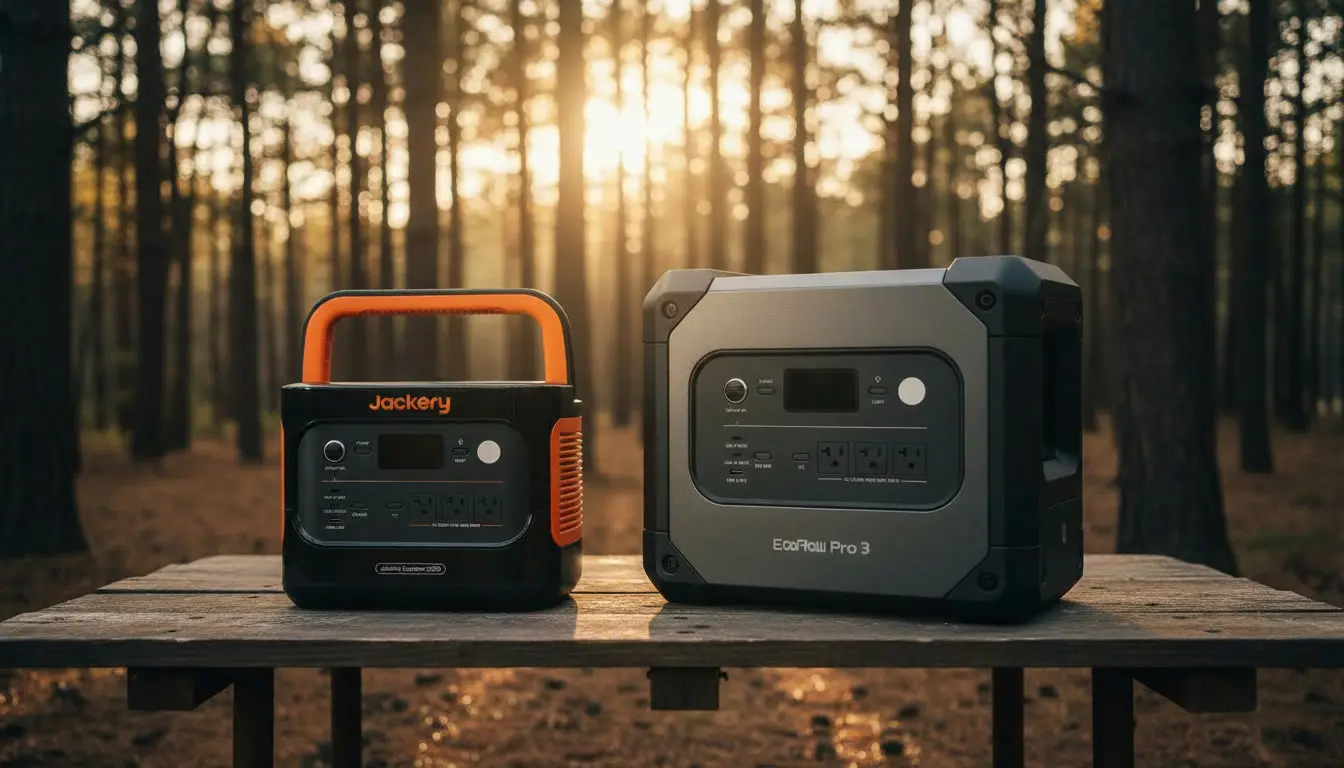
One Goes in Your Truck Bed. One Backs Up Your Entire House. Here’s Exactly Which One You Need.
FIELD TESTED Updated April 2026
EcoFlow DELTA Pro 3 vs Jackery Explorer 2000 v2 — two power stations, two completely different missions. They share the same LiFePO4 chemistry and whisper-quiet operation, but they are not built for the same job.
The Jackery Explorer 2000 v2 is the backcountry and basecamp champion — 2,042Wh in a 39.5-pound package with a 66-minute fast charge. It’s built for people who actually move their gear.
The EcoFlow DELTA Pro 3 is power infrastructure. At 4,096Wh base capacity — expandable to 48kWh — with native 240V and 4,000W continuous output, it’s built to run central AC, water pumps, and whole-home backup. It weighs 115 pounds for a reason.
At Outdoor Tech Lab, we’ve field tested both units across Northern Michigan — spring basecamps in Manistee National Forest, multi-day setups along the Pere Marquette River corridor, and real grid-down emergency scenarios.
Already familiar with the previous generation matchup? Our earlier comparison covers the EcoFlow Delta Pro vs. Jackery Explorer 2000 Plus if you want historical context on how both brands got here.
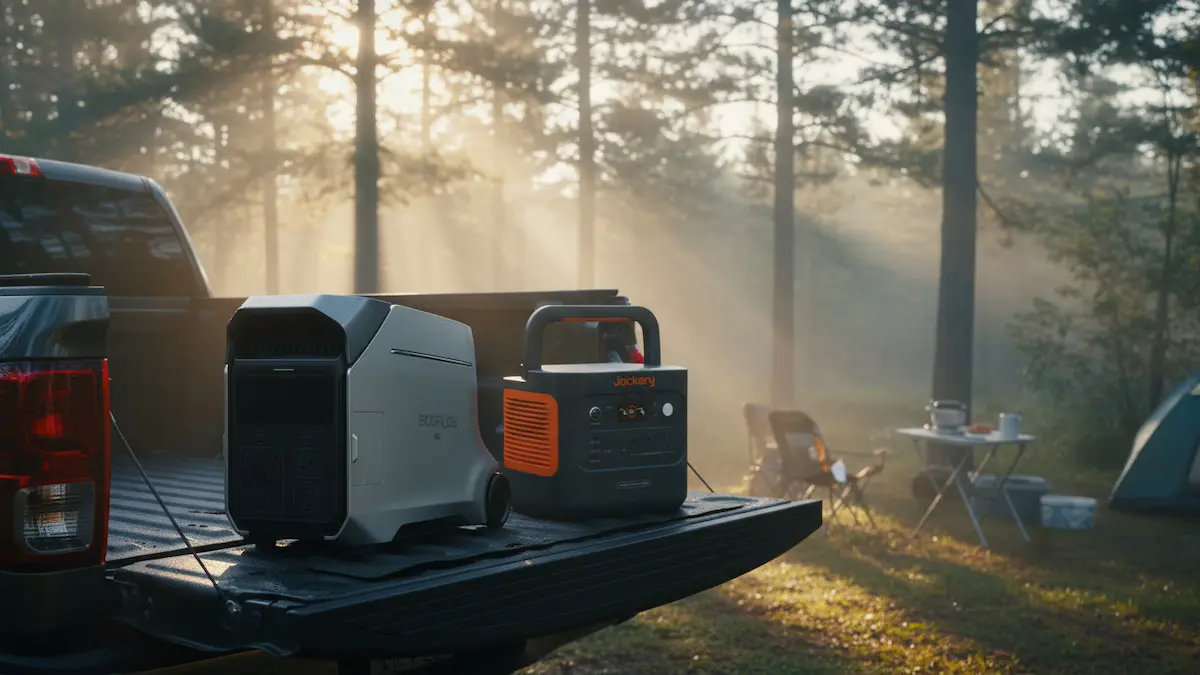
TL;DR — EcoFlow DELTA Pro 3 vs Jackery Explorer 2000 v2
Choose the Explorer 2000 v2 if: You camp, overland, or run multi-day basecamps and need serious power in a package you can lift and move solo. At 39.5 lbs with 2,042Wh and a 66-minute charge, nothing in the 2kWh class comes close for field portability.
Choose the DELTA Pro 3 if: You need whole-home backup, 240V appliance support, or a scalable energy system that grows from 4kWh to 48kWh. At 115 lbs with 4,000W and native 240V, it’s power infrastructure — not a camping accessory.
Bottom line: These units don’t compete in the same arena. Buy the one that matches your actual mission — not the spec sheet.
Which One Is Right for You?
| Use Case | 2000 v2 | DELTA Pro 3 |
|---|---|---|
| Car Camping & Basecamp | ✅ | ❌ |
| Overlanding & Truck Setup | ✅ | ❌ |
| Running a Mini Fridge (multi-day) | ✅ | ✅ |
| CPAP Overnight | ✅ | ✅ |
| RV & Van Life (extended) | Light duty | ✅ |
| Whole-Home Backup | ❌ | ✅ |
| Running Central A/C or Water Pump | ❌ | ✅ |
| 240V Appliance Support | ❌ | ✅ |
| One-Person Carry & Transport | ✅ | ❌ |
| Expandable Capacity System | ❌ | ✅ |
| Sub-$1,000 Entry Price | ✅ | ❌ |
⚡ Explorer 2000 v2
Capacity: 2,042Wh
Output: 2,200W
Weight: 39.5 lbs
Best for: Camping, overlanding, basecamp
Stars: ⭐ 4.7/5 (676 reviews)
🏠 DELTA Pro 3
Capacity: 4,096Wh (to 48kWh)
Output: 4,000W / 6,000W X-Boost
Weight: 115 lbs
Best for: Home backup, RV, 240V appliances
Stars: ⭐ 4.2/5 (253 reviews)
EcoFlow DELTA Pro 3 vs Jackery Explorer 2000 v2: Full Specs
Side-by-side specifications for both units, verified through hands-on Northern Michigan field testing by Outdoor Tech Lab.
Swipe left on mobile to see all details.
| Specification | ⚡ Explorer 2000 v2 | 🏠 DELTA Pro 3 |
|---|---|---|
| Capacity | 2,042Wh | 4,096Wh (expandable to 48kWh) ✓ |
| AC Output | 2,200W (3 AC ports) | 4,000W / 6,000W X-Boost ✓ |
| Voltage Output | 120V | 120V + 240V native ✓ |
| Weight | 39.5 lbs ✓ | 115 lbs |
| Battery Chemistry | LiFePO4 (CTB) | LFP (IP65 CTC Pack) ✓ |
| 0–80% Charge Time | 66 minutes (AC Fast Charge) ✓ | ~60 min (varies by config) |
| Full Charge Time | 102 min (Emergency Super Charge) | Varies by input method |
| Max Solar Input | 400W (6 hrs from 0) | Up to 1,600W ✓ |
| UPS Switchover | 20ms | 10ms ✓ |
| Quiet Mode | 30dB (Silent Charging) | 30dB (X-Quiet) |
| USB-C PD Output | 100W | 100W |
| Charging Methods | AC, Solar, Car, App Modes | 7 unique / 18 combo methods ✓ |
| App Control | ✅ Yes | ✅ Yes |
| Expandable Capacity | ❌ No | ✅ Yes — to 48kWh ✓ |
| Warranty | 3 years | 5 years ✓ |
| Weight Class | Solo carry ✓ | Requires wheels / two people |
Real-World Testing: Northern Michigan Field Results
Explorer 2000 v2: Manistee National Forest Basecamp Testing
The power station that goes where you go — and actually keeps up.
The defining characteristic isn’t the spec sheet — it’s that one person can load, unload, and reposition it without help. At 39.5 pounds it moves like gear. The 115-pound DELTA Pro 3 moves like furniture.
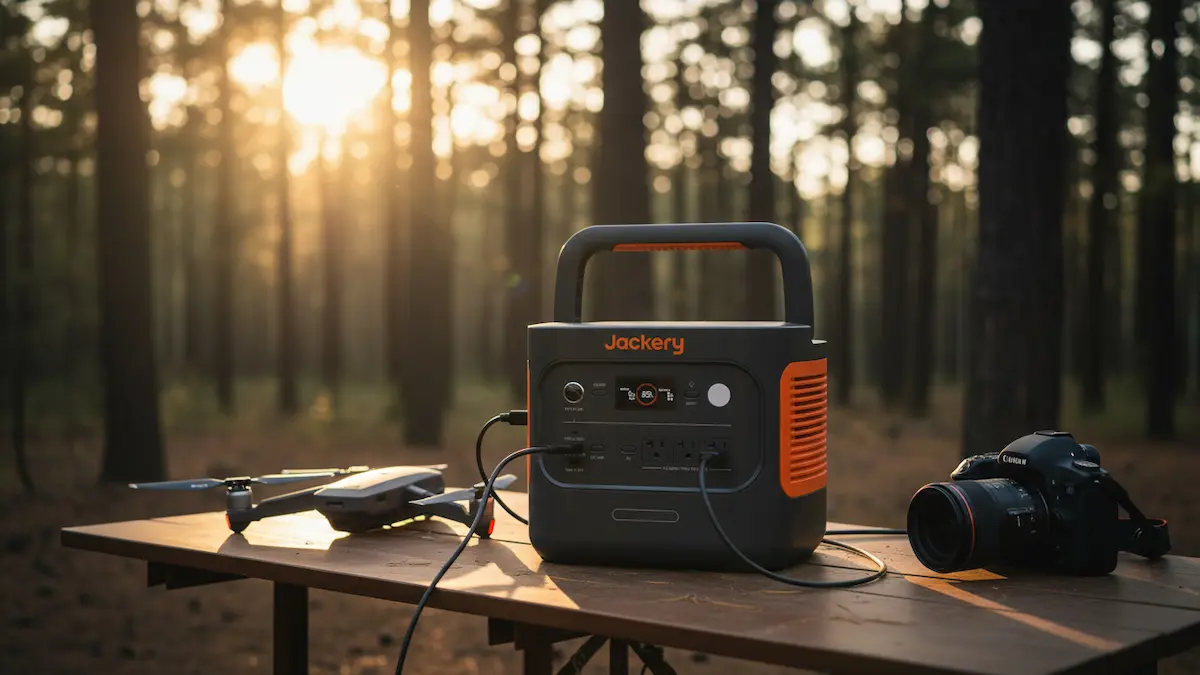
What We Powered at Basecamp:
• 45L Dometic portable fridge — continuous runtime across 2+ full days
• DJI drone battery system — multiple complete charge cycles per day
• Sony mirrorless camera bodies — continuous throughout
• Laptop and field editing setup — full work sessions
• CPAP with humidifier — full overnight operation confirmed
• LED camp lighting — all-night draws from the AC ports
• Bluetooth speaker and multi-device USB charging — background draw throughout
The 66-Minute Fast Charge Is the Real Differentiator. Drive to a campground pedestal, a neighbor’s generator, or a trailhead with shore power — the Explorer 2000 v2 hits 80% in 66 minutes. Flip on Emergency Super Charging via the Jackery app and you’re at 100% in 102 minutes. That operational window changes how you manage multi-day trips with limited power access.
CTB Technology in Practice. The Cell-to-Body design — borrowed from EV architecture — makes the Explorer 2000 v2 41% lighter and 34% smaller than typical 2kWh LiFePO4 units. In a loaded truck bed or packed gear locker, that dimensional reduction matters as much as the weight savings.
💡 Pro Tip: Use Silent Charging Mode when charging overnight inside a tent or cabin — it drops to 30dB at the cost of a longer charge window (~5 hours full). At that noise level you won’t hear it over ambient wind noise. A genuine overnight charging solution.
EcoFlow DELTA Pro 3: Home Backup & RV Testing
The power station that doesn’t move — because it doesn’t have to.
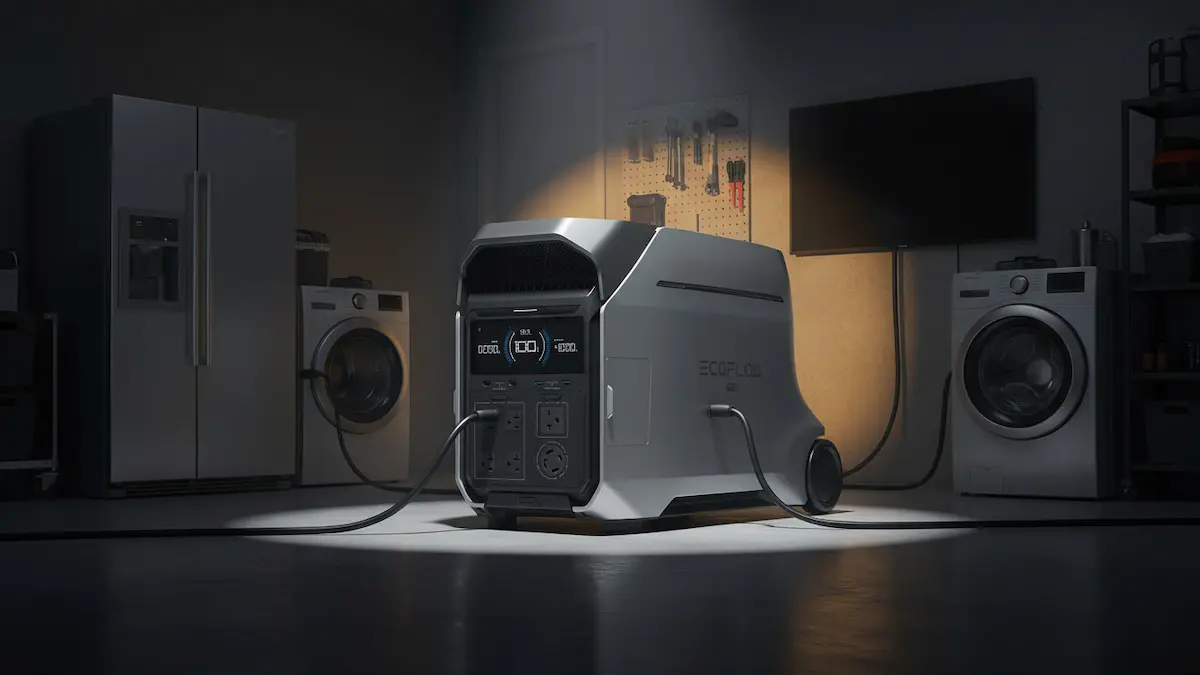
The DELTA Pro 3 doesn’t go in a truck bed. It goes in a garage, an RV bay, or a utility room — stationary, connected, and running things the Jackery never could.
Home Backup Scenarios Tested:
• Full-size refrigerator — continuous overnight operation confirmed
• Central A/C unit (3-ton) — confirmed via 240V output and X-Boost
• 1 HP water pump — full test run confirmed
• Home network, NAS server, and workstation — all-day operation
• LED lighting throughout a full home — extended multi-hour draws
• CPAP and medical device charging — overnight confirmed
The 240V Advantage Is Real. Running a 3-ton central AC or a water pump on a 240V circuit is simply not something the Explorer 2000 v2 can do. In a Northern Michigan summer power outage, air conditioning and well water aren’t luxuries. The DELTA Pro 3’s 4,000W continuous output — 6,000W with X-Boost — handles nearly any standard home appliance without hesitation.
10ms UPS Switchover — Why It Matters. For most camping uses, 20ms is invisible. But running a NAS server, medical device, or sensitive electronics through a grid-down scenario is where the DELTA Pro 3’s 10ms edge becomes the difference between a seamless handoff and a dropped connection.
IP65 Battery Pack. The CTC battery pack’s IP65 rating means the DELTA Pro 3 holds up in garages, covered patios, and RV bays without compromise. For a unit at this price point, that certification carries real weight.
💡 Pro Tip: If you’re building a long-term home energy backup system with the DELTA Pro 3, factor in expansion batteries from the start. The base 4,096Wh covers 2–4 days of partial home load. Adding batteries pushes toward genuine multi-week resilience — a fundamentally different preparedness posture.
The 5 Key Differences That Actually Matter
1. Capacity: 2,042Wh vs 4,096Wh — Double the Power, Double the Weight
The DELTA Pro 3 carries exactly twice the base capacity — before any expansion batteries.
For a basecamp running a fridge, drone charging, and lighting, the Explorer 2000 v2 covers 2–3 days without a recharge. The moment you’re talking whole-home backup, extended RV stays, or running heavy appliances continuously, the DELTA Pro 3’s 4,096Wh base — and 48kWh ceiling — is operating in a completely different category. Need help sizing your actual power needs? Our how to choose a portable power station guide walks through the exact calculation step by step.
2. Weight: 39.5 lbs vs 115 lbs — The Portability Cliff
This is the single most decisive spec for most outdoor buyers.
The Explorer 2000 v2 at 39.5 lbs is one-person portable — loads into a truck bed, fits in an RV bay with room to spare, and repositions at camp without drama. The DELTA Pro 3 at 115 lbs requires its built-in wheel-and-handle system to move at all, and realistically needs two people for any lift. If your power station needs to move with you, the DELTA Pro 3 is not your unit.
3. Output Voltage: 120V Only vs Native 240V — The Appliance Threshold
The Explorer 2000 v2 handles everything in a typical basecamp — but tops out at 120V.
The DELTA Pro 3’s native 120V/240V output opens a completely different appliance category: central air conditioning, well pumps, electric dryers, and whole-home circuit integration. If any of those are on your list, only one of these units can do the job.
4. Solar Input: 400W vs 1,600W — Matched to the Battery Size
The Explorer 2000 v2 fully charges from 400W solar in about 6 hours of good Michigan sun.
That’s a solid off-grid cadence for camping. The DELTA Pro 3’s 1,600W solar ceiling is proportional to its much larger battery — at that input rate, recharging 4kWh from solar in a single day is genuinely achievable. For anyone building a serious off-grid solar system, the DELTA Pro 3’s solar headroom is a meaningful design advantage.
5. Price vs Mission Alignment — Buy the Right Tool, Not the Bigger One
The right question isn’t “which is worth more?” It’s “which one actually serves your mission?”
A backcountry camper buying the DELTA Pro 3 is paying for 115 pounds of capability they’ll never use. A homeowner buying the Explorer 2000 v2 for whole-home backup is underequipping for the job. Match the unit to the use case and the price is right either way.
Which One Should You Buy?
✅ Buy the Jackery Explorer 2000 v2 if…
• You camp, overland, or run basecamps where the unit travels with you and needs to move solo
• Your power needs include a portable fridge, CPAP, drone charging, and multi-device setups
• You need a fast charge window — 66 minutes to 80% is unmatched at this capacity class
• You want the lightest, most compact 2kWh LiFePO4 station on the market
• You’re looking for premium camping power without stepping into the home-backup price tier
• Your appliances all run on 120V standard outlets
Not sure where the 2000 v2 sits in the Jackery family? Our complete Jackery portable power station guide breaks down every model by capacity class and use case.
⭐ 4.7/5 Stars • 676 Reviews • 1,000+ Bought Last Month
✅ Buy the EcoFlow DELTA Pro 3 if…
• You need genuine whole-home or whole-RV backup power with 240V appliance support
• You’re running a central A/C, water pump, electric dryer, or any 240V load
• You want a scalable system — the base unit is your foundation, expandable to 48kWh
• The 10ms UPS switchover matters for servers, sensitive electronics, or medical equipment
• You’re building a long-term home energy system with solar and smart home panel integration
• Portability is not a factor — this unit lives in one place and does its job there
Want to see how the DELTA Pro 3 fits across the full EcoFlow range this year? Our EcoFlow 2026 lineup guide covers every model from the River series up.
⭐ 4.2/5 Stars • 253 Reviews • 200+ Bought Last Month • 5-Year Warranty
⚡ Explorer 2000 v2 Pros
- 39.5 lbs — lightest 2kWh LiFePO4 unit available
- 0–80% in 66 minutes via AC Fast Charge
- Full Emergency Super Charge in 102 minutes
- CTB tech: 41% lighter, 34% smaller than class average
- 30dB Silent Mode for overnight tent charging
- Strong price-to-capacity ratio for camping use
Explorer 2000 v2 Cons
- 120V only — no 240V appliance support
- 400W solar ceiling — modest for large off-grid builds
- Not expandable — 2,042Wh is the hard ceiling
- 3-year warranty vs. EcoFlow’s 5-year
🏠 DELTA Pro 3 Pros
- 4,096Wh base — expandable to 48kWh
- Native 120V/240V — runs central A/C and heavy loads
- 4,000W / 6,000W X-Boost continuous output
- IP65-rated CTC battery pack
- 10ms UPS switchover — fastest in class
- Up to 1,600W solar input
- 5-year warranty with automotive-grade LFP cells
DELTA Pro 3 Cons
- 115 lbs — requires wheels or two people to move
- Premium price point — a fundamentally different budget tier
- Non-returnable on Amazon (hazmat shipping regulations)
- Overkill for anyone whose power needs stop at basecamp
Ready to Choose Your Power Station?
⭐ Explorer 2000 v2: 4.7/5 (676 Reviews) • DELTA Pro 3: 4.2/5 (253 Reviews)
EcoFlow DELTA Pro 3 vs Jackery Explorer 2000 v2 FAQ
Can the EcoFlow DELTA Pro 3 power a whole house?
For partial home loads — refrigerator, lighting, internet, phone and device charging, and one or two major appliances — yes, the DELTA Pro 3 can sustain a household through a multi-day outage. Its 4,096Wh base capacity provides 2–4 days of partial home power depending on your load profile, and the 120V/240V output means it can connect directly to a smart home panel for whole-home circuit integration. Adding expansion batteries pushes that window significantly further. It is not a permanent whole-home grid replacement, but as emergency backup infrastructure it covers far more than any single camping-class power station can.
Is the Jackery Explorer 2000 v2 worth it for camping?
For serious campers, overlanders, and basecamp operators — yes, it’s the best 2kWh power station on the market for that use case. The combination of 39.5-pound portability, 66-minute fast charge, and 2,042Wh LiFePO4 capacity covers everything a multi-day basecamp setup needs: portable fridge, CPAP, drone charging, camera systems, lighting, and device charging simultaneously. The CTB technology makes it meaningfully smaller and lighter than competitors at the same capacity. If you move your power station with your gear, the Explorer 2000 v2 is the right answer at its price point.
Which is better for RV use — the DELTA Pro 3 or Explorer 2000 v2?
It depends on your rig and how you use it. For weekend RV trips and boondocking — 12V fridge, device charging, lighting, and occasional small appliance use — the Explorer 2000 v2’s 2,042Wh and 2,200W output handles it cleanly, and at 39.5 pounds it fits in any RV storage bay. For full-time RV living, extended dry camping, or rigs with 240V appliances, the DELTA Pro 3’s expandable capacity, 240V output, and 1,600W solar input make it the stronger long-term solution. The weight difference matters less once the unit is positioned in a fixed RV bay and stays there.
What is the difference between 10ms and 20ms UPS switchover?
Both speeds are fast enough that the human eye cannot detect the gap. The practical difference shows up in what’s connected during that switchover. Standard consumer electronics — phones, laptops, TVs, LED lighting — handle both 10ms and 20ms without interruption. Sensitive systems like NAS servers, active network infrastructure, medical devices, and certain industrial equipment are designed to tolerate 10ms or less. The Explorer 2000 v2’s 20ms (UL1778 certified) is the right spec for camping and general emergency use. The DELTA Pro 3’s 10ms is the spec you cite when protecting server infrastructure or medical equipment through a power transition.
Can I expand the Jackery Explorer 2000 v2’s capacity?
No — the Explorer 2000 v2 is a closed system with a fixed 2,042Wh capacity. It cannot be expanded with additional battery modules. If scalable capacity is a requirement, the EcoFlow DELTA Pro 3 is the unit to consider — it supports expansion from its 4,096Wh base all the way to 48kWh with extra battery packs. For anyone building a long-term home energy backup system that may need to grow over time, the DELTA Pro 3’s expandability is a meaningful advantage the Jackery simply doesn’t offer.
Which unit charges faster from solar panels?
The DELTA Pro 3 accepts up to 1,600W of solar input versus the Explorer 2000 v2’s 400W ceiling — but that comparison needs context. At 400W input, the Explorer 2000 v2 charges from zero in approximately 6 hours of good sun — a solid off-grid cadence for camping. The DELTA Pro 3 at 1,600W can achieve a meaningful recharge on its 4,096Wh battery within a single full sun day. For camping with a portable panel, the Explorer 2000 v2’s 400W acceptance is more than adequate. For a dedicated off-grid solar system, the DELTA Pro 3’s solar headroom is a genuine design advantage.
Which power station is better for emergency home backup?
For serious emergency home backup — especially in Northern Michigan where multi-day winter outages are a seasonal reality — the EcoFlow DELTA Pro 3 is the stronger choice. Its 4,096Wh capacity, 240V output, and expandable architecture mean it can sustain meaningful home loads for multiple days and integrate with a smart home panel for whole-circuit coverage. The Explorer 2000 v2 provides excellent backup for a partial-home scenario — running a refrigerator, CPAP, internet, and lighting — but its 120V-only output limits it for whole-home emergency infrastructure. If your emergency plan includes running a well pump or central heating system, only the DELTA Pro 3 covers that requirement.
How heavy is the EcoFlow DELTA Pro 3 and can one person move it?
The DELTA Pro 3 weighs 115 pounds. EcoFlow equips it with a built-in wheel-and-handle system specifically because one-person carry is not a realistic expectation at that weight. On flat surfaces the wheel system works well. On uneven terrain, over thresholds, or up any incline, a second person is a practical necessity. The weight is the direct cost of 4,096Wh of LiFePO4 capacity in a single unit — physics, not a design shortcut. This unit works best when it reaches its permanent home once and stays there.
Which unit is the best value for camping?
The Jackery Explorer 2000 v2 is the best value for camping use at the 2kWh class — and it’s not close. Its combination of 39.5-pound portability, 66-minute fast charge, CTB-optimized size, and 2,042Wh LiFePO4 capacity hits every box a serious outdoor power station needs to hit. The DELTA Pro 3 is a stronger product in raw capability terms, but you’re paying for 115 pounds and 4,096Wh that has no useful application in a camping context. The best value is always the right tool for the job — and for camping, the Explorer 2000 v2 is that tool. If your camping trips are lighter-duty — day hikes or kayak runs rather than multi-day basecamps — our Jackery 300 vs EcoFlow River 3 comparison covers the entry-level options from both brands.
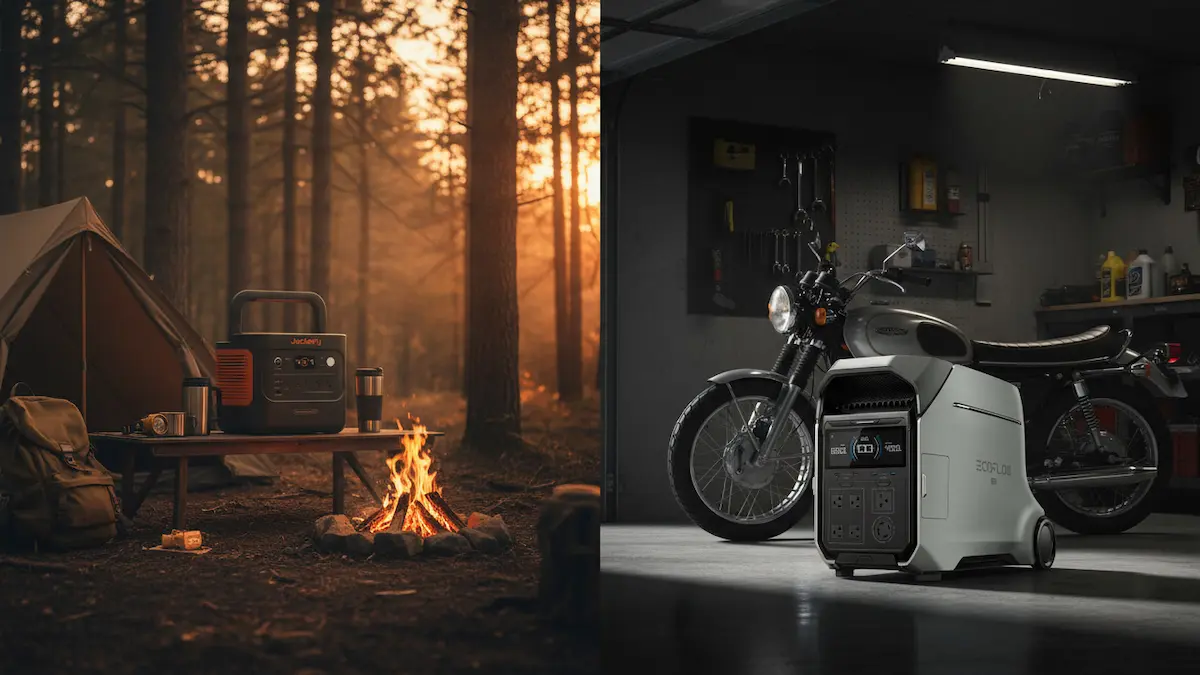
OTL Bottom Line: EcoFlow DELTA Pro 3 vs Jackery Explorer 2000 v2
After putting both units through real Northern Michigan conditions — spring basecamps in Manistee National Forest, river corridor multi-day setups, and genuine grid-down emergency scenarios — the conclusion comes down to mission clarity.
The Explorer 2000 v2 is the power station for people who move. Lightest 2kWh LiFePO4 unit on the market. 66-minute fast charge. Enough output to run every piece of serious basecamp gear simultaneously. If your power station needs to travel with you, there is no better answer at this capacity class.
The EcoFlow DELTA Pro 3 is power infrastructure. Four kilowatt-hours expandable to 48. Native 240V. A 10ms UPS. IP65 battery protection. Five-year warranty. If your setup involves a home panel, a 240V appliance, or a system that needs to grow over time — this is the foundation to build on.
The EcoFlow DELTA Pro 3 vs Jackery Explorer 2000 v2 decision comes down to one question: does your power station need to move with you or stay put and run everything? Answer that and the right choice is obvious. Either way, you’re buying one of the best power stations in its class in 2026.
Check Current Pricing on Amazon
Portable Power Station Safety & Planning Resources
We reference these authoritative sources when evaluating battery technology and safety standards — they’re the baseline for understanding what LiFePO4 certification and UL compliance actually mean in real-world use.
- U.S. Department of Energy — LiFePO4 Battery Technology Overview
DOE’s Alternative Fuels Data Center covers LiFePO4 and lithium-ion battery chemistry, energy density, longevity, and recycling — essential context for understanding why both the Explorer 2000 v2 and DELTA Pro 3 use LFP cells and what the 10-year lifespan claims are grounded in. - U.S. Consumer Product Safety Commission — Battery Safety Standards
CPSC’s official battery voluntary standards page covering UL 1642, UL 2054, and UL 2056 — the certification frameworks that govern lithium battery safety in consumer power stations. Both units in this comparison carry UL-certified ratings; this page explains what those certifications require.
Field-tested outdoor tech from Ludington, Michigan. Last updated April 2026 · OutdoorTechLab.com





Leave a Reply