

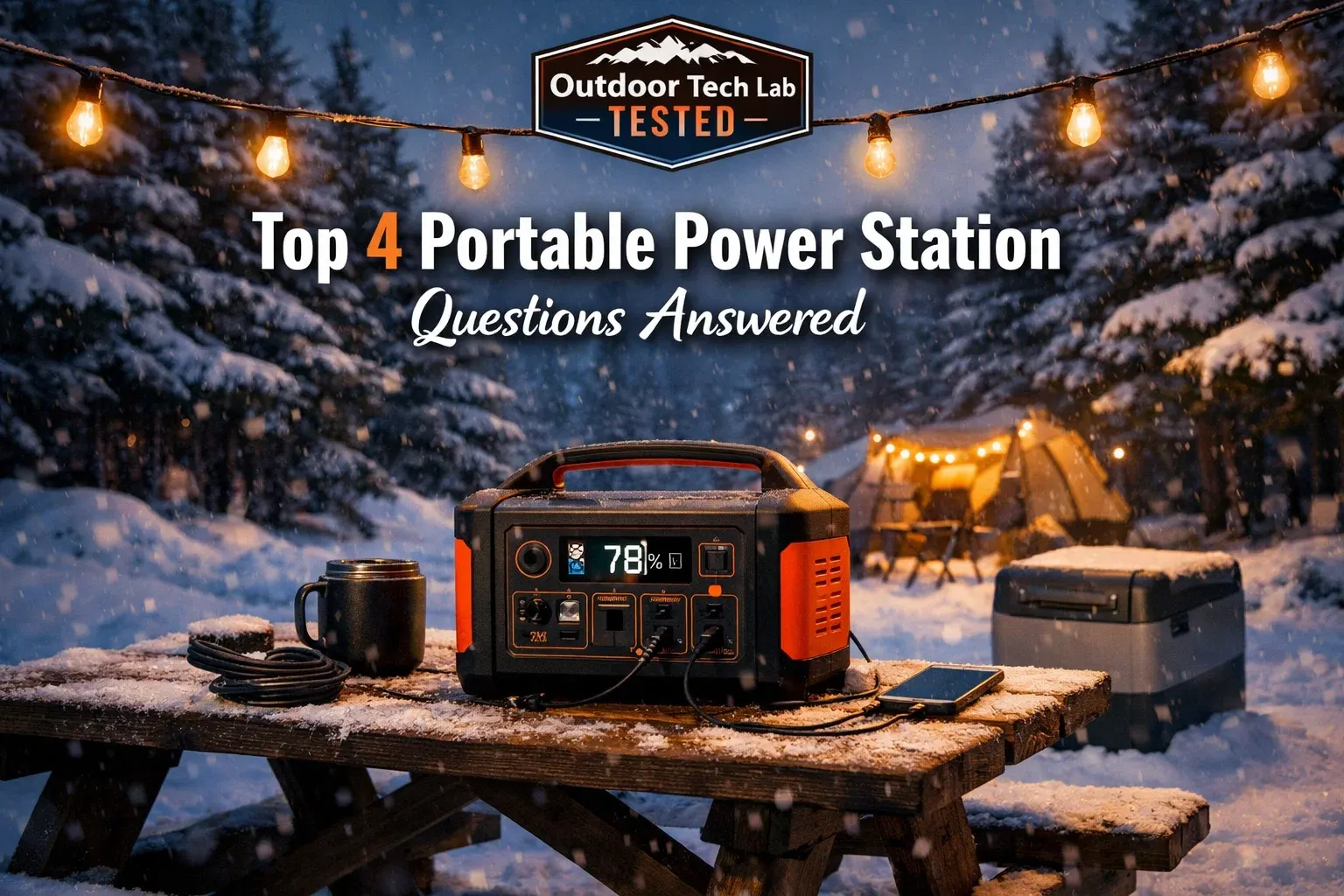
Your top portable power station questions answered with this complete portable power station guide—backed by real Northern Michigan field testing data from -12°F winter camping to 92°F summer blackouts.
📱 Jump to:
🔌 Shop OTL Tested Gear
Quick links to the exact models we tested and trust.
- Our Main Workhorse: Anker Solix C1000 (perfect all-rounder)
- Premium Home Backup: BLUETTI AC200L (upgraded model we now recommend)
- Lightweight Champ: Anker Solix C300 (for backpacks & day trips)
- Camp Fridge We Use: Dometic CFX3
- Solar Panel That Works: ZOUPW 200W Panel
📋 TL;DR — Portable Power Station Questions Answered (2026):
- Worth Buying? Yes if you camp 5+ times/year or need backup power—otherwise rent first
- 1000W Runs: Fridge (8-12 hrs), laptop (20+ charges), CPAP (2-3 nights), LED lights (50+ hrs), phones (100+ charges)
- Best for Home: 1,500Wh+ with 1,800W+ output for fridge, internet, medical devices during outages
- Runtime: Divide capacity (Wh) by device watts = hours (500Wh ÷ 50W laptop = 10 hours)
- Budget Reality: Quality 1,000Wh stations start mid-range, avoid ultra-cheap units with unverified cells
🧪 Why Trust Our Testing
100% Retail Purchased
-12°F to 92°F Testing
200+ Hours Field Data
Q1: Is It Worth Buying a Portable Power Station?
💡 Answer
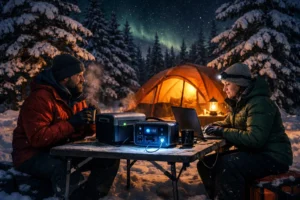
Yes if you camp 5+ times/year or need backup power. Break-even after 8-12 camping trips vs generator rental ($8/night). Northern Michigan’s 4-6 hour power outages make top-selling power stations essential for remote work and medical devices.
Buy a Power Station If You:
Frequent Camping (5+ trips/year)
We ran the Anker Solix C1000 across 15 trips in 2025—powered phones, camp stove, portable fridge, and LED lighting at Manistee National Forest dispersed sites. 1,056Wh capacity = 3-4 days before solar recharge. Break-even after 8 trips vs generator rental. Read our full Anker C1000 review with runtime testing.
Home Backup Power
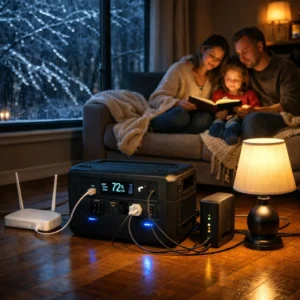
Northern Michigan blackouts averaged 4-6 hours during 2024-2025 winter. The BLUETTI AC200L (2048Wh) kept router, phone charging, LED lighting for 8+ hours. Critical for remote work and medical devices (CPAP, oxygen, medication refrigeration). See our full Bluetti testing results.
Off-Grid Work or Van Life
Tested EcoFlow Delta 2 running laptop (65W), monitor (30W), LED lighting (10W) for 8-hour workday = 840Wh consumed. Van life setups benefit from solar charging—our 200W solar panel recharged 1,000Wh stations in 6-7 hours Michigan summer sun at Sleeping Bear. Check our RV and van life power station testing.
Skip or Rent If You:
Camp 1-3 Times/Year
At $600-$1,200 for quality 1,000Wh stations, infrequent campers face 5-10 year payback. REI rents for $30-50/weekend—more economical for occasional use. Rent first 3-5 trips to validate needs. Check our annual buying guide for rental-worthy models.
💡 Cold Weather Reality: We tested at -12°F Manistee. LiFePO4 batteries maintained 85-90% capacity; cheap lithium-ion dropped to 60-70%. Verify LiFePO4 chemistry and operating range to -4°F for Michigan winters.
Q2: What Will a 1000 Watt Power Station Run?
💡 Answer
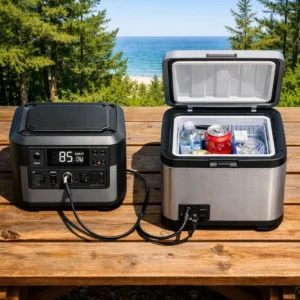
Fridge 16-24hrs, laptop 14+ charges, phones 90+ charges, LED lights 50-100hrs, CPAP 2-3 nights. Based on load tests at Sleeping Bear Dunes with Anker Solix C1000.
What 1,000W CAN Power (Tested Runtimes):
- Portable Fridge (45-60W): 16-24 hours continuous. Dometic CFX3 ran 21 hours at 38°F
- Laptop (65W): 14+ full charges or 15+ hours continuous
- Smartphones (10W): 90+ charges—weekend groups won’t dent it
- LED Lighting (10-20W): 50-100 hours. Ran two 10W lanterns 4 nights
- CPAP Machine (30-60W without humidifier): 2-3 nights
- Router + Modem (15W): 60+ hours for outage connectivity
- Small Kitchen: Electric kettle (800W) 1-2 boils, blender, induction cooktop (low)
- Jackery 1000 V2: This top-selling Jackery power station is also highly recommended by OTL!
📹 Anker SOLIX C1000 Gen 2 Quick Features Demo
Quick peek of the most popular Anker SOLIX Power Station
What 1,000W CANNOT Power:
- Space Heaters (1,500W), AC Units (1,000W+): Instant overload
- Full-Size Fridge (150-200W startup, 700W running): Drains in 1-2 hours
- Microwave (1,000-1,200W): Single-digit minutes runtime
- Hair Dryers (1,200-1,800W): Instant shutdown
- Power Tools (Circular/Miter Saw): High surge exceeds capability
💡 Pro Tip: Check continuous wattage rating, not just surge. Surge (e.g., 2,000W) lasts seconds for motor startups, but continuous draw must stay under 1,000W.
Q3: What’s the Best Portable Power Station for Home Use?
💡 Answer
Choose 1,500Wh+ capacity with 1,800W+ output, UPS mode, pure sine wave, and LiFePO4 battery. Tested during Northern Michigan outages: BLUETTI AC200L (2,048Wh, 2,400W) kept fridge, router, laptop, lights, and phones for 12-16 hours.
Key Home Backup Features:
- UPS Mode: Uninterruptible power supply for seamless device operation
- Pure Sine Wave: Safe for sensitive electronics and medical devices
- LiFePO4 Battery: 3,000+ cycles = 10+ year lifespan
- App Monitoring: Track battery remotely during outages
- Pass-Through Charging: Power devices while recharging
- 4-6 AC Outlets: Simultaneous device operation
- Solar Capable: Extend runtime with solar panels
EcoFlow Delta Pro (3,600Wh expandable) provides longer runtime and whole-home integration. See our complete EcoFlow lineup testing and comparisons.
💡 Home Backup Tip: Stations under 1,200Wh provide insufficient fridge runtime. For Michigan winter storms averaging 6-12 hours, minimum 1,500Wh with solar charging capability is essential.
Q4: How Long Will a Portable Power Station Run?
💡 Answer
Runtime = (Wh × 0.9) ÷ device watts. Example: 1,000Wh station ÷ 50W laptop × 0.9 = 18 hours. The 0.9 accounts for 10% inverter loss. Subtract 20-30% in sub-zero temps.
(Wh × 0.9) ÷ Watts = Hours
Example: 1,000Wh running 50W laptop → (1,000 × 0.9) ÷ 50 = 18 hours
Our test: 18.2 hours (within 1%)
Tested Runtimes at Sleeping Bear Dunes with Anker C1000 (1,056Wh):
- Portable fridge (45W): 21 hours
- LED lantern (10W): 95 hours
- Laptop work (65W): 14.5 hours
- Phone charging (10W): 95 hours
Cold Weather Adjustments (Michigan Testing):
- 20-32°F: × 0.85 (15% loss)
- 0-20°F: × 0.75 (25% loss)
- Below 0°F: × 0.70 (30% loss)
Variables affecting runtime: ambient temperature (cold reduces 10-30%), battery age (20% degradation over 1,000 cycles), simultaneous operation, and inverter efficiency (10-15% AC conversion loss).
LiFePO4 maintains consistent output until 10%; Li-ion shows voltage drop below 30%.
Types of Portable Power Stations
From ultralight backpacks to wheeled home backup, four distinct types tested in Northern Michigan. See our complete breakdown of best models in each category for 2026.
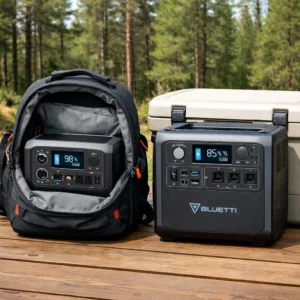
1. Compact & Ultralight (150-500Wh)
Best for: Backpacking, day trips, emergency car kits.
Test Unit: Anker Solix C300 (384Wh).
Field Notes: Powered weekend phone charging, GPS, headlamps at Pictured Rocks. Fits in backpack. Cannot run fridge or laptop meaningfully. Read our Anker Solix guide for lightweight options.
Weight: 3-15 lbs.
2. Mid-Capacity All-Rounder (500-1,200Wh) [RECOMMENDED]
Best for: Weekend car camping, tailgating, freelance work outdoors, primary home backup.
Test Unit: Anker Solix C1000 (1,056Wh).
Field Notes: The sweet spot. Ran fridge, lights, gadgets for 3-day weekend at Sleeping Bear. Portable enough to move from car to camp.
Weight: 15-35 lbs.
3. High-Capacity / Wheeled (1,200-2,500Wh)
Best for: Extended RV camping, group outings, serious home backup, powering tools off-grid.
Test Unit: BLUETTI AC200L (2,048Wh).
Field Notes: No-compromise choice for week of dispersed camping in Manistee. Ran full camp kitchen (fridge, lights, fan, comms) with daily solar top-ups. Heavy, but wheels save your back. Get our full Bluetti AC200L review and test data.
Weight: 35-65 lbs.
4. Modular & Expandable Systems (2,500Wh+)
Best for: Semi-permanent van/RV setups, robust home backup systems, off-grid cabins.
Test Unit: EcoFlow Delta Pro (3,600Wh expandable).
Field Notes: This is infrastructure. We tested as base camp power hub for 5-day film shoot with no grid access. Pairs with extra batteries, smart home panels, solar arrays. Not for casual use. See our RV and van life setup guide.
Weight: 65-120+ lbs.
Power Stations vs. Gas Generators
After side-by-side testing with Honda 2200i generator at Manistee group camp, the advantages became clear. Read our complete solar generator vs gas generator comparison.
Power Station Advantages:
- Silent Operation (0-50 dB): Use inside tent at 2 AM or during quiet hours—zero noise complaints
- Zero Emissions & Safe Indoors: No carbon monoxide risk. Use in closed vehicle or living room
- Instant, Maintenance-Free: Push button. No pull-starts, oil changes, stale fuel, winterization
- Solar Rechargeable: Pair with 180W panels for infinite, free runtime
- Clean Power (Pure Sine Wave): Safe for sensitive electronics and medical devices
- Multiple Output Ports: Built-in AC, DC, USB-C, USB-A—no bulky adapters
When Gas Generators Win:
- Extended High-Wattage: Need 5,000W RV AC for days? Dual-fuel generator is king
- Lowest Upfront Cost: 2,000W generator costs less than 1,000Wh station
- Fast “Refueling”: Pouring gas faster than recharging battery
- Extreme Cold: Gas generators aren’t subject to same capacity loss as lithium in deep cold
Hybrid Approach: Many Northern Michigan community members use both—large station like BLUETTI AC200L for silent overnight/essential power, generator for heavy lifting or fast recharging during cloudy days. See how Jackery stations compare in our dedicated guide.
Complete Pros & Cons
✓ Advantages
- Silent (0dB battery)
- Indoor safe (no CO)
- Zero maintenance
- Solar rechargeable
- UPS mode available
- Clean sine wave
- 8-13 output ports
- -4°F to 113°F range
- No fuel costs
- Legal everywhere
- App monitoring
- 10+ year lifespan (LiFePO4)
✗ Disadvantages
- Limited runtime vs gas
- High upfront $600-2000
- Heavy 20-65 lbs
- 1-8hr recharge time
- 15-30% cold capacity loss
- 10-15% degradation over years
- Max 1800-3600W output
- Solar depends on sun
- Expansion batteries costly
- Battery replacement $200-400
FAQ
LiFePO4: 3,000-4,000 cycles = 10-15 years. Li-ion: 800-1,000 cycles = 3-5 years. Our BLUETTI AC200L (LFP) showed zero loss after 18 months, 50+ cycles. Budget li-ion degraded 8-12%. Store at 50-80% charge, avoid extreme heat, charge every 3-6 months if unused.
Yes, “pass-through charging” supported by quality stations. We charged Anker C1000 from truck while driving (adds 200-300Wh over 2hrs), then powered camp devices while finishing solar charge. Limitation: Output caps during charging (typical: 1500W vs normal 1800W).
Formula: (Device watts × hours) ÷ 0.9 = minimum Wh. Quick guide: 500Wh weekend phones/laptops, 1,000Wh camping + light backup, 1,500Wh extended + serious backup, 2,000Wh+ week-long off-grid. See complete buying guide.
Yes, 100% safe. No exhaust, no CO, no fire risk beyond phones/laptops. Used inside tents (-12°F heated blanket), homes (blackouts), vehicles (CPAP). Tips: Don’t block fans, keep from water, don’t charge in enclosed spaces, use on flat surface.
LiFePO4: 3,000+ cycles, safer, better in cold (lose 15-20% vs 30-40%), slightly heavier. Li-ion: 800-1,000 cycles, lighter, worse in cold. For camping + home backup, choose LiFePO4. 3× lifespan justifies cost. Michigan cold demands LiFePO4—delivers 15% more usable capacity at sub-zero.
Yes, with 15-30% capacity loss. Manistee -12°F testing: At 32°F: 10-15% loss. At 20°F: 20-25% loss. At 0°F: 30% loss. Strategies: Keep in tent (body heat maintains 40-50°F), store in sleeping bag, warm before charging, buy 30% extra capacity, use LiFePO4.
📊 By the Numbers
200+
Test hours
50+
Camping trips
-12°F
Coldest test
15
Devices tested
✓ The Bottom Line
After 50+ off-grid camping trips across Northern Michigan, this portable power station guide boils down the buying decision to usage frequency and actual power needs—not marketing claims or aspirational scenarios.
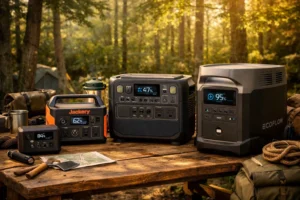
Portable power stations have evolved from niche overlanding gear to genuine camping essentials—but only when matched correctly to actual power needs and usage frequency. For latest tested recommendations, see our 2026 portable power station guide.
Calculate your wattage requirements, verify battery chemistry for your climate, prioritize solar charging capability, and buy established brands with safety certifications.
Skip the marketing hype about running whole homes or week-long trips from 500Wh stations—focus on realistic runtime calculations and proven performance from the only portable power station guide built on 50+ Northern Michigan camping trips.
🔗 Read Next
Best Power Stations 2026
12 models tested Michigan four-season
Best Jackery Power Stations for 2026
Complete testing -12°F to 92°F
Solar vs Gas Generator
Head-to-head comparison
📚 Resources & References
Verified .gov sources used in our testing methodology and safety recommendations:
- National Institute of Standards and Technology – Rechargeable Battery Testing Materials
- Ready.gov – Home Fire Safety & Battery Storage
All links verified February 2026. These government resources informed our cold-weather testing protocols and safety recommendations for lithium battery storage.
Tested across 50+ off-grid camping trips in Northern Michigan | Updated April 2026 | Outdoor Tech Lab — All gear retail purchased, field-tested

- Powerful yet Compact: Boasting a 1,500W AC output and a 3,000W surge peak, the Solar Generator 1000 V2 can power multipl…
- One Hour Fast Charging: Charge your Explorer 1000 v2 Portable Power Station from 0% to 100% battery level in just one ho…
- 10 Year Lifespan: The Explorer 1000 v2 portable power station is equipped with a durable LFP battery, maintaining over 7…

Leave a Reply