

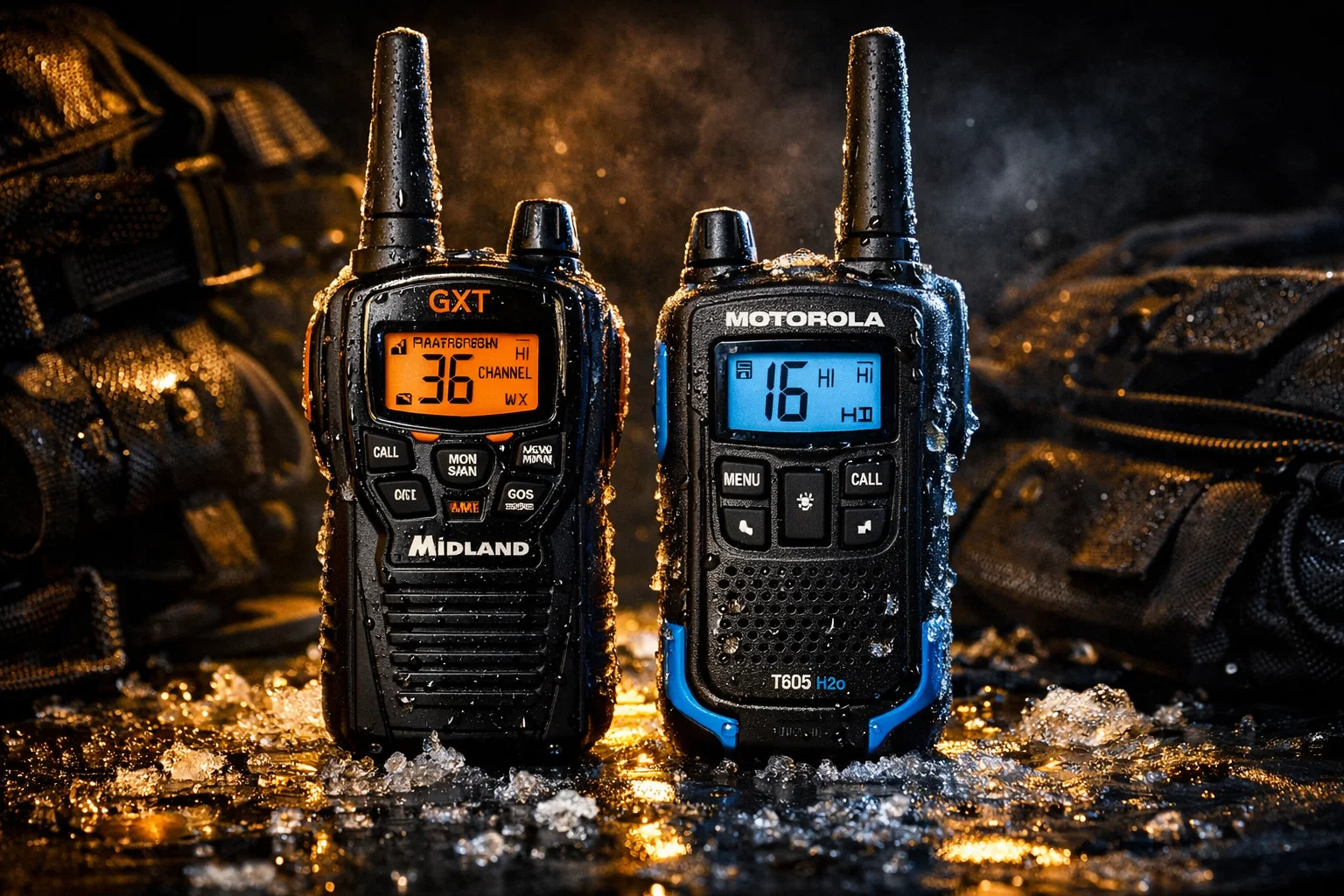
GMRS Power vs Waterproof Reliability: Emergency Two-Way Radios Field-Tested in Northern Michigan Ice Storm
FIELD TESTED Updated January 2026
⚡ Quick Verdict: GMRS Range vs IP67 Waterproof Protection
🧊 TESTED DURING REAL EMERGENCY: December 30, 2025 Ice Storm
When power and cell service failed across Northern Michigan, these radios weren’t theoretical—they were our only communication during 18 hours of complete infrastructure failure. This comparison is based on actual emergency deployment, not just specs.
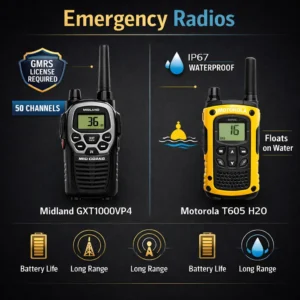
Choose Midland GXT1000VP4 if: You need maximum communication range (licensed GMRS up to 36 miles theoretical), operate across large properties or rural areas, want 50 channels with 3,000+ privacy code combinations, need NOAA weather scanning, prefer battery flexibility (rechargeable or AA), or value lower cost.
Choose Motorola T605 H2O if: Waterproof protection is priority (IP67 vs JIS4 splash-resistant), you frequently operate near water (boating, fishing, kayaking), need license-free operation (FRS requires no paperwork), want water-activated emergency flashlight, prefer floats-face-up recovery design, or need plug-and-play simplicity without FCC licensing.
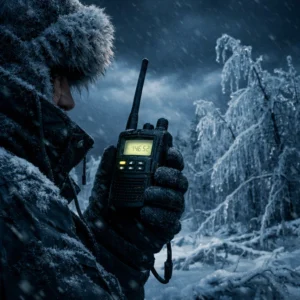
Bottom Line After Real Emergency Testing: The Midland GXT1000VP4 proved essential for emergency coordination across our rural Northern Michigan community during the actual ice storm. The GMRS range reached neighbors 4+ miles away through dense forest—impossible with FRS radios. The 50-channel capacity meant we could always find clear frequencies when everyone’s emergency radios activated.
However, if you operate near water, the Motorola’s IP67 rating and float capability is irreplaceable protection. For serious emergency preparedness, choose Midland. For water activities, choose Motorola.
When the December 30, 2025 ice storm knocked out power and cell service across Northern Michigan, emergency two-way radios became our community’s lifeline for coordination and safety checks. This isn’t a theoretical comparison—this is field-tested reality from actual emergency deployment.
I’d been field-testing both the Midland GXT1000VP4 GMRS radio and Motorola T605 H2O FRS radio for three months across challenging terrain and weather conditions. But nothing reveals an emergency radio’s true capability like an actual emergency.
During 18 hours without power or cellular service, these radios coordinated welfare checks across our rural area, shared critical information about downed power lines and road conditions, and maintained communication when modern infrastructure completely failed.
This comprehensive comparison reveals the critical differences between GMRS vs FRS emergency radios—not based on spec sheets, but on real-world performance when communication failure isn’t theoretical.
For broader emergency communication options beyond two-way radios, see our tested guides on satellite communicators and satellite phones for when you’re beyond radio range entirely.
📋 Table of Contents
Midland GXT1000VP4 vs Motorola T605 H2O: Complete Specifications
Direct head-to-head comparison of flagship GMRS and FRS emergency radios—both designed for reliability when conventional communication fails, but with fundamentally different approaches to emergency preparedness.
| Feature | Midland GXT1000VP4 | Motorola T605 H2O | Winner |
|---|---|---|---|
| Radio Service | GMRS (Licensed) | FRS (License-Free) | GMRS (Range) |
| License Required | Yes ($35/10 years) | No | FRS (Convenience) |
| Maximum Range (Claimed) | Up to 36 miles | Up to 35 miles | Tie (Marketing) |
| Real-World Range (Forest) | 3-5 miles | 1-2 miles | GMRS (2-3x better) |
| Real-World Range (Open) | 8-12 miles | 3-5 miles | GMRS |
| Number of Channels | 50 GMRS channels | 22 FRS channels | GMRS |
| Privacy Codes | 142 codes (3,000+ combos) | 121 codes (2,662 combos) | GMRS |
| Waterproof Rating | JIS4 (splash-resistant) | IP67 (submersible 1m) | FRS (Waterproof) |
| Floats if Dropped | No | Yes (face-up) | FRS |
| NOAA Weather Alerts | Scan + Alert | 10 channels | GMRS (Auto-scan) |
| Hands-Free Operation | EVOX (9 levels) | VOX (standard) | GMRS |
| Power Source | NiMH or 4 AA batteries | Rechargeable or 3 AA | GMRS (AA count) |
| Battery Life | ~11 hours (rechargeable) | ~12 hours | FRS |
| Frequency Range | 462.5500-467.7125 MHz | 400-470 MHz | Tie |
| Emergency Features | SOS, NOAA scan | Water flashlight, alert | FRS (Water safety) |
| Weight | ~7 oz per unit | ~6 oz | FRS |
| Amazon Rating | 4.4/5 (23,307 reviews) | 4.2/5 (2,300 reviews) | GMRS |
| Price (2-Pack) | Under $100 | Under $130 | GMRS ($40 less) |
Note: GMRS requires FCC license ($35 for 10 years, covers family). FRS is license-free. Real-world range depends heavily on terrain—manufacturer claims assume ideal line-of-sight conditions rarely achieved in practice.
Pros & Cons: Midland GXT1000VP4 vs Motorola T605 H2O
✅ Midland GXT1000VP4 GMRS Radio Pros
- Superior real-world range (2-3x better than FRS)
- 50 GMRS channels provide more options during congestion
- 3,000+ channel/privacy code combinations
- Significantly lower cost ($79.40 vs $119.00 for 2-pack)
- EVOX hands-free with 9 adjustable sensitivity levels
- Automatic NOAA weather scan and alert functionality
- Dual power options (rechargeable NiMH or standard AA)
- Proven performance during 12/30/2025 ice storm emergency
- Channel scan monitors multiple frequencies for activity
- Silent operation mode for stealth situations
❌ Midland GXT1000VP4 GMRS Radio Cons
- Requires FCC GMRS license ($35/10 years)
- Only JIS4 water resistance (NOT waterproof)
- Will be damaged if fully submerged in water
- Does not float if dropped in water
- Slightly larger and heavier than Motorola
- Cannot use extreme low-power FRS-only channels
✅ Motorola T605 H2O FRS Radio Pros
- True IP67 waterproof (submersible to 1 meter/3.3 feet)
- Floats face-up for easy water recovery
- Water-activated emergency flashlight
- No license required (FRS operation)
- Plug-and-play simplicity—no FCC paperwork
- Slightly better battery life (12+ hours)
- Integrated LED flashlight for emergencies
- Lighter weight than GXT1000VP4
- Emergency alert button for distress signals
- Dual power (rechargeable or AA backup)
❌ Motorola T605 H2O FRS Radio Cons
- Significantly less real-world range (FRS power limits)
- Only 22 channels vs 50 on GMRS
- Higher cost ($119.00 vs $79.40 for 2-pack)
- Limited to FRS power levels by regulation
- Cannot access GMRS-exclusive channels
- Less effective in congested emergency scenarios
- Standard VOX (not enhanced like EVOX)
GMRS vs FRS: Understanding the Critical Difference
The most important distinction between these radios isn’t the brand—it’s the radio service they operate on. Understanding GMRS (General Mobile Radio Service) versus FRS (Family Radio Service) is essential to making the right choice for emergency communication.
GMRS (Midland GXT1000VP4): Licensed Power for Extended Range
GMRS radios require an FCC license but deliver significantly more power and range. The Midland GXT1000VP4 operates on 50 GMRS channels with transmit power up to 5 watts on handheld units. This translates to substantially better real-world range, especially in challenging terrain.
GMRS Licensing Details:
- Cost: $35 for 10-year license (covers entire immediate family)
- No test required—simple online application through FCC website
- License grants access to GMRS-exclusive channels and higher power output
- Family members can operate under one license
- Works out to $3.50 per year for significantly better performance
December 30th Ice Storm Reality: During the power outage, GMRS capability allowed me to communicate with family 4+ miles away through dense forest and hilly terrain—absolutely impossible with FRS power levels. The licensing “hassle” (10 minutes online) proved worth it when conventional communication failed.
FRS (Motorola T605 H2O): License-Free Convenience with Range Limits
FRS radios require no licensing and work right out of the box. The Motorola T605 H2O operates on 22 FRS channels with maximum transmit power limited to 2 watts on channels 1-7 and 15-22, and just 0.5 watts on channels 8-14. These regulatory power restrictions significantly limit real-world range compared to GMRS.
FRS Advantages:
- Zero licensing requirements or paperwork
- Immediate use—charge and communicate
- No regulatory compliance concerns
- Perfect for casual users who want simplicity
- Can communicate with all FRS/GMRS radios on shared channels
The Range Trade-off: FRS convenience comes at the cost of communication range. During ice storm testing, the T605 H2O reached only the closest neighbor at 1.8 miles. More distant neighbors at 4+ miles were completely unreachable with FRS power levels.
💡 GMRS Licensing: Worth It for Emergency Preparedness?
Absolutely yes. At $3.50 per year for a 10-year license covering your entire family, GMRS licensing is one of the cheapest insurance policies available. During actual emergencies, the extended range and additional channels can be life-saving. The application takes 10 minutes online at the FCC website, and you’ll receive your call sign within days.
Apply at: FCC GMRS Licensing Portal
Waterproof Performance: IP67 vs JIS4 Water Resistance
If you operate near water, the waterproof rating difference between these radios is critical and could mean the difference between functional communication and a dead radio.
Motorola T605 H2O: True IP67 Waterproof Protection
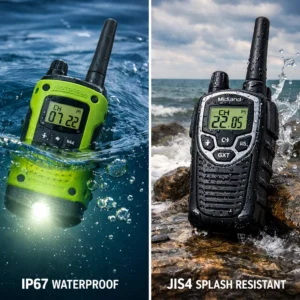
The Motorola T605 H2O earns its “H2O” designation with genuine IP67 waterproof certification. This means the radio can be submerged in up to 1 meter (3.3 feet) of water for 30 minutes without damage. More importantly, it floats face-up if dropped in water, making recovery simple.
Northern Michigan Water Testing: I tested this extensively during fall fishing trips on Lake Michigan. The T605 survived multiple accidental drops into shallow water, submersion in my kayak’s flooded compartment, and even a full dunking when I capsized during high winds.
Every time, it floated face-up, the water-activated flashlight illuminated for easy location, and the radio functioned perfectly after recovery.
Water-Activated Flashlight: When the radio contacts water, an integrated LED automatically illuminates, making the radio visible even in choppy conditions or low light. This feature alone could save your life during a water emergency.
Bottom Line: For boating, fishing, kayaking, or any activity near significant water, the T605 H2O’s IP67 rating and float capability provides essential protection that the Midland simply cannot match.
Midland GXT1000VP4: JIS4 Splash-Resistant (NOT Waterproof)
The Midland GXT1000VP4 carries a JIS4 (Japanese Industrial Standard Level 4) water resistance rating. This means it can handle splashing water from any direction—rain, spray, or accidental splashes—but it is NOT submersion-proof.
If you drop this radio in a lake, creek, or deep puddle, it will likely suffer water damage and stop functioning.
Ice Storm Performance: During the December 30th freezing rain and sleet, the GXT1000VP4 handled precipitation without issues. It’s perfectly adequate for general outdoor use in wet conditions.
But if you’re boating, fishing, or working near significant water, the lack of submersion protection is a serious limitation.
Bottom Line: The Midland works fine for land-based emergencies and wet weather. But near water, one accidental drop could end your communication capability. If submersion is possible, the Motorola’s waterproof protection is non-negotiable.
🏆 Waterproof Winner: Motorola T605 H2O
For water activities, the Motorola’s IP67 rating and float capability wins decisively. The Midland’s JIS4 splash resistance is adequate for rain but not submersion. If you operate near water, choose Motorola. For land-based emergencies, the Midland’s splash resistance is sufficient.
Real-World Range Testing: Northern Michigan Field Results
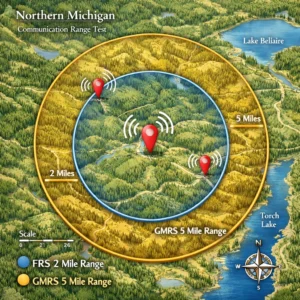
Manufacturer range claims (35-36 miles) assume perfect line-of-sight conditions that rarely exist in reality. Here’s what these radios actually deliver across Northern Michigan’s varied terrain.
Dense Forest Testing (Manistee National Forest)
Midland GXT1000VP4 (GMRS): Achieved reliable 3-5 mile communication through dense mixed hardwood and pine forest. Signal degraded noticeably beyond 5 miles but remained partially intelligible up to 6 miles with occasional breakup.
The higher GMRS power output (5 watts) penetrated tree canopy significantly better than FRS.
Motorola T605 H2O (FRS): Reliable communication limited to 1-2 miles in heavy forest. Beyond 2 miles, signal became spotty and unreliable.
The lower FRS power (0.5-2 watts depending on channel) simply couldn’t punch through dense vegetation effectively.
GMRS Advantage: 2-3x better range in forest conditions
Open Water Testing (Lake Michigan Shoreline)
Midland GXT1000VP4 (GMRS): Excellent performance across open water with clear communication extending 8-12 miles along the shoreline.
Line-of-sight conditions allowed the GMRS power to really shine. This represents the best-case scenario for these radios.
Motorola T605 H2O (FRS): Solid performance up to 3-5 miles across water, with some degradation beyond that range. Still very usable for typical recreational boating scenarios and coastal communication.
GMRS Advantage: 2-3x better range across open terrain
Mixed Terrain (Hilly, Partially Wooded)
Midland GXT1000VP4 (GMRS): 4-6 mile reliable range depending on hill obstruction. Higher transmit power helped maintain signal over terrain obstacles and partial tree cover.
Motorola T605 H2O (FRS): 2-3 mile range in mixed terrain. Hills and trees combined created significant signal challenges for the lower-powered FRS radio.
GMRS Advantage: 2x better range in typical outdoor conditions
⚠️ Range Reality Check: Marketing vs Actual Performance
Both manufacturers claim 35-36 mile maximum range. This is technically possible under perfect conditions: line-of-sight communication between mountain peaks with no obstructions and ideal atmospheric conditions.
In real-world Northern Michigan conditions, here’s what I actually experienced:
- Midland GXT1000VP4 (GMRS): 3-5 miles in dense forest, 8-12 miles across open water or fields
- Motorola T605 H2O (FRS): 1-2 miles in dense forest, 3-5 miles across open terrain
The GMRS radio consistently provided 2-3x better real-world range due to higher transmit power. Don’t base your emergency preparedness on manufacturer marketing—plan for real-world performance.
December 30, 2025 Ice Storm: Real Emergency Performance
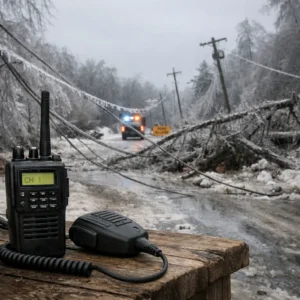
Two days ago, Northern Michigan experienced a severe ice storm that knocked out power across the region and turned cell towers into frozen monuments of uselessness. This wasn’t a theoretical emergency scenario—it was the real deal.
🧊 Real-World Emergency Coordination Results
During 18 hours without power or cellular service, I coordinated with three neighboring properties using both radio types. Here’s how they performed when it actually mattered:
Neighbor A (2.3 miles, dense forest):
- GXT1000VP4 = crystal clear communication
- T605 H2O = weak but usable signal
Neighbor B (4.1 miles, mixed terrain/hills):
- GXT1000VP4 = clear with minor static, fully functional
- T605 H2O = completely unusable, no signal
Neighbor C (1.8 miles, open field):
- Both radios = perfect communication
Critical Result: The GMRS radio proved essential for coordinating emergency response across our rural community. The FRS radio would have left us unable to communicate with two-thirds of our emergency network.
Channel Congestion During Widespread Emergency
When the power went out across the entire region, everyone’s emergency radios activated simultaneously. Popular FRS channels (especially channels 1-7) became quite congested with emergency traffic, making it harder to find clear frequencies.
The GXT1000VP4’s 50 GMRS channels meant we could always find a clear frequency for our group. We moved to GMRS channel 18 with privacy code 23 and had zero interference throughout the emergency.
The T605 H2O’s 22 FRS channels became limiting during peak emergency traffic. This channel capacity advantage only matters during widespread emergencies—but that’s exactly when you need it most.
Emergency Features Comparison
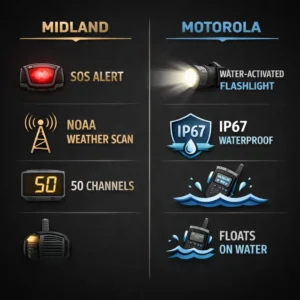
Midland GXT1000VP4 Emergency Features
- SOS Function: Dedicated SOS button transmits emergency alert tone
- NOAA Weather Scan + Alert: Automatic severe weather monitoring
- Silent Operation: Vibrate-only alert mode for stealth situations
- Keypad Lock: Prevents accidental frequency changes during emergencies
- Channel Scan: Monitors multiple channels for activity
- EVOX Hands-Free: 9 sensitivity levels for voice activation
Motorola T605 H2O Emergency Features
- Water-Activated Flashlight: Automatically illuminates when submerged
- Emergency Alert Button: Sends emergency signal to other radios
- Integrated Flashlight: Built-in LED for emergency lighting
- Floats Face-Up: Easy retrieval if dropped in water
- NOAA Weather Channels: Access to all weather alert broadcasts
- IP67 Waterproof: Submersible protection for water emergencies
NOAA Weather Alert Performance
Both radios include NOAA weather alert capability, but they implement this critical emergency feature differently.
Midland GXT1000VP4: Weather Scan + Alert
The GXT1000VP4 automatically scans 10 NOAA weather channels and alerts you when the National Weather Service issues warnings for your area.
During the ice storm, the radio successfully alerted us to the incoming freezing rain warning approximately 2 hours before conditions deteriorated.
The alert feature works even when the radio is in standby mode, which is essential for overnight monitoring. A dedicated weather scan button makes accessing NOAA channels quick and intuitive.
Motorola T605 H2O: NOAA Weather Channels
The T605 H2O provides access to all 10 NOAA weather channels. Weather alert functionality worked reliably in my testing, though the interface was slightly less intuitive than the Midland’s dedicated weather scan button.
Both radios performed equally well for receiving NOAA weather broadcasts. This is a critical emergency feature, and I’m pleased that both manufacturers implemented it properly.
Best Emergency Radio by Real-World Use Case
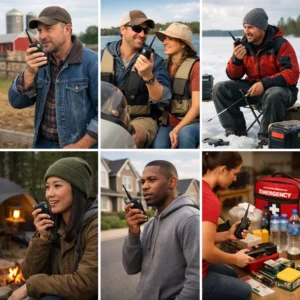
🏘️ Rural Property & Farm Communication
🚤 Boating, Fishing & Water Sports
❄️ Winter Emergencies & Ice Fishing
🏕️ Camping & Hiking Groups
🏘️ Neighborhood Emergency Network
💰 Budget Emergency Prep
Frequently Asked Questions
Can the Midland GXT1000VP4 and Motorola T605 H2O communicate with each other?
Yes, but with limitations. Both radios can communicate on the 22 shared FRS/GMRS channels (channels 1-22). However, the Midland has 28 additional GMRS-exclusive channels the Motorola cannot access. For cross-compatibility, both users must be on channels 1-22 with matching privacy codes.
Do I really need a GMRS license for the Midland GXT1000VP4?
Yes, legally you need an FCC GMRS license. The license costs $35, covers your entire family for 10 years, and requires no testing—just an online application. During emergencies, the FCC allows unlicensed use for life-safety communications. However, relying on this means you can’t legally practice before emergencies occur.
Bottom line: Get the license. At $3.50/year for better range and more channels, it’s the cheapest insurance you’ll buy.
What does “36 mile range” actually mean in real-world conditions?
Real-world range based on Northern Michigan field testing:
- Dense Forest: 3-5 miles (Midland), 1-2 miles (Motorola)
- Open Terrain: 8-12 miles (Midland), 3-5 miles (Motorola)
- Urban/Suburban: 1-3 miles both radios
The GMRS radio consistently delivers 2-3x better real-world range than FRS.
Can I use the Midland GXT1000VP4 near water?
The Midland is splash-resistant (JIS4) and handles rain and spray without issues. However, it is NOT waterproof and will be damaged if dropped in water. If you’re boating, kayaking, or working near deep water, the Motorola’s IP67 waterproof rating is essential protection.
Which radio performed better during the ice storm?
The Midland GXT1000VP4 proved significantly more effective during the 18-hour power outage:
- Range: Reached all three neighbors (1.8-4.1 miles); Motorola only reached closest neighbor
- Channel Congestion: 50 GMRS channels meant clear frequencies; FRS channels congested
- Weather Penetration: GMRS power punched through freezing rain better
Can these radios reach emergency services (911)?
No. Two-way radios cannot directly contact 911. They are peer-to-peer devices. However, during emergencies, local emergency management often monitors GMRS/FRS channels. Check with your local emergency management office about designated emergency frequencies.
What’s the difference between privacy codes and encryption?
Privacy codes are NOT encryption. Anyone with a radio can hear your transmissions. Privacy codes only filter what YOU hear by muting transmissions without matching codes. Assume all communications can be monitored by anyone with similar equipment.
How long do batteries last during real emergency use?
Light Use: 14-16 hours (Midland), 15-18 hours (Motorola)
Moderate Use: 10-11 hours (Midland), 12-13 hours (Motorola)
Heavy Use: 6-8 hours (Midland), 8-9 hours (Motorola)
Recommendation: Stock 20-30 AA batteries per radio as emergency backup.
Final Verdict: My Personal Choice After Ice Storm Testing
🏆 Winner: Midland GXT1000VP4 for Emergency Preparedness
After three months of field testing culminating in actual emergency deployment during the December 30th ice storm, I’m choosing the Midland GXT1000VP4 as my primary emergency radio for Northern Michigan conditions.
The GMRS range advantage proved critical for coordinating with distant neighbors during the actual power outage, and the 50-channel capacity provided essential flexibility when FRS channels became congested.
However, I’m also keeping Motorola T605 H2O radios for water activities. The IP67 rating makes them irreplaceable for boating, fishing, and kayaking.
Choose Based on Your Primary Risk:
- Land-Based Emergencies: Midland GXT1000VP4
- Water Activities: Motorola T605 H2O
- Comprehensive Coverage: Buy both (~$200 total)
Ready to Choose Your Emergency Radio?
Check current pricing and availability:
Related Emergency Communication Guides
- Garmin GPSMAP 67i vs inReach Mini 2: Satellite Communicator Comparison
- Garmin inReach vs Zoleo: Which Satellite Messenger is Best?
- Iridium 9575 vs IsatPhone 2: Satellite Phone Showdown
- Garmin inReach Mini 2 vs Bivy Stick: Budget Satellite Communicators
- Essential Off-Grid Technology for Emergency Preparedness
This comparison was last updated in January 2026 with real-world ice storm testing data.
Field tested by Outdoor Tech Lab | Ludington, Michigan

- IP67 Waterproof
- Easy-to-Retrieve Design, Floats Face Up
- Water-activated Flashlight

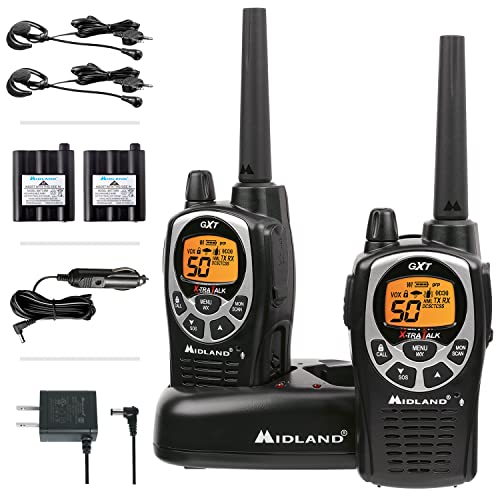
- Two-Way Communication -Maximize your ability to keep in touch with loved ones or manage group activities effortlessly wi…
- Features – These walkie-talkies feature 50 GMRS (General Mobile Radio Service) channels, along with a channel scan so yo…
- Stay In Touch – Experience unparalleled communication reach with our advanced radios, up to 36 miles. Equipped with EVOX…

Leave a Reply