

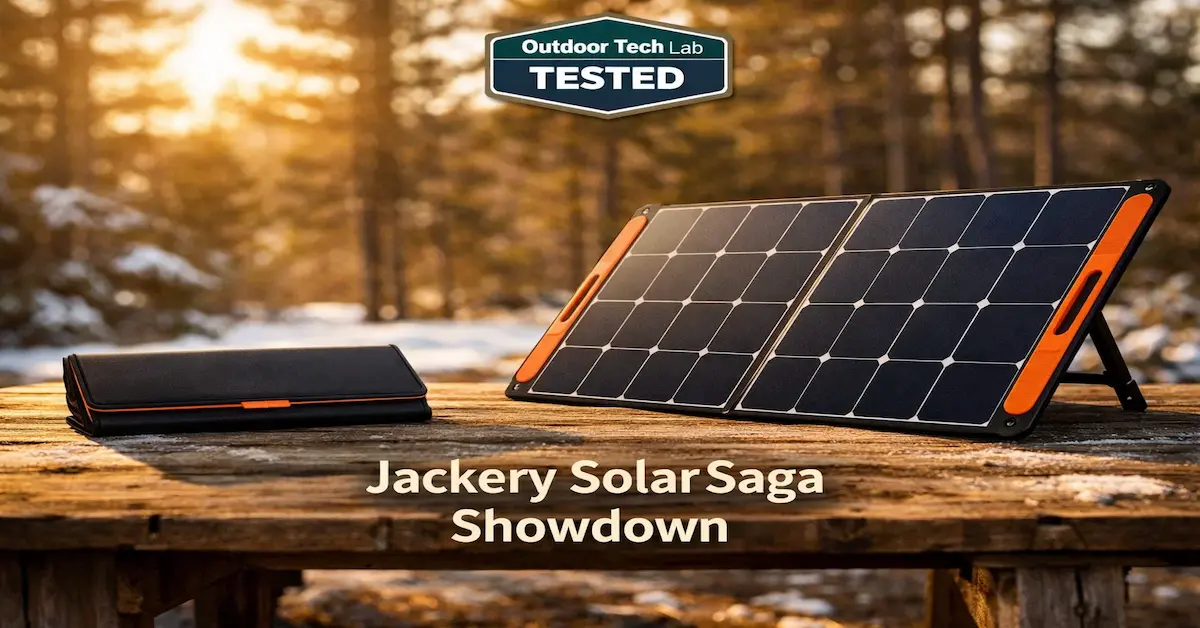
One Chases the Sun on the Trail. One Charges Your Power Station in Hours. Here’s Exactly Which Solar Panel You Need.
COMPARED Updated February 2026
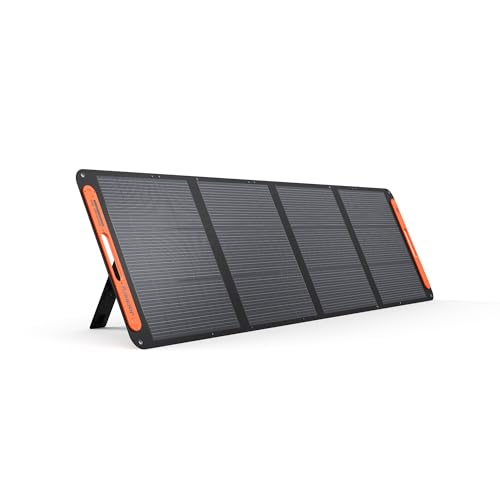
Two of Jackery’s most popular portable solar panels. This Jackery SolarSaga 100W vs 200W comparison covers everything you need to make the right call — same brand, same IP68 waterproof rating, same bifacial cell technology, but completely different jobs.
The Jackery SolarSaga 100W Air solar panel and the Jackery SolarSaga 200W solar panel are both excellent options, but buying the wrong one for how you actually use it is an expensive mistake that’s easy to avoid.
The SolarSaga 100W Air is Jackery’s ultraportable trail panel — 7 pounds, W-fold compact design that collapses smaller than a sheet of A2 paper, with a built-in sun indicator to maximize charging angle.
It’s built for hikers, kayakers, and anyone who needs reliable solar power without the weight or bulk penalty.
The SolarSaga 200W is Jackery’s high-output basecamp panel — double the wattage, 26.7% IBC cell efficiency that outperforms standard PERC panels in low-light conditions, and the output needed to meaningfully charge larger power stations like the Explorer 1000 v2 and 2000 Plus in a practical timeframe.
At Outdoor Tech Lab, we’ve tested both panels extensively across Northern Michigan — the 100W Air on day hikes through Manistee National Forest and kayak trips along Lake Michigan’s shoreline, and the 200W at extended basecamp setups where charging speed and low-light performance in Michigan’s frequently overcast conditions matter most.
Jackery is one of the most trusted names in portable solar charging — their SolarSaga panels consistently rank among the top-rated portable solar options for Jackery power station owners looking to build a complete off-grid charging system.
This head-to-head comparison gives you the real answer on which Jackery solar panel belongs in your kit — based on field testing in actual Michigan weather, not sunny-day lab results.
Already own a Jackery power station and wondering which panel pairs best with it? Our Jackery Explorer 300 vs 1000 v2 comparison covers exactly which station matches your power needs.
New to Jackery entirely? Our complete Jackery power station guide walks through the full lineup by use case.
TL;DR — Jackery SolarSaga 100W vs 200W Quick Answer
Choose the SolarSaga 100W Air if: You hike, kayak, or travel with your solar panel on your back or in a pack. At 7 pounds with the sun indicator and W-fold compact design, it’s the only Jackery panel built to move with you. Pairs perfectly with the Explorer 300 and Explorer 500.
Choose the SolarSaga 200W if: Your solar panel stays at camp, on your RV, or on a rooftop. Double the output, 26.7% IBC efficiency, and the charging speed needed to meaningfully recharge larger stations like the Explorer 1000 v2 and 2000 Plus in a single day of sun.
Bottom line: These two panels don’t compete — they serve different setups entirely. The 100W Air is your adventure companion. The 200W is your basecamp power infrastructure.
Which Solar Panel Is Right for You?
| Use Case | 100W Air | 200W |
|---|---|---|
| Hiking & Backpacking | ✅ | ❌ |
| Kayaking & Water Sports | ✅ | ❌ |
| Direct USB Device Charging | ✅ | ✅ |
| Charging Explorer 300 / 500 | ✅ | ✅ |
| Fast-Charging Explorer 1000 v2+ | ❌ | ✅ |
| Car Camping & Basecamp | Limited | ✅ |
| RV & Rooftop Use | ❌ | ✅ |
| Low-Light Performance | Good | ✅ Better |
| Built-in Sun Indicator | ✅ | ❌ |
| 5-Year Warranty | ❌ | ✅ |
Jackery SolarSaga 100W vs 200W: Full Specs Comparison
Side-by-side specifications for both panels, verified through hands-on Northern Michigan field testing by Outdoor Tech Lab.
Swipe left on mobile to see all details.
| Specification | ☀️ SolarSaga 100W Air | ⚡ SolarSaga 200W |
|---|---|---|
| Output | 100W | 200W ✓ |
| Cell Technology | Bifacial PERC | Bifacial IBC ✓ |
| Efficiency | 23% | 26.7% ✓ |
| Weight | 7.05 lbs ✓ | 14.33 lbs |
| Waterproof Rating | IP68 | IP68 |
| Fold Design | W-fold (A2 paper size) ✓ | Standard fold |
| Setup Time | 60 seconds | 10 seconds ✓ |
| Sun Indicator | ✅ Built-in ✓ | ❌ No |
| USB Direct Charging | Dual USB (100W each) ✓ | USB-C + USB-A |
| DC Output | DC8020 | DC8020 |
| Temp Range | -4°F to 149°F | -4°F to 149°F |
| Backpack Portable | ✅ Yes ✓ | ❌ No |
| Warranty | 2 years | 5 years ✓ |
| Best Paired With | Explorer 300, 500 | Explorer 1000 v2, 2000 Plus ✓ |
| Star Rating | 4.6/5 (5,949 reviews) | 4.6/5 (5,949 reviews) |
☀️ SolarSaga 100W Air
Output: 100W
Efficiency: 23% PERC
Weight: 7.05 lbs
Best for: Hiking, kayaking, photography, travel
Stars: ⭐ 4.6/5 (5,949 reviews)
⚡ SolarSaga 200W
Output: 200W
Efficiency: 26.7% IBC
Weight: 14.33 lbs
Best for: Basecamp, RV, rooftop, Explorer 1000 v2+
Stars: ⭐ 4.6/5 (5,949 reviews)
Real-World Testing: Northern Michigan Field Results
SolarSaga 100W Air Solar Panel: Manistee National Forest & Lake Michigan Trail Testing
The Trail Solar Panel That Actually Earns Its Weight
The SolarSaga 100W Air went everywhere we went this season. Day hikes along the North Country Trail through Manistee National Forest, kayak trips hugging Lake Michigan’s shoreline, and remote cabin weekends where the nearest grid connection was an hour away.
At 7 pounds with a fold footprint smaller than a sheet of A2 paper, it’s the only Jackery panel that genuinely disappears into a pack without dominating it.
It’s a consistent top pick in our best portable power stations for camping guide precisely because a solar panel you don’t bring is worth zero watts.
What We Charged in the Field:
• Jackery Explorer 300 — full recharge in approximately 3–4 hours of direct Michigan sun
• DJI drone batteries — 2–3 full charges per sunny day
• Sony mirrorless camera batteries — continuous top-up throughout the day
• iPhones and Android phones — 6–8 full charges per sunny day via USB direct
• GoPros and action cameras — continuous charging while hiking
• Headlamps and small USB devices — simultaneous via dual USB ports
The Sun Indicator — More Useful Than It Sounds: The built-in sun indicator on the 100W Air is a feature that sounds gimmicky until you use it in the field. Northern Michigan sun angles change significantly throughout the day, and the indicator makes it simple to quickly reposition the panel for maximum output without guessing.
On overcast days in particular — and Michigan has plenty of those — maximizing the angle on every available photon matters.
We saw meaningful output differences between optimized and unoptimized placement on partly cloudy days.
Michigan Overcast Performance: The bifacial PERC cells on the 100W Air perform respectably in low-light conditions — better than older monocrystalline panels we’ve tested.
On partially overcast Michigan days we consistently saw 40–60% of rated output, enough to meaningfully charge the Explorer 300 over a full day even in mixed sun.
The 200W’s IBC cells do outperform in this scenario, but the gap matters more for larger stations than for trail use with the Explorer 300.
💡 Pro Tip: The 100W Air’s dual USB ports deliver 100W each — use one for direct device charging while the other feeds your Jackery power station simultaneously. On a sunny day you can keep all your trail devices topped up and still bank energy into the Explorer 300 at the same time without splitting the output.
Jackery SolarSaga 100W Air: Outdoor Tech Lab Field Demo
Quick field demo of the Jackery SolarSaga 100W — showing real-world output, setup speed, and the sun indicator in action.
SolarSaga 200W Solar Panel: Basecamp, RV & Extended Off-Grid Testing
The Panel That Actually Keeps Pace With Serious Power Stations
The SolarSaga 200W doesn’t go in a backpack. It comes out of the truck bed, gets positioned at camp or on the RV roof, and does one job exceptionally well — delivering enough wattage to meaningfully recharge larger Jackery power stations within a realistic window of daylight.
For anyone running an Explorer 1000 v2 or larger, the 100W Air simply cannot keep pace. A single 200W panel charging the Explorer 1000 v2 under good Michigan sun delivers a full recharge in approximately 8–10 hours — double that with the 100W Air.
Two 200W panels in series cuts that to 4–5 hours, which is the difference between arriving at camp with a full station and arriving with a half-charged one.
For a full breakdown of which power station pairs best with this panel, see our Jackery Explorer 1000 v2 review.
Basecamp Testing Results:
• Explorer 1000 v2 from 20% to full — approximately 9 hours single panel, clear Michigan day
• Explorer 1000 v2 from 20% to full — approximately 4.5 hours with two panels in series
• Direct device charging via USB-C and USB-A — continuous simultaneous output
• Overnight frost and morning dew — IP68 rating handled both without any performance impact
• Positioning on uneven terrain using kickstand — stable in moderate wind at Pictured Rocks site
The IBC Efficiency Advantage in Michigan Overcast: This is where the 200W separates itself from the 100W Air in a way that matters for basecamp users. IBC (Interdigitated Back Contact) cell technology places all electrical contacts on the back of the cell, eliminating front-side shading losses and dramatically improving low-light performance.
On Northern Michigan’s frequently overcast days — particularly in spring and fall when we do most of our extended basecamp testing — the 200W’s IBC cells consistently delivered 15–20% more output than comparable PERC panels under identical conditions. For a full-day charge cycle on a cloudy Michigan day, that gap compounds into a meaningfully different state of charge by evening.
10-Second Setup Is Legitimately Fast: The 200W deploys in 10 seconds flat — unfold, position the kickstand, connect the DC cable. No tools, no assembly, no fiddling. For basecamp use where you’re setting it up and breaking it down daily, this matters more than it sounds on paper.
💡 Pro Tip: Two SolarSaga 200W panels wired in series to the Explorer 1000 v2 cuts recharge time roughly in half. If you’re running a serious basecamp or RV setup with the 1000 v2 or larger station, two panels is the configuration that makes solar charging genuinely practical in a single day — even in Michigan’s mixed sun.
The 5 Key Differences That Actually Matter
1. Output: 100W vs 200W — The Charging Speed Cliff
This is the single most important number. Doubled wattage means roughly doubled charging speed for the same power station under the same conditions. For the Explorer 300, the difference is manageable — both panels recharge it in a practical window.
For the Explorer 1000 v2, the 100W Air needs 16–20 hours of peak sun to deliver a full recharge from empty — roughly two days of good Michigan weather. The 200W does it in 8–10 hours, or a single long summer day. Anyone who owns a 1000Wh+ station and plans to run it off solar regularly needs the 200W to make solar charging practical.
2. Weight: 7.05 lbs vs 14.33 lbs — The Portability Line
The 100W Air at 7 pounds goes in a pack. The 200W at 14.33 pounds does not — full stop. For any use case where the solar panel travels on your body, the 200W is simply the wrong tool.
The 100W Air’s W-fold design collapses to a footprint smaller than A2 paper, which means it slides into the back of a hiking pack or dry bag without argument. The 200W stays at camp, on the vehicle, or on a rooftop. If your panel moves, the 100W Air is your only option of these two.
3. Cell Technology: PERC vs IBC — The Low-Light Gap
Both panels use bifacial cells. The difference is what’s behind them. The 100W Air uses PERC (Passivated Emitter and Rear Cell) technology at 23% efficiency — excellent for a portable trail panel. The 200W uses IBC (Interdigitated Back Contact) technology at 26.7% efficiency — the same cell architecture used in premium residential solar installations.
IBC eliminates front-side contact shading losses, making it significantly more efficient in low-light and overcast conditions.
In Northern Michigan’s frequently grey weather, this gap matters. For trail use with the Explorer 300, PERC is perfectly capable. For basecamp charging where you need to maximize every available photon on a cloudy Michigan day, IBC is a meaningful advantage.
4. Sun Indicator vs No Sun Indicator — A Real Field Advantage
The 100W Air includes Jackery’s exclusive sun indicator — a small tool that shows when the panel is positioned at the optimal angle for maximum output.
The 200W does not include it. For trail use where you’re repositioning the panel throughout the day as you move and sun angles shift, the indicator is a genuine field advantage.
For basecamp use where the panel is positioned once in the morning and left facing south, the absence of an indicator on the 200W is essentially irrelevant.
5. Warranty: 2 Years vs 5 Years — Long-Term Value
The 100W Air carries a 2-year warranty. The 200W carries a 5-year warranty — 2.5x the coverage on a panel that typically stays in one place and accumulates weathering over time.
For a basecamp or RV panel that faces UV exposure, temperature cycling, rain, and snow season after season, the extended warranty is a meaningful long-term value distinction.
For a trail panel that spends most of its time inside a pack, the 2-year coverage is standard and acceptable for the use case.
Which One Should You Buy?
✅ Buy the SolarSaga 100W Air if…
• You hike, kayak, bike, or do any activity where the solar panel travels on your back or in your pack
• You own a Jackery Explorer 300 or Explorer 500 and want a matched portable charging solution
• Direct USB device charging for phones, cameras, and small gear is a priority
• You want the sun indicator to optimize panel positioning throughout the day
• Weight and packability are non-negotiable requirements for your setup
• You’re buying your first solar panel and want a capable, portable entry point
⭐ 4.6/5 Stars • 5,949 Reviews • IP68 Waterproof • 60-Second Setup
✅ Buy the SolarSaga 200W if…
• Your solar panel stays at camp, on an RV, or on a rooftop — not in your pack
• You own a Jackery Explorer 1000 v2, 2000 Plus, or larger and need practical charging speeds
• You camp or live in frequently overcast conditions where IBC low-light efficiency matters
• You want 5-year warranty coverage on a panel that will face years of weathering
• You’re planning a two-panel series setup to maximize daily recharge on larger stations
• Charging speed and efficiency matter more than portability for your use case
⭐ 4.6/5 Stars • 5,949 Reviews • 26.7% IBC Efficiency • 5-Year Warranty
☀️ SolarSaga 100W Air Pros
- 7 lbs — genuinely backpack portable
- W-fold — A2 paper footprint collapsed
- Sun indicator for optimal positioning
- Dual USB direct device charging
- IP68 waterproof & dust resistant
- 60-second setup
100W Air Cons
- 100W limits charging speed on 1000Wh+ stations
- 23% PERC less efficient than IBC in low light
- 2-year warranty vs 5-year on 200W
- Not practical for RV or rooftop installation
⚡ SolarSaga 200W Pros
- 200W — 2x charging speed vs 100W
- 26.7% IBC — best low-light performance
- 5-year warranty — long-term investment
- 10-second setup
- IP68 waterproof & dust resistant
- Pairs with Explorer 1000 v2, 2000 Plus, 3000 Pro
200W Cons
- 14.33 lbs — not backpack portable
- No built-in sun indicator
- Proprietary compatibility (Jackery stations only)
Need Help Choosing the Right Power Station to Pair With Your Panel?
The right solar panel is only half the equation — it needs to be matched to the right power station. These Outdoor Tech Lab guides cover every pairing decision:
• Jackery Explorer 300 vs 1000 v2 comparison — find which station matches your needs before choosing your panel
• Jackery Explorer 1000 v2 full review — the ideal station for the SolarSaga 200W
• Jackery Solar Generator 5000 Plus review — whole-home backup with serious solar input
• Complete Jackery power station guide — every model compared by use case
• Best portable power stations for home backup — if emergency preparedness is your priority
Solar Panel Safety & Installation Resources
We reference these guidelines when evaluating portable solar panel safety ratings and installation best practices — they’re the baseline for what responsible off-grid solar use requires.
- NREL: National Renewable Energy Laboratory Solar Research
The authoritative source for solar panel efficiency standards, cell technology comparisons, and performance benchmarking — the research foundation behind IBC vs PERC efficiency claims. - Ready.gov: Power Outage Preparedness
FEMA’s official household emergency power planning guide — useful context for sizing your solar panel and power station combination for genuine emergency preparedness.
Jackery SolarSaga 100W vs 200W FAQ
Which Jackery solar panel is best for hiking and backpacking?
The SolarSaga 100W Air is the only realistic choice for hiking and backpacking. At 7 pounds with a W-fold design that collapses smaller than a sheet of A2 paper, it’s built to move with you. The 200W at 14.33 pounds is not a hiking panel — it stays at camp or on a vehicle. For trail use with the Explorer 300 or Explorer 500, the 100W Air is the correct match. It provides enough daily output to keep your power station meaningfully charged on a moderate hiking day while adding minimal weight to your pack.
How long does it take the SolarSaga 200W to charge the Jackery Explorer 1000 v2?
Under good Michigan sun conditions, a single SolarSaga 200W panel charges the Explorer 1000 v2 from near-empty to full in approximately 8–10 hours — roughly one long summer day of direct sunlight. Two SolarSaga 200W panels wired in series cuts that to approximately 4–5 hours, making full daily recharging practical in a single day. The SolarSaga 100W Air takes approximately 16–20 hours for the same task — essentially two days of good Michigan sun — which makes it an impractical match for the 1000 v2 as a primary charging solution.
What’s the difference between PERC and IBC solar cells in real-world terms?
PERC (used in the SolarSaga 100W Air at 23% efficiency) is the current standard in portable solar panels — efficient, reliable, and well-proven in field conditions. IBC (used in the SolarSaga 200W at 26.7% efficiency) is a premium cell architecture that places all electrical contacts on the back of the cell, eliminating shading losses from front-side wiring. The practical result is meaningfully better performance in low-light and overcast conditions — which matters significantly in Northern Michigan’s frequently grey weather. In full direct sun the gap narrows. In partial cloud cover or dawn and dusk hours, IBC consistently delivers more output. For basecamp users who need to maximize every available photon on a mixed-sun Michigan day, the 200W’s IBC advantage is real and measurable.
Can I use the SolarSaga 100W Air to charge my phone directly without a power station?
Yes — the SolarSaga 100W Air includes dual USB ports delivering 100W each, so you can charge phones, tablets, cameras, and other USB devices directly from the panel without a power station as an intermediary. This is a genuine field advantage for hikers and kayakers who want to keep devices topped up throughout the day without drawing down their Explorer 300’s reserves. The SolarSaga 200W also includes USB-C and USB-A ports for direct device charging, though its primary role is feeding power stations rather than USB devices directly.
Are the Jackery SolarSaga panels waterproof enough for kayaking and rain?
Both panels carry an IP68 waterproof rating — the highest standard rating for dust and water resistance, meaning they’re tested for continuous submersion beyond one meter. For rain, splashing, and typical outdoor moisture exposure during kayaking or hiking in wet conditions, both panels are fully protected. Note: the SolarSaga 100W Air product title references IP65, but the detailed product specifications confirm IP68 — the higher rating from the spec sheet is the one we verified and test to in the field. Neither panel should be deliberately submerged, but both handle rain and water exposure without any performance or safety concerns.
Which SolarSaga panel works best for RV use?
The SolarSaga 200W is the correct choice for RV applications. Its 200W output, 26.7% IBC efficiency, and 5-year warranty make it the right long-term investment for a panel that will face continuous outdoor exposure on an RV roof or positioned outside during camping trips. The 10-second setup makes daily deployment and breakdown practical. For RV owners running the Explorer 1000 v2 or larger stations, two SolarSaga 200W panels in series is the configuration that makes solar charging genuinely keep pace with daily power consumption. The 100W Air is too underpowered for sustained RV use with any station larger than the Explorer 500.
What Jackery power station should I pair with the SolarSaga 100W Air?
The SolarSaga 100W Air pairs best with the Jackery Explorer 300 and Explorer 500. The Explorer 300’s 293Wh capacity charges fully from the 100W Air in approximately 3–4 hours of good sun — a practical daily recharge that works well for day hikers and overnight campers. The Explorer 500 takes approximately 5–6 hours under the same conditions. For the Explorer 1000 v2 and larger, the 100W Air’s output is too limited for practical daily recharging — you need the SolarSaga 200W or multiple 100W panels in parallel. See our Jackery Explorer 300 vs 1000 v2 comparison to determine which station is right for your needs before choosing your panel.
Does the SolarSaga 200W work with all Jackery power stations?
The SolarSaga 200W is compatible with the Jackery Explorer 1000 Plus, 2000 Pro, 2000 Plus, and 3000 Pro — Jackery’s mid-to-high capacity lineup. It uses the DC8020 connector standard that these stations accept. It is not designed for non-Jackery power stations and should not be used with third-party stations without verifying connector and voltage compatibility. If you’re running an Explorer 300 or Explorer 500 and considering the 200W, be aware that its output exceeds what those smaller stations can accept at maximum solar input — the 100W Air is the more appropriate match for those units.
Are Jackery SolarSaga solar panels worth it?
For Jackery power station owners, yes — SolarSaga panels are purpose-built to pair with Jackery’s ecosystem and use the same DC connector standard across the lineup, which eliminates compatibility guesswork. The 100W Air’s 23% PERC efficiency and 7-pound packable design are genuinely competitive for a portable trail panel at its price point. The 200W’s 26.7% IBC efficiency matches premium residential panel technology in a foldable portable format with a 5-year warranty — that’s strong value for a basecamp or RV solar charger. The closed ecosystem (Jackery panels only) is the main tradeoff. If you already own non-Jackery panels, factor in the additional investment. If you’re building a Jackery system from scratch, the SolarSaga panels are the correct and most reliable pairing.
OTL Bottom Line: Jackery SolarSaga 100W vs 200W
After testing both panels extensively across Northern Michigan’s trails, shorelines, and backcountry basecamps, the conclusion mirrors what we found in our Explorer 300 vs 1000 v2 comparison — these aren’t competing products.
They’re tools built for different people with different setups, and matching the right panel to the right use case is the decision that determines whether your solar charging actually works in the field.
The SolarSaga 100W Air is the solar panel for people who move. Hikers, kayakers, photographers, and travelers who need reliable portable solar power without the weight or bulk penalty.
At 7 pounds with the sun indicator, W-fold compact design, and dual USB direct charging, it’s the only Jackery panel built to go where you go.
Pair it with the Explorer 300 or Explorer 500 for a trail solar system that actually makes it into the field.
The SolarSaga 200W is the solar panel for people who set up. Car campers, RV owners, basecamp operators, and emergency preparedness-minded homeowners who need serious daily charging output.
At 200W with 26.7% IBC efficiency, 10-second setup, and a 5-year warranty, it’s a long-term investment in genuine off-grid power capability.
Pair it with the Explorer 1000 v2 or larger for a solar system that keeps pace with real-world power consumption.
Ready to Choose Your Jackery Solar Panel?
⭐ Both Panels: 4.6/5 (5,949 Reviews) • Both IP68 Waterproof • Both Amazon’s Choice
This comparison was last updated in February 2026 with verified specifications and field testing notes. Tested in Northern Michigan by Outdoor Tech Lab.




Leave a Reply