

One Goes in Your Backpack. One Powers Your Campsite for Days. Here’s Exactly Which One You Need.
COMPARED Updated February 2026
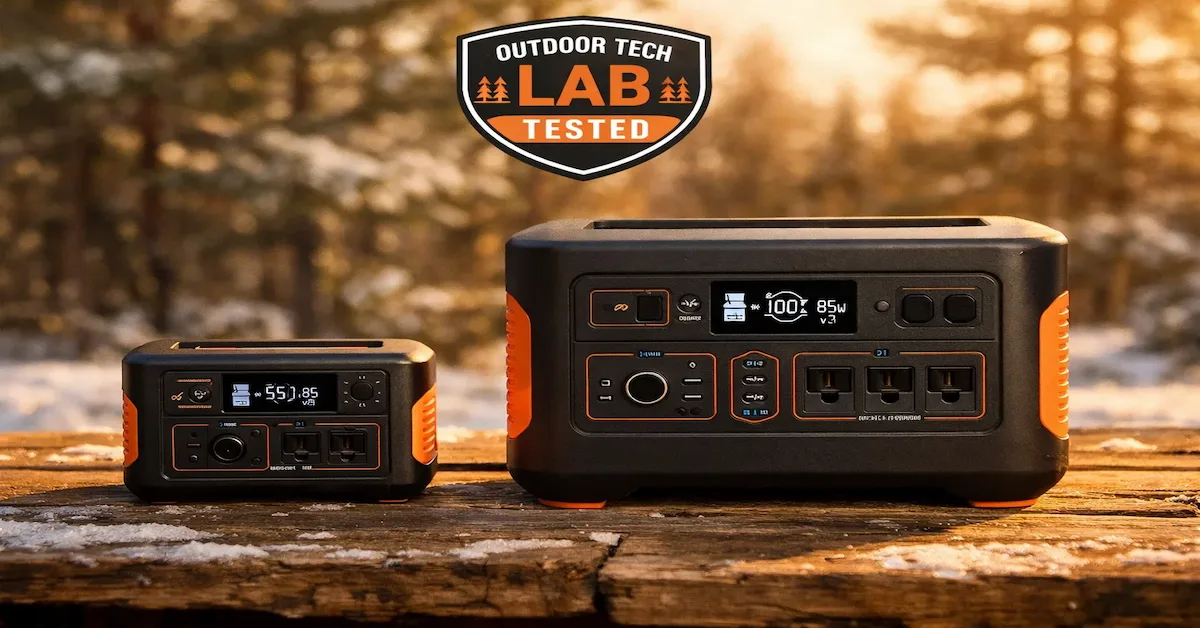
Two of Jackery’s best-selling portable power stations. Jackery is one of the most trusted names in portable power — millions of units sold, consistently rated a good brand by outdoor enthusiasts and emergency preparedness communities alike — but these two models are built for completely different jobs.
The question isn’t which one is better. It’s which one is built for how you actually use it.
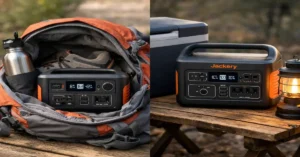
The Jackery Explorer 300 is the ultraportable grab-and-go unit — 7.1 pounds, backpack-ready, and built for day hikers, kayakers, photographers, and anyone who needs reliable power without the weight penalty.
The Jackery Explorer 1000 v2 is the serious outdoor power station — 1070Wh of LiFePO4 capacity, 1500W output, and enough muscle for basecamp setups, RV boondocking, and genuine emergency home backup.
At Outdoor Tech Lab, we’ve tested both units extensively across Northern Michigan — the Explorer 300 on day hikes through Manistee National Forest, kayak trips along Lake Michigan’s shoreline, and remote cabin weekends, and the Explorer 1000 v2 at basecamp setups near Pictured Rocks, in RV applications, and as emergency home backup during winter outage scenarios.
This head-to-head OTL comparison gives you the real answer to which Jackery portable power station belongs in your gear kit — based on field testing, not spec sheets alone.
New to portable power stations entirely? Our complete Jackery power station guide walks through every model in the lineup and how to size the right unit for your needs. Just getting started with outdoor gear in general?
Our Camping 101 beginner’s guide covers everything you need before your first trip.
TL;DR — Jackery Explorer 300 vs 1000 v2 Quick Answer
Choose the Explorer 300 if: You’re a hiker, kayaker, photographer, or day tripper who needs lightweight portable power for phones, cameras, drones, and small devices. At 7.1 pounds it fits in a backpack and goes anywhere you do.
Choose the Explorer 1000 v2 if: You need to power a mini-fridge, CPAP machine, laptop setup, or run a basecamp, RV, or emergency home backup situation. The 1070Wh LiFePO4 capacity and 1500W output put it in a fundamentally different class.
Bottom line: These two units don’t really compete with each other — they serve different people entirely. The 300 is your adventure companion. The 1000 v2 is your power infrastructure.
Which One Is Right for You?
| Use Case | 300 | 1000 v2 |
|---|---|---|
| Hiking & Backpacking | ✅ | ❌ |
| Kayaking & Water Sports | ✅ | ❌ |
| Photography & Drones | ✅ | ✅ |
| Car Camping & Basecamp | ❌ | ✅ |
| Running a Mini Fridge | ❌ | ✅ |
| CPAP Overnight | ❌ | ✅ |
| RV & Van Life | ❌ | ✅ |
| Home Backup | ❌ | ✅ |
| Air Travel | Check airline | ❌ |
| 10+ Year Lifespan | ❌ | ✅ |
Jackery Explorer 300 vs 1000 v2: Full Specs Comparison
Side-by-side specifications for both units, verified through hands-on Northern Michigan field testing by Outdoor Tech Lab.
Swipe left on mobile to see all details.
| Specification | 🟡 Explorer 300 | ⚡ Explorer 1000 v2 |
|---|---|---|
| Capacity | 293Wh | 1,070Wh ✓ |
| AC Output | 300W (500W surge) | 1,500W (3,000W surge) ✓ |
| Battery Type | Lithium-Ion | LiFePO4 ✓ |
| Cycle Life | ~500 cycles | 4,000 cycles (10+ years) ✓ |
| Weight | 7.1 lbs ✓ | 23.8 lbs |
| AC Outlets | 2 | 3 ✓ |
| USB-C Output | 60W PD | 100W PD ✓ |
| USB-A Ports | 2 (QC 3.0 + standard) | 1 |
| DC Car Port | ✅ Yes | ✅ Yes |
| AC Recharge Time | ~2 hours (80% via wall + USB-C) | 1 hour (emergency mode) ✓ |
| Max Solar Input | 100W | Higher ✓ |
| Smart App | ❌ No | ✅ Yes — quiet mode, fast charge ✓ |
| LED Lights | ❌ No | ✅ Built-in ✓ |
| Backpack Portable | ✅ Yes ✓ | ❌ No |
| Star Rating | 4.6/5 (11,059 reviews) | 4.7/5 (4,521 reviews) |
🟡 Explorer 300
Capacity: 293Wh
Output: 300W
Weight: 7.1 lbs
Best for: Hiking, kayaking, photography, travel
Stars: ⭐ 4.6/5 (11,059 reviews)
⚡ Explorer 1000 v2
Capacity: 1,070Wh
Output: 1,500W
Weight: 23.8 lbs
Best for: Basecamp, RV, emergency backup, CPAP
Stars: ⭐ 4.7/5 (4,521 reviews)
Real-World Testing: Northern Michigan Field Results
Explorer 300: Manistee National Forest Day Hike & Kayak Testing
The Ultraportable That Goes Everywhere You Do
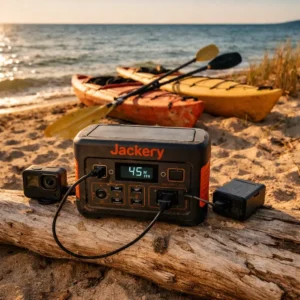
At 7.1 pounds it rides in a pack without being noticed. That’s the defining feature — not the specs, but the fact that you’ll actually bring it. The best power station for a day hike is the one that makes it into your bag, and the 300 clears that bar every time.
What We Powered on the Trail:
• DJI drone (3–4 full charges per Explorer 300 charge)
• Sony mirrorless camera bodies and batteries — multiple full charges
• GoPro and action cameras — continuous charging throughout the day
• iPhone and Android phones — 4–6 full charges per Explorer 300 charge
• Bluetooth speaker — all-day runtime
• Headlamps and USB lighting at the campsite
• Small 12V cooler — 2–3 hours runtime (limited by 300W ceiling)
The Weight Test: We packed the Explorer 300 into a 40L daypack alongside standard trail gear — rain layer, first aid kit, water filter, food, and camera kit. Total pack weight landed around 28 pounds. Noticeable but manageable. The 300 earned its spot every time we needed to charge something in the field.
Recharge Speed: The 2-hour recharge via wall outlet (using both AC adapter and 60W USB-C simultaneously) is genuinely fast for a hiking-class unit. Plug it in when you get back to the trailhead parking lot or cabin, and it’s ready for the next day before dinner.
💡 Pro Tip: The Explorer 300’s 60W USB-C port is the fastest charging option for modern laptops and cameras. Connect your most power-hungry device there first and use the USB-A ports for phones and smaller devices simultaneously — you can run all 6 outputs at once without any noticeable output reduction.
Jackery Explorer 300: Small Cabin Power Demo
Quick real-world demo of the Jackery Explorer 300 powering a small off-grid cabin setup — showing exactly what 293Wh of portable power can handle in the field.
Explorer 1000 v2: Basecamp, RV & Emergency Backup Testing
The Power Station That Runs Your Basecamp Like a Grid Connection
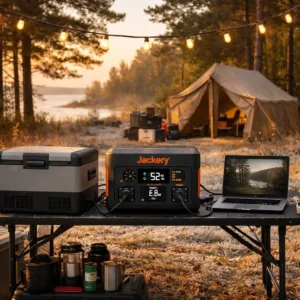
We tested the 1000 v2 extensively across three primary scenarios: a 3-day basecamp setup at a remote site near Pictured Rocks National Lakeshore, RV boondocking across multiple nights without hookups, and as emergency home backup during a Michigan winter outage event. For a full breakdown of how it stacks up against other home backup options, see our best portable power stations for home backup guide.
Basecamp Testing — Pictured Rocks:
• Full-size portable fridge (45L): Ran continuously for 18+ hours per charge
• Two-burner induction cooktop: Multiple cooking sessions per charge
• Laptop and dual monitor field editing setup: Full work sessions
• CPAP machine with humidifier: Overnight operation confirmed
• LED camp lighting and USB devices: Continuous background draw
• Drone and camera charging: Multiple units simultaneously
• Portable projector for evening use: Multi-hour runtime
The LiFePO4 Advantage in Michigan Winter: The Explorer 1000 v2’s LiFePO4 battery chemistry handled sub-freezing Northern Michigan temperatures significantly better than standard lithium-ion units we’ve tested. Stored in a vehicle during cold nights and brought into the heated tent or cabin for use, we saw minimal capacity reduction even in temperatures that reached 18°F overnight. The 4,000-cycle rating — more than 8x the cycle life of the Explorer 300’s lithium-ion pack — also means this unit is a decade-long investment rather than a gear item you’ll replace in 3–4 years.
1-Hour Fast Charge is Real: Via the Jackery App’s emergency charging mode, the 1000 v2 charges from 0 to 100% in approximately one hour. For emergency situations where you have brief access to grid power — a neighbor’s generator, a campground hookup, or a work location with power — this is a game-changing capability. The default 1.7-hour charging mode is recommended for daily use to maximize battery longevity.
Smart App in the Field: The quiet overnight charging mode (30dB) meant we could charge the 1000 v2 inside the tent at basecamp without disturbing anyone’s sleep. The energy efficiency mode automatically optimizes charging behavior based on conditions. These aren’t gimmick features — they’re tools that change how you manage power in the field.
💡 Pro Tip: Use the Explorer 1000 v2’s built-in LED lights as your primary camp lighting — it saves significant battery life compared to running a lamp off the AC outlet. The built-in LEDs are bright enough for tent and immediate camp area illumination and draw almost nothing from the 1070Wh reserve.
The 5 Key Differences That Actually Matter
1. Capacity: 293Wh vs 1070Wh — It’s Not a Small Gap
The Explorer 1000 v2 holds 3.6x more energy than the Explorer 300. That’s the difference between charging your phone 20 times versus 72 times. Or powering a portable fridge for 5 hours versus 18+ hours. For single-day adventures with device charging needs, the 300’s 293Wh is plenty. The moment you’re talking about running appliances, overnight trips with a fridge, or multi-day setups, the 1000 v2’s 1070Wh becomes not just better but necessary.
2. Weight: 7.1 lbs vs 23.8 lbs — The Portability Cliff
This is the single most important spec for most buyers. The Explorer 300 at 7.1 pounds is genuinely backpack-portable — it goes on hikes, in kayaks, in overhead bins on planes. The Explorer 1000 v2 at 23.8 pounds is not. It has a foldable handle for short carries, but nobody is hiking with 23.8 pounds of power station. If you need to carry it on foot, the 300 is your only option of these two. If your power station stays in the vehicle until you set up camp, the 1000 v2’s weight becomes irrelevant.
3. Battery Chemistry: Lithium-Ion vs LiFePO4 — Longevity That Compounds
The Explorer 300 uses standard lithium-ion rated for approximately 500 charge cycles. The Explorer 1000 v2 uses LiFePO4 rated for 4,000 cycles — an 8x longevity advantage. For occasional-use gear that gets one or two cycles per week, this translates to roughly 5 years for the 300 versus a projected 10+ year lifespan for the 1000 v2. For anyone buying a power station as a long-term investment rather than a seasonal piece of kit, the LiFePO4 chemistry in the 1000 v2 is a meaningful value advantage over time.
4. Output Power: 300W vs 1500W — The Appliance Threshold
The Explorer 300’s 300W ceiling handles phones, cameras, drones, laptops, and small appliances cleanly. The moment you try to run a mini-fridge, induction cooktop, CPAP machine, or any appliance with a significant motor or heating element, you need 1000W+ of continuous output. The Explorer 1000 v2’s 1500W continuous output (3000W surge) covers virtually everything short of 240V whole-home appliances. For anyone whose power needs extend beyond personal electronics, the 300’s output ceiling becomes a hard limit that the 1000 v2 doesn’t have.
5. Smart App: No App vs Full App Control — A Genuine Feature Gap
The Explorer 300 has no smart app. The Explorer 1000 v2 connects to the Jackery App via Bluetooth and WiFi, giving you 1-hour emergency charging mode, quiet overnight charging at 30dB, energy efficiency mode, and real-time monitoring. For basecamp use where you’re managing power over multiple days, the app control is a meaningful operational advantage. For a day hike where you plug things in and check the LED indicator, you’ll never miss it.
Which One Should You Buy?
✅ Buy the Jackery Explorer 300 if…
• You hike, kayak, bike, or do any activity where the power station travels on your back or body
• Your primary charging needs are phones, cameras, drones, laptops, and small personal devices
• You want the lightest possible power station that can still handle serious outdoor gear
• You travel by air and need something that clears airline battery restrictions
• You’re buying a first power station and want to learn your actual usage before committing to a larger unit
• Budget is a primary consideration and your power needs are genuinely light-duty
⭐ 4.6/5 Stars • 11,059 Reviews • Amazon’s Choice • 5K+ Bought Last Month
✅ Buy the Jackery Explorer 1000 v2 if…
• You run a basecamp, car camp, or RV setup where the power station stays in the vehicle
• You need to power a mini-fridge, induction cooktop, CPAP machine, or any appliance above 300W
• You want emergency home backup capability for phones, lights, internet, and small appliances
• You’re investing in a long-term power solution — the LiFePO4 battery is a 10+ year asset
• You need app-controlled smart charging and quiet overnight operation
• You want 1-hour fast charging capability for emergency scenarios
⭐ 4.7/5 Stars • 4,521 Reviews • Amazon’s Choice • 3K+ Bought Last Month
🟡 Explorer 300 Pros
- 7.1 lbs — genuinely backpack portable
- 2-hour recharge via wall + USB-C
- 60W USB-C for fast laptop charging
- 6 simultaneous outputs
- Compatible with SolarSaga 100
- Lowest entry investment in the lineup
Explorer 300 Cons
- 293Wh limits multi-day or appliance use
- 300W ceiling rules out fridges, cooktops
- Standard lithium-ion (~500 cycles)
- No smart app control
⚡ Explorer 1000 v2 Pros
- 1070Wh — serious multi-day capacity
- 1500W output handles fridges, cooktops, CPAP
- LiFePO4 — 4,000 cycles, 10+ year lifespan
- 1-hour emergency fast charge
- Smart app with quiet & efficiency modes
- 100W USB-C output
- Built-in LED lighting
Explorer 1000 v2 Cons
- 23.8 lbs — not backpack portable
- Higher investment than the 300
- Proprietary solar input (Jackery panels only)
Need to Compare Further Up or Across Brands?
If neither the 300 nor 1000 v2 is quite the right fit, these Outdoor Tech Lab guides cover the full landscape of your options:
• Complete Jackery power station guide — every model in the lineup compared by use case
• Jackery HomePower 3600 Plus review — the step up for serious home backup needs
• Jackery vs BLUETTI comparison — how Jackery stacks up against the competition
• EcoFlow Delta Pro vs Jackery Explorer 2000 Plus — premium whole-home backup comparison
• Anker Solix C1000 review — a strong cross-brand alternative for 1000Wh-class buyers comparing outside the Jackery lineup
Portable Power Station Safety & Planning Resources
We use these same guidelines when testing units for emergency preparedness — they’re the baseline for what real backup power requires.
- CPSC: Backup Power Safety Guidelines
U.S. Consumer Product Safety Commission guidance covering safe backup power operation and the CO hazards of gas alternatives — essential context for understanding why battery-electric systems like the Explorer 300 and 1000 v2 are safe for any environment. - Ready.gov: Power Outage Preparedness
FEMA’s official household power outage planning guide — useful for sizing which Jackery unit covers your specific emergency power needs.
Jackery Explorer 300 vs 1000 v2 FAQ
Can the Jackery Explorer 300 power a mini-fridge?
It depends on the fridge. Compact 12V coolers that draw 40–60W will run for several hours on the Explorer 300’s 293Wh capacity. Standard mini-fridges with compressors typically draw 100–150W continuously, which the 300 can technically run but will drain its entire charge in 2–3 hours — not practical for overnight use. If a portable fridge is a core part of your setup, the Explorer 1000 v2’s 1070Wh capacity will run a 45L portable fridge for 18+ hours per charge, which is the right tool for that job.
Is the Jackery Explorer 1000 v2 good for hiking?
Not for hiking in the traditional sense — 23.8 pounds is simply too heavy to carry on your back for any meaningful distance. The Explorer 1000 v2 is excellent for car camping, truck camping, RV setups, and basecamp situations where it travels in a vehicle and stays at camp. If you need power on the trail itself, the Explorer 300 at 7.1 pounds is the right choice. If you’re driving to a trailhead and basecamp is your home base, the 1000 v2 is the significantly more capable option.
Which Jackery is better for emergency home backup?
The Explorer 1000 v2 is meaningfully better for emergency home backup. Its 1070Wh capacity will keep a full-size refrigerator running for 12+ hours, power a CPAP machine overnight, maintain your home network and laptop setup for a full work day, and run LED lighting throughout your home. The Explorer 300’s 293Wh covers phones, a laptop, and small devices for a day — useful but not whole-home backup by any definition. For serious emergency preparedness in Northern Michigan where multi-day outages are a seasonal reality, the 1000 v2 is the minimum viable option between these two units.
What’s the difference between lithium-ion and LiFePO4 in real-world terms?
The Explorer 300 uses standard lithium-ion rated for approximately 500 charge cycles before reaching 80% capacity — roughly 5 years at 2 cycles per week. The Explorer 1000 v2 uses LiFePO4 rated for 4,000 cycles — roughly 38 years at that same rate, or a realistic 10+ year lifespan with heavier use. LiFePO4 is also significantly more thermally stable, meaning better cold-weather performance and no meaningful risk of thermal runaway under normal conditions. For Northern Michigan outdoor use in sub-freezing temperatures, the 1000 v2’s LiFePO4 chemistry is a real-world advantage, not just a spec sheet distinction.
Can I bring the Jackery Explorer 300 on a plane?
The Explorer 300’s 293Wh capacity places it in FAA’s regulated lithium battery category for air travel. Airlines generally allow lithium batteries under 100Wh in carry-on without restriction, and batteries between 100–160Wh with airline approval. At 293Wh, the Explorer 300 exceeds 160Wh and is generally not permitted on commercial flights as carry-on or checked baggage under standard FAA rules. Always check with your specific airline before traveling — policies vary and enforcement differs by carrier. Neither unit is a great choice for air travel; smaller power banks under 100Wh are the practical option for flying.
How many times can each unit charge an iPhone?
Using a modern iPhone with approximately 15Wh battery capacity as the benchmark: the Explorer 300’s 293Wh provides approximately 16–20 full iPhone charges accounting for conversion efficiency. The Explorer 1000 v2’s 1070Wh provides approximately 60–70 full iPhone charges. For a solo hiker on a day trip, the 300 is more than sufficient — you’ll never drain it on phones alone in a day. For a group of four on a 3-day trip, the 1000 v2’s capacity becomes meaningful for keeping everyone’s devices topped up without rationing.
Does the Jackery Explorer 1000 v2 work with any solar panels?
The Explorer 1000 v2 is compatible with Jackery solar panels only — it is not designed for third-party solar panel compatibility. The Explorer 300 is compatible with the Jackery SolarSaga 100. If you’re planning to integrate solar charging into your setup, factor in the cost of Jackery’s solar panels alongside the power station. Jackery’s SolarSaga panels are well-regarded and pair seamlessly with both units, but the closed ecosystem is worth understanding before purchase if you already own solar panels from another manufacturer.
Can I run a CPAP machine all night on the Jackery Explorer 300?
No — the Explorer 300 is not the right tool for overnight CPAP use. A standard CPAP machine draws 30–60W per hour; with a humidifier added that climbs to 60–100W. At that draw rate the Explorer 300’s 293Wh capacity runs out in roughly 3–5 hours — well short of a full night’s sleep. For reliable overnight CPAP operation you need the Explorer 1000 v2. Its 1070Wh capacity runs a CPAP with humidifier for a full 8+ hour night with capacity to spare for other devices. If you use a CPAP machine in the field, the 1000 v2 isn’t just a better option — it’s the only option between these two units that actually covers you through the night.
How long will the Jackery Explorer 1000 v2 run a refrigerator?
A standard full-size refrigerator draws 100–200W depending on the model and how often the compressor cycles. Using a mid-range 150W average draw, the Explorer 1000 v2’s 1070Wh capacity runs a full-size refrigerator for approximately 6–8 hours accounting for conversion efficiency. A more efficient modern fridge drawing 80–100W will stretch that to 10–12 hours. For a compact 45L portable camping fridge drawing 40–60W, the 1000 v2 delivers 15–20+ hours of runtime — enough for a full overnight and into the next day. The Explorer 300’s 293Wh runs the same full-size fridge for only 1.5–2 hours, making the 1000 v2 the clear choice for any refrigerator application beyond a short-term top-up situation.
What size Jackery do I need?
The right Jackery size comes down to what you’re powering and for how long. Here’s the quick answer by use case:
• ⭐ Best for day trips & device charging: Explorer 300 (293Wh). Phones, cameras, drones, laptops on the trail. Light, portable, enough for a full day. Check price on Amazon →
• ⭐ Best for fridges, CPAP, basecamp & RV: Explorer 1000 v2 (1070Wh). Anything that draws over 300W or runs overnight. The LiFePO4 battery is a 10-year investment. Check price on Amazon →
• ⭐ Best for whole-home backup & 240V appliances: Step up to the Jackery Solar Generator 5000 Plus. Well pumps, electric dryers, electric ranges — a different class of power entirely.
Still deciding? Our complete Jackery power station guide breaks down every model in the lineup by use case.
Which is the better first portable power station to buy?
If your primary use is hiking, camping, photography, or travel with device charging needs, start with the Explorer 300. It’s the right tool for that job and the lower investment makes it easy to learn your actual power usage patterns. If you already know you need to run a fridge, CPAP, or serious appliances — or you’re buying for emergency home preparedness — the Explorer 1000 v2 is the right starting point and a better long-term investment thanks to its LiFePO4 battery longevity. The worst outcome is buying the 300 thinking it will handle jobs it wasn’t built for — use the wattage and capacity numbers in this comparison as your decision filter.
OTL Bottom Line: Jackery Explorer 300 vs 1000 v2
After testing both units extensively across Northern Michigan’s trails, waterways, and backcountry camps, the conclusion is simple: these aren’t competing products.
They’re tools built for different people with different needs, and the right choice becomes obvious once you’re honest about how you actually use power in the field.
The Explorer 300 is the power station for people who move. Hikers, kayakers, photographers, cyclists, and travelers who need reliable device charging without the weight penalty. At 7.1 pounds with 293Wh and 6 output ports, it handles everything from drone batteries to MacBooks without slowing you down.
The Explorer 1000 v2 is the power station for people who set up. Car campers, RV owners, basecamp operators, and emergency preparedness-minded homeowners who need serious sustained power. At 1070Wh, 1500W output, LiFePO4 longevity, and smart app control, it’s a decade-long investment in real power independence.
Ready to Choose Your Jackery?
⭐ Explorer 300: 4.6/5 (11,059 Reviews) • Explorer 1000 v2: 4.7/5 (4,521 Reviews) • Both Amazon’s Choice
This comparison was last updated in February 2026 with verified specifications and field testing notes. Tested in Northern Michigan by Outdoor Tech Lab.

- SPEED UP YOUR RECHARGEABILITY: It takes only 2 hours to recharge 80% battery of the power station through the wall outle…
- SAFE & STEADY POWER SUPPLY: Armed with a 293Wh lithium-ion battery pack, the Explorer 300 features 2 Pure Sine Wave AC o…
- POWER YOUR EXPECTATIONS: Featuring 2* AC outlet, 1* PD 60W USB-C port (input/output supported) , 1* fast charge 3.0 port…


- Powerful yet Compact: Boasting a 1,500W AC output and a 3,000W surge peak, the Solar Generator 1000 V2 can power multipl…
- One Hour Fast Charging: Charge your Explorer 1000 v2 Portable Power Station from 0% to 100% battery level in just one ho…
- 10 Year Lifespan: The Explorer 1000 v2 portable power station is equipped with a durable LFP battery, maintaining over 7…

Leave a Reply