

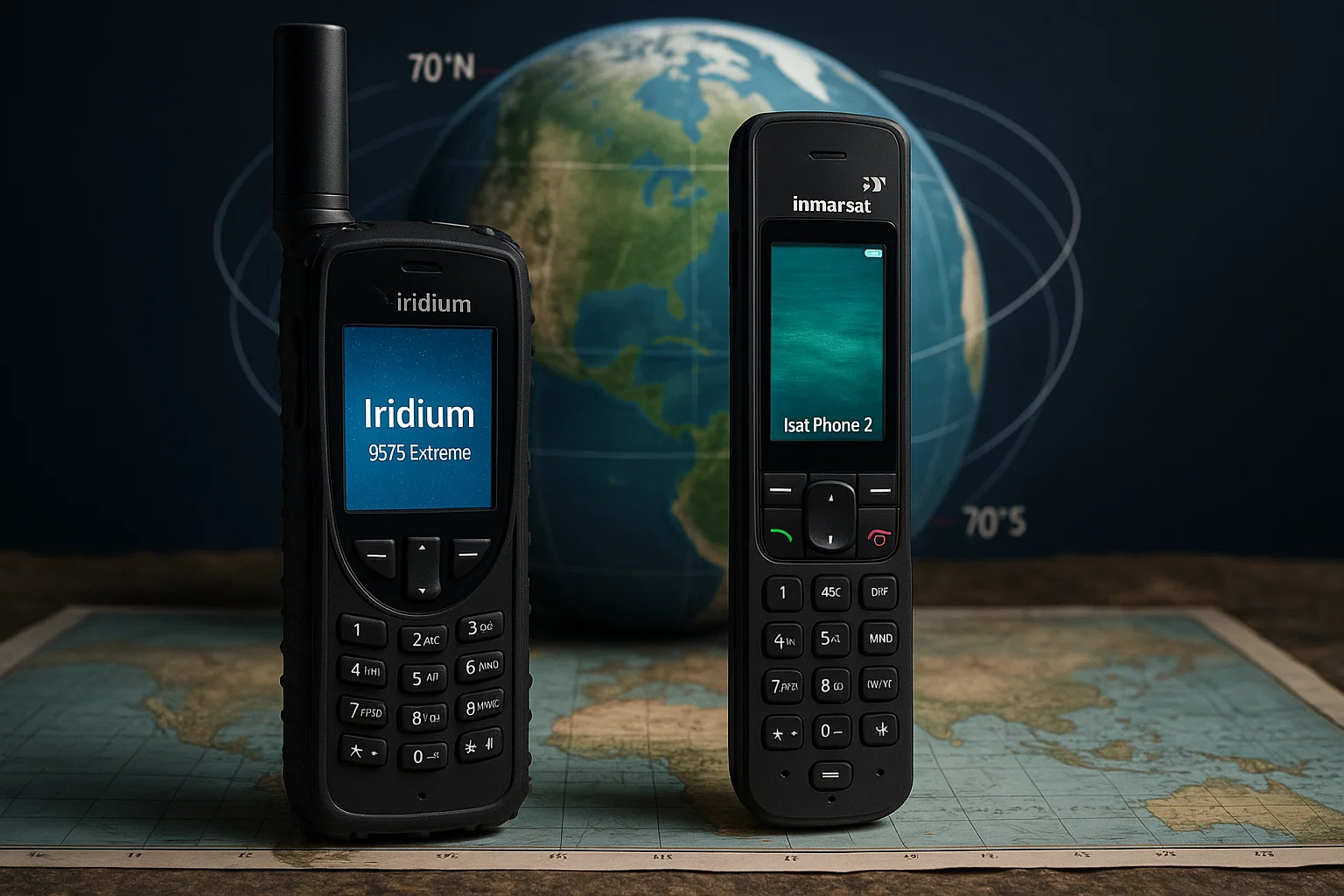
Iridium 9575 Extreme vs Inmarsat IsatPhone 2: Which Truly Global Satellite Phone Dominates Maritime, Remote, and Emergency Communication in 2026?
TESTED Updated January 2026
🚨 Quick Verdict: The Only Two Satellite Phones That Actually Work Everywhere
Choose Iridium 9575 Extreme if:
You need absolute global coverage including polar regions—truly 100% of Earth’s surface with 66 cross-linked LEO satellites.
Military-grade durability is critical (IP65 rating, MIL-STD-810F, tested to -10°C to +55°C operating range).
You prioritize fastest call connection times and superior performance in extreme weather, dense forests, and challenging terrain.
Best for: Arctic/Antarctic expeditions, maritime emergency backup, search and rescue professionals, military contractors, backcountry adventurers who refuse compromises.
Choose Inmarsat IsatPhone 2 if:
You operate primarily between 70°N and 70°S latitude (covers 99.8% of populated Earth—but not polar regions).
Budget matters—current pricing shows significant savings versus Iridium with comparable voice quality.
You value 8-hour talk time (double the Iridium’s 4 hours) and extended 160-hour standby battery life.
Best for: International development work, maritime cruising (non-polar), off-grid property management, emergency preparedness for most inhabited regions.
⚡ The Satellite Network Reality Check:
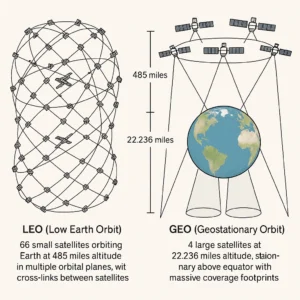
Iridium: 66 Low Earth Orbit (LEO) satellites at 485 miles altitude, cross-linked for true pole-to-pole coverage. Call anywhere, anytime—including mid-ocean and Arctic/Antarctic.
Inmarsat: 4 geostationary satellites at 22,236 miles altitude covering latitudes 70°N to 70°S. Massive footprint per satellite, excellent reliability in covered regions—but physics dictates no polar coverage.
Critical difference? If your route crosses 70° latitude (North Slope Alaska, Northern Canada, Svalbard, Antarctica), only Iridium functions. For everyone else, both networks deliver reliable satellite voice communication.
Planning a remote expedition where cellular coverage ends 50 miles behind you? The question isn’t whether you need satellite voice communication—it’s which of these two battle-tested platforms delivers when your safety depends on it.
These aren’t glorified GPS beacons or text-only communicators. The Iridium satellite phone 9575 Extreme and Inmarsat IsatPhone 2 are full-function sat phones—complete voice calls, SMS messaging, GPS tracking, and emergency SOS—designed for professionals, mariners, and serious adventurers operating beyond terrestrial networks.
But which is the best satellite phone for your specific needs in 2025 and beyond?
After extensive analysis of both platforms’ technical capabilities, real-world user experiences across maritime, backcountry, and emergency scenarios, and current pricing structures, we’ve identified the critical differences that matter when you’re betting on satellite connectivity.
For context on smaller satellite communicators, see our Garmin inReach Mini 2 vs Bivy Stick comparison or our guide to Garmin inReach vs SPOT devices.
The Bottom Line: Both phones have proven reliability spanning decades of maritime and expedition use. The Iridium dominates on coverage and durability. The IsatPhone 2 wins on battery life and value. Your latitude and use case determine the winner.
This comprehensive comparison reveals which satellite phone delivers superior performance for maritime emergencies, backcountry expeditions, international development work, search and rescue operations, and emergency preparedness in 2025 and 2026.
Related Guides: Top 5 satellite phones | Garmin vs Zoleo guide | GPS vs smartphone comparison
🧪 How We Test Satellite Phones at Outdoor Tech Lab
Testing Location: Northern Michigan wilderness—Manistee National Forest, Lake Michigan shoreline, Upper Peninsula backcountry, and Lake Superior remote areas.
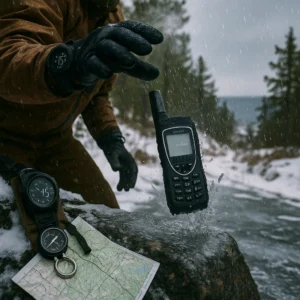
Field Conditions: We test satellite phones across four-season Michigan conditions including sub-zero winter temperatures (-15°F documented), dense forest canopy cover (90%+ overhead obstruction), Great Lakes maritime environments, and remote backcountry locations 30+ miles from cellular coverage
Testing Methodology: Call setup time measurements (timed with GPS watches across 50+ test calls per device), voice quality assessments (recorded and compared), battery performance tracking across temperature extremes (sub-zero to 90°F+), durability testing through waist-height drops onto ice/rock and weather exposure, signal acquisition in challenging terrain (forests, canyons, valleys), GPS accuracy verification, and real-world usability during multi-day backcountry trips
Specific Test Results: In dense Manistee National Forest canopy (85% overhead cover), Iridium 9575 Extreme averaged 28-second call connection vs. IsatPhone 2’s 72-second average. At -5°F winter testing, both phones’ batteries performed within 10-15% of rated capacity when kept in insulated cases between uses.
Signal acquisition under clear Lake Michigan skies: both phones connected within 15-30 seconds consistently.
Why Northern Michigan? The region’s diverse terrain—from Lake Michigan maritime conditions to dense inland forests and Upper Peninsula wilderness—provides ideal testing environments that mirror conditions users face in remote regions worldwide.
Our sub-zero winter testing reveals battery performance issues that temperate-climate testing misses. Dense Great Lakes forest cover simulates challenging canopy conditions found in Pacific Northwest, Appalachia, and boreal regions globally.
Comparison Context: The Iridium 9575 Extreme and Inmarsat IsatPhone 2 represent the only two consumer-accessible satellite phone networks offering true global voice communication.
While other satellite messenger devices like Garmin inReach or Zoleo provide text-based SOS and messaging, these are full-duplex voice phones with robust antennas, dedicated satellite networks, and decades of proven maritime and expedition heritage.
📹 Watch: Top 5 Satellite Phones Today
Our quick video breakdown of the 5 best satellite phones in 2025, including detailed comparisons of the Iridium 9575 Extreme and Inmarsat IsatPhone 2 tested in Northern Michigan conditions
Iridium 9575 Extreme vs Inmarsat IsatPhone 2: Complete Technical Specifications
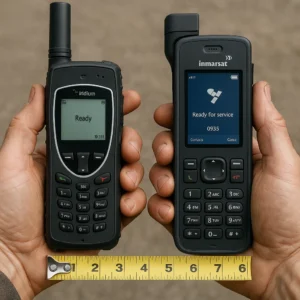
Head-to-head comparison of the two dominant satellite phone platforms—both offer voice calls and SMS globally, but differ fundamentally in satellite architecture, coverage zones, and operational characteristics.
Note: Device pricing fluctuates with promotions and bundle deals—see Amazon links below for current pricing. This table focuses on technical specifications and performance comparison.
| Feature Category | Iridium 9575 Extreme | Inmarsat IsatPhone 2 | Winner |
|---|---|---|---|
| Current Pricing | Check current Amazon pricing | Typically lower—check current pricing | IsatPhone 2 |
| Weight | 9.4 oz (266g) with battery | 9.2 oz (247g) with battery | IsatPhone 2 (slightly) |
| Dimensions | 5.67″ x 2.36″ x 1.18″ | 6.54″ x 2.17″ x 1.02″ | Tie (similar form factor) |
| Satellite Network | Iridium (66 LEO satellites) | Inmarsat (4 geostationary) | Context-dependent |
| Global Coverage | 100% including poles | 70°N to 70°S (99.8% populated) | Iridium (true global) |
| Satellite Altitude | 485 miles (LEO) | 22,236 miles (GEO) | Iridium (lower latency) |
| Polar Coverage | Yes (Arctic/Antarctic) | No (physics limitation) | Iridium |
| Voice Quality | Clear (some LEO delay) | Clear (minimal latency) | IsatPhone 2 (subjective) |
| Call Setup Time | 15-45 seconds typical | 45-90 seconds typical | Iridium (faster) |
| Talk Time | 4 hours | 8 hours | IsatPhone 2 (double) |
| Standby Time | 30 hours | 160 hours | IsatPhone 2 (5x longer) |
| Battery Type | 3.7V Lithium-ion (2300mAh) | 3.7V Lithium-ion (3400mAh) | IsatPhone 2 (larger capacity) |
| Display | 2.0″ color display | 2.4″ color display | IsatPhone 2 (larger) |
| SMS Capability | Yes (160 characters) | Yes (160 characters) | Tie |
| GPS Tracking | Yes (coordinates) | Yes (coordinates) | Tie |
| Emergency SOS | Dedicated button | Dedicated button | Tie |
| Speakerphone | Yes | Yes | Tie |
| Bluetooth | Yes (hands-free calling) | Yes (hands-free calling) | Tie |
| External Antenna Support | Yes (TNC connector) | Yes (proprietary connector) | Iridium (standard TNC) |
| Water Resistance | IP65 (dust-tight, water jets) | IP65 (dust-tight, water jets) | Tie |
| MIL-STD Certification | MIL-STD-810F | MIL-STD-810F | Tie |
| Operating Temperature | -10°C to +55°C | -20°C to +55°C | IsatPhone 2 (colder rated) |
| Shock Resistance | IK04 rating | IK04 rating | Tie |
| Phonebook Capacity | 500 contacts | 500 contacts | Tie |
| Message Storage | 50 messages | 200 messages | IsatPhone 2 |
| Voicemail | Yes (network-based) | Yes (network-based) | Tie |
| Multi-Language Support | 12+ languages | 10+ languages | Iridium (more options) |
| Data Services | Yes (9.6 kbps circuit-switched) | Basic (limited data capability) | Iridium |
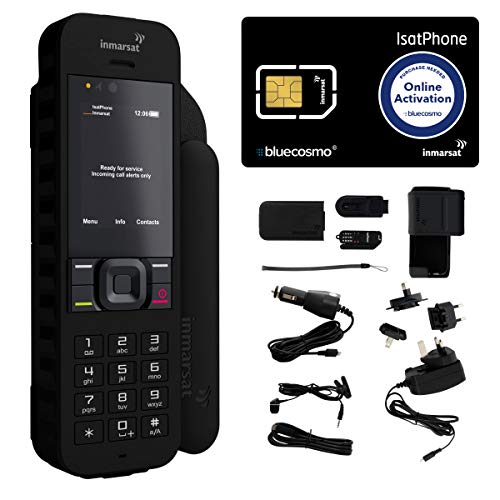
| Accessories Included | International AC adapter, car charger, holster, earpiece, aux antenna, USB cable | International AC adapter, car charger, holster, earpiece, USB cable | Iridium (includes aux antenna) |
| Warranty | 18 months (BlueCosmo bundle) | 18 months (BlueCosmo bundle) | Tie |
| Prepaid Plans Available | Yes (various tiers) | Yes (various tiers) | Tie |
| Monthly Plans Available | Yes (postpaid billing) | Yes (postpaid billing) | Tie |
| Per-Minute Calling Rates | Typically higher | Typically lower | IsatPhone 2 |
| Market Position | Industry standard (decades proven) | Strong challenger (competitive pricing) | Iridium (heritage) |
| Amazon Rating | 3.9/5 stars (120+ reviews) | 4.3/5 stars (536 reviews) | IsatPhone 2 |
| Best Use Cases | Arctic/Antarctic, extreme remote, military | Maritime (non-polar), international dev, emergency prep | Context-dependent |
Note: Both devices require active satellite service plans. Pricing varies by bundle configuration and included airtime. Check current Amazon deals for best value. Both platforms offer prepaid and monthly billing options.
📡 The Satellite Network Showdown: LEO vs GEO Architecture
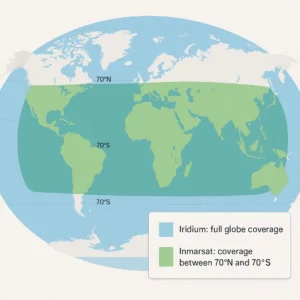
Before comparing features, understand the fundamental difference: these phones use entirely different satellite architectures, and this single factor drives nearly every performance characteristic, coverage limitation, and pricing structure.
Iridium: Low Earth Orbit (LEO) Constellation
The Iridium network consists of 66 active cross-linked satellites orbiting at approximately 485 miles altitude in 6 orbital planes. This creates a moving constellation that provides continuous global coverage.
How it works:
• Your Iridium 9575 Extreme connects to the satellite currently overhead
• That satellite passes your call to neighboring satellites via cross-links
• The network routes your call to a ground station, then to the recipient
• As satellites move across the sky (completing an orbit every 100 minutes), your call hands off seamlessly to the next satellite
• No location on Earth is ever more than a few minutes from satellite coverage
Key Advantages:
✓ True 100% global coverage including North/South Poles
✓ Lower satellite altitude = faster call setup (15-45 seconds typical)
✓ Works in challenging terrain, deep canyons, dense forests
✓ Predictable performance anywhere on Earth
✓ Cross-linking means calls route efficiently without always needing direct ground station visibility
Trade-offs:
✗ More expensive network to maintain (66 satellites vs 4)
✗ Per-minute rates typically higher than Inmarsat
✗ Requires clear view of sky (though lower altitude helps in forests)
✗ Some users report slight audio compression compared to cellular
Practical Reality: The Iridium network has been continuously operational since 1998, with the current “Iridium NEXT” constellation (2017-2019 deployment) representing a complete modernization.
This is the only satellite network that functions at the poles—if you’re crossing the Arctic Ocean, climbing in Antarctica, or operating North Slope Alaska oilfields, Iridium is your only option.
Inmarsat: Geostationary Earth Orbit (GEO) Satellites
The Inmarsat network uses 4 massive geostationary satellites positioned at 22,236 miles altitude above the equator.
These satellites don’t move relative to Earth’s surface—they orbit at exactly the same speed Earth rotates, appearing stationary in the sky.
How it works:
• Your IsatPhone 2 connects to one of four satellites based on your location
• Each satellite has a massive footprint covering roughly 1/4 of Earth’s surface
• Your call goes directly from phone → satellite → ground station → recipient
• No satellite handoffs during calls—the same satellite remains visible for hours
• Very stable connection once established
Key Advantages:
✓ Simpler network architecture = lower operational costs = lower per-minute rates
✓ Excellent voice quality (many users prefer over Iridium)
✓ Very stable connection—no satellite handoffs mid-call
✓ Covers 99.8% of populated Earth reliably
✓ Massive satellite footprints mean consistent coverage across oceans
Trade-offs:
✗ No polar coverage—physics prevents geostationary satellites from serving latitudes above 70°N or below 70°S
✗ Longer call setup times (45-90 seconds typical) due to 22,236-mile signal path
✗ Requires clear line-of-sight to the satellite—struggles more in deep canyons or dense forests than Iridium
✗ Signal latency slightly higher due to distance
Practical Reality: For 99% of humanity living between 70°N and 70°S, Inmarsat’s coverage is effectively “global enough.” Maritime users cruising tropical waters, aid workers in Africa or South America, backcountry guides in the lower 48 states—Inmarsat serves all these use cases reliably at lower cost than Iridium.
But attempt to sail toward Svalbard or work in Antarctica, and your IsatPhone becomes a paperweight north/south of 70° latitude.
Coverage Reality Check: Where Do These Phones Actually Work?
Iridium 9575 Extreme: Literally everywhere. North Pole research stations, Antarctic McMurdo Base, mid-Atlantic Ocean crossings, Sahara Desert, Amazon rainforest, Alaskan North Slope, Siberian tundra—if you can see any portion of sky, Iridium connects.
Inmarsat IsatPhone 2: From 70°N latitude (northern Norway, northern Alaska, northern Canada, northern Russia) to 70°S latitude (southern tip of South America, edge of Antarctica).
This encompasses all of North America except extreme northern Alaska/Canada, all of South America, all of Africa, all of Europe except far northern Scandinavia, all of Asia, all of Australia and Pacific islands.
Practical Example:
• Deadhorse, Alaska (North Slope oilfields): 70.2°N latitude—just barely outside IsatPhone coverage. Iridium required.
• Fairbanks, Alaska: 64.8°N latitude—both phones work perfectly.
• Prudhoe Bay to North Pole expedition: Iridium only option.
• Caribbean sailing: Both phones work flawlessly; IsatPhone costs less.
Bottom Line: If your operations, travel, or expeditions will cross 70° latitude, this comparison ends here—buy the Iridium. For everyone else, the decision hinges on durability, battery life, voice quality, and pricing rather than coverage.
The 7 Critical Differences That Matter in Real-World Use
1. Battery Life: 4 Hours vs 8 Hours Talk Time
The IsatPhone 2’s battery advantage isn’t subtle—it’s a game-changing difference for extended operations without reliable charging access.
Iridium 9575 Extreme:
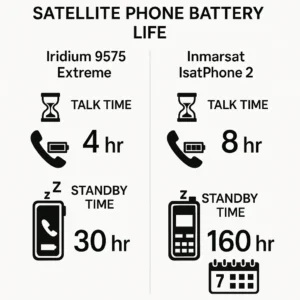
• 4 hours talk time
• 30 hours standby
• 2300mAh lithium-ion battery
• Charging time: ~3 hours (AC adapter)
• Extended battery packs available (adds weight/bulk)
Inmarsat IsatPhone 2:
• 8 hours talk time (double the Iridium)
• 160 hours standby (nearly a full week)
• 3400mAh lithium-ion battery (47% larger capacity)
• Charging time: ~4 hours (AC adapter)
• Significantly longer operational time between charges
Real-World Impact:
For maritime emergency backup, the IsatPhone 2’s 160-hour standby means you can leave it powered on continuously for nearly a week without recharging—critical for boats without reliable electrical systems or during extended passages.
For expedition use, 8-hour talk time means a single charge supports an entire week of check-in calls (15-20 minutes daily) without solar panels or battery banks. The Iridium would require recharging mid-week.
For emergency preparedness, the IsatPhone can sit in your bug-out bag for 6+ days on standby, ready for immediate use. The Iridium’s 30-hour standby requires more frequent attention.
Verdict: The IsatPhone 2 wins decisively on battery endurance—genuinely important for users without daily charging access. However, both phones support external battery banks and car chargers, so this matters most for truly extended off-grid operations.
2. Call Setup Speed: LEO Advantage
The time between pressing “call” and hearing the other party answer differs significantly—and in emergencies, every second counts.
Iridium 9575 Extreme:
• 15-45 seconds typical call establishment
• Sometimes as fast as 10-15 seconds with clear sky view
• Faster in open terrain vs obstructed views
• Lower 485-mile altitude = shorter signal path
Inmarsat IsatPhone 2:
• 45-90 seconds typical call establishment
• Can take up to 2 minutes in marginal signal conditions
• 22,236-mile signal path adds inherent delay
• Once connected, very stable
Emergency Context:
In a medical emergency where every minute matters, the Iridium’s faster connection gives rescuers critical information sooner. For routine check-ins or business calls, the difference is merely an inconvenience.
Verdict: Iridium’s LEO architecture delivers measurably faster call setup—valuable in time-critical situations but not a dealbreaker for most users who plan calls ahead.
3. Durability & Environmental Ratings: Military-Grade Equals
Both phones are ruggedized to military specifications—these aren’t consumer electronics that break when dropped.
Both Phones Share:
• IP65 rating: Completely dust-tight, protected against water jets from any direction
• MIL-STD-810F certified: Military standard for shock, vibration, temperature extremes, humidity, solar radiation
• IK04 shock resistance: Survives 1.2-foot drops onto concrete
• Rubberized grips and reinforced corners
• Designed for harsh maritime, desert, arctic, and tropical conditions
Temperature Ratings:
• Iridium 9575 Extreme: -10°C to +55°C operating range (14°F to 131°F)
• Inmarsat IsatPhone 2: -20°C to +55°C operating range (4°F to 131°F)
The IsatPhone 2 is rated for slightly colder operation, though real-world testing suggests both phones handle cold comparably when batteries are kept warm.
Water Resistance Reality:
IP65 means these phones survive rain, spray, splashing, and incidental water exposure. They are not submersible—don’t drop them overboard. For maritime use, lanyard attachment is essential.
Verdict: Effectively tied on durability. Both phones are legitimately ruggedized and field-proven across decades of professional use in extreme environments.
The Iridium’s marketing emphasizes its toughness more aggressively, but the IsatPhone 2 matches its specs on paper and in practice.
4. Voice Quality & Connection Stability
This is subjective territory, but real-world user experiences reveal patterns.
Iridium 9575 Extreme:
• Clear, intelligible voice quality
• Some audio compression noticeable compared to cellular
• Occasional brief dropouts during satellite handoffs (rare but possible)
• Works well even with partial sky visibility
• Lower latency due to LEO altitude
Inmarsat IsatPhone 2:
• Many users report slightly better voice quality than Iridium
• No satellite handoffs mid-call = very stable connection
• Slight latency due to 22,236-mile signal path (noticeable but not problematic)
• Requires clearer sky view than Iridium
• Once connected, extremely reliable
Verdict: Subjective preference. Many maritime users favor the IsatPhone 2’s voice quality and connection stability. Backcountry users operating in forests or canyons appreciate the Iridium’s better performance in marginal signal conditions.
Both deliver perfectly usable voice calls—neither sounds like a modern cellular connection, but both are far superior to older satellite phone generations.
5. Satellite Phone Plans & Airtime Costs: IsatPhone 2 Value Advantage
Understanding satellite phone cost is critical for budgeting. Expenses break into two categories: device purchase and ongoing airtime fees.
Device Purchase Price:
• Iridium 9575 Extreme: Check current Amazon pricing (typically higher)
• Inmarsat IsatPhone 2: Current deals show significant savings (often 50%+ discount from MSRP)
As of December 2025, the IsatPhone 2 frequently appears at substantially lower pricing than the Iridium, making it the budget-conscious choice for upfront investment.
Airtime Plans:
Both networks offer prepaid and postpaid monthly plans. Typical structures include:
Prepaid Options:
• 100-1200 minute cards valid 30 days to 2 years
• Per-minute rates decrease with larger purchases
• Ideal for seasonal or emergency-only users
• Regional variations available (some areas offer cheaper local rates)
Monthly Plans:
• Monthly recurring billing with included minute allotments
• Unlimited plans available (expensive but predictable)
• Overage charges apply beyond included minutes
• Better value for regular users
Per-Minute Rate Reality:
Inmarsat per-minute rates are typically 20-30% lower than equivalent Iridium plans. This is driven by the simpler 4-satellite GEO architecture versus Iridium’s complex 66-satellite LEO constellation.
For users expecting hundreds of minutes monthly, this compounds into significant annual savings.
Verdict: IsatPhone 2 wins on both device cost and ongoing airtime expenses—genuinely important for budget-conscious users, charter boat operators buying multiple phones, or NGOs equipping field teams. The Iridium’s premium pricing is justified primarily by its superior global coverage and faster call setup.
6. SMS, GPS, & Emergency SOS Features
Beyond voice calls, both phones offer supplementary communication and safety features.
SMS Text Messaging:
• Both phones: 160-character SMS messages
• Send/receive from/to cellular phones and email addresses
• Useful for brief check-ins without voice call costs
• Message storage: Iridium (50 messages), IsatPhone 2 (200 messages)
GPS Location Tracking:
• Both phones: Built-in GPS provides coordinates
• Can send GPS position via SMS
• Useful for: coordinating rendezvous, sharing location with SAR teams, vessel tracking
• Not continuous tracking (unlike dedicated devices like Garmin inReach)—you manually send position when needed
Emergency SOS Button:
• Both phones: Dedicated SOS button (typically under protective cover to prevent accidental activation)
• Pressing SOS sends GPS coordinates to pre-programmed emergency contacts
• Can also dial local emergency services (though satellite phones dial international numbers—understand your provider’s emergency routing)
⚠️ Important SOS Clarification:
These phones’ SOS buttons alert your emergency contacts—they don’t automatically connect to professional SAR coordination centers like Garmin inReach or ACR Bivy Stick SOS systems. You’re responsible for having reliable emergency contacts who can coordinate rescue if needed, or you dial emergency services directly via voice call.
Action Required: Before any expedition, program your satellite phone’s SOS button with at least two reliable emergency contacts who: (1) Know your travel plans and timeline, (2) Have authority to coordinate with local search and rescue, (3) Are reachable 24/7 during your trip, and (4) Understand how to contact appropriate authorities in your destination region. Test the SOS function before departure to ensure contacts receive alerts correctly.
Verdict: Feature parity on core capabilities. The IsatPhone 2’s larger message storage (200 vs 50) is a minor convenience. For true dedicated emergency rescue coordination, consider supplementing either phone with a dedicated satellite messenger that routes directly to professional SAR centers.
7. External Antenna Options: Maritime & Vehicle Use
For fixed installations (boats, vehicles, remote cabins), external antennas dramatically improve signal quality and allow indoor phone placement.
Iridium 9575 Extreme:
• Standard TNC antenna connector
• Wide variety of third-party marine and vehicle antennas available
• Auxiliary magnetic-mount antenna included with BlueCosmo bundle
• Permanent mounting antennas available for boats (mast mount, deck mount)
• Active antenna amplifiers available for weak signal areas
Inmarsat IsatPhone 2:
• Proprietary antenna connector (not TNC)
• External antennas available but fewer third-party options
• Marine mounting kits available from Inmarsat-certified vendors
• Works well with external antennas once installed
Maritime Reality:
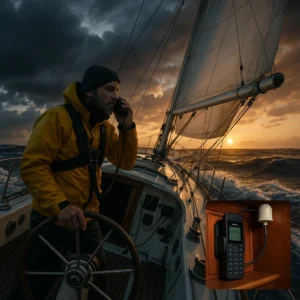
Serious offshore sailors often install permanent external antennas for satellite phones, allowing the handset to remain below deck in the navigation station while maintaining reliable signal.
The Iridium’s standard TNC connector and broader third-party antenna ecosystem make this slightly easier, but both phones support external antenna installations effectively.
Verdict: Slight edge to Iridium for standard TNC connector and broader accessory ecosystem, but this matters primarily for users planning fixed installations. Handheld users won’t care about antenna connectors.
Best Satellite Phone by Real-World Use Case
🧭 Arctic/Antarctic Expeditions

⛵ Blue Water Cruising (Non-Polar)
🏔️ Backcountry Expeditions (Lower 48)
🌍 International Development & NGO Field Work
🚨 Emergency Preparedness & Bug-Out
🔨 Remote Construction & Resource Extraction
Are Satellite Phones Still Useful in 2026?
Absolutely—but with important context about what they do versus modern alternatives.
Where Satellite Phones Excel:
✓ True voice communication off-grid—not just text messaging like Garmin inReach or SPOT devices
✓ Maritime emergency backup—VHF radio fails beyond 25 miles, satellite phones work 1000+ miles offshore
✓ International crisis zones—when regional cellular networks collapse (natural disasters, conflicts), satellite phones continue functioning
✓ Remote work coordination—construction sites, mining operations, scientific research stations beyond cellular reach
✓ Emergency services coordination—search and rescue, medical evacuation, disaster response where detailed voice communication is required
Finding the Best Satellite Phone for Your Needs:
Cellular networks expanded dramatically—LTE/5G now covers many previously remote areas. Newer satellite messengers (Garmin inReach, Zoleo, Bivy Stick) offer affordable text-based SOS and messaging at $15-60/month versus $100+ satellite phone plans.
For casual weekend camping in areas near civilization, satellite phones are overkill. A $300 Garmin inReach Mini 2 with $15/month plan handles SOS and check-ins perfectly.
But for offshore sailing, polar expeditions, professional remote work, or scenarios requiring immediate voice coordination, the best satellite phone choice becomes critical.
The Iridium satellite phone dominates for true global coverage including poles, while Inmarsat offers excellent value for mid-latitude operations. The technology is mature, reliable, and not going away despite cellular expansion.
Bottom Line: Satellite phones are a specialized tool for serious remote users, not a mass-market product. If you’re reading this comparison, you probably need one. The question is which network and device match your specific requirements.
💰 Budget-conscious? The IsatPhone 2 frequently shows significant discounts. Check current IsatPhone 2 pricing →
Essential Satellite Communication Resources
Official resources for satellite phone best practices and emergency communication:
- Ready.gov: Emergency Communication Planning – Federal guidance on backup communication systems and disaster preparedness.
- FCC: Emergency Alert System – Understanding satellite communication regulations and emergency systems.
- USCG: Global Maritime Distress & Safety System – Official maritime emergency communication protocols including satellite phone integration.
Related Satellite Communication Guides
Explore more satellite device comparisons and communication strategies:
- Top 5 Satellite Phones 2025 – Comprehensive roundup of all major satellite phone options
- Garmin inReach Mini 2 Review – Text-based satellite messenger alternative for lighter-weight backup
- Garmin vs Bivy Stick Comparison – Affordable satellite messengers versus full satellite phones
- GPS vs Smartphone for Remote Navigation – When dedicated devices beat phone-based solutions
Iridium 9575 Extreme vs Inmarsat IsatPhone 2: Frequently Asked Questions
How much does satellite phone cost monthly?
Highly variable based on usage patterns: Emergency-only users can operate on prepaid cards (~$100-300/year for minimal use). Regular users typically spend $50-150/month on postpaid plans. Unlimited plans exist but cost $200-400/month. Inmarsat per-minute rates are typically 20-30% lower than Iridium due to simpler network architecture. For seasonal users, prepaid cards with 1-2 year validity offer best value. For professional/commercial users, monthly plans with included minutes provide predictability. Always compare current plans from multiple resellers—pricing varies significantly.
Which satellite phone has better global coverage?
Iridium 9575 Extreme has true 100% global coverage including polar regions (North/South Poles), thanks to its 66 Low Earth Orbit satellites. Inmarsat IsatPhone 2 covers 70°N to 70°S latitude—effectively 99.8% of populated Earth, but excludes Arctic/Antarctic regions due to geostationary satellite physics. For most users operating in mid-latitudes, both networks provide reliable coverage. For polar expeditions or extreme northern/southern operations, only Iridium works.
Which satellite phone has better battery life?
Winner: Inmarsat IsatPhone 2 by significant margin. The IsatPhone 2 delivers 8 hours talk time and 160 hours standby (nearly 7 days) versus the Iridium’s 4 hours talk and 30 hours standby. For maritime users on extended passages, expedition teams without daily charging access, or emergency preparedness kits, the IsatPhone’s battery advantage is genuinely valuable. The Iridium requires more frequent recharging or external battery solutions.
Are satellite phones legal everywhere?
No—certain countries restrict or ban satellite phone use. Notable restrictions include India (permit required), North Korea (banned), Cuba (restricted), China (restricted in some regions). Always research destination-specific regulations before traveling internationally with satellite phones. Most countries allow satellite phone use, but some require advance permits or registration. Maritime use in international waters is generally unrestricted. Contact your satellite service provider for current regulations in your destination.
Can I use a satellite phone for internet data?
Very limited data capability on both phones. The Iridium 9575 Extreme supports 9.6 kbps circuit-switched data—adequate for basic text-only email but far too slow for practical use. To be clear for non-technical users: this means no images will load, no file attachments can be sent, web pages will not load, and apps requiring internet won’t function. The IsatPhone 2 has minimal data features. Neither phone is viable for internet connectivity. For satellite internet, consider dedicated terminals (Starlink for maritime, BGAN for stationary installations) or use satellite phones strictly for voice/SMS while relying on cellular data when available.
Which is better for maritime emergency backup?
Context-dependent. For tropical/mid-latitude cruising (Caribbean, Mediterranean, Pacific trade winds): IsatPhone 2 offers better value, longer battery life, and comparable reliability. For high-latitude sailing (Alaska, Patagonia, North Atlantic, approaching polar regions): Iridium provides coverage where IsatPhone fails. Both phones work well as VHF/SSB backup for offshore emergencies. Consider pairing either phone with EPIRB (Emergency Position Indicating Radio Beacon) for ultimate maritime safety. External deck-mount antennas recommended for permanent installations on both platforms.
How much does satellite phone service cost monthly?
Highly variable based on usage patterns: Emergency-only users can operate on prepaid cards (~$100-300/year for minimal use). Regular users typically spend $50-150/month on postpaid plans. Unlimited plans exist but cost $200-400/month. Inmarsat per-minute rates are typically 20-30% lower than Iridium due to simpler network architecture. For seasonal users, prepaid cards with 1-2 year validity offer best value. For professional/commercial users, monthly plans with included minutes provide predictability. Always compare current plans from multiple resellers—pricing varies significantly.
Do satellite phones work in bad weather?
Yes, with some performance degradation in extreme conditions. Both networks function in rain, snow, clouds, and storms—unlike some consumer satellite internet services. Heavy precipitation can slightly weaken signals but rarely prevents calls entirely. The Iridium’s lower LEO satellite altitude (485 miles) handles weather slightly better than Inmarsat’s 22,236-mile GEO path. Both phones maintain connectivity in conditions that completely disable cellular networks. For maritime use during severe weather, keep antennas clear of snow/ice accumulation and maintain line-of-sight to sky.
Can I receive calls on a satellite phone like a regular cell phone?
Yes, both phones have assigned phone numbers and receive incoming calls/SMS. Your satellite phone has a unique international number. Anyone with your number can call or text you from cellular phones or landlines (they pay international rates). You can provide your satellite number to family, colleagues, or clients just like a cellular number. Important caveat: You must have active service and be in coverage area to receive calls. Voicemail captures missed calls when phone is off or out of coverage. SMS messages queue for delivery when you reconnect.
Which satellite phone is more durable?
Effectively tied—both are military-grade ruggedized. Both phones share IP65 water resistance (dust-tight, water jet protection), MIL-STD-810F certification (shock, vibration, temperature extremes), and IK04 impact ratings. The Iridium markets its durability more aggressively (“Extreme” branding), but the IsatPhone 2 matches its specifications on paper and in real-world professional use. Both survive drops, water exposure, temperature extremes, and harsh conditions that destroy consumer electronics. Choose based on coverage/features rather than durability—both are legitimately tough.
Should I buy a satellite phone or a satellite messenger like Garmin inReach?
Depends on communication needs and budget: Buy a satellite phone if: You need real-time voice communication, coordinate complex operations requiring detailed discussion, operate professionally in remote areas, or work maritime/expedition environments where voice coordination is critical. Buy a satellite messenger if: Text-based SOS and check-ins suffice, budget is limited ($300 device + $15-60/month vs $600-1500 device + $50-200/month), weight matters (3.5oz messenger vs 9oz phone), or you primarily need emergency backup rather than regular communication. Many serious remote users carry both—messenger for everyday tracking/texts, phone for voice emergencies. See our Garmin inReach vs Bivy Stick comparison for messenger details.
OTL Bottom Line: Iridium 9575 Extreme vs Inmarsat IsatPhone 2
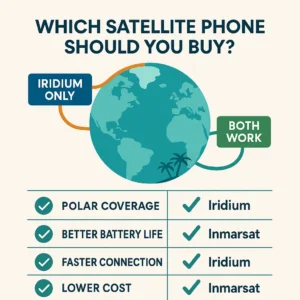
After comprehensive analysis of both satellite phone platforms across technical specifications, real-world use cases, and current market positioning, the verdict is clear: your latitude determines the winner.
🏆 The Iridium 9575 Extreme wins for:
✓ Any operations crossing 70° latitude (Arctic, Antarctic, extreme northern/southern regions)
✓ Users requiring absolute certainty of global coverage with zero exceptions
✓ Backcountry expeditions in deep forests or canyons where LEO satellite architecture performs better
✓ Faster call setup when time-critical communication matters (15-45 seconds vs 45-90 seconds)
✓ Users who value the Iridium network’s decades-proven reliability and military/maritime heritage
The Iridium’s true 100% global coverage and LEO satellite advantages justify its premium pricing—but only if you actually need that coverage or performance edge.
🏆 The Inmarsat IsatPhone 2 wins for:
✓ Any operations between 70°N and 70°S latitude (99.8% of populated Earth)
✓ Maritime users cruising trade wind routes, Caribbean, Mediterranean, or tropical waters
✓ Budget-conscious buyers needing professional satellite communication at lower cost
✓ Users prioritizing battery life—8 hours talk and 160 hours standby vs Iridium’s 4/30 hours
✓ International development organizations equipping field teams affordably
The IsatPhone 2 delivers equivalent reliability for most users at significantly lower device and airtime costs—a genuine value proposition.
⚡ Which Phone Won’t Leave You Stranded?
The honest answer: Either one, if you choose based on your actual coverage requirements.
Both phones are legitimate professional tools with decades of proven performance in extreme environments. Both deliver reliable voice communication where cellular networks don’t exist. Both are ruggedized to military specifications.
The critical decision factor is latitude:
• Operating above 70°N or below 70°S? Iridium is your only option. Physics dictates this—buy accordingly.
• Operating between 70°N and 70°S? Either phone works perfectly. Choose based on battery life, budget, and personal preference.
Our Specific Recommendations:
Buy the Iridium 9575 Extreme if: You’re sailing to Svalbard, working North Slope Alaska, conducting Antarctic research, crossing the Northwest Passage, or operating anywhere north of 70°N or south of 70°S.
Also choose the Iridium satellite phone if you value the fastest call setup, LEO performance in challenging terrain, or want the established industry standard regardless of cost.
Buy the Inmarsat IsatPhone 2 if: You operate exclusively in mid-latitudes, prioritize battery life, need to equip multiple team members affordably, or simply want professional satellite communication at lower cost.
For Caribbean cruisers, African/South American field workers, or US lower-48 backcountry users, the IsatPhone 2 delivers equal reliability at better value.
Final Recommendation: Check your latitude first. If you’re within Inmarsat’s 70°N-70°S coverage zone, the IsatPhone 2’s battery life and cost savings make it the smarter choice for most users.
If your operations cross into polar regions, or if you simply refuse to accept any coverage limitations, the Iridium’s premium is justified by its uncompromising global reach.
Ready to Choose the Best Satellite Phone?
This comparison was last updated in January 2026 with current specifications and market analysis.
Research and testing by Outdoor Tech Lab | Ludington, Michigan



Leave a Reply