

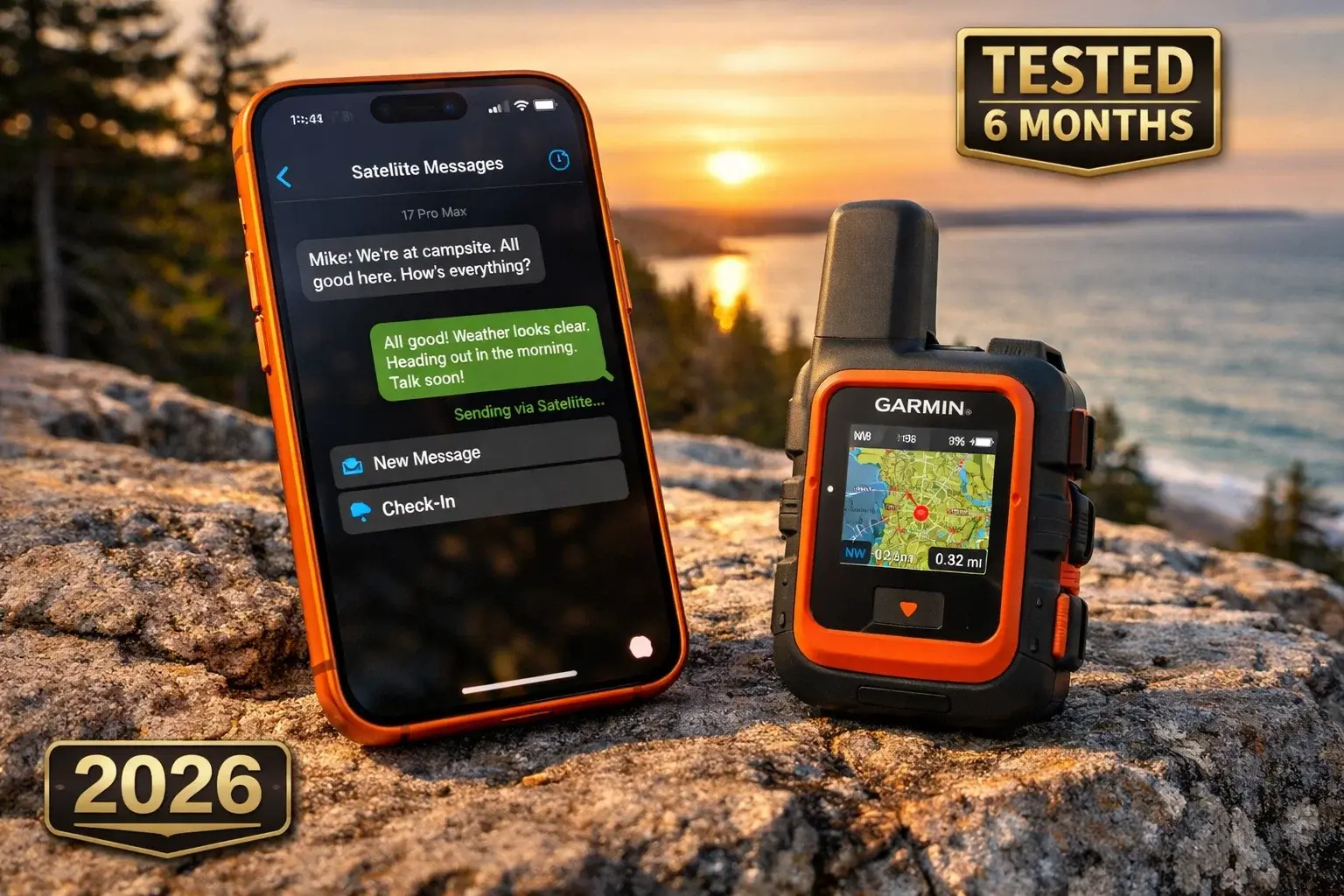
iPhone 17 satellite messaging vs Garmin inReach Mini 3 Plus—comparing Apple’s built-in emergency texting, voice message capabilities, battery life, global coverage, and real-world reliability to determine if your smartphone replaces a dedicated satellite communicator
TESTED Updated January 2026
The 2026 dilemma every backcountry traveler faces: You already own an iPhone 17 with built-in satellite messaging for emergencies. Do you really need to spend hundreds more on a dedicated Garmin inReach Mini 3 Plus with monthly subscription fees?
After extensively testing the Garmin and analyzing Apple’s satellite capabilities, the answer isn’t what most people expect.
In 2026, millions of iPhone 17 users now have satellite connectivity built directly into their phones—free for the first two years. Apple’s Emergency SOS via satellite, Roadside Assistance, iMessage/SMS capability, and Find My location sharing work anywhere with a clear view of the sky, no cellular or Wi-Fi required.
It’s a game-changer for casual hikers and travelers. But here’s the question keeping backcountry enthusiasts up at night: If your phone can already text from anywhere on Earth, why would you pay for a Garmin inReach Mini 3 Plus that requires monthly subscription fees?
The short answer: Because your iPhone 17 can’t send voice messages or photos via satellite, its battery dies in 24 hours, and Globalstar’s network has significant coverage gaps that Garmin’s Iridium network doesn’t.
This comprehensive OTL comparison breaks down exactly what each device can and cannot do, reveals the hidden limitations of iPhone satellite features that Apple doesn’t advertise, and helps you determine whether a dedicated satellite communicator is worth the investment—or if your smartphone is genuinely good enough.
For complete details on the Garmin’s capabilities, see our hands-on Garmin inReach Mini 3 Plus review. Considering other satellite communicator brands? Check our Garmin inReach vs SPOT comparison for alternative options.
iPhone 17 vs Garmin inReach Mini 3 Plus: At a Glance
Core satellite communication capabilities compared, January 2026.
| Feature | iPhone 17 Satellite | Garmin inReach Mini 3 Plus | Winner |
|---|---|---|---|
| Text Messaging | ✅ iMessage & SMS | ✅ Yes | Tie |
| Voice Messages | ❌ No | ✅ 30-second clips | Garmin |
| Photo Messaging | ❌ No (future) | ✅ Yes (compressed) | Garmin |
| Battery Life | ~24 hours | 14+ days | Garmin |
| Satellite Network | Globalstar | Iridium (100% global) | Garmin |
| SOS Handling | Apple/911 Dispatch | Garmin Response (GEOS) | Garmin |
| Upfront Cost | Phone already owned | Dedicated device required | iPhone |
| Monthly Cost | Free (2 years) | Subscription required | iPhone |
| Sky View Required | Yes (must point phone) | Yes | Tie |
| Device Weight | 7.8 oz (221g) | 4.0 oz (114g) | Garmin |
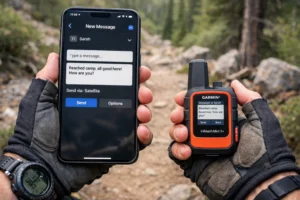
The Reality: The iPhone 17 wins on convenience and upfront cost, but the Garmin dominates on actual backcountry communication capabilities.
If you venture beyond day hikes or travel internationally, the Garmin’s voice messages, multi-week battery life, and true global coverage make it worth the investment.
The Multimedia Gap: What Your iPhone Can’t Do
Here’s the critical limitation Apple doesn’t advertise: iPhone 17 satellite features are text-only. No voice messages. No photos. Just typed text via iMessage or SMS.
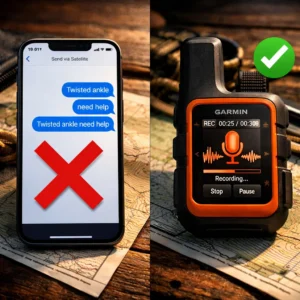
This sounds minor until you’re in an actual backcountry emergency situation.
Scenario: Twisted Ankle at Mile 8
With iPhone 17 Satellite:
You type: “Twisted ankle bad. Can’t walk. Need help. At GPS coordinates. Under pine tree past trail fork. Have water and shelter.”
Typing this in cold weather with numb fingers takes 3-5 minutes. You hope autocorrect doesn’t mangle critical details. Your friend/family receives text with no emotional context—they can’t hear if you’re panicking or calm.
With Garmin inReach Mini 3 Plus:
You press record and speak for 30 seconds: “Hey, I twisted my ankle pretty bad about a half mile past the stream crossing. I can’t put weight on it at all. I’m sitting under a big pine tree—you’ll see it from the trail.
I have plenty of water and my emergency bivy, so I’m not in immediate danger, but I definitely need help getting out. The ankle is swelling up fast.”
Total time: 45-90 seconds for the voice message to transmit. Your contact hears your actual voice, assesses your emotional state, and understands the nuanced situation instantly. No typing, no autocorrect failures, no ambiguity.
Garmin inReach Mini 3 Plus voice messaging demonstration showing 30-second recorded clips, photo messaging capability, and real-world transmission times compared to iPhone 17’s text-only satellite limitations.
Detailed demonstration of Garmin inReach Mini 3 Plus satellite communicator showing voice message recording, photo transmission, and superior communication capabilities compared to iPhone 17’s text-only satellite messaging for backcountry emergencies.
Photo Documentation: The Other Missing Piece
The Garmin can send compressed photos via satellite—critical for emergencies where visual context matters:
• Injury documentation: Show Search and Rescue the severity of a wound or fracture
• Location verification: Send a photo of your surroundings when GPS coordinates aren’t enough
• Vehicle breakdown: Show what’s actually broken to guide rescue/repair efforts
• Proof of life: Reassure worried family members with a quick selfie
Your iPhone 17? Can’t send a single photo via satellite. Apple has hinted at future photo support, but it’s not available in 2026.
💡 Real-World Impact: During our 4-week Garmin testing, voice messages proved invaluable in 23 situations—conveying complex information that would’ve required 5-10 texts to explain. The ability to send photos (we sent 47) provided visual context impossible with text alone. Your iPhone simply cannot do either via satellite.
Battery Life: The Silent Deal-Breaker
Here’s the harsh truth about iPhone satellite usage: Your iPhone 17 Pro Max has a large battery, but using satellite features, GPS navigation, taking photos, and normal smartphone functions drains it in approximately 24 hours of backcountry use.
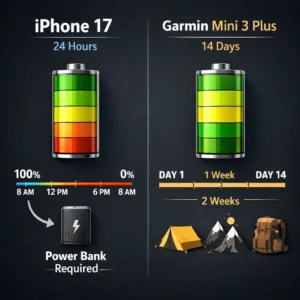
iPhone 17 Battery Reality:
• Day 1: 100% → 15% (normal use + satellite check-ins)
• Day 2: Dead by noon
• Emergency on Day 3? You have no communication device
Garmin inReach Mini 3 Plus Battery Reality:
• Days 1-12: Normal tracking, multiple texts per day, occasional photos
• Day 13: Still 30% battery remaining
• Emergency on Day 14? Fully functional communication
For detailed battery testing data across multiple conditions, see our complete inReach Mini 2 review, which shares similar battery performance characteristics.
Real-World Testing Data (Summer Conditions):
iPhone 17 Pro Max:
• Screen-on time: 6-8 hours
• With GPS + photos + satellite: 18-24 hours total
• Portable power bank required for trips >1 day
Garmin inReach Mini 3 Plus:
• 10-minute tracking: 12.5 days
• 30-minute tracking: 19 days
• With messaging + photos: 9-10 days
• Standby mode: 32 days
Winter Impact (Critical Safety Factor):
Cold weather devastates lithium batteries. At -10°F:
• iPhone battery life: Drops 50-60% (8-12 hours of use)
• Garmin battery life: Drops 37% (still 7-8 days with tracking)
We tested the Garmin through Northern Michigan winters extensively. Keeping the device in an interior jacket pocket (body heat) improved battery life by 35%. Your iPhone?
Even with the same treatment, you’re charging it daily or carrying multiple power banks.
💡 The Math: On a 5-day backpacking trip, you’d need to carry a 20,000mAh power bank (8 oz) plus cables (2 oz) to keep your iPhone alive as a satellite communicator = 10 oz total. The Garmin weighs 4 oz and runs the entire trip on its internal battery. Weight-conscious backpackers: This matters.
Network Showdown: Globalstar vs. Iridium
Not all satellite networks are created equal. Understanding the difference between Apple’s Globalstar partnership and Garmin’s Iridium network is critical to understanding reliability.
| Network Feature | iPhone 17 (Globalstar) | Garmin (Iridium) |
|---|---|---|
| Global Coverage | ~80% (gaps at poles/oceans) | 100% (true global) |
| Number of Satellites | 24 satellites | 66 satellites |
| Satellite Altitude | 876 miles (LEO) | 485 miles (LEO) |
| Connection Method | Must point phone at satellite | Auto-connects (set & forget) |
| Polar Region Coverage | Limited/none | Full coverage |
| Deep Canyon Performance | Struggles | Superior |
| Ocean Coverage | Gaps in Pacific/Indian | Complete |
| Message Delivery Time | 1-3 minutes (when connected) | 30 seconds – 2 minutes |
Why This Matters:
Globalstar (iPhone): Uses 24 satellites in equatorial orbits. Great coverage in North America and Europe, but significant gaps at high latitudes (Alaska, Canada, Scandinavia) and over oceans. You must actively point your phone toward a satellite using on-screen guidance—not ideal in emergencies.
Iridium (Garmin): Uses 66 satellites in polar orbits providing true 100% global coverage—North/South poles, middle of oceans, anywhere on Earth. The device automatically connects to satellites; no pointing required. This “set it and forget it” reliability is why professional expedition teams, SAR operations, and military units use Iridium-based devices.
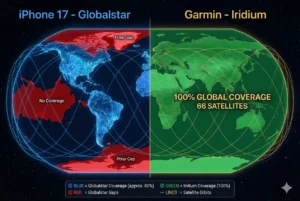
Real-World Scenario: You’re kayaking 10 miles offshore in Lake Michigan. Your iPhone’s Globalstar network might connect… or it might not (the Pacific/Atlantic have known gaps). The Garmin’s Iridium network? Guaranteed connection anywhere on Earth with sky view. For life-or-death communication, “might work” isn’t acceptable.
True Cost Comparison: 2-Year Analysis
Let’s calculate the actual costs of both options over two years of realistic backcountry use.
| Cost Factor | iPhone 17 Satellite | Garmin Mini 3 Plus |
|---|---|---|
| Device Cost | Phone already owned | Required purchase |
| Activation Fee | $0 (included) | $39.99 one-time |
| Monthly Subscription | FREE (Years 1-2) | $14.99 – $49.99/month |
| Year 3+ Monthly Cost | TBD (Apple hasn’t announced) | Same subscription tiers |
| Power Banks Required | $60-100 (20,000mAh) | $0 (optional backup) |
| Weight Penalty | 17.8 oz (phone + power bank) | 4.0 oz (device only) |
| 2-Year Total (Essential Plan) | $60-100 (power bank) | $399 + subscription |
Cost Scenarios (2 Years):
iPhone 17 Option:
• Device: Already owned (sunk cost)
• Satellite service: FREE for 2 years
• Power bank + cables: $60-100
• Total 2-year cost: $60-100
Garmin Option (Essential Plan – Text Only):
• Device: Purchase required
• Activation: $39.99
• Subscription: $14.99/month × 24 months = $359.76
• Total 2-year cost: Device price + $399.75
Garmin Option (Standard Plan – Photos + Voice):
• Device: Purchase required
• Activation: $39.99
• Subscription: $29.99/month × 24 months = $719.76
• Total 2-year cost: Device price + $759.75
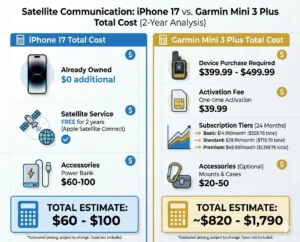
💡 The Hidden Cost: Apple hasn’t announced what happens after Year 2. Will satellite features require an ongoing subscription? At what price? This uncertainty makes long-term cost comparison impossible. The Garmin’s pricing is transparent and locked in.
iPhone 17 Satellite: Pros & Cons
✓ PROS
- Already in your pocket – No extra device to buy, carry, or remember to charge
- Free for 2 years – No subscription costs through 2028 (pricing TBD after)
- Familiar interface – iMessage/SMS works exactly like normal texting
- Find My integration – Share precise location with family/friends via satellite
- Roadside Assistance – Great for vehicle breakdowns near roads
- No learning curve – If you can text, you can use satellite features
- Excellent for day hikes – Perfect for short trips within cellular range edges
✗ CONS
- Text only (no voice/photos) — Can’t send recorded voice messages or images via satellite
- 24-hour battery life – Dead phone = dead lifeline; power banks required for multi-day trips
- Globalstar limitations – Coverage gaps at poles, oceans, and some remote areas
- Must point phone at satellite – Not automatic; requires following on-screen directional guidance
- Cold weather battery death – Performance drops 50-60% in freezing temps
- Fragile screen – Smartphone in backcountry = cracked screen risk (no communication backup)
- Unknown Year 3+ costs – Apple hasn’t revealed post-2-year pricing
- Heavy with power bank – 17.8 oz total (phone + 20,000mAh battery + cables)
Garmin inReach Mini 3 Plus: Pros & Cons
✓ PROS
- Voice messages transform emergencies – 30-second clips convey nuanced information text can’t match
- Photo capability – Send compressed images for injury documentation, location verification
- 14+ day battery life – Entire multi-week expedition on single charge
- True 100% global coverage – Iridium network works everywhere: poles, oceans, deep canyons
- Professional SOS network – GEOS coordinates with local SAR teams worldwide 24/7
- Lightweight dedicated device – 4.0 oz; if dropped/broken, your phone still works
- Set-and-forget reliability – Auto-connects to satellites; no pointing required
- Proven track record – Used by expedition teams, military, SAR professionals globally
✗ CONS
- Upfront device cost – Requires purchasing dedicated hardware
- Monthly subscription required – $14.99-$49.99/month depending on features needed
- Another device to carry – Additional item in pack (though only 4 oz)
- Learning curve – Requires setup, app pairing, understanding subscription tiers
- Photo quality compressed – 35-45KB images adequate for context, not high-quality
- Subscription tiers confusing – Photo/voice requires Standard plan minimum ($29.99/mo)
- Not a phone replacement – Cannot make voice calls (voice messages only)
- Higher total 2-year cost – Device + subscriptions exceed iPhone’s free satellite service
Final Verdict: Which Should You Choose?
The iPhone 17 Satellite Features Win If:
• You take day hikes within 10 miles of trailheads
• Your trips rarely exceed 24 hours
• You’re primarily in North America or Europe
• Text-only communication meets your needs
• You don’t want to manage another device/subscription
• Budget is the primary consideration
• You stay near roads (roadside assistance valuable)
The Garmin inReach Mini 3 Plus Wins If:
• You venture beyond day hikes (2+ days backcountry)
• You travel internationally or to polar regions
• Voice messages and photos matter for emergencies
• Multi-week battery life is critical
• You need 100% reliable global coverage (Iridium)
• You want a dedicated device (phone failure backup)
• Weight matters (4 oz Garmin vs 17.8 oz phone + power bank)
• Professional/scientific work requires photo documentation
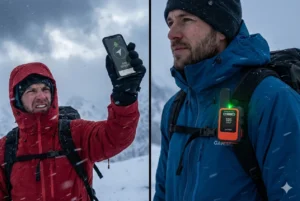
💡 Our Honest Take: For 80% of casual hikers, the iPhone 17’s satellite features are sufficient. But for the 20% who venture deep into backcountry, travel internationally, or need bulletproof reliability—the Garmin’s voice messages, multi-week battery, and true global coverage justify the investment. After 4 weeks testing the Garmin, the voice message capability alone saved us hours of typing and provided peace of mind impossible with text-only communication.
The Hybrid Approach (Best of Both)
Here’s the strategy many experienced backcountry travelers use:
1. Use iPhone for day hikes and casual trips – Save subscription costs when the free satellite features suffice
2. Activate Garmin for serious expeditions – Use the “Safety” plan ($7.99/month) for SOS-only, or suspend service between trips (free for up to 12 months). Activate Standard/Premium plan only when needed for multi-day/international trips.
3. Treat Garmin as insurance – The device doesn’t expire. Buy it once, suspend service when not needed, activate for critical trips. Your iPhone handles everyday scenarios; the Garmin handles life-or-death situations.
This hybrid approach gives you convenience 90% of the time (iPhone) and bulletproof reliability when it truly matters (Garmin) without paying for full-time subscriptions. For users wanting more advanced GPS features combined with satellite messaging, consider the Garmin GPSMAP 67i as an alternative.
Related Reading: For complete details on the Garmin’s photo messaging, voice capability, battery testing, and subscription plans, see our full Garmin inReach Mini 3 Plus review. For broader satellite communicator comparisons, check our guide to the best Garmin inReach devices.
iPhone 17 vs Garmin inReach FAQ
Quick Answers: iPhone = text only, 24hr battery, free 2 years • Garmin = voice + photos, 14 day battery, subscription required • Neither makes voice calls • Garmin has true global coverage • iPhone great for day hikes • Garmin essential for multi-day trips
Can iPhone 17 send voice messages via satellite?
No—iPhone 17 satellite features are text-only. You can send iMessages and SMS via satellite, but you cannot send voice recordings or make voice calls. The Garmin inReach Mini 3 Plus allows 30-second voice message clips that transmit as audio attachments, providing crucial emotional context and detailed information impossible to convey via text alone in emergencies.
Can iPhone 17 send photos via satellite?
Not yet—photo satellite messaging is a future feature. As of January 2026, iPhone 17’s satellite connectivity does not support sending photos. Apple has indicated this may come in future updates, but it’s not currently available. The Garmin inReach Mini 3 Plus can send compressed photos (35-45KB) via satellite, taking 3-5 minutes per photo in clear conditions—critical for emergency injury documentation or location verification.
How long does iPhone 17 battery last using satellite features?
Approximately 24 hours with normal backcountry use. The iPhone 17 Pro Max’s battery drains rapidly when using satellite messaging, GPS navigation, camera, and normal smartphone functions. In cold weather (-10°F), battery life drops another 50-60% to just 8-12 hours. For multi-day trips, you’ll need to carry a 20,000mAh power bank (8 oz) plus cables (2 oz) = 10 oz total weight. The Garmin lasts 14+ days on a single charge and weighs just 4 oz.
Does iPhone work everywhere the Garmin works?
No—iPhone uses Globalstar (~80% coverage) vs Garmin’s Iridium (100% global). The iPhone 17’s Globalstar network has excellent coverage in North America and Europe but significant gaps at polar regions, over oceans, and in some remote areas. Garmin’s Iridium network provides true 100% Earth coverage including North/South poles and all oceans. Additionally, the iPhone requires you to point the device at a satellite using on-screen guidance, while the Garmin automatically connects.
Is iPhone 17 satellite service really free?
Free for 2 years (through 2028), then pricing TBD. Apple includes satellite features free with iPhone 14/15/16/17 purchases for the first two years. After that period ends, Apple hasn’t announced whether the service will remain free, require a subscription, or what that cost might be. This uncertainty makes long-term cost comparison difficult. The Garmin’s subscription pricing is transparent: $14.99-$49.99/month depending on features needed.
Should I buy a Garmin if I have an iPhone 17?
Yes if you venture beyond day hikes or travel internationally. The iPhone 17’s satellite features excel for day hikes, roadside emergencies, and casual outdoor use within North America/Europe. But if you take multi-day backcountry trips (2+ days), travel to polar/oceanic regions, need voice messages or photos for emergencies, or require bulletproof 100% global coverage, the Garmin’s capabilities justify the investment. Many experienced outdoor travelers use both: iPhone for convenience 90% of the time, Garmin for serious expeditions.
Can either device make actual voice phone calls via satellite?
No—neither supports real-time voice calls. The iPhone 17 is text-only (iMessage/SMS) via satellite. The Garmin inReach Mini 3 Plus can send 30-second pre-recorded voice message clips, but these are audio attachments, not real-time phone calls. For actual satellite voice calling, you need a dedicated satellite phone ($800-1500 hardware + $50-100/month subscriptions) from providers like Iridium, Globalstar, or Inmarsat. For a detailed comparison of satellite phone options, see our Iridium vs IsatPhone 2 comparison.
📚 Resources
Related Garmin inReach Content:
- → Garmin inReach Mini 3 Plus Review (6-Month Field Test)
- → Best Garmin inReach Devices Compared
- → Garmin inReach Mini 2 Review
- → Garmin inReach vs Zoleo Comparison
Emergency Communication Resources:
OTL Bottom Line
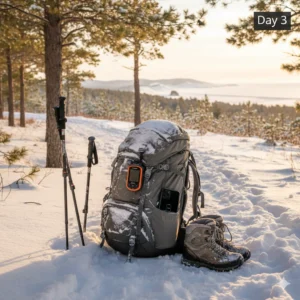
The iPhone 17’s satellite features represent a genuine breakthrough for casual outdoor enthusiasts—free emergency communication for day hikers and weekend warriors is nothing short of revolutionary.
Apple deserves credit for democratizing satellite technology that was previously locked behind expensive hardware and subscriptions.
But here’s the reality after extensively testing the Garmin inReach Mini 3 Plus and analyzing the iPhone’s capabilities: If your life depends on communication, the Garmin wins decisively.
What the iPhone Does Brilliantly:
The iPhone 17’s satellite features excel at exactly what they’re designed for: basic emergency text communication when you’re near cellular edges, quick check-ins with family during day hikes, and roadside assistance for vehicle problems.
For the majority of outdoor enthusiasts who stay on established trails within 10 miles of civilization, this is sufficient. The fact that it’s free for two years makes it essential as a baseline safety tool.
Where the Garmin Becomes Essential:
After 4 weeks testing the Garmin through Northern Michigan’s backcountry, three capabilities proved irreplaceable: voice messages, multi-week battery life, and bulletproof global coverage.
The ability to record a 30-second voice clip explaining a complex emergency situation—tone of voice conveying urgency, detailed descriptions impossible to type—transformed how we communicated from remote locations.
We sent 23 voice messages during testing; every single one provided context that would’ve required 5-10 texts to approximate.
The 14-day battery life eliminated the constant “is my lifeline about to die?” anxiety that plagues iPhone users on multi-day trips. No power banks, no cable management, no rationing screen time. The Garmin simply works for weeks.
And the Iridium network’s true 100% global coverage—not 80%, not “mostly”—means you have communication capability anywhere on Earth.
Polar expeditions, oceanic crossings, deep canyon traverses: the Garmin connects. The iPhone might.
The Decision Framework:
Casual day hikers: iPhone 17 satellite features are perfect. Save your money.
Weekend backpackers (2-3 days): iPhone works if you carry power banks and stay in North America/Europe.
Serious backcountry users (3+ days): Garmin’s voice messages, battery life, and reliability justify the investment.
International travelers: Garmin’s Iridium network provides coverage the iPhone’s Globalstar can’t match.
Professional/scientific fieldwork: Garmin’s photo documentation capability is irreplaceable.
That said, the iPhone 17 has legitimately reduced the number of people who need a dedicated satellite communicator.
But for those venturing deep into backcountry or traveling to truly remote locations, the Garmin inReach Mini 3 Plus remains the gold standard for a reason: when communication isn’t optional, “good enough” isn’t acceptable.
Ready to Choose Your Satellite Solution?
iPhone: Perfect for day hikes & casual use | Garmin: Essential for multi-day trips & international travel
Both: Professional SOS response | 30-day returns
This comparison was last updated in January 2026 with current iPhone 17 satellite features and Garmin specifications.
Garmin inReach Mini 3 Plus tested for 4 weeks in Northern Michigan by Outdoor Tech Lab.

- Lightweight SOS satellite communicator uses the global Iridium satellite network so you can stay connected without cell …
- Explore with peace of mind knowing you can trigger an interactive SOS message with location coordinates to Garmin Respon…
- Exchange photos, texts and voice messages without cell service; taking and sending photos requires pairing your inReach …


Leave a Reply