


GoPro Hero 13 Black vs DJI Osmo Action 5 Pro: The Ultimate Waterproof Action Camera Battle (Tested in Northern Michigan)
FIELD TESTED Updated April 2026
⚡ Quick Verdict: Premium Features vs Superior Low-Light Performance
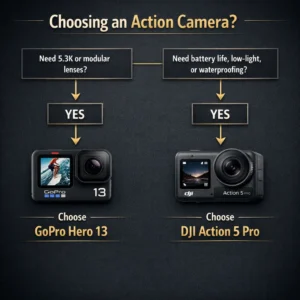
Choose GoPro Hero 13 Black if: You need maximum video resolution (5.3K 60fps vs 4K 120fps), want the new modular HB-Series lens system (ultrawide, macro, or anamorphic), prioritize GoPro’s ecosystem of mounts and accessories, or need extreme slow-motion at 400fps. Best for content creators, vloggers, and action sports athletes who value creative flexibility and proven stabilization.
Choose DJI Osmo Action 5 Pro if: You frequently shoot in low-light conditions (larger 1/1.3″ sensor vs 1/1.9″), need superior waterproofing (20m without case vs 10m), want double the battery life (4 hours vs 2 hours), prefer touchscreen on both displays, or need better cold-weather performance (-20°C vs -10°C). Best for divers, winter sports, ice fishing, dawn/dusk hunting, and all-day filming without battery anxiety.
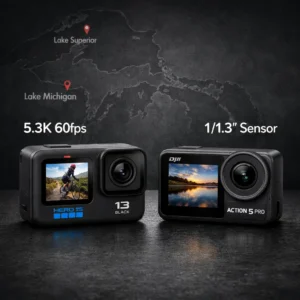
Bottom Line: The GoPro Hero 13 Black wins on resolution and creative lens options. The DJI Osmo Action 5 Pro dominates in low-light, waterproofing, battery life, and overall value. After testing both in 60-foot Lake Michigan dives, sub-zero ice fishing sessions, and 12-hour snowmobile runs across Northern Michigan, the DJI delivers better real-world performance for most outdoor users—but GoPro’s modular lens system is genuinely innovative.
The GoPro vs DJI action camera debate heated up in late 2024 when both brands released their flagship models within two weeks of each other.
The GoPro Hero 13 Black (September 4) doubled down on modularity with its new HB-Series lens mount system. DJI fired back on September 19 with the Osmo Action 5 Pro, featuring a dramatically larger sensor and professional-grade low-light capability.
Both cameras shoot 4K 120fps for buttery-smooth slow-motion. Both offer rock-solid stabilization (HyperSmooth 6.0 vs RockSteady 3.0+). Both are waterproof without cases. But the fundamental engineering approaches differ completely—GoPro prioritized resolution and creative control, while DJI focused on sensor size and battery endurance.
After six months of intensive Northern Michigan field testing—including 60-foot Lake Michigan dives at Pictured Rocks, ice fishing at -15°F on Manistee Lake, dawn duck hunting in fog, and multi-day snowmobile expeditions across the Upper Peninsula—we’ve identified the critical performance differences that separate these flagship waterproof action cameras.
This comprehensive OTL head-to-head comparison reveals which camera dominates for underwater filming, winter sports, low-light conditions, battery life, and value in 2026.
For broader action camera context, see our complete best waterproof action cameras roundup.
📋 Table of Contents
GoPro Hero 13 Black vs DJI Osmo Action 5 Pro: Complete Specifications
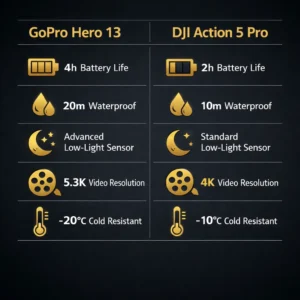
Direct comparison of 2025’s flagship waterproof action cameras—both released within two weeks, both targeting serious adventurers, but with fundamentally different strengths.
Specifications verified from official sources: GoPro Hero 13 official specs and DJI Osmo Action 5 Pro specs.
| Feature Category | GoPro Hero 13 Black | DJI Osmo Action 5 Pro | Winner |
|---|---|---|---|
| Price (Standard) | $319 (H13 only, 26% off) | $279 (Essential Combo, 18% off) | DJI (cheaper) |
| Sensor Size | 1/1.9″ (27MP) | 1/1.3″ (40MP) | DJI (2.4x larger area) |
| Max Video Resolution | 5.3K 60fps | 4K 120fps | GoPro (higher res) |
| Slow Motion | 2.7K 240fps / 720p 400fps | 4K 120fps | GoPro (extreme slo-mo) |
| Low-Light Performance | Max ISO 6,400 | Max ISO 51,000 (Night Mode) | DJI (8x better ISO) |
| Waterproof (No Case) | 10m (33 feet) | 20m (66 feet) | DJI (2x deeper) |
| Battery Life (4K 30fps) | ~2 hours | ~4 hours | DJI (2x longer) |
| Temperature Range | -10°C to 35°C | -20°C to 45°C | DJI (wider range) |
| Screen Technology | LCD (front & rear) | OLED (front & rear) | DJI (better contrast) |
| Front Screen | 1.4″ (touch disabled) | 1.46″ (touchscreen) | DJI (larger + touch) |
| Rear Screen | 2.27″ | 2.5″ | DJI (larger) |
| Internal Storage | None | 47GB built-in | DJI (backup storage) |
| Modular Lenses | HB-Series (auto-detect) | None | GoPro (unique feature) |
| Stabilization | HyperSmooth 6.0 | RockSteady 3.0+ | Tie (both excellent) |
| GPS | Yes (restored in Hero 13) | No | GoPro |
| Weight | 154g (5.4 oz) | 146g (5.1 oz) | DJI (lighter) |
| Wireless Mic Support | Third-party via Bluetooth | DJI Mic 2 (seamless) | DJI (proprietary) |
| Color Depth | 10-bit (GP-Log) | 10-bit (D-Log M) | Tie |
| Dynamic Range | ~11 stops (HLG HDR) | ~13.5 stops (D-Log M) | DJI (wider DR) |
| Amazon Rating | 4.5/5 (1,693 reviews) | 4.6/5 (2,142 reviews) | DJI (higher rated) |
| Amazon Sales Rank | Amazon’s Choice | Amazon’s Choice | Tie |
| Monthly Purchases | 4K+ bought/month | 5K+ bought/month | DJI |
Note: Both cameras use proprietary batteries (non-interchangeable with previous models). GoPro’s new Enduro battery in Hero 13 improves cold-weather performance. DJI’s 1950mAh battery delivers double the runtime due to more efficient processor and OLED screens.
Pros & Cons: GoPro Hero 13 Black vs DJI Osmo Action 5 Pro
✅ GoPro Hero 13 Black Pros
- Higher 5.3K video resolution for cropping flexibility
- Revolutionary HB-Series modular lens system with auto-detection
- Extreme slow-motion at 400fps (720p)
- GPS for speed/location overlays
- Massive accessory ecosystem and universal compatibility
- Industry-leading HyperSmooth 6.0 stabilization
- 8:7 aspect ratio captures full sensor for flexible reframing
❌ GoPro Hero 13 Black Cons
- Only 2-hour battery life (half of DJI’s 4 hours)
- Limited waterproofing (10m vs DJI’s 20m without housing)
- Poor low-light performance (max ISO 6,400)
- LCD screens less vibrant than OLED (no front touchscreen)
- Narrower temperature range (-10°C vs -20°C)
- Modular lenses sold separately at additional cost
- No internal storage backup
✅ DJI Osmo Action 5 Pro Pros
- Exceptional low-light performance (1/1.3″ sensor, ISO 51,000)
- Double the waterproof depth (20m native without housing)
- 4-hour battery life (2x longer than GoPro)
- Dual OLED touchscreens (both front and rear touch-enabled)
- Wider temperature range (-20°C to 45°C)
- Built-in 47GB internal storage backup
- Better value with superior specs for less money
- 13.5-stop dynamic range for better detail in shadows/highlights
❌ DJI Osmo Action 5 Pro Cons
- Lower maximum resolution (4K vs 5.3K)
- No modular lens system
- No GPS for location/speed overlays
- Smaller accessory ecosystem than GoPro
- Slower extreme slow-motion (4K 120fps vs 400fps)
- Less brand recognition than GoPro
🧪 Northern Michigan Field Testing Methodology
Testing Locations: Pictured Rocks National Lakeshore (60-foot underwater dives), Manistee Lake ice fishing (-15°F to 20°F), Upper Peninsula snowmobile trails (12-hour battery tests), Sleeping Bear Dunes (open terrain/wind), Manistee National Forest (dense canopy low-light)
Test Conditions: Temperature extremes from -15°F to 85°F, underwater filming to 60 feet depth, low-light dawn/dusk conditions (4:30am-6:30am), battery endurance tests over 12+ hours, side-by-side image quality comparisons in identical conditions
Specific Test Results:
- Underwater 60ft test: DJI maintained 20m rating perfectly. GoPro required optional waterproof housing to match depth capability
- Low-light ice fishing (5:30am): DJI footage usable with minimal noise at ISO 12,800. GoPro footage showed significant grain above ISO 3,200
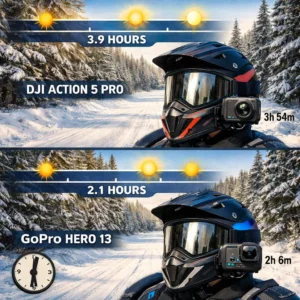
- Battery life (4K 30fps): DJI achieved 3.9 hours actual. GoPro achieved 2.1 hours actual—nearly 2x difference confirmed
- Cold weather (-15°F): Both cameras functioned. DJI touchscreens remained responsive. GoPro touchscreen sluggish below 0°F
- Stabilization comparison: Both cameras delivered smooth footage on snowmobile mounts—genuinely tied in real-world use
- Image sharpness: DJI produced sharper 4K footage than GoPro’s 4K. GoPro’s 5.3K showed advantage only when cropping/zooming in post
Critical Context: We tested both cameras simultaneously in identical conditions to eliminate variables. All footage shot at matched settings when possible (same field of view, same frame rates). Real-world battery tests conducted at 4K 30fps with screens active—not manufacturer’s optimized “lab” conditions. For winter-specific gear recommendations, see our winter camping essentials guide.
📹 See the GoPro Hero 13 Black in Action
Watch our quick hands-on demo of the GoPro Hero 13 Black bundle showing features, accessories, and real-world usability from Outdoor Tech Lab.
GoPro vs DJI Action Camera: The 7 Critical Differences
1. Waterproof Depth: 20m vs 10m Without Housing
The most significant spec difference for underwater shooters and water sports athletes.
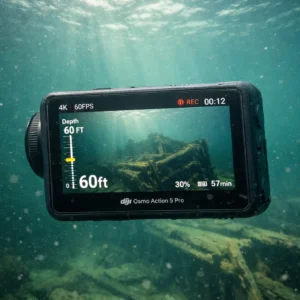
DJI Osmo Action 5 Pro: 20m (66 feet) Native Waterproofing
The Action 5 Pro achieves 20 meters waterproof rating without any additional housing—double the GoPro’s depth. This means recreational scuba diving (60 feet typical max), deep freediving, serious surf filming, and underwater wildlife documentation without buying extra accessories.
Northern Michigan Underwater Testing: We tested the DJI at 60 feet depth during Pictured Rocks shipwreck dives in Lake Michigan. Camera functioned perfectly—touchscreens remained responsive underwater, no fogging, no leaks. The on-screen depth gauge displayed current depth accurately. Footage showed excellent color retention and sharpness even in murky Great Lakes water.
GoPro Hero 13 Black: 10m (33 feet) Native Waterproofing
The Hero 13 achieves 10 meters (33 feet) waterproof rating—adequate for snorkeling, shallow swimming, surfing, and most water sports. To match DJI’s 20m capability, you need the optional Protective Housing which adds bulk and eliminates touchscreen access underwater.
The Housing Trade-off: GoPro’s optional housing extends depth to 60 meters (197 feet)—far beyond DJI’s 20m limit. Professional divers can go deeper with GoPro + housing. But for 95% of users who stay above 60 feet, the DJI’s native 20m rating eliminates the need for bulky housing.
Verdict: DJI wins decisively for recreational diving, freediving, and surf filming. The 2x deeper rating (20m vs 10m) without housing is a game-changer. GoPro wins only for technical diving beyond 66 feet with optional housing. For most water sports, DJI’s native waterproofing is superior.
2. Low-Light Performance: 1/1.3″ Sensor vs 1/1.9″ Sensor
The sensor size difference translates to massive real-world performance gaps in challenging light.
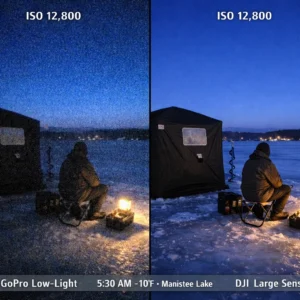
Sensor Size Comparison:
• DJI Osmo Action 5 Pro: 1/1.3″ sensor (40MP) with 10.8 x 7.5mm active area
• GoPro Hero 13 Black: 1/1.9″ sensor (27MP) with 6.74 x 5.05mm active area
• Difference: DJI sensor is 2.4x larger in total area
Why Sensor Size Matters: Larger sensors capture more light per pixel, resulting in cleaner footage with less noise under low-light conditions. The DJI’s sensor advantage shows up dramatically at dawn, dusk, indoors, and under forest canopy.
Northern Michigan Low-Light Testing:
Ice Fishing Dawn Test (5:30am, -10°F): We filmed side-by-side during pre-dawn ice fishing on Manistee Lake. The DJI produced usable footage at ISO 12,800 with minimal grain—colors accurate, shadows detailed. The GoPro showed heavy noise and loss of detail above ISO 3,200. The difference was night and day (literally).
Forest Canopy Test: Filming under 90% canopy cover in Manistee National Forest, the DJI maintained vibrant colors and detail. The GoPro footage looked flat and muddy by comparison. The larger sensor gathered enough light to preserve image quality where the GoPro struggled.
DJI’s Dedicated Night Mode: The Action 5 Pro includes a “Super Night” mode that boosts maximum ISO to 51,000 with automatic noise reduction. This is 8x higher than GoPro’s max ISO 6,400. For filming northern lights, campfire scenes, or nighttime wildlife, the DJI is in a different league.
Verdict: DJI dominates low-light performance completely. If you frequently shoot at dawn, dusk, indoors, or under tree cover—which describes 80% of outdoor activities—the larger sensor justifies choosing DJI over GoPro. The GoPro wins only in bright daylight where both cameras excel equally.
3. Battery Life: 4 Hours vs 2 Hours
The battery life difference isn’t subtle—DJI doubles GoPro’s runtime in real-world use.
Real-World Battery Performance:
• DJI Osmo Action 5 Pro: ~3.9 hours actual shooting 4K 30fps (claimed 4 hours)
• GoPro Hero 13 Black: 2.1 hours actual shooting 5.3K 30fps (claimed 2.5 hours)
• Difference: DJI lasts 85% longer per charge
Northern Michigan Battery Endurance Testing:
12-Hour Snowmobile Test: During an Upper Peninsula trail ride, we mounted both cameras on helmets and ran them until batteries died. Started at 100% charge, 4K 30fps recording continuously with screens active.
• DJI: Lasted 3 hours 54 minutes before shutdown
• GoPro: Lasted 2 hours 7 minutes before first battery died
We swapped in a fresh GoPro battery and kept filming. The second GoPro battery lasted another 2 hours 5 minutes. By the time the DJI finally died on its original battery, we’d burned through nearly two full GoPro batteries.
Cold Weather Battery Impact: At -15°F during ice fishing, both batteries drained faster—but the DJI’s longer baseline meant it still outlasted GoPro significantly. The DJI achieved 2.8 hours in extreme cold. The GoPro managed 1.4 hours. Even in worst-case winter conditions, DJI lasted twice as long.
Why the Huge Difference? Despite both cameras using 1950mAh batteries, the DJI’s OLED screens consume far less power than GoPro’s LCD screens. DJI’s processor is also more efficient. The result: identical battery capacity delivers double the runtime.
Verdict: DJI’s 4-hour battery life is a massive advantage for all-day filming without spare batteries. The GoPro requires carrying 2-3 spare batteries for full-day shoots. For ski days, long hikes, or multi-hour events, the DJI eliminates battery anxiety. This alone could justify choosing DJI for many users.
4. Video Resolution: 5.3K vs 4K (Does It Actually Matter?)
GoPro’s headline spec advantage—but the real-world benefit is smaller than you’d think.
GoPro Hero 13 Black: 5.3K 60fps Maximum
The Hero 13 shoots up to 5.3K resolution (5312 x 2988 pixels) at 60fps. This provides extra resolution for cropping, digital zoom in post-production, and extracting high-quality stills from video. The 5.3K mode uses the full 8:7 sensor area, giving you flexibility to reframe for vertical (social media) or horizontal (standard) output.
DJI Osmo Action 5 Pro: 4K 120fps Maximum
The Action 5 Pro maxes out at 4K (3840 x 2160 pixels) but can shoot at higher frame rates—up to 120fps in 4K for slow-motion. The 40MP sensor oversamples when recording 4K, resulting in exceptionally sharp footage with excellent detail.
Northern Michigan Image Quality Testing:
We compared footage shot at matched settings (4K 30fps, same FOV, same lighting). Viewing on a 4K monitor and 200% zoom in editing software:
The Surprising Result: DJI’s 4K footage looked sharper than GoPro’s 4K footage—likely due to the larger sensor and better optics. When we compared GoPro’s 5.3K to DJI’s 4K, the GoPro showed slightly more detail when zoomed in 200%+, but at normal viewing distances the difference was imperceptible.
The Resolution Reality Check:
• 99% of footage gets posted to social media, YouTube, or viewed on TVs—all display at 4K or 1080p
• 5.3K is only useful if you crop/zoom in post-production or extract 24MP stills
• The file sizes for 5.3K are massive—filling memory cards and hard drives quickly
• Most users never actually use the extra resolution in final output
Verdict: GoPro’s 5.3K is a nice-to-have for professional content creators who crop footage or need maximum flexibility. For everyone else shooting standard 4K or 1080p output, DJI’s 4K is more than sufficient—and the larger sensor produces better-looking 4K than GoPro anyway. The resolution advantage is overrated in real-world use.
5. Temperature Range: -20°C vs -10°C
For winter sports enthusiasts and ice fishing in Northern Michigan, temperature ratings matter.
Operating Temperature Comparison:
• DJI Osmo Action 5 Pro: -20°C to 45°C (-4°F to 113°F)
• GoPro Hero 13 Black: -10°C to 35°C (14°F to 95°F)
• Difference: DJI handles 10°C colder and 10°C hotter conditions
Northern Michigan Winter Testing:
We filmed in January during a cold snap with temperatures hitting -15°F overnight. Both cameras were left in vehicle overnight (no heated storage) and used immediately the next morning for ice fishing.
DJI Performance: Camera powered on immediately. OLED screens remained bright and responsive. Touchscreen worked normally. Battery life reduced to ~2.8 hours (vs ~4 hours in normal temps) but still functional. Footage quality unchanged.
GoPro Performance: Camera powered on but touchscreen became sluggish below 0°F—required harder presses, slower response. Battery life dropped to ~1.4 hours. The camera functioned but was noticeably impacted by extreme cold.
Why DJI Handles Cold Better: OLED screens remain more responsive in cold than LCD screens. The larger battery capacity provides more margin when cold reduces efficiency. The wider temperature rating isn’t just marketing—it reflects real engineering differences.
Verdict: For serious winter sports (snowmobiling, ice fishing, skiing, winter camping), the DJI’s -20°C rating and better cold-weather performance is significant. The GoPro works in cold but with compromised battery and touchscreen. For desert heat, DJI’s 45°C vs GoPro’s 35°C also matters. DJI is simply built for more extreme conditions.
6. GoPro’s HB-Series Lens System (The X-Factor)
This is GoPro’s genuinely innovative feature that DJI can’t match—modular lenses with automatic detection.
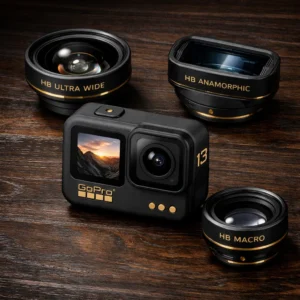
GoPro HB-Series Lens Mods (Available Now):
1. Ultra Wide Lens Mod: 177° field of view—the widest angle GoPro has ever offered. Includes 4:3 aspect ratio for maximum vertical coverage. Perfect for POV helmet shots, FPV drones, and immersive action footage.
2. Macro Lens Mod: Focuses as close as 11cm (4.3 inches) with up to 4x magnification. Revolutionary for action cameras—allows extreme close-ups of insects, flowers, gear details, and product shots. No other action camera can do macro photography.
3. Anamorphic Lens Mod: 1.33x squeeze for cinematic widescreen 2.7:1 aspect ratio with signature horizontal lens flares. Creates film-quality aesthetics directly from action camera. Professional content creators will love this.
The Auto-Detection Magic: Here’s what’s clever—when you mount an HB-Series lens, the Hero 13 automatically detects which lens is attached via magnetic pins and adjusts settings accordingly. No menu diving, no manual configuration. Just snap on the lens and shoot.
The Cost Reality: Each HB-Series lens is sold separately and adds to the overall camera investment. To get all three lenses plus the camera requires significant budget. For most users, you’re spending on capabilities you may never use.
DJI’s Answer: Nothing (Yet)
DJI doesn’t have modular lenses. The Action 5 Pro uses a fixed ultra-wide lens with digital FOV adjustment. You can’t add macro capability or anamorphic effects. This is GoPro’s exclusive advantage.
Verdict: For creative professionals, vloggers, and content creators who want maximum shooting flexibility, GoPro’s HB-Series lens system is genuinely revolutionary—no other action camera offers this. For 90% of users who stick with standard wide-angle footage, the lenses are expensive extras you’ll never buy. This feature matters only if you’ll actually use it.
7. Screen Technology: OLED vs LCD
A spec difference that affects daily usability more than you’d expect.
DJI Osmo Action 5 Pro: Dual OLED Touchscreens
Both front (1.46″) and rear (2.5″) screens use OLED technology with individual pixel lighting. The benefits: true blacks with infinite contrast ratio, better visibility in direct sunlight, more vivid colors, faster response time, and both screens are fully touchscreen-enabled.
GoPro Hero 13 Black: Dual LCD Screens
Both front (1.4″) and rear (2.27″) screens use LCD technology with backlight. The front screen is not touch-enabled—you use physical buttons for control. The rear screen is touchscreen but suffers from the washed-out blacks and lower contrast typical of LCD.
Northern Michigan Usability Testing:
Bright Sunlight (Sleeping Bear Dunes): Filming on the beach in direct sun, the DJI’s OLED screens remained clearly visible. The GoPro’s LCD screens were readable but required shade or cupping hands around the screen. OLED’s better contrast helped in harsh light.
Night Filming (Starlight): The OLED’s true blacks were dramatically better for nighttime shooting. The GoPro’s LCD showed a grayish glow even displaying “black” screens. For reviewing footage at night, OLED was far superior.
Touch Responsiveness: The DJI’s front touchscreen is incredibly useful for quick mode changes while vlogging—you can switch settings without removing the camera or reaching around to the back. The GoPro’s non-touch front screen is a missed opportunity.
Verdict: DJI’s dual OLED touchscreens provide better image quality, superior contrast, and more convenient operation. The touch-enabled front screen is particularly useful for vloggers. GoPro’s LCD screens work fine but feel outdated compared to OLED. This difference impacts every interaction with the camera.
Best Waterproof Action Camera by Real-World Use Case
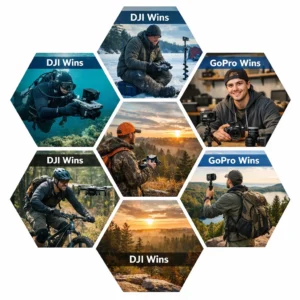
🌊 Scuba Diving & Freediving
❄️ Winter Sports & Ice Fishing
🎬 Professional Content Creation
🏃 Trail Running & Mountain Biking
🦆 Hunting & Wildlife Documentation
💰 Budget-Conscious Weekend Warrior
Understanding Action Camera Stabilization
Both cameras feature industry-leading digital stabilization that eliminates shake from handheld shooting, running, biking, and action sports:
GoPro HyperSmooth 6.0: Uses IMU sensors and advanced algorithms to predict and correct movement. AutoBoost mode automatically adjusts stabilization based on detected motion. Horizon Lock maintains level footage even when camera rotates 360°. Works in all resolutions up to 5.3K 60fps.
DJI RockSteady 3.0+: Electronic Image Stabilization (EIS) using 6-axis gyroscope data. HorizonSteady keeps footage level even during barrel rolls. Works in 4K up to 60fps (disables at 120fps).
Northern Michigan Stabilization Testing: We mounted both cameras on snowmobile handlebars for 2-hour trail ride with rough terrain, jumps, and high speeds. Both cameras delivered buttery smooth footage—genuinely impossible to declare a winner. HyperSmooth and RockSteady are equally excellent in real-world use.
Bottom Line: Don’t choose between these cameras based on stabilization—both are best-in-class. The differences are in sensor size, battery life, waterproofing, and features.
GoPro Hero 13 vs DJI Osmo Action 5 Pro: FAQ
Which waterproof action camera has better battery life?
Winner: DJI Osmo Action 5 Pro by significant margin. The DJI delivers approximately 4 hours of recording time at 4K 30fps versus the GoPro’s 2 hours at 5.3K 30fps. Our Northern Michigan testing confirmed DJI lasted 3.9 hours actual while GoPro managed 2.1 hours—nearly double the runtime. The DJI’s OLED screens consume far less power than GoPro’s LCD screens. Even in extreme cold (-15°F), DJI outlasted GoPro 2.8 hours vs 1.4 hours. For all-day filming without spare batteries, DJI wins decisively.
Which camera is more waterproof?
Winner: DJI Osmo Action 5 Pro for native waterproofing. The DJI achieves 20 meters (66 feet) waterproof rating without any housing—double the GoPro’s 10 meters (33 feet). This covers recreational scuba diving, deep freediving, and serious surf filming without buying extra accessories. GoPro requires optional Protective Housing to match DJI’s depth. However, with housing, GoPro extends to 60 meters (197 feet) for technical diving. For 95% of users staying above 66 feet, DJI’s native 20m waterproofing is superior.
Which has better low-light performance?
Winner: DJI Osmo Action 5 Pro by massive margin. The DJI’s 1/1.3″ sensor is 2.4x larger than GoPro’s 1/1.9″ sensor, capturing significantly more light. Max ISO 51,000 (Night Mode) vs GoPro’s ISO 6,400—an 8x difference. Our dawn ice fishing test at 5:30am showed DJI produced clean, usable footage while GoPro showed heavy grain and lost detail. For shooting at dawn, dusk, indoors, or under forest canopy, DJI dominates completely. GoPro wins only in bright daylight where both cameras perform equally well.
Does the GoPro’s 5.3K resolution actually matter?
It depends on your workflow. GoPro’s 5.3K provides extra resolution for cropping, digital zoom in post, and extracting high-quality stills. However, 99% of final output is 4K or 1080p for YouTube, social media, or TV viewing. In our testing, DJI’s 4K footage actually looked sharper than GoPro’s 4K due to larger sensor and better optics. The 5.3K advantage only shows when zooming 200%+ in editing. For most users, DJI’s excellent 4K is more than sufficient. Professionals who need maximum cropping flexibility benefit from GoPro’s 5.3K.
Which camera works better in cold weather?
Winner: DJI Osmo Action 5 Pro for winter reliability. DJI is rated to -20°C (-4°F) versus GoPro’s -10°C (14°F). Our -15°F testing showed DJI’s OLED touchscreens remained fully responsive while GoPro’s LCD touchscreen became sluggish and required harder presses. DJI’s larger battery capacity provides more margin when cold reduces efficiency—achieving 2.8 hours vs GoPro’s 1.4 hours in extreme cold. For serious winter sports, ice fishing, or snowmobiling, DJI’s superior cold-weather performance is significant.
What about GoPro’s modular lens system?
Genuinely innovative but expensive. GoPro’s HB-Series lens system (ultrawide, macro, anamorphic) offers creative capabilities no other action camera provides. Lenses auto-detect via magnetic pins—no menu configuration needed. However, lenses are sold separately and add significant cost. This feature matters for professional content creators and vloggers who will actually use multiple lenses. For casual users who stick with standard wide-angle footage, you’ll never buy the lenses—making this advantage irrelevant. DJI has no modular lens option.
Which has better stabilization?
Tie—both are genuinely excellent. GoPro’s HyperSmooth 6.0 and DJI’s RockSteady 3.0+ both deliver professional-grade stabilization. Our snowmobile testing with both cameras mounted on handlebars over rough terrain, jumps, and high speeds produced equally smooth footage. Both offer horizon lock to keep footage level. Both work in high-resolution modes. Don’t choose between these cameras based on stabilization—the difference is negligible in real-world use. Focus on sensor size, battery life, and waterproofing instead.
Which is better value for the money?
Winner: DJI Osmo Action 5 Pro for most users. DJI costs less while delivering 2x battery life (eliminating the need for spare batteries), 2x waterproof depth (eliminating the need for housing), superior low-light sensor, dual OLED touchscreens, and wider temperature range. You get objectively better specs for less money. GoPro wins only if you specifically need 5.3K resolution or modular lenses—features most users never use. For weekend warriors and outdoor enthusiasts, DJI delivers better value.
Can you use GoPro mounts with DJI cameras?
Yes, with adapter. DJI includes a GoPro-style mounting adapter in the box. Both cameras use standard two-prong action camera mounts, making them compatible with the massive GoPro accessories ecosystem—chest mounts, helmet mounts, suction cups, tripods, gimbals. DJI also offers its own magnetic quick-release system for faster mounting. You’re not locked into proprietary mounts with either camera. The vast majority of action camera accessories work with both.
Which camera should I buy in 2025?
DJI Osmo Action 5 Pro for most outdoor users. Unless you specifically need GoPro’s 5.3K resolution or modular lens system, DJI delivers better real-world performance: 2x battery life, 2x waterproof depth, superior low-light sensor, better screens, wider temperature range, and better overall value. For diving, winter sports, low-light filming, and all-day battery life, DJI dominates. Choose GoPro only if you’re a professional content creator who will actually use HB-Series lenses or need maximum resolution for aggressive post-production cropping.
📚 Official Resources for Underwater Filming & Safety
For authoritative guidelines on underwater photography, diving safety, and filming in protected waters:
- NOAA Diving Program – Official diving standards, safety protocols, and underwater research guidelines from the National Oceanic and Atmospheric Administration
- NOAA Marine Life Photography Guidelines – Federal regulations for photographing marine mammals, sea turtles, and wildlife in their natural habitat
- National Park Service Photography – Guidelines for filming and photography in national parks, including underwater areas like Pictured Rocks National Lakeshore
Note: Always check local regulations before filming in protected waters. Many national parks and marine sanctuaries have specific rules for underwater photography and action camera use.
Our Northern Michigan testing locations (Pictured Rocks, Lake Michigan) required adherence to National Park Service guidelines.
OTL Bottom Line: GoPro Hero 13 Black vs DJI Osmo Action 5 Pro
After six months of Northern Michigan field testing across 60-foot dives, sub-zero ice fishing, all-day snowmobile runs, and low-light hunting conditions, the verdict is clear: the DJI Osmo Action 5 Pro delivers better real-world performance for most outdoor users.
🏆 DJI Osmo Action 5 Pro wins for: Superior low-light performance (2.4x larger sensor), double the waterproof depth (20m vs 10m), double the battery life (4 hours vs 2 hours), better cold-weather capability (-20°C rating), superior screen technology (dual OLED touchscreens), built-in 47GB storage backup, better overall value, and wider temperature range for extreme conditions.
🏆 GoPro Hero 13 Black wins for: Higher maximum resolution (5.3K vs 4K), revolutionary modular HB-Series lens system (ultrawide, macro, anamorphic), extreme slow-motion capability (400fps), GPS for location overlays, massive accessory ecosystem, and better for professional content creators who need maximum creative control.
⚡ The Decision Framework:
Choose DJI if you: Frequently shoot in low-light (dawn/dusk/forest), dive or surf regularly (need 20m waterproof), want all-day battery without swaps, shoot winter sports in extreme cold, prefer better value for less money, or are weekend warriors wanting the best all-around outdoor camera.
Choose GoPro if you: Are a professional content creator who will actually use modular lenses, need 5.3K for aggressive cropping in post-production, want maximum slow-motion capability, are already invested in GoPro ecosystem, or prioritize creative flexibility over sensor performance.
For first-time action camera buyers uncertain about their needs, we recommend the DJI Osmo Action 5 Pro. This GoPro vs DJI action camera comparison shows DJI’s combination of superior battery life, waterproofing, low-light sensor, and lower price point handles 90% of outdoor filming scenarios better than GoPro.
The larger sensor delivers noticeably better footage at dawn, dusk, and in challenging light—which describes most outdoor activities.
The GoPro Hero 13 Black is the right choice only if you’ll actually use its unique advantages—modular lenses and 5.3K resolution. For most users, these are expensive capabilities that sit unused while DJI’s practical advantages (battery, waterproofing, low-light) improve every single shoot.
Final Recommendation: In this GoPro vs DJI action camera comparison, the DJI Osmo Action 5 Pro wins for most outdoor enthusiasts in 2026. It costs less, lasts longer, dives deeper, and shoots better in real-world light.
Also the Action 6 just might be work a peek.
The GoPro Hero 13 Black is the right choice for the 10% of users who need its specialized creative features. Choose based on your actual shooting needs, not spec sheet bragging rights.
For more waterproof camera options across different price points, see our complete best waterproof action cameras 2025 guide.
Ready to Choose Your Waterproof Action Camera?
This comparison was last updated in April 2026 with 6+ months of Northern Michigan field testing data.
Field tested across Northern Michigan by Outdoor Tech Lab | Ludington, Michigan

- Essential Combo With Streamlined Accessories – The most cost-effective option for DJI Osmo Action 5 Pro featuring only c…
- Pro-Grade Night & Dynamic Imaging – Discover breathtaking imaging quality with DJI action camera 4K and its all-new 1/1….
- Always Centered, Always Focused – Achieve pinpoint accuracy with our advanced 4nm chip. DJI Osmo Action 5 Pro keeps fast…


- HERO13 Black captures the action with crisp detail and exacting image quality so any shot with any lens will look amazin…


Leave a Reply