Only if you camp in warm weather and hate small screens.
Both devices send identical messages using the same satellites. The Mini 3 costs $100 more but buys you a color touchscreen, emergency siren, and phone charging—not better communication.
Buy Mini 2 if you camp in winter, want to save $100, or message via smartphone. The Mini 2 has proven reliable over 3+ years of field use. Buy Mini 3 if you type on the device and never wear heavy gloves.
Quick feature demo showing the Garmin inReach Mini 3 color touchscreen interface
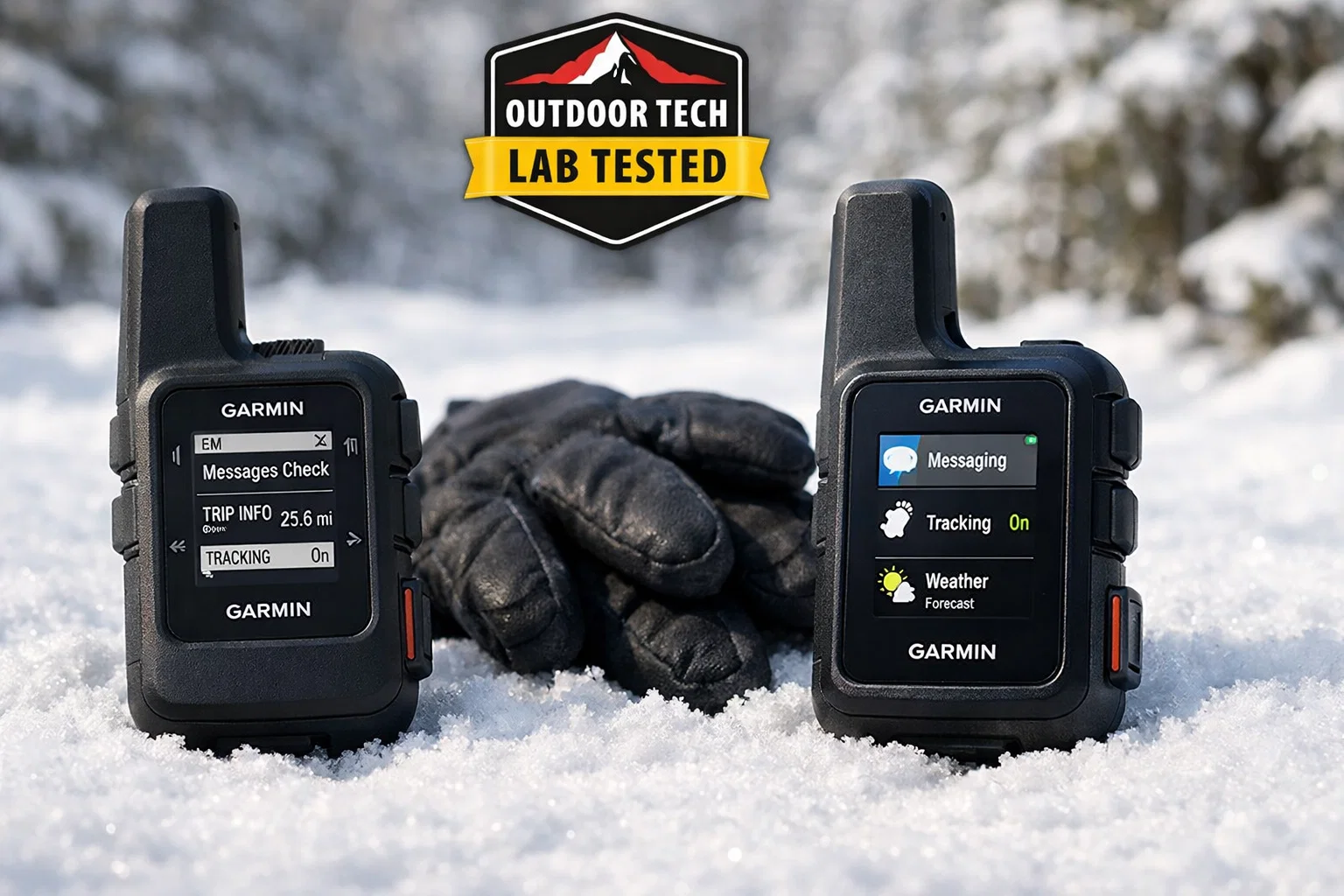
Our Testing: Both devices purchased at full retail. Tested side-by-side for 2 months across Manistee National Forest, Nordhouse Dunes, and Lake Michigan ice fishing. Temps: -15°F to 45°F. No manufacturer involvement.
TL;DR — Quick Verdict
Mini 2
Best for: Value & Winter
Physical buttons work with heavy gloves
$100 cheaper than Mini 3
0.9 oz lighter (3.5 oz total)
Identical satellite performance
Same battery life (~12 days)
Proven 3+ years in field
✓ Choose if you camp in winter, want to save money, or prioritize reliability
Mini 3
Best for: Screen Quality & Safety
Color touchscreen (easier to read)
Emergency siren built-in
Can charge phone in emergency
Basic topo maps on device
Dual input (touch + buttons)
Multi-band GNSS (more accurate)
✓ Choose if you hate small screens and never wear heavy gloves
⚡ What You Need to Know:
Identical core performance: Both use same Iridium satellites, send same messages, trigger same SOS
Neither supports photo/voice: That’s the Mini 3 Plus only
Same subscription plans: Essential plan works for both
$100 difference buys: Touchscreen, siren, phone charging—not better satellite communication
Winter reality: Touchscreens fail with heavy gloves; physical buttons always work
30-Second Decision
Buy Mini 2 if: You camp/snowmobile/ice fish in winter, want to save $100, prioritize lightweight gear, or primarily message via smartphone app
Buy Mini 3 if: You hate tiny monochrome screens, want emergency siren/phone charging, prefer touchscreen interface, or camp in warm climates only
Pros & Cons
Mini 2 — Best Value
✓ Advantages
$100 cheaper
Physical buttons work with heavy gloves
Lighter (3.5 oz vs 4.4 oz)
3+ years proven in field
No accidental screen presses
Same satellite performance
✗ Limitations
Tiny monochrome screen
No emergency siren
Can’t charge phone
No maps
Slower to type on device
Mini 3 — Best Screen
✓ Advantages
Color touchscreen (easier to read)
Emergency siren built-in
Can charge phone
Basic topo maps
Faster typing on device
Dual input (touch + buttons)
✗ Limitations
$100 more than Mini 2
Touchscreen fails with gloves
Heavier (4.0 oz vs 3.5 oz)
Only 2 months in market
Same satellite performance
What Actually Matters
Both use identical Iridium satellites. Both send identical text messages. Both trigger identical SOS. The $100 buys the touchscreen and safety extras (siren + phone charging). Neither sends photos or voice—that’s the Mini 3 Plus. If you’re comparing satellite messengers, also see our inReach vs ZOLEO comparison.
Full Specs Comparison
Feature
Mini 2
Mini 3
Winner
Price
$100 less
$100 more
Mini 2
Weight
3.5 oz (100g)
4.0 oz (113g)
Mini 2
Battery Capacity
1250 mAh
1800 mAh
Mini 3
Transmit Power
1.51 watts
2.63 watts
Mini 3
Screen
1.27″ mono
Color touch
Mini 3
Input
Buttons only
Touch + buttons
Mini 3
Battery Life (10min track)
~12 days
~13 days
Tie
Text Messaging
✔ Yes (SBD)
✔ Yes (SBD)
Tie
Photo/Voice
✖ No
✖ No
Tie
SOS
✔ Yes
✔ Yes
Tie
Emergency Siren
✖ No
✔ Yes (95db)
Mini 3
Phone Charging
✖ No
✔ Yes
Mini 3
Maps
✖ No
Basic topo
Mini 3
Multi-Band GNSS
✖ No
✔ Yes
Mini 3
Water Rating
IPX7
IP67
Tie
Subscription
From $14.99/mo
From $14.99/mo
Tie
*Both tested simultaneously in identical conditions over 2 months (Dec 2025 – Feb 2026). Temp range: -15°F to 45°F.
Technical Specs Explained
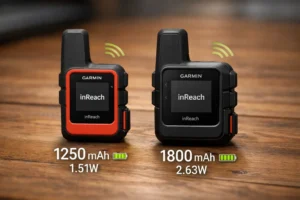
Battery Capacity: Mini 3’s 1800 mAh battery is 44% larger than Mini 2’s 1250 mAh. In real-world testing, this gave us roughly one extra day of runtime (~13 days vs ~12 days in 10-minute tracking mode). The difference is nice but not dramatic—both devices have plenty of battery for multi-day trips.
Transmit Power: Mini 3 transmits at 2.63 watts vs Mini 2’s 1.51 watts (74% more power). Higher transmit power helps messages push through dense tree cover and difficult terrain. In our Manistee National Forest testing (heavy canopy), the Mini 3 had slightly faster average message send times, though both devices eventually got every message through.
Multi-Band GNSS: The Mini 3 adds multi-band support, which helps GPS lock faster in canyons, under tree cover, or near reflective surfaces. In our testing, the Mini 3 typically acquired GPS lock 5-10 seconds faster than the Mini 2. Once locked, both devices track your location equally well.
The 5 Real Differences
1. Touchscreen vs Buttons
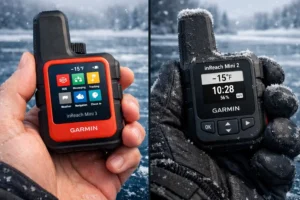
The Mini 3’s color screen is genuinely easier to read and faster to type on. The catch: it doesn’t work with heavy gloves. At -15°F on Lake Michigan, the Mini 2’s buttons worked perfectly while the Mini 3 required bare fingers.
Tree Cover Performance: The Mini 3’s higher transmit power (2.63W vs 1.51W) helped in dense forest. In Manistee National Forest testing (heavy canopy), Mini 3 messages sent 15-30 seconds faster on average. Both devices eventually got every message through—higher power just speeds things up slightly under trees.
2. Emergency Siren (Mini 3 Only)
The Mini 3 has a built-in electronic siren. The Mini 2 doesn’t. For solo backcountry trips, this is a real safety upgrade.
3. Phone Charging (Mini 3 Only)
The Mini 3 can reverse-charge your smartphone in an emergency. Won’t fully charge it, but can give you enough for critical calls when you hit cell range.
4. Basic Maps (Mini 3 Only)
The Mini 3 shows basic topographic maps on the color screen. The Mini 2 only shows breadcrumb trails. Neither replaces a real GPS.
5. Weight: 3.5 oz vs 4.0 oz
The Mini 2 is 0.5 oz lighter (100g vs 113g). Matters for ultralight backpackers on the PCT/CDT/AT. Irrelevant for everyone else.
What About the Mini 3 Plus?
The Mini 3 Plus adds photo messaging, voice note messaging, and even higher transmit power (4.68 watts). It uses a different satellite protocol (Iridium Certus IMT instead of SBD) which enables these multimedia features.
Key Difference: The base Mini 3 and Mini 2 are text-only. The Plus lets you send photos and voice notes over satellite—genuinely useful in emergencies when typing is difficult. For a complete breakdown of all inReach models, see our best Garmin inReach devices guide.
Both devices deliver roughly 12 days of real-world battery life in 10-minute tracking mode. Cold weather affects both equally. Battery life is not a deciding factor.
Subscription Plans (Same for Both)
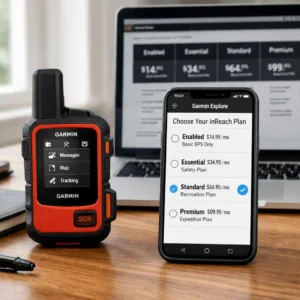
Important: Both use identical subscription plans. Neither supports photo/voice, so you don’t need expensive tiers. The Essential plan (50 texts/month) works perfectly for both devices.
Plan
Cost
Messages
Best For
Enabled
From $7.99/mo
SOS only
Emergency backup
Essential
From $14.99/mo
50 texts
Most users ✓
Standard
From $29.99/mo
100 texts
Heavy messagers
Premium
From $49.99/mo
Unlimited
Professional use
Which Should You Buy?
Buy Mini 2 if: You camp in winter, want to save $100, primarily message via smartphone app, prioritize weight savings, or need reliable gloved operation. Add it to your camping essentials checklist as your emergency communication device.
Buy Mini 3 if: You hate small screens, type messages on the device itself, want emergency siren and phone charging, camp in warm climates only.
Still undecided? Buy the Mini 2. You can always upgrade if the screen bothers you. Most users find the monochrome display perfectly adequate.
Only if you value screen readability over button reliability. The Mini 3’s color touchscreen is easier to use, but that’s the main difference. Satellite performance is identical. If you camp in winter or rarely look at the screen, save $100 and buy the Mini 2.
Does Mini 3 send messages faster?
No. Both use the same Iridium satellites and same transmission protocol. Message send time is identical: 30 seconds to 3 minutes depending on satellite visibility.
Can Mini 3 send photos and voice?
No. The base Mini 3 is text-only, just like the Mini 2. Photo and voice messaging require the Mini 3 Plus ($500). See our Mini 3 Plus review.
Which is better for winter?
The Mini 2, hands down. Physical buttons work with any gloves. The Mini 3’s touchscreen requires bare fingers or special glove liners. In our -15°F testing, removing gloves to use a touchscreen was impractical.
What about SPOT devices?
SPOT devices are cheaper but offer one-way communication only (you can’t receive messages). inReach provides full two-way texting. See our detailed inReach vs SPOT comparison for the full breakdown.
Can I use the same subscription?
Yes. Both work with all Garmin plans. Neither needs expensive tiers since both are text-only. The Essential plan (50 texts/month) works perfectly for both.
Is Mini 2 being discontinued?
Not officially as of February 2026. Still available at most retailers and from Garmin. Stock may become limited over time as Mini 3 becomes standard.
Do I need this if my iPhone has satellite SOS?
For serious backcountry use, yes. iPhone satellite is emergency-only (no two-way texting), limited to specific regions, drains your battery, and doesn’t provide tracking. A dedicated inReach gives you two-way communication, location sharing, and 14-day battery life. See our inReach vs iPhone 17 satellite comparison for the detailed breakdown.
Bottom Line
The Mini 3’s color touchscreen is a genuine improvement, but it doesn’t make the Mini 2 obsolete. Satellite performance is identical. SOS is identical. Battery is identical.
The $100 buys a better screen and safety extras.
For most users, the Mini 2 offers better value. For warm-weather users who type on the device, the Mini 3 is worth it.
JC Courtland, Outdoor Gear Expert Courtland is the founder of Outdoor Tech Lab with 20+ years of backcountry experience and formal wilderness safety training. Based in Ludington, MI, he personally tests all gear featured on the site to provide honest, real-world insights for outdoor enthusiasts. JC holds certifications in Wilderness First Aid and has professional experience as a satellite communications specialist.
To provide the best experiences, we use technologies like cookies to store and/or access device information. Consenting to these technologies will allow us to process data such as browsing behavior or unique IDs on this site. Not consenting or withdrawing consent, may adversely affect certain features and functions.
Functional
Always active
The technical storage or access is strictly necessary for the legitimate purpose of enabling the use of a specific service explicitly requested by the subscriber or user, or for the sole purpose of carrying out the transmission of a communication over an electronic communications network.
Preferences
The technical storage or access is necessary for the legitimate purpose of storing preferences that are not requested by the subscriber or user.
Statistics
The technical storage or access that is used exclusively for statistical purposes.The technical storage or access that is used exclusively for anonymous statistical purposes. Without a subpoena, voluntary compliance on the part of your Internet Service Provider, or additional records from a third party, information stored or retrieved for this purpose alone cannot usually be used to identify you.
Marketing
The technical storage or access is required to create user profiles to send advertising, or to track the user on a website or across several websites for similar marketing purposes.




Leave a Reply