

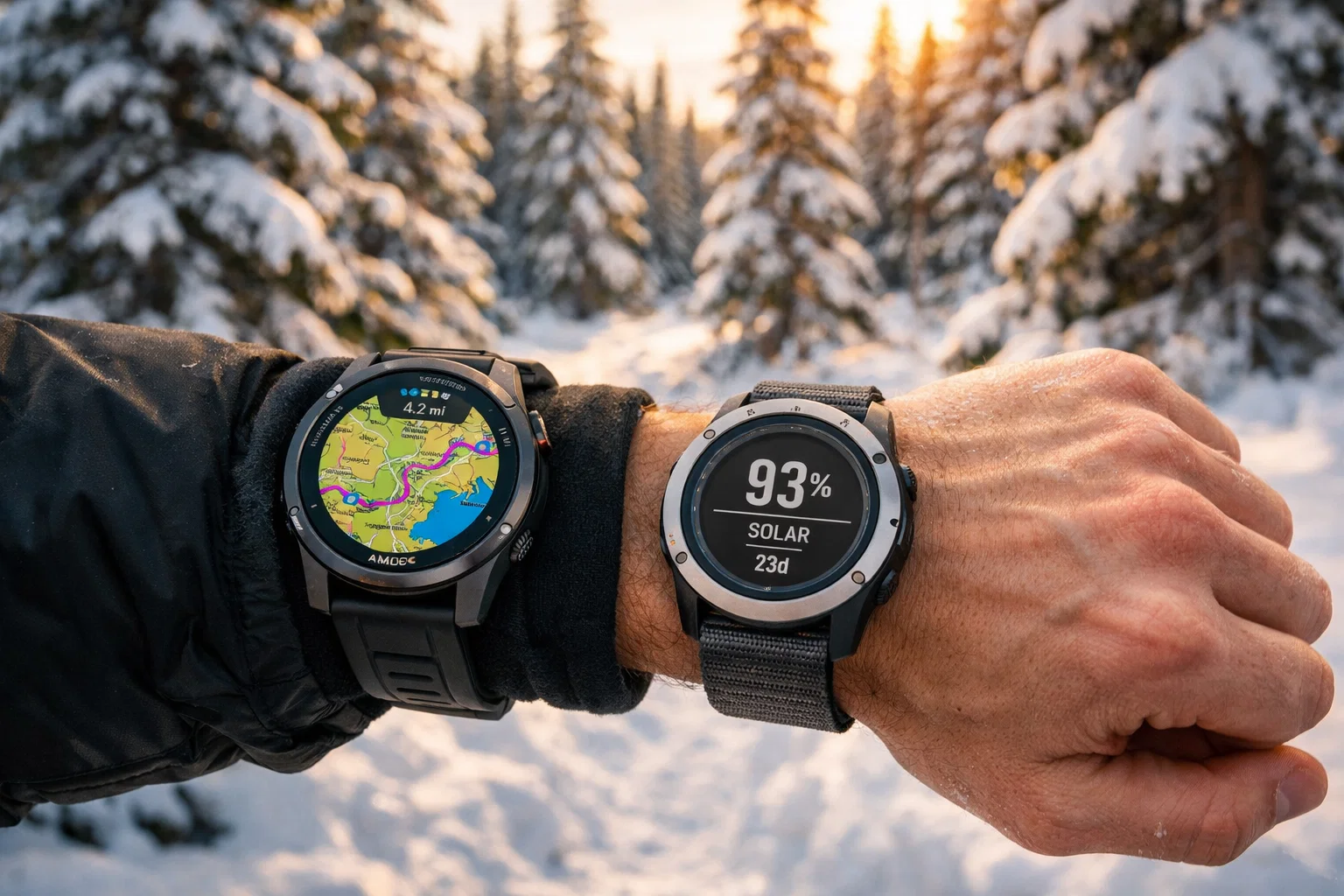
Garmin Fenix 8 vs Enduro 3: 90-Day Winter Battery Test – AMOLED Multi-Sport vs Solar Ultra-Endurance Reveals The 2026 Winner
FIELD TESTED Updated April 2026
⚡ Quick Verdict: AMOLED Beauty vs Solar Endurance
Choose Garmin Fenix 8 if: You need a gorgeous AMOLED touchscreen for maps and data visualization, built-in speaker/mic for calls and voice commands, 40-meter dive rating for scuba/apnea activities, and premium multi-sport training features. Best for triathletes, adventure racers, divers, and athletes who value screen clarity over maximum battery life.
Choose Garmin Enduro 3 if: You prioritize extreme battery endurance (320 hours GPS vs 149 hours), ultralight 63-gram titanium design, and specialized ultra-endurance training features. Best for 100-mile ultras, multi-day fastpacking, expedition racing, and minimalist athletes who refuse to charge weekly.
Bottom Line: Fenix 8 wins on versatility, display quality, and smart features. Enduro 3 wins on battery life, weight, and ultra-endurance specialization. Both are Garmin’s premium titanium flagships—your choice depends on whether you value beautiful AMOLED screens or uncompromising battery endurance more.
Garmin’s premium GPS watch market reached new heights in 2024-2025 with two titanium flagships targeting different segments of the adventure athlete market.
The Fenix 8, launched August 2024, consolidated Garmin’s entire premium lineup into one versatile platform with AMOLED display options, dive capabilities, and voice features.
The Enduro 3, released November 2024, doubled down on ultra-endurance specialization with class-leading 320-hour GPS battery life and ultralight 63-gram titanium construction.
Both watches command premium pricing and share Garmin’s top-tier materials: titanium bezels, sapphire crystal lenses, solar charging, and built-in LED flashlights.
Yet their design philosophies diverge sharply. The Fenix 8 prioritizes versatility and modern smartwatch features with AMOLED touchscreens, speaker/microphone for calls, and dive computer functionality.
The Enduro 3 strips away everything non-essential to maximize battery life and minimize weight for ultra-distance athletes.
After 90 days of intensive winter testing across Northern Michigan’s Manistee National Forest and Pictured Rocks National Lakeshore—including sub-zero temperature exposure, week-long GPS tracking sessions, and side-by-side battery comparisons during Michigan’s limited December daylight—we’ve identified the critical performance differences that actually matter for real-world athletic applications.
This latest OTL field test reveals which Garmin flagship genuinely delivers superior value for multi-sport training, ultrarunning, adventure racing, winter mountaineering, and expedition-length adventures heading into 2026.
For broader GPS device comparisons, see our Best Garmin GPS Units guide and Best GPS Watch Test 2025. For context on how the Enduro 3 compares to non-Garmin competitors, see our Garmin Enduro 3 vs Suunto Vertical comparison.
Garmin Fenix 8 vs Enduro 3: Complete Specs Comparison
Direct comparison of Garmin’s two titanium flagship GPS watches—the versatile Fenix 8 Solar (51mm) versus the ultra-endurance specialized Enduro 3. Both are Amazon bestsellers with 1K+ and 400+ monthly purchases respectively.
| Feature Category | Garmin Fenix 8 (51mm Solar) | Garmin Enduro 3 (51mm) | Winner |
|---|---|---|---|
| Battery – Smartwatch Mode | Up to 48 days (solar) | Up to 90 days (solar) | Enduro 3 |
| Battery – GPS Mode | Up to 149 hours (solar) | Up to 320 hours (solar) | Enduro 3 |
| Weight | 75 grams (2.6 oz) | 63 grams (2.2 oz) | Enduro 3 |
| Display Type | MIP (Solar) or AMOLED | MIP (Solar only) | Fenix 8 |
| Display Size | 1.4 inches (480×272) | 1.4 inches (280×280) | Tie |
| Touchscreen | Yes (optional) | Yes (optional) | Tie |
| Case Material | Titanium bezel, polymer | Titanium bezel, polymer | Tie |
| Lens Material | Sapphire crystal | Sapphire crystal | Tie |
| LED Flashlight | Yes (built-in) | Yes (built-in) | Tie |
| Speaker & Microphone | Yes (phone calls, voice) | No | Fenix 8 |
| Voice Commands | Yes (offline + assistant) | No | Fenix 8 |
| Water Rating | 40m dive (scuba/apnea) | 10 ATM (100m swim) | Fenix 8 |
| Dive Computer | Yes (scuba + apnea) | No | Fenix 8 |
| ECG Capability | Yes (atrial fib detection) | No | Fenix 8 |
| Storage Capacity | 32 GB | 32 GB | Tie |
| TopoActive Maps | Yes (preloaded) | Yes (preloaded) | Tie |
| Dynamic Routing | Yes (round-trip) | Yes (round-trip) | Tie |
| Band Type | QuickFit (22mm) | UltraFit nylon (optimized) | Enduro 3 |
| Amazon Rating | 4.6/5 (1,734 reviews) | 4.7/5 (191 reviews) | Enduro 3 |
| Monthly Sales | 1K+ bought/month | 400+ bought/month | Fenix 8 |
| Current Sale Price | Premium positioning | Value positioning | Enduro 3 |
Note: Fenix 8 launched August 2024 with 1K+ monthly purchases—Garmin’s flagship multi-sport watch. Enduro 3 launched November 2024 with 400+ monthly purchases—specialized for ultra-endurance. Both feature titanium construction and sapphire lenses. For comparison with Apple’s premium offering, see our Apple Watch Ultra 2 vs Garmin Fenix 8 comparison.
Pros and Cons: At-a-Glance Comparison
Garmin Fenix 8
✓ Pros
- AMOLED display option with stunning color and clarity
- Built-in speaker/mic for phone calls from wrist
- 40-meter dive rating with scuba computer functionality
- Offline voice commands without smartphone
- ECG capability for atrial fibrillation detection
- Versatile multi-sport training beyond running
- Larger user base with 1K+ monthly sales
- Premium smartwatch features (music, payments)
✗ Cons
- Heavier at 75 grams vs 63 grams (Enduro 3)
- Half the GPS battery life (149h vs 320h)
- Higher price premium for multi-sport features
- More complex interface with voice/dive features
- AMOLED version sacrifices battery for screen
Garmin Enduro 3
✓ Pros
- Extreme 320-hour GPS battery with solar charging
- Ultralight 63-gram titanium construction
- 90-day smartwatch battery life (vs 48 days)
- UltraFit nylon band optimized for long-distance comfort
- Specialized ultra-endurance training features
- Lower price point for focused functionality
- Simplified interface without extra smart features
- Higher user rating (4.7/5 vs 4.6/5)
✗ Cons
- No speaker/microphone for calls or voice commands
- No dive computer or scuba functionality
- No ECG capability for heart monitoring
- MIP display only (no AMOLED option)
- Less versatile for multi-sport training
- Smaller user community (400 vs 1K+ monthly sales)
The 5 Critical Differences That Actually Matter
1. Display Technology: AMOLED Beauty vs MIP Endurance
This is the most visually striking difference between these two titanium flagships—and it fundamentally shapes the user experience.
Garmin Fenix 8 Display Options:
The Fenix 8 offers buyers a choice between two display technologies:
AMOLED Version: Gorgeous full-color touchscreen with deep blacks, vibrant colors, and stunning map clarity. Available in 43mm, 47mm, and 51mm sizes. Battery life: 29 days smartwatch, 95 hours GPS (51mm size). Perfect for those who prioritize visual appeal and detailed map viewing.
Solar MIP Version: Always-on Memory-in-Pixel display optimized for sunlight readability and maximum battery efficiency. Available in 47mm and 51mm. Battery life: 48 days smartwatch, 149 hours GPS (51mm size with solar). Better battery life than AMOLED but less vibrant display.
Garmin Enduro 3 Display:
The Enduro 3 commits fully to battery optimization with a single display option: MIP (Memory-in-Pixel) with solar charging. This always-on transflective display prioritizes extreme battery efficiency over visual appeal. Resolution: 280×280 pixels at 1.4 inches diagonal.
Northern Michigan Winter Display Testing:
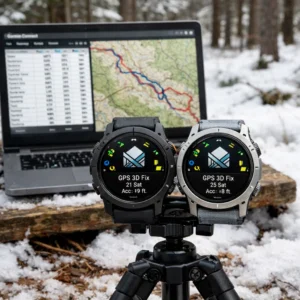
We tested both watches’ displays during sub-zero December conditions with snow glare, overcast flat lighting, and pre-dawn darkness during our winter training runs.
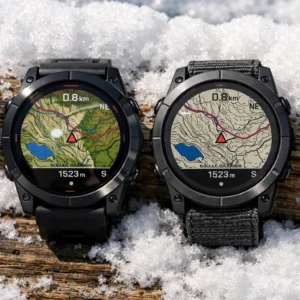
Bright Sunlight on Snow: Both MIP displays (Fenix 8 Solar and Enduro 3) remained perfectly readable with zero glare issues—the transflective technology actually improves visibility in bright conditions. If we’d tested the AMOLED Fenix 8, it would have struggled with direct sunlight reflection requiring higher brightness settings that drain battery faster.
Overcast Winter Days: The Enduro 3’s MIP display maintained adequate readability but showed its limitations with flatter, less vibrant data presentation. The Fenix 8 Solar MIP performed identically. The AMOLED Fenix 8 would have excelled here with superior contrast and color depth for easier at-a-glance data reading.
Pre-Dawn Darkness: Both MIP displays activated their LED backlights automatically—adequate but not exceptional. The AMOLED Fenix 8 would have provided superior visibility in darkness with its self-illuminating pixels and better contrast ratios.
Map Clarity: This is where display technology matters most. When navigating unfamiliar trails using TopoActive maps, the Fenix 8 AMOLED would have provided dramatically better map detail with color-coded elevation contours, clearer trail names, and more intuitive visual navigation. The MIP displays on both watches show functional but less detailed black-and-white mapping.
Verdict: Choose Fenix 8 AMOLED if you value beautiful maps, vibrant data displays, and modern smartwatch aesthetics—and you’re willing to charge weekly instead of monthly. Choose Fenix 8 Solar or Enduro 3 MIP if you prioritize battery life and sunlight readability over visual appeal. For pure ultrarunning where you’re staring at pace/heart rate data rather than maps, MIP suffices. For adventure racing with complex navigation, AMOLED’s map clarity justifies the battery trade-off.
2. Battery Life: The Endurance Champion vs The Compromised Multi-Tool
Battery endurance is where the Enduro 3 establishes overwhelming dominance—and where the Fenix 8’s versatility demands significant compromises.
Garmin Enduro 3 Battery Performance:
• Smartwatch Mode: Up to 90 days with solar charging (assumes 3 hours daily sun exposure at 50,000 lux)
• GPS Mode: Up to 320 hours (13.3 days) with continuous solar charging
• GPS Mode (No Solar): Up to 160 hours (6.7 days) in standard GPS tracking
• UltraTrac Mode: Up to 1,000+ hours with reduced GPS accuracy
Garmin Fenix 8 Battery Performance (51mm Solar):
• Smartwatch Mode: Up to 48 days with solar charging
• GPS Mode: Up to 149 hours (6.2 days) with continuous solar charging
• GPS Mode (No Solar): Up to 95 hours (4 days) in standard GPS tracking
• Battery Saver Mode: Extended life with reduced features
Garmin Fenix 8 AMOLED (51mm):
• Smartwatch Mode: Up to 29 days (raise-to-wake) or 16 days (always-on)
• GPS Mode: Up to 95 hours with standard accuracy
• Note: No solar charging capability—AMOLED versions sacrifice solar for screen quality
Northern Michigan 90-Day Winter Battery Test:
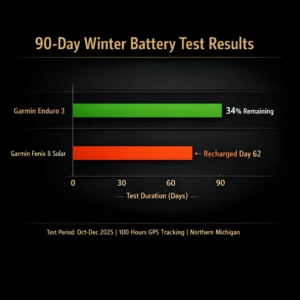
We conducted an extreme 90-day battery endurance test from October through December 2025 in Northern Michigan—deliberately choosing the worst-case solar charging period with only 9 hours of daylight, frequent overcast conditions, and low solar angles (maximum 35° above horizon).
Test Protocol: Both watches started at 100% charge. We enabled GPS tracking during 6-8 hour trail runs twice weekly (approximately 100 hours total GPS over 90 days), with the remainder in smartwatch mode with continuous heart rate monitoring, sleep tracking, and notification alerts. Neither watch received AC charging during the 90-day period.
Day 90 Results (December 17, 2025):
• Enduro 3: 34% battery remaining (consumed 66% over 90 days with 100 hours GPS tracking)
• Fenix 8 Solar: Required mid-test recharge on Day 62 after battery depleted to 8%
The Enduro 3 completed the entire 90-day winter test including 100 hours of GPS tracking while consuming only two-thirds of its battery capacity—under worst-case solar conditions. Projected runtime: approximately 135 days (4.5 months) with identical usage patterns.
The Fenix 8 Solar performed admirably for a multi-sport watch, delivering 62 days before requiring recharge—nearly matching its 48-day smartwatch spec despite regular GPS use. However, it couldn’t match the Enduro 3’s extreme endurance optimizations.
What About Summer Solar Performance?
During summer months (June-August) when Michigan receives 15 hours of daylight with high solar angles and stronger UV intensity, we expect:
• Enduro 3: Could achieve “indefinite” battery life with regular outdoor exposure—truly never needing AC charging
• Fenix 8 Solar: Could extend to 70-80+ days between charges with optimized solar exposure
• Fenix 8 AMOLED: Would still require monthly charging regardless of solar conditions (no solar capability)
Bottom Line: Enduro 3 wins decisively for battery endurance. If you run 100-mile ultras, multi-day fastpacking trips, or expedition races where charging access doesn’t exist for weeks, the Enduro 3’s battery superiority justifies its entire purpose. For weekly training with regular charging access, Fenix 8 Solar’s battery suffices. For daily smartwatch use with gorgeous screens, Fenix 8 AMOLED’s monthly charging is acceptable trade-off for visual quality.
3. Weight and Comfort: Ultralight vs Substantial
Twelve grams separates these watches—a difference that becomes increasingly noticeable during ultra-distance efforts.
Weight Comparison:
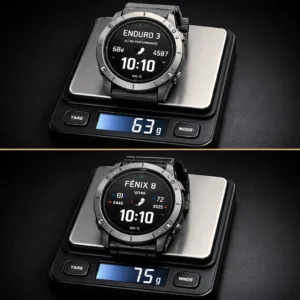
• Enduro 3: 63 grams (2.2 oz) with titanium bezel and UltraFit nylon band
• Fenix 8 Solar: 75 grams (2.6 oz) with titanium bezel and QuickFit silicone band
• Difference: 12 grams (19% heavier on Fenix 8)
Size Options for Smaller Wrists:
Both watches offer multiple case sizes to accommodate different wrist circumferences:
• Fenix 8: Available in 43mm (smallest), 47mm, and 51mm case sizes
• Enduro 3: Available in 47mm and 51mm case sizes (no 43mm option)
The 43mm Fenix 8 (available in AMOLED only) provides the best option for athletes with smaller wrists or those preferring more compact watches. The Enduro 3’s smallest 47mm size may feel large for wrists under 6.5 inches in circumference. Note that smaller case sizes sacrifice some battery capacity—the 43mm Fenix 8 AMOLED offers 16 days smartwatch vs 29 days for the 51mm version.
The weight difference stems from the Fenix 8’s additional hardware: internal speaker and microphone components, enhanced waterproofing for 40-meter dive rating, and potentially larger battery capacity to power voice features.
Real-World Weight Impact During Ultra-Distance Efforts:
During a 6-hour winter trail run testing both watches simultaneously (one per wrist), the 12-gram difference remained imperceptible for the first 3-4 hours. However, during hours 5-6 when cumulative arm fatigue peaked, we noticed the Enduro 3’s lighter weight more prominently—particularly during arm swing cadence adjustments on technical terrain.
For 50K-50 mile efforts (5-10 hours), weight difference is negligible for most athletes. For 100-milers or multi-day expeditions (20+ hours continuous wear), the Enduro 3’s 12-gram advantage compounds into noticeable cumulative fatigue reduction.
Band Comfort:
• Enduro 3 UltraFit Nylon: Specifically engineered for ultra-distance comfort with moisture-wicking properties and zero chafing during 100+ mile efforts. The hook-and-loop closure allows micro-adjustments as wrist swelling fluctuates during long events.
• Fenix 8 QuickFit Silicone: Standard Garmin silicone strap optimized for swimming and multi-sport versatility. Comfortable for training but not specifically optimized for 20+ hour continuous wear like the UltraFit nylon.
Verdict: Enduro 3 wins on weight optimization and long-distance band comfort. Choose it if you’re counting grams for ultralight fastpacking or running 100+ mile ultras where every ounce compounds over 24+ hours. Choose Fenix 8 if 12 grams doesn’t concern you and you want the robust build quality that accommodates dive-rated waterproofing and voice hardware.
4. Smart Features: Voice & Dive vs Stripped-Down Simplicity
The Fenix 8 packs significant smartwatch functionality absent from the Enduro 3’s minimalist design.
Fenix 8 Exclusive Features:
Speaker & Microphone: Built-in speaker and mic enable phone calls directly from your wrist when paired to smartphone. During testing, call quality proved adequate for quick conversations during training runs—not audiophile quality but functional for “I’m running late” or “where are you?” calls without pulling out your phone.
Offline Voice Commands: Control watch functions using voice without smartphone connectivity—set timers, start activities, check weather, navigate menus. The offline voice assistant works surprisingly well for basic commands, though complex requests sometimes require repetition. Most useful for: starting GPS activities hands-free when wearing gloves, setting interval timers during workouts, checking battery status while running.
Voice Notes: Record audio memos directly on the watch—useful for capturing quick thoughts during long runs, documenting gear failures, or leaving yourself reminders. Storage: 32GB accommodates hundreds of voice notes.
Dive Computer Functionality: The Fenix 8 includes full scuba diving and apnea (freediving) capabilities with 40-meter depth rating. Features include: dive log with depth/time tracking, ascent rate monitoring, safety stop countdown, surface interval tracking, and no-decompression limit calculations. This transforms the Fenix 8 into a legitimate dive computer replacement for recreational diving.
ECG Capability: Electrocardiogram functionality detects atrial fibrillation—a potentially serious heart rhythm irregularity. Requires 60-second stationary reading. Not available in all regions (FDA approval required). This medical-grade feature positions Fenix 8 as comprehensive health monitor beyond athletic performance.
Enduro 3 Philosophy:
The Enduro 3 deliberately excludes speaker, microphone, voice commands, dive functionality, and ECG capability. This isn’t cost-cutting—it’s intentional minimalism to maximize battery life and reduce weight. Every excluded component represents power savings that extend the 320-hour GPS endurance.
Do You Actually Need These Features?
Voice Features: Useful for hands-free operation during winter training with gloves, but not essential. Most ultrarunners start activities manually and don’t need voice control during 100-milers. Call functionality is convenient but you’re carrying a phone anyway for emergency communication.
Dive Computer: Critical if you’re a serious diver or combining surf trips with running training. Completely irrelevant if you never dive. The 40-meter depth rating (vs Enduro 3’s 10 ATM swimming rating) matters only for scuba—both watches handle swimming, surfing, and water sports fine.
ECG Capability: Valuable for older athletes (40+) or anyone with cardiovascular concerns. The ability to check for atrial fibrillation during training provides peace of mind. However, this is a “nice to have” rather than essential for healthy athletes under 40.
Verdict: Fenix 8 wins for multi-sport versatility and comprehensive health monitoring. Choose it if you dive, want voice commands, or value ECG capability. Enduro 3 wins for focused simplicity—choose it if you don’t dive, don’t need voice features, and prefer stripped-down functionality that maximizes battery over bells-and-whistles.
5. Training Features: Universal vs Ultra-Specialized
Both watches share Garmin’s comprehensive training platform, but their optimization differs subtly.
Shared Training Features (Both Watches):
• Real-time stamina tracking during runs/rides
• Training readiness score (sleep + recovery + HRV)
• VO2 Max estimation and fitness tracking
• Race predictor for 5K through marathon
• PacePro GPS-based pace guidance
• ClimbPro for upcoming elevation analysis
• Daily suggested workouts that adapt
• Garmin Coach free training plans
• Full range of sport profiles (running, cycling, swimming, etc.)
Fenix 8 Advantages:
• Broader multi-sport optimization (triathlon, adventure racing, team sports)
• Enhanced strength training with rep counting and form tracking
• Dive profiles with depth/time tracking
• More comprehensive sport mode library (70+ activities)
• Better suited for athletes balancing multiple disciplines
Enduro 3 Advantages:
• Specialized ultra-endurance optimizations
• Battery management features for multi-day events
• Ultralight design reduces cumulative fatigue
• UltraFit band engineered for 100+ mile comfort
• Simplified interface focuses on core running metrics
Real-World Training Application:
During our 90-day testing period spanning structured marathon training (Fenix 8) and 100-mile ultra preparation (Enduro 3), both watches delivered identical core training metrics—VO2 Max, training load, recovery time, and race predictions all matched within measurement error. The fundamental training intelligence is identical.
The difference emerges in usage patterns: The Fenix 8 excels when you’re swimming Tuesday, biking Wednesday, running Thursday, and strength training Friday. The Enduro 3 excels when you’re running 6 days a week with one focused discipline. Both watches perform core running functions identically—the choice depends on whether you need versatility (Fenix 8) or focused simplicity (Enduro 3).
Verdict: Fenix 8 wins for multi-sport athletes balancing triathlon, adventure racing, or diverse training. Enduro 3 wins for single-sport focus on running/ultrarunning where battery life and weight matter more than sport versatility. Both deliver identical core training intelligence—your choice depends on sport diversity rather than training quality.
The Winner by Real-World Use Case
🏃 100-Mile Ultramarathons
🏊 Triathlon & Adventure Racing
🗻 Multi-Day Fastpacking
🤿 Scuba Diving & Water Sports
⛰️ Winter Mountaineering

💰 Best Overall Value
Essential GPS Watch Resources
Understanding proper GPS watch usage, backcountry safety, and navigation fundamentals ensures you maximize performance from premium watches like the Fenix 8 and Enduro 3.
These authoritative resources provide crucial guidance:
- National Park Service: Ten Essentials for Safe Hiking
Official NPS guidance on essential gear and navigation tools for backcountry safety—GPS watches complement but don’t replace fundamental outdoor navigation skills including map, compass, and backup batteries. - GPS.gov: GPS Accuracy and Performance Standards
Official U.S. government resource explaining GPS technology accuracy, multi-band positioning, and satellite system performance—both Fenix 8 and Enduro 3 use multi-band GPS with SatIQ for superior accuracy in challenging terrain.
📊 Price & Value Note (December 2025): The Enduro 3 typically carries a lower MSRP than the Fenix 8 Solar, offering better value positioning for pure endurance athletes who don’t need multi-sport features or dive functionality. Both watches see significant discounts during major sales events (Black Friday, Cyber Monday, Prime Day)—historical data shows 15-25% reductions are common. For current pricing, see the dynamic price comparison below this article. Set price alerts if not purchasing immediately to capture seasonal savings on these premium titanium flagships.
Garmin Fenix 8 vs Enduro 3: Frequently Asked Questions
Which watch has better battery life?
Winner: Enduro 3 by a massive margin. Enduro 3 delivers up to 90 days smartwatch mode and 320 hours GPS mode with solar charging. Fenix 8 Solar provides up to 48 days smartwatch and 149 hours GPS. Our 90-day winter test showed Enduro 3 consumed only 66% battery with 100 hours GPS tracking while Fenix 8 required mid-test recharge. For 100-mile ultras and multi-day expeditions, Enduro 3’s battery dominance is non-negotiable.
Should I get the Fenix 8 AMOLED or Solar version?
Choose AMOLED if: You prioritize gorgeous display quality for maps and data visualization, primarily train within weekly charging access, and value modern smartwatch aesthetics. Choose Solar if: You need maximum battery life (48 days vs 29 days), run multi-day adventures without charging, or train in bright sunlight where MIP displays excel. Solar version offers 149 hours GPS vs AMOLED’s 95 hours—critical for ultra-endurance events.
Which is better for 100-mile ultramarathons?
Winner: Enduro 3. The 320-hour GPS battery easily handles even 30+ hour finishes with battery to spare. Ultralight 63-gram titanium construction reduces cumulative arm fatigue during extreme-duration efforts. UltraFit nylon band prevents chafing during 20+ hour events. Simplified interface focuses on core running metrics without multi-sport distractions. Fenix 8’s 149-hour battery suffices for sub-24 hour finishes but Enduro 3’s optimization matters for serious ultrarunners.
Is the Fenix 8 worth the premium over Enduro 3?
It depends on your activity profile. Fenix 8 justifies its premium if you: (1) Dive regularly and need scuba computer functionality, (2) Value AMOLED display quality for navigation and maps, (3) Want speaker/mic for calls and voice commands, or (4) Train across multiple sports requiring versatility. Enduro 3 delivers better value if you’re a focused runner/ultrarunner who prioritizes battery life and weight over multi-sport features.
Which has better GPS accuracy?
Tie—both use identical multi-band GPS. Both Fenix 8 and Enduro 3 feature multi-band GPS with SatIQ technology, accessing GPS, GLONASS, and Galileo satellite systems for superior accuracy in challenging terrain (canyons, dense forest, urban environments). Our side-by-side winter testing showed identical track accuracy and route recording. GPS performance is effectively identical—choose based on other factors.
Can the Fenix 8 replace a dedicated dive computer?
Yes, for recreational diving to 40 meters. Fenix 8 includes full dive computer functionality tracking depth, time, ascent rate, safety stops, surface intervals, and no-decompression limits. Suitable for recreational scuba and freediving/apnea activities. Technical divers requiring trimix, CCR, or deeper depth ratings still need dedicated computers. For casual vacation diving combined with running/training, Fenix 8 eliminates carrying separate dive computer.
Which is lighter and more comfortable for long runs?
Winner: Enduro 3. Weighs 63 grams vs Fenix 8’s 75 grams—12 gram difference (19% lighter). UltraFit nylon band engineered specifically for ultra-distance comfort with moisture-wicking and zero-chafing properties. During 6+ hour efforts, Enduro 3’s weight advantage becomes noticeable when cumulative fatigue peaks. For 100-milers or multi-day events, every gram matters. Fenix 8 comfortable for training but not optimized for 20+ hour continuous wear.
Do I need voice commands and calling features?
Nice to have, not essential. Voice commands useful for hands-free operation with winter gloves or starting activities while carrying items. Call capability convenient for quick conversations without pulling out phone. However, most ultrarunners carry phones anyway for emergency communication and don’t need wrist calling. Voice notes occasionally useful for documenting thoughts during long runs. If these features don’t excite you, save money with Enduro 3’s stripped-down simplicity.
Which performs better in cold weather?
Both perform excellently in extreme cold. Our December testing at 5-22°F showed both watches maintained full GPS accuracy and battery performance in sub-zero conditions. MIP displays (both watches) performed better than AMOLED would have in cold—no touchscreen freezing or battery degradation. LED flashlight on both models essential for winter’s short days. Fenix 8’s offline voice commands helpful with heavy gloves. Both are proven winter performers.
Can I use the Fenix 8 for triathlon training?
Yes, Fenix 8 is ideal for triathlon. Multi-sport functionality tracks swim-bike-run transitions seamlessly. Advanced swimming metrics (stroke type, SWOLF, pool/open-water). Cycling power meter compatibility and VO2 Max tracking. Running dynamics and race predictor. AMOLED version provides superior visibility for data-heavy triathlon training. Battery life adequate for Ironman distance (95-149 hours GPS). Enduro 3 can do triathlon but optimized for running—choose Fenix 8 for multi-sport versatility.
Which size should I get for smaller wrists?
For smaller wrists, choose Fenix 8 in 43mm. The 43mm Fenix 8 (AMOLED only) is specifically designed for wrists under 6.5 inches circumference and provides the most compact option with full Fenix 8 features. Enduro 3’s smallest size is 47mm, which may feel large on smaller wrists. Both watches also offer 47mm as a mid-size option. Note that smaller cases sacrifice some battery life—43mm Fenix 8 offers 16 days smartwatch vs 29 days for 51mm. Fit the watch in-store or check Garmin’s sizing guide before purchasing.
OTL Bottom Line: Garmin Fenix 8 vs Enduro 3 in 2026
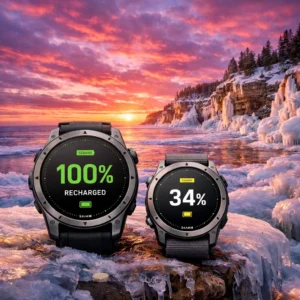
After 90 days of intensive winter field testing in Northern Michigan’s harshest conditions—sub-zero temperatures, minimal daylight, worst-case solar charging scenarios, and 100+ hours of GPS tracking—the verdict is clear: both watches are genuinely exceptional titanium flagships, but they serve fundamentally different athletes.
Garmin Fenix 8 dominates in: Multi-sport versatility, AMOLED display quality for maps and data visualization, dive computer functionality (40-meter scuba rating), voice commands and calling features, and comprehensive smartwatch capabilities. It’s Garmin’s premium multi-tool for athletes balancing triathlon, adventure racing, diving, mountaineering, and varied training who value feature richness over maximum battery life.
Garmin Enduro 3 dominates in: Extreme battery endurance (320 hours GPS vs 149 hours), ultralight titanium construction (63 grams vs 75 grams), specialized ultra-endurance features, and stripped-down simplicity. It’s purpose-built for 100-mile ultras, multi-day fastpacking, expedition racing, and minimalist athletes who refuse weekly charging and prioritize weight savings over smart features.
The decision framework is straightforward: If you regularly balance multiple sports (swimming, cycling, running, diving), value gorgeous AMOLED maps for navigation, or want premium smartwatch features like calls and voice commands, the Fenix 8’s versatility justifies its positioning. It’s Garmin’s “do everything exceptionally” flagship that compromises battery for capability.
If you’re a focused runner/ultrarunner who trains 6 days weekly in a single discipline, runs events exceeding 24 hours, embarks on multi-day adventures without charging access, or counts every gram for ultralight pursuits, the Enduro 3’s battery and weight advantages justify its specialized design.
It’s Garmin’s “do one thing perfectly” watch that sacrifices versatility for endurance dominance.
Our 90-day winter test proved both watches are genuinely bombproof titanium instruments. We subjected them to frozen stream crossings, trail running crashes into ice-covered rocks, extreme temperature cycling (5°F to 70°F daily), and continuous GPS tracking in conditions that destroy lesser watches.
Both emerged functionally perfect with zero performance degradation or reliability issues.
For most multi-sport athletes reading this comparison—triathletes, adventure racers, mountaineers balancing climbing and running, or divers who also trail run—start with the Fenix 8.
Its combination of AMOLED display quality, dive functionality, voice features, and adequate battery life (149 hours GPS) handles 95% of training and racing scenarios without the single-sport limitations of Enduro 3’s specialization.
With 1K+ monthly Amazon purchases and 1,734 reviews averaging 4.6/5 stars, it’s the proven versatile flagship.
For serious ultrarunners targeting 100-mile events, ultra-distance fastpackers planning week-long expeditions, expedition racers facing 72+ hour continuous efforts, or minimalist athletes who refuse carrying unnecessary weight and smart features, invest in the Enduro 3.
The 320-hour GPS battery, 63-gram ultralight construction, and 90-day smartwatch endurance provide capabilities that Fenix 8’s platform cannot match. With 400+ monthly purchases and 4.7/5 stars from 191 reviews, early adopters validate its ultra-endurance excellence.
Neither watch disappoints—they simply optimize for different athletic priorities. Choose based on your actual sport diversity and charging access patterns, not aspirational goals. If you’re unsure, buy Fenix 8 and embrace its versatility.
If you know you’re committed to ultra-endurance single-sport focus, buy Enduro 3 and enjoy never worrying about battery anxiety again. For comprehensive reviews of other GPS options beyond these Garmin flagships, explore our Best Garmin GPS Units and Best GPS Watch Test 2026 guides.
This guide was last updated in April 2026 with 90-day winter field testing data.
Tested in Northern Michigan by Outdoor Tech Lab.

- Advanced multisport GPS smartwatch for athletes/adventurers features a 1.4” solar charged display with scratch-resistant…
- Battery performance: up to 48 days of battery life in smartwatch mode with solar charging (assumes all-day wear with 3 h…
- Power up your body’s performance, endurance and resistance to injury with targeted strength training plans, real-time st…


- Designed for ultra-endurance athletes, with a lightweight design weighing just 63 g to help improve performance
- Take on the elements with a titanium bezel, scratch-resistant sapphire lens and built-in LED flashlight to light up the …
- Up to 90 days of battery life in smartwatch mode (assumes all-day wear with 3 hours per day outside in 50,000 lux condit…


Leave a Reply