Backcountry Pulse · OutdoorTechLab.com · March 2026
EcoFlow has unveiled its EcoFlow 2026 lineup of portable power stations, headlined by the heavy-duty DELTA Pro Ultra X for whole-home backup and the portable DELTA 3 series. Across the board, new models ship with lithium iron phosphate (LFP) batteries rated to 4,000 cycles — a meaningful durability gain — along with faster UPS switching and deeper smart home energy management.
4,000LFP cycle rating on new 2026 models — to 80% capacity
<10msUPS switchover on DELTA 3 series, down from 30ms on older DELTA gen
12kWOutput from a single DELTA Pro Ultra X; scales to 36kW with 3 units
25%Above industry standard cycle life per EcoFlow’s published spec
EcoFlow 2026 Lineup: What’s New
⚡ EcoFlow DELTA Pro Ultra X — Whole-Home Flagship
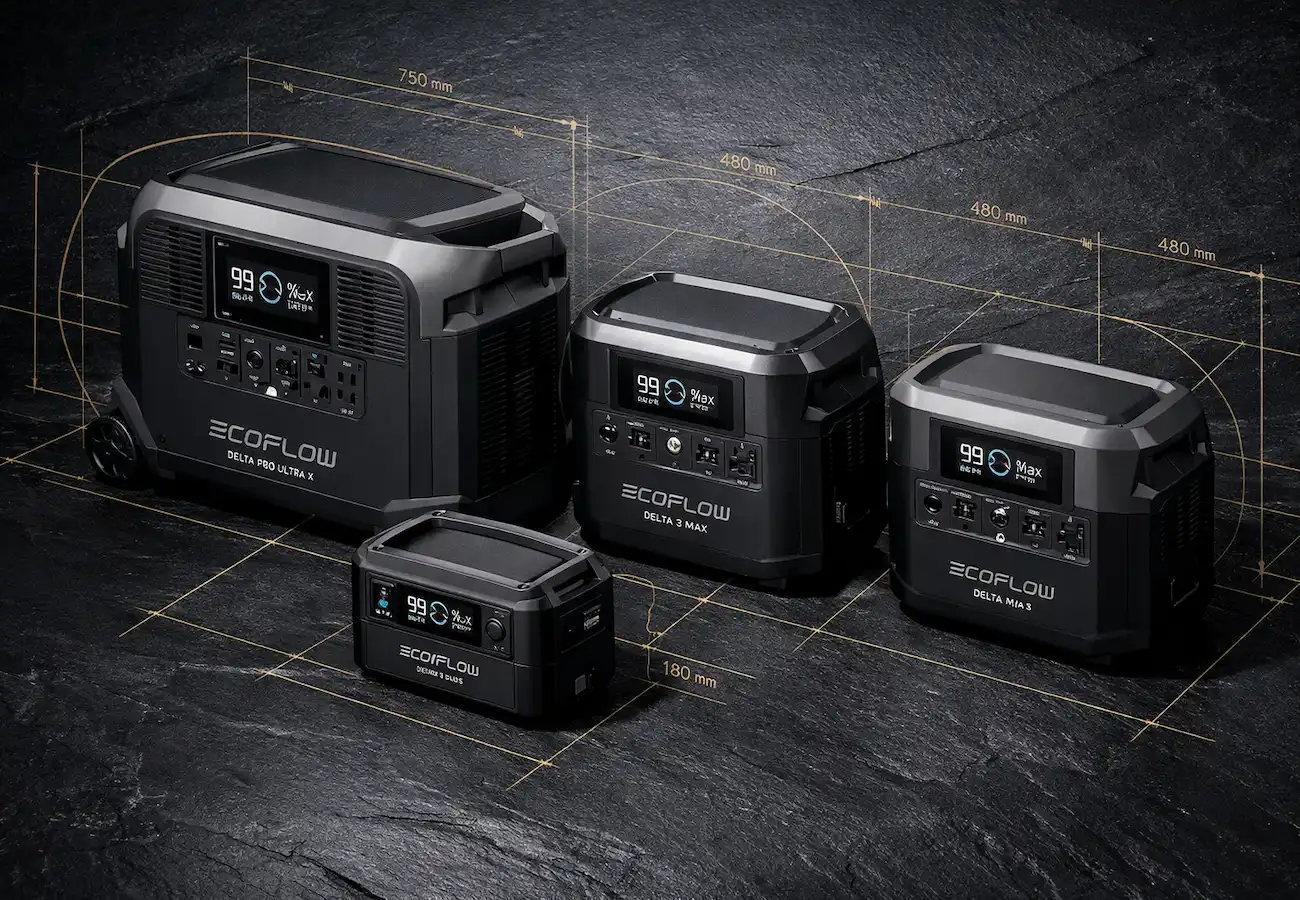
The DELTA Pro Ultra X delivers 12kW of continuous AC output from a single inverter unit, with base capacity of 12kWh expandable to 180kWh via up to 30 plug-in batteries. Three units connected in parallel scale total output to 36kW — enough for whole-home loads including a 5-ton central AC. The system is designed for professional installation alongside EcoFlow’s Smart Home Panel 3 or Smart Gateway.
UPS switchover is rated at under 10ms when operating as a standalone unit. When paired with the Smart Home Panel 3 or Smart Gateway for full home integration, that number shifts to under 20ms. Solar input tops out at 10kW — enough to recharge the 12kWh base unit to 80% in approximately one hour per EcoFlow’s published figures.
Storm Guard mode monitors incoming weather and can automatically charge the system to 100% ahead of severe storm events. Generator integration uses the EcoFlow FlowMaster Generator Rectifier accessory, which enables charging while simultaneously delivering up to 12kW output.
📡 OTL Take: The Ultra X is a whole-home installation product — not a grab-and-go unit. For rural Northern Michigan properties dealing with multi-day ice storm outages or anyone running a well pump, the 12kW single-unit output is the most capable portable-class spec we’ve seen from EcoFlow. See how it stacks up against the competition. Hands-on testing pending unit availability.
🎒 EcoFlow DELTA 3 Series — Portable Meets Home-Ready
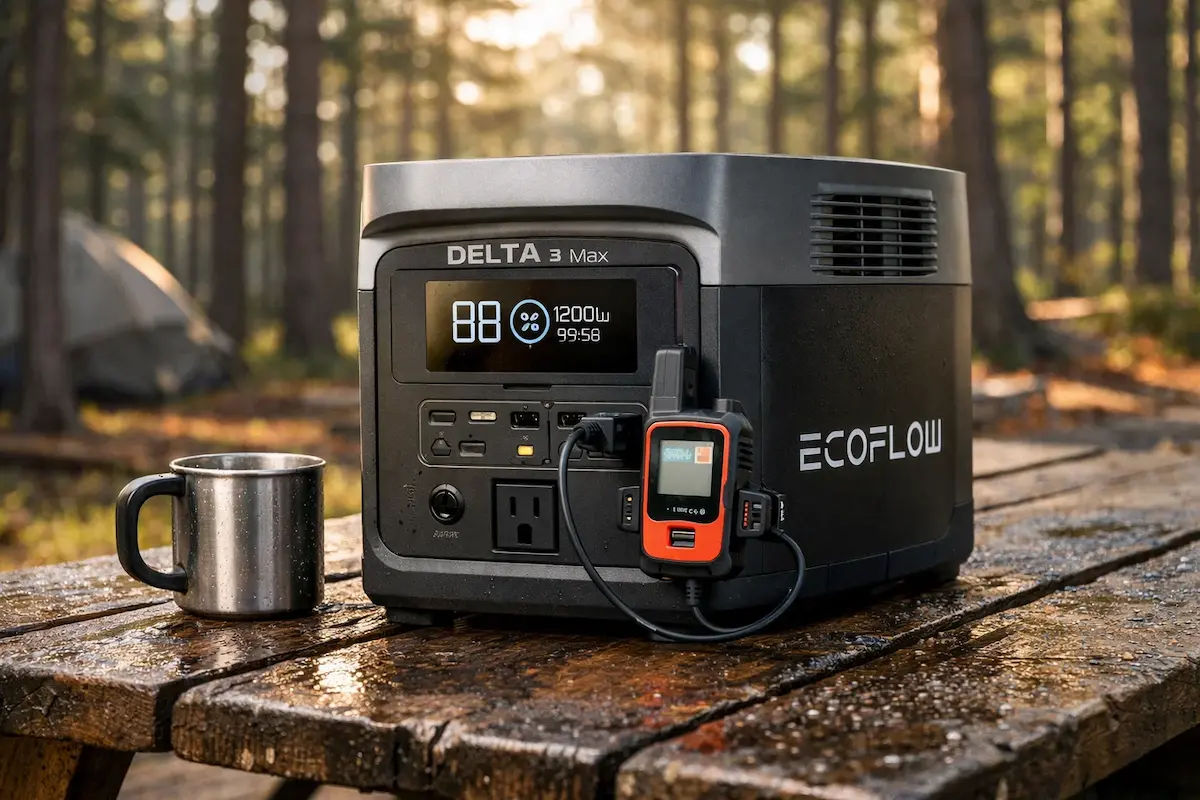
The DELTA 3 series spans multiple tiers in 2026. The DELTA 3 and DELTA 3 Plus share a 1024Wh base capacity, expandable to 5kWh with compatible extra batteries. The DELTA 3 Max steps up to 2048Wh with 2400W AC output (4800W surge) and X-Boost support for appliances up to 3400W. The DELTA 3 Max Plus pushes AC output to 3000W (6000W surge). The DELTA 3 Ultra Plus tops the portable tier at 3072Wh with expandable capacity from 3 to 11kWh. An entry-level DELTA 3 Classic with 1800W output is listed with a March 22, 2026 ship date.
The headline improvement across the DELTA 3 series is the UPS switchover: <10ms, down from 30ms on older DELTA generation units. EcoFlow’s product page specifically lists desktop computers, laptops, NAS servers, and 3D printers as devices protected at this switchover speed without interruption.
The DELTA 3 Max recharges to 80% in 68 minutes via AC and operates at a rated 25dB under 600W load. All DELTA 3 models carry the 4,000-cycle LFP rating and an IP65 battery pack rating for dust and water resistance.
📡 OTL Take: The <10ms UPS on a portable unit is the spec that matters most for our use cases — keeping a router live through a Pere Marquette corridor storm, or protecting a satellite communicator charging setup at a Manistee National Forest dispersed campsite. We’ll run the DELTA 3 Max against our Bluetti AC200L using our Northern Michigan outage protocol as soon as units are available.
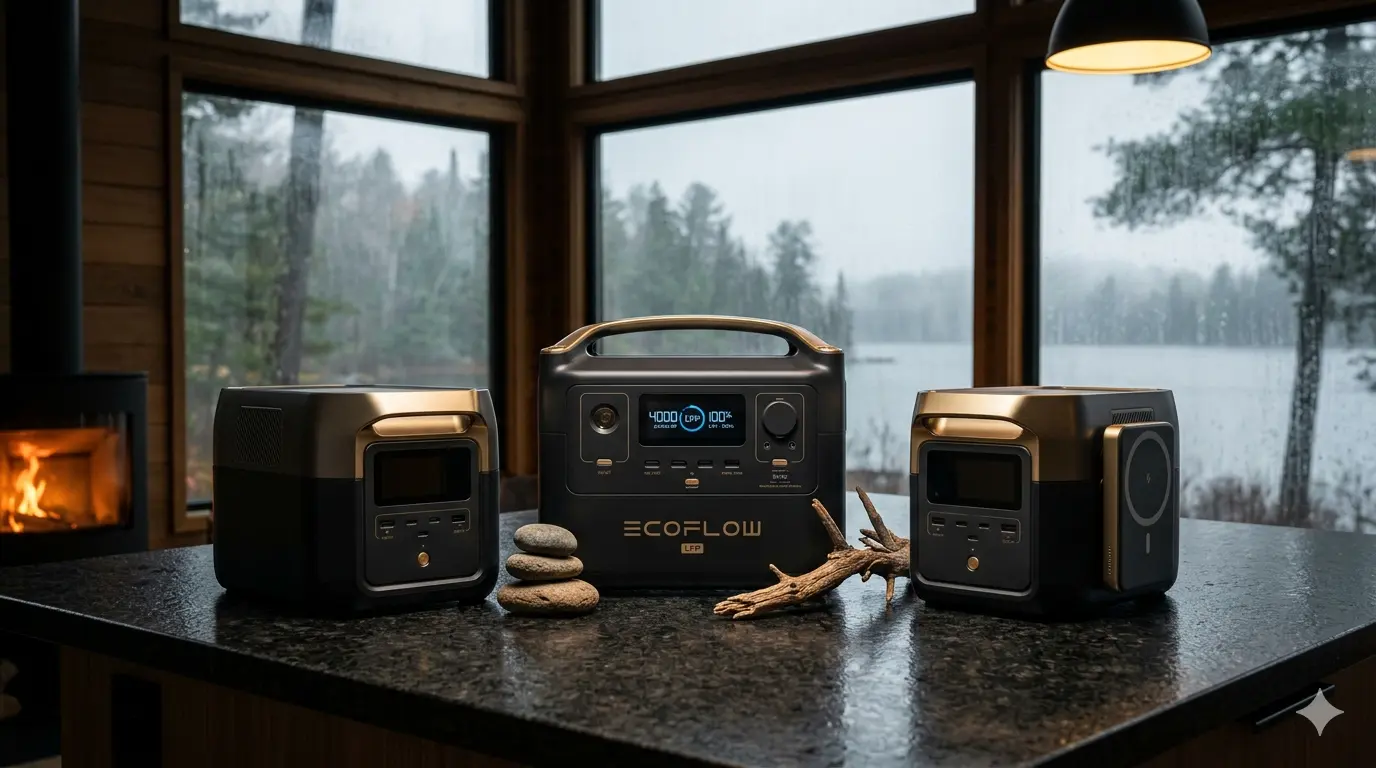
The River line gets a 2026 refresh with the River 3, River 3 Plus, and wireless-capable variants including magnetic power bank options. The River 3 Plus carries a 286Wh capacity with 600W output. EcoFlow specs it powering a 3W Wi-Fi router for up to 35 hours and includes a UPS function with app and PC/NAS-compatible alerts — a notable feature set for a unit this compact.
Like the rest of the 2026 lineup, River 3 models carry the 4,000-cycle LFP rating. Full weight specs and complete pricing were not confirmed in EcoFlow’s published documentation at time of publication. Not sure which capacity tier fits your needs? Our portable power station buying guide breaks it down.
📡 OTL Take: The River 3 Plus hits a sweet spot for weekend paddling trips on the Pere Marquette and Manistee — enough capacity to keep phones, headlamps, and a GPS running without adding significant weight to a canoe kit. We’ll have real-world runtime numbers once we get one on the water this season.
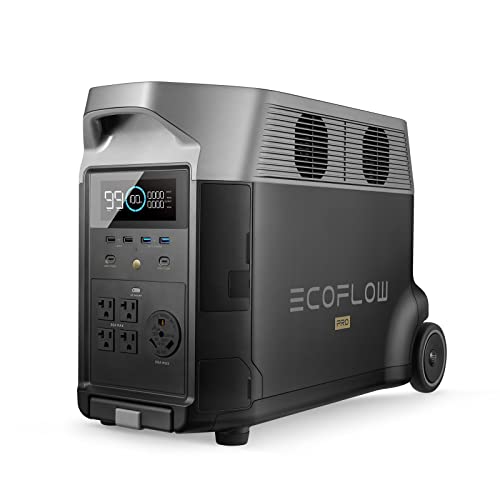
The Smart Generator 4000 runs on gasoline or propane and is designed to pair with the DELTA Pro 3 — not the DELTA Pro Ultra X, which uses a separate FlowMaster Generator Rectifier for generator integration. EcoFlow’s product page explicitly notes the Smart Generator 4000 is not compatible with the DELTA Pro Ultra or River Series for its DC charging and auto start/stop function.
When paired with the DELTA Pro 3, it delivers up to 3200W DC fast charging and enables four intelligent auto start/stop backup modes managed through the EcoFlow app. The intended use model is periodic top-off charging during extended outages rather than continuous operation.
📡 OTL Take: The Smart Generator 4000 is aimed squarely at homeowners running the DELTA Pro 3 through extended multi-day grid outages — think hurricane season or prolonged winter ice events — where solar alone isn’t cutting it. Run the generator briefly to top off the battery, then shut it down and let the power station carry the load quietly indoors. Not a backcountry tool, but a smart pairing for rural grid-down scenarios.
2026 EcoFlow Lineup at a Glance
Model
Capacity
AC Output
LFP Cycles
UPS Speed
Target Use
DELTA Pro Ultra X
12kWh base / 180kWh max
12kW (36kW with 3 units)
Not published
<10ms standalone / <20ms with Smart Panel
Whole-home installation
DELTA 3 Ultra Plus
3072Wh / 3–11kWh expandable
TBD
4,000
<10ms
Home backup, heavy loads
DELTA 3 Max Plus
2048Wh
3000W (6000W surge)
4,000
<10ms
Home + portable hybrid
DELTA 3 Max
2048Wh
2400W (4800W surge)
4,000
<10ms
Home + portable hybrid
DELTA 3 / 3 Plus
1024Wh / up to 5kWh
Up to 2600W
4,000
<10ms
Portable / light home backup
DELTA 3 Classic
TBD
1800W (3600W surge)
4,000
TBD
Entry-level home backup
River 3 Plus
286Wh
600W
4,000
Yes (speed TBD)
Camping, light portable
Smart Generator 4000
N/A (gas/propane)
3200W DC output to DELTA Pro 3
—
—
DELTA Pro 3 companion only
Specs sourced from EcoFlow’s published product pages and CES 2026 announcements. Fields marked TBD not confirmed in official documentation at time of publication. For a deeper portable tier comparison, see our Jackery Explorer 1000 v2 vs EcoFlow Delta 2 breakdown.
Technology: What the 2026 Upgrades Actually Mean
🔋 4,000 Cycles — The Long-Term Cost Equation
EcoFlow rates the new DELTA 3 series at 4,000 cycles to 80% capacity — described on EcoFlow’s product pages as 25% above the industry standard for LFP batteries, with an estimated 10-year useful life under daily cycling. For home backup units that cycle infrequently, real-world service life extends further. For overlanders and paddlers running daily solar charge cycles through a full season, the higher cycle count has more direct impact on total cost of ownership.
⚡ <10ms UPS — Why the Number Matters
Consumer-grade routers, NAS drives, and desktop PCs can crash or lose connection with a power interruption longer than 10–20ms. EcoFlow’s previous DELTA generation ran a 30ms switchover — fast enough for most appliances but occasionally enough to reboot network equipment. The DELTA 3 series’ <10ms spec brings the portable line into direct competition with dedicated UPS hardware on this metric. EcoFlow’s product pages specifically call out desktop computers, laptops, NAS servers, and 3D printers as protected at this switchover speed.
🧠 Smart Energy Management
Storm Guard mode — available on the DELTA Pro Ultra X and larger units — monitors weather forecasts and automatically charges the system ahead of severe weather events. For the DELTA Pro Ultra X paired with the Smart Home Panel 3, the app enables circuit-level load prioritization: keeping essential circuits powered while throttling non-essentials to extend backup runtime. EcoFlow states this approach can extend backup time by up to 42% compared to running all circuits at equal priority.
📍 OTL Field Context: Northern Michigan Implications
For readers across the Manistee National Forest corridor and into the UP — where grid reliability drops sharply during winter storm events — the DELTA 3 Max lands at the right spec tier for most home essentials scenarios.
The <10ms UPS on a portable 2048Wh unit is exactly what matters during a multi-hour ice storm outage: refrigerator stays cold, internet stays connected, and the CPAP doesn’t miss a cycle.
The River 3 series’ improved solar integration is relevant for Pere Marquette and Manistee river corridor camping and Manistee National Forest dispersed camping, where generator use isn’t practical and vehicle access is limited. We’ll have hands-on river testing data once paddling season opens.
What We’re Watching
Full DELTA 3 pricing — EcoFlow has not confirmed retail pricing across all 2026 DELTA 3 tiers at press time. How the Max and Ultra Plus are priced relative to competitors will determine real-world value positioning.
DELTA 3 Max UPS performance in the field — The <10ms spec is published; we’ll verify it against our oscilloscope testing protocol used in previous power station comparisons.
River 3 weight and dimension specs — Not yet published by EcoFlow. For paddlers and dispersed campers, exact weight matters more than any other spec on the River line.
DELTA 3 Classic — Listed with a March 22, 2026 ship date. Full specs and pricing to be confirmed by EcoFlow.
Real-world solar performance — EcoFlow’s solar recharge figures are rated under controlled lab conditions. Northern Michigan spring weather — variable cloud cover, lower sun angles — will test those numbers in the field.
The EcoFlow 2026 lineup is available now. OutdoorTechLab field testing is underway — check back for hands-on results and head-to-head comparisons as the season gets rolling.
Outdoor Tech Lab Backcountry Pulse — Field News & Gear Intel Northern Michigan | March 2026
JC Courtland, Outdoor Gear Expert Courtland is the founder of Outdoor Tech Lab with 20+ years of backcountry experience and formal wilderness safety training. Based in Ludington, MI, he personally tests all gear featured on the site to provide honest, real-world insights for outdoor enthusiasts. JC holds certifications in Wilderness First Aid and has professional experience as a satellite communications specialist.
To provide the best experiences, we use technologies like cookies to store and/or access device information. Consenting to these technologies will allow us to process data such as browsing behavior or unique IDs on this site. Not consenting or withdrawing consent, may adversely affect certain features and functions.
Functional
Always active
The technical storage or access is strictly necessary for the legitimate purpose of enabling the use of a specific service explicitly requested by the subscriber or user, or for the sole purpose of carrying out the transmission of a communication over an electronic communications network.
Preferences
The technical storage or access is necessary for the legitimate purpose of storing preferences that are not requested by the subscriber or user.
Statistics
The technical storage or access that is used exclusively for statistical purposes.The technical storage or access that is used exclusively for anonymous statistical purposes. Without a subpoena, voluntary compliance on the part of your Internet Service Provider, or additional records from a third party, information stored or retrieved for this purpose alone cannot usually be used to identify you.
Marketing
The technical storage or access is required to create user profiles to send advertising, or to track the user on a website or across several websites for similar marketing purposes.







Leave a Reply