

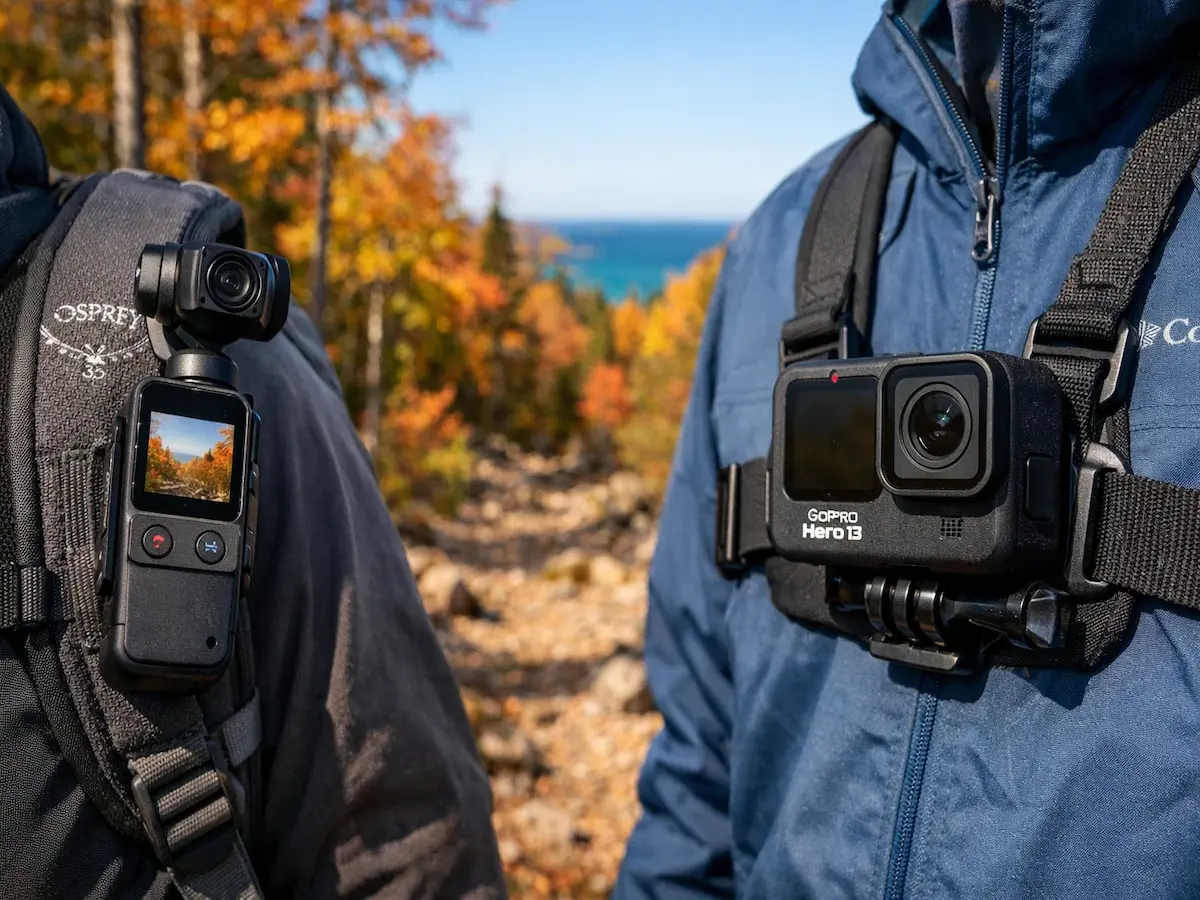
A Cinematic Gimbal Camera vs a Rugged Action Cam. Two Different Philosophies. One Trail. Here’s Which One Belongs in Your Pack.
COMPARED Updated February 2026
This DJI Osmo Pocket 3 vs GoPro Hero 13 Black comparison tackles a matchup that looks straightforward on paper but splits sharply in the field. These are not the same camera competing for the same buyer — they’re two fundamentally different tools built around two different ideas of what an outdoor camera should do.
The DJI Osmo Pocket 3 is a cinematic pocket camera. Its 1-inch CMOS sensor and 3-axis mechanical gimbal produce footage that looks like it came off a professional gimbal rig — smooth, cinematic, and rich in detail even in the low-light forest conditions you’ll find throughout the Manistee National Forest.
The Creator Combo adds a DJI Mic 2 wireless transmitter, making it a complete content production kit in a package that fits in a shirt pocket.
The GoPro Hero 13 Black is an action camera. Waterproof to 33 feet without a housing, built for chest mounts and helmet rigs, HyperSmooth 6.0 stabilization that handles the kind of punishment no mechanical gimbal survives, and a massive accessory ecosystem built over a decade of outdoor use.
At its current price point it’s also the significantly more affordable option of the two.
Check current pricing on Amazon below before deciding — both cameras have been running at meaningful discounts off list price.
At Outdoor Tech Lab, we’ve run both cameras through Northern Michigan field conditions — the Osmo Pocket 3 on the Manistee River Trail and North Country Trail segments through Manistee National Forest, tracking wildlife and capturing cinematic hiking footage; the GoPro Hero 13 chest-mounted through the same terrain in rain, creek crossings, and the kind of late-season weather that tests what “waterproof” actually means in practice.
Both cameras earned their ratings. Neither is wrong. The question is which one fits how you actually shoot.
If you want the broader action camera picture before this specific matchup, our GoPro vs DJI action camera field test covers the full brand comparison across every current model.
For POV action cam recommendations specifically, our best waterproof action cameras guide ranks the full category by use case.
Already decided on action camera style but comparing the Osmo Action 5 Pro? Our DJI Osmo Action 5 Pro vs GoPro Hero 13 comparison covers that head-to-head directly.
TL;DR — DJI Osmo Pocket 3 vs GoPro Hero 13 Quick Answer
The DJI Osmo Pocket 3 is better for: hiking footage quality, wildlife shooting, and cinematic handheld video.
Its 1-inch CMOS sensor and 3-axis mechanical gimbal produce the best image quality in this price class — especially under forest canopy, at dawn and dusk, and in any high-contrast lighting.
The Creator Combo includes a DJI Mic 2 wireless mic, making it a complete outdoor content kit. It is not waterproof without a separate case.
The GoPro Hero 13 Black is better for: watersports, action mounting, and adverse weather.
It is waterproof to 33 feet without any housing, works on chest and helmet mounts with HyperSmooth 6.0 stabilization, includes built-in GPS telemetry, and costs significantly less than the Pocket 3 Creator Combo.
It is the right choice for kayaking, mountain biking, trail running, and any use where the camera must survive impact or submersion.
Bottom line: The DJI Osmo Pocket 3 wins on footage quality. The GoPro Hero 13 wins on durability, versatility, and price.
Choose the Pocket 3 if you hike and shoot wildlife in fair conditions and footage quality is the priority.
Choose the Hero 13 if you need a camera that works in the water, survives a drop, mounts anywhere, and costs less.
Which Camera Is Right for You?
| Use Case | Osmo Pocket 3 | Hero 13 Black |
|---|---|---|
| Trail Hiking Footage | ✅ Best | ✅ Good |
| Waterproof Without Housing | ❌ Not waterproof | ✅ 33ft/10m |
| Wildlife & Nature Photography | ✅ Best (1-inch sensor) | Good |
| Kayaking / Watersports | ❌ Needs case | ✅ Native |
| Cinematic Stabilization | ✅ Mechanical gimbal | Digital (HyperSmooth) |
| Chest / Helmet Mounting | ❌ Not designed for it | ✅ Full ecosystem |
| Low-Light / Forest Canopy | ✅ 1-inch CMOS wins | ❌ Smaller sensor |
| Built-In GPS Telemetry | ❌ | ✅ Yes |
| Vlogging / Face Tracking | ✅ ActiveTrack 6.0 | Basic |
| Budget-Conscious Buyer | ❌ Premium price | ✅ Lower price |
| Included Wireless Mic | ✅ DJI Mic 2 (Creator Combo) | ❌ Not included |
| 4K 120fps Slow Motion | ✅ Yes | 4K 120fps (cropped) |
DJI Osmo Pocket 3 vs GoPro Hero 13 Black: Full Specs Comparison
Side-by-side specifications verified through Northern Michigan field testing by Outdoor Tech Lab. Swipe left on mobile to see all details.
| Specification | 🎬 DJI Osmo Pocket 3 | 🔵 GoPro Hero 13 Black |
|---|---|---|
| Sensor Size | 1-inch CMOS ✓ | 1/1.9-inch CMOS |
| Max Video Resolution | 4K/120fps (Slo-Mo) / 4K/60fps | 5.3K/60fps ✓ |
| Stabilization Type | 3-Axis Mechanical Gimbal ✓ | HyperSmooth 6.0 (Digital) |
| Slow Motion | 4K/120fps, 1080p/240fps | 400fps @ 720p / 5.3K 120fps ✓ |
| Waterproof (Native) | ❌ Not waterproof | ✅ 33ft (10m) ✓ |
| Aperture | f/2.0 ✓ | f/2.5 |
| Screen | 2-inch Rotatable OLED ✓ | Front + Rear Touchscreen |
| Subject Tracking | ActiveTrack 6.0 ✓ | Basic |
| Audio | 3-Mic Array + DJI Mic 2 (Combo) ✓ | 3-Mic Array |
| Color Profiles | 10-bit D-Log M + HLG ✓ | 10-bit HLG + GP-Log |
| Built-In GPS | ❌ No | ✅ Yes ✓ |
| Weight | 179g (6.3 oz) | 154g (5.4 oz) ✓ |
| Battery Life | ~140 min (Wi-Fi off) ✓ | ~90 min @ 4K30 |
| Interchangeable Lenses | Wide-angle lens (add-on) | HB-Series Lens System ✓ |
| Mounting Ecosystem | Limited (tripod/handheld) | Universal GoPro mount system ✓ |
| Connectivity | Wi-Fi + Bluetooth | Wi-Fi 6 + Bluetooth ✓ |
| Star Rating | 4.6/5 (5,456 reviews) ✓ | 4.5/5 (1,933 reviews) |
| Amazon Status | #1 Best Seller Camcorders ✓ | Amazon’s Choice |
| Current Price | See live price ↓ | See live price ↓ (lower price) |
🎬 DJI Osmo Pocket 3
Sensor: 1-inch CMOS
Video: 4K/60fps (4K/120fps Slo-Mo)
Stabilization: 3-Axis Mechanical Gimbal
Battery: ~140 minutes
Best for: Hiking footage, wildlife, vlogging
Stars: ⭐ 4.6/5 (5,456 reviews)
🔵 GoPro Hero 13 Black
Sensor: 1/1.9-inch CMOS
Video: 5.3K/60fps, 4K/120fps
Stabilization: HyperSmooth 6.0
Waterproof: 33ft (10m) native
Best for: Action, watersports, durability
Stars: ⭐ 4.5/5 (1,933 reviews)
Real-World Testing: Northern Michigan Field Results
DJI Osmo Pocket 3: Manistee River Trail & Wildlife Testing
The Camera That Makes Every Hiking Shot Look Intentional
The Osmo Pocket 3 was our primary camera for trail footage testing along the Manistee River Trail and through the hardwood corridors of Manistee National Forest — terrain where mixed canopy, shifting light conditions, and unpredictable wildlife movement test everything a camera can do.
The mechanical gimbal is the story here, and it delivers exactly what the spec sheet promises.
Walking footage on rooted, uneven trail surfaces — the kind of terrain that turns digital stabilization into a jelly mess — produces smooth, cinematic clips with the Pocket 3 that look like they were shot on a dedicated handheld rig.
The difference between mechanical gimbal stabilization and electronic processing is immediately visible in motion footage, and it’s not subtle.
For the broader camera landscape at this price level, see our best mirrorless camera guide — but for pocket-sized cinematic video in outdoor settings, the Pocket 3 operates in its own category.
Wildlife Performance — The 1-Inch Sensor Advantage: The Pocket 3’s 1-inch CMOS sensor separates itself from every action camera in this class when shooting wildlife in forest conditions.
Under closed canopy in the afternoon — the kind of lighting situation where most action cameras start producing grainy, over-processed footage — the Pocket 3 maintains clean, detailed imagery with accurate color rendering.
We tracked deer movement along the forest edge and captured a pair of sandhill cranes on a Manistee River bend using ActiveTrack 6.0 — the subject tracking locked cleanly and held through movement without the subject drifting or losing focus.
For wildlife content creators, the combination of ActiveTrack and the 1-inch sensor is a legitimate competitive advantage over the GoPro in this specific use case.
What We Shot in the Field:
• Trail walking footage on Manistee River Trail — gimbal eliminated footfall shake completely
• Wildlife tracking (deer, cranes, songbirds) — ActiveTrack 6.0 maintained subject lock
• Forest canopy golden-hour shots — 1-inch sensor rendered shadow detail the GoPro couldn’t match
• Camp setup and gear review footage — Creator Combo DJI Mic 2 captured clean audio outdoors
• Lake Michigan shoreline at dusk — low-light performance noticeably superior to GoPro
• Hyperlapse on North Country Trail — 3-axis gimbal produced smooth motion time-lapse results
The One Limitation That Matters in Michigan: The Pocket 3 is not waterproof. In late-season Michigan weather — the kind of intermittent rain and wet brush conditions you encounter regularly in Manistee National Forest — the camera required protection that the GoPro simply doesn’t need. We used a dry bag between shots and were careful near creek crossings.
That’s a real workflow cost that doesn’t show up in spec comparisons. If your hiking regularly involves water crossings, sustained rain, or kayak portages, you need to factor in a waterproof case (sold separately) or reconsider whether the GoPro’s native weatherproofing is the smarter trail choice.
💡 OTL Pro Tip: For wildlife shooting with the Pocket 3, set ActiveTrack 6.0 before you spot your subject — not after. The tracking is fast, but pre-positioning in the direction of movement gives you cleaner lock-on acquisition when an animal moves into frame. We used this approach for the crane shots and got clean tracking on the first attempt.
DJI Osmo Pocket 3: 6 Reasons It Wins for Outdoor Use
6 reasons to get the DJI Osmo Pocket 3 — real-world footage.
GoPro Hero 13 Black: North Country Trail & Adverse Weather Testing
The Camera That Doesn’t Care What the Weather Does
The GoPro Hero 13 went into conditions the Pocket 3 simply cannot handle — chest-mounted through creek crossings on the North Country Trail, running in sustained rain on a Manistee County forest road segment, and fully submerged in the shallows of the Manistee River for a brief underwater shot sequence.
Not once did weatherproofing become a concern. That’s the GoPro’s foundational advantage and it’s an enormous one in real Michigan outdoor use.
HyperSmooth 6.0 on a chest mount performs well for walking and light running. For mountain biking — tested on gravel forest roads — it holds up better than any digital stabilization system we’ve tested at this price point, though the mechanical difference versus the Pocket 3’s gimbal is immediately visible when comparing walking footage side by side.
The GoPro footage is stable. The Pocket 3 footage is cinematic. Those are meaningfully different results.
Landscape & Versatility Results:
• Chest mount POV on North Country Trail — HyperSmooth held well in walking pace
• Creek crossing and shallow water shots — fully submerged, no issues
• Rain testing in sustained Lake Michigan weather system — zero performance impact
• Wide-angle landscape captures on Lake Michigan shoreline — strong with default lens
• GPS telemetry overlay testing — speed and elevation data rendered cleanly in Quik app
• 5.3K captures on open trail sections — resolution advantage over Pocket 3 visible in static shots
The HB-Series Lens System in the Field: The Hero 13’s interchangeable HB-Series Lenses add creative range that the Pocket 3 can’t match without additional accessories.
The Ultra Wide Lens Mod at 177° field of view opens up landscape and trail-ahead compositions that the standard lens can’t achieve.
The Auto Detection feature works as advertised — attach a lens and the camera configures itself automatically, which matters when you’re managing gear on trail.
The lenses are sold separately at meaningful additional cost, but they represent a genuine capability expansion that broadens the GoPro’s creative range significantly.
The 5.3K resolution ceiling also gives the Hero 13 a cropping advantage in post-production — pulling a 4K output from a 5.3K capture leaves room to reframe shots without quality loss, which is useful for wildlife captures where you couldn’t physically get closer.
💡 OTL Pro Tip: For Michigan trail use, enable HindSight mode on the Hero 13 before crossing water obstacles or entering technical terrain. HindSight buffers up to 30 seconds before you hit record — meaning you can capture an unexpected wildlife encounter or a technical section you didn’t anticipate needing footage of. It’s the most underused feature on the camera and it’s excellent for trail use.
The 5 Key Differences That Actually Matter
1. Stabilization: Mechanical Gimbal vs HyperSmooth 6.0 — A Fundamental Difference
This is the most important technical distinction between these two cameras, and it’s frequently misunderstood. The DJI Osmo Pocket 3 stabilizes footage physically — three motors continuously counteract camera movement in real time, producing the kind of fluid, cinematic motion that digital processing cannot fully replicate.
HyperSmooth 6.0 on the GoPro is genuinely excellent digital stabilization, and for action camera use — chest mounts, helmet mounts, bike handlebar mounts — it performs at a level that makes the GoPro footage usable in almost any conditions.
The difference becomes visible on walking footage. Side-by-side comparison of trail walking at a brisk pace shows the Pocket 3 producing smooth, flowing footage while the GoPro produces footage that is stable but retains a subtle rhythmic motion characteristic of digital stabilization.
Neither is bad. One is demonstrably more cinematic. For anyone whose primary use case is hiking and trail footage rather than action mounting, the Pocket 3’s mechanical gimbal is a meaningful quality difference.
2. Sensor Size: 1-Inch vs 1/1.9-Inch — The Image Quality Gap
A 1-inch sensor collects significantly more light than a 1/1.9-inch sensor — the physical area difference is substantial, not marginal. In the well-lit conditions that most outdoor action camera footage is shot in, the gap is visible but not dramatic.
Under forest canopy in overcast conditions, at dawn or dusk during wildlife activity hours, or in any scene with high contrast between bright and shadow areas, the Pocket 3’s sensor advantage becomes immediately apparent in the quality of footage it produces.
The f/2.0 aperture on the Pocket 3 versus the GoPro’s f/2.5 compounds this advantage in low light. For wildlife and nature content where you’re often shooting in conditions that aren’t ideal, the Pocket 3’s sensor is a genuine creative asset.
For action sports in bright daylight — the core GoPro use case — the sensor gap narrows considerably and the resolution advantage of the Hero 13’s 5.3K ceiling becomes more relevant.
3. Waterproofing: Not Waterproof vs 33ft Native — The Durability Decision
The GoPro Hero 13 is waterproof to 33 feet without any case or housing. The DJI Osmo Pocket 3 is not waterproof at all without a separately purchased case. This is not a minor spec difference — in Northern Michigan outdoor conditions it’s a fundamental workflow distinction that shapes how you can use each camera.
If you hike in rain, paddle on rivers, fish, or encounter any consistent moisture exposure, the GoPro is the correct tool and the conversation largely ends there. The Pocket 3’s superior image quality is irrelevant if you’re managing it into and out of a dry bag every time the weather changes.
For fair-weather trail use and controlled outdoor content creation, the Pocket 3’s lack of waterproofing is manageable. For Michigan paddling season, it’s disqualifying without accessory investment.
Our best waterproof action cameras guide breaks down the full waterproof category if durability is your primary requirement.
4. Form Factor & Mounting: Pocket Camera vs Action Camera Ecosystem
The DJI Osmo Pocket 3 is designed to be held in your hand or set on a tripod. It is not designed to be mounted to a helmet, chest harness, bike handlebar, or kayak. With the right adapters you can attach it to some mounting systems, but it was not engineered for that use case and the results reflect it.
The GoPro Hero 13 was built from the ground up for mounting — built-in mounting fingers, 1/4-20 threads, magnetic latch mounting, and a decade-deep accessory ecosystem that spans every conceivable outdoor mounting scenario.
If you want POV footage — first-person trail perspective, cycling footage, paddling footage from a bow mount — the GoPro is the only answer here. The Pocket 3 is a handheld camera that you carry and point intentionally.
They’re different tools for different shooting styles, and choosing the wrong one for your primary use case produces footage that looks wrong regardless of sensor quality.
5. Price: Creator Combo vs Hero 13 — A Meaningful Value Gap
The DJI Osmo Pocket 3 Creator Combo carries a significantly higher price than the GoPro Hero 13 Black — check current Amazon pricing on each, as both run discounts, but the Pocket 3 consistently sits at a premium.
The Creator Combo price includes the DJI Mic 2 wireless transmitter, battery handle, mini tripod, and carry bag — so you’re getting a full content kit, not just a camera body. Evaluated as a complete system including the wireless mic, the Pocket 3’s price premium narrows considerably against a GoPro Hero 13 with separately purchased audio accessories.
That said, the Hero 13 at its current price point is a compelling value for what it delivers — 5.3K video, excellent stabilization, full waterproofing, and a proven accessory ecosystem. For outdoor enthusiasts who need a capable, durable camera without a premium price, the Hero 13 is the right answer.
For content creators whose footage quality directly impacts their output, the Pocket 3’s price reflects a genuine performance difference.
Which One Should You Buy?
✅ Buy the DJI Osmo Pocket 3 Creator Combo if…
• Hiking and trail footage is your primary use case and footage quality is the priority
• You shoot wildlife and nature content where the 1-inch sensor’s low-light advantage matters
• Smooth, cinematic handheld footage matters more to you than action-mounting capability
• You want a complete content kit with wireless mic included in the package
• Your shooting conditions are generally dry — you’re not paddling, fishing in rain, or doing watersports
• You create content for YouTube, social media, or any platform where footage quality directly impacts performance
• The rotatable OLED screen and face tracking are useful for your solo content creation workflow
⭐ 4.6/5 Stars • 5,456 Reviews • #1 Best Seller Camcorders • 1-Inch CMOS
✅ Buy the GoPro Hero 13 Black if…
• Waterproofing is a non-negotiable — kayaking, fishing, paddling, or hiking in sustained rain
• You want POV footage from chest, helmet, or handlebar mounts for cycling, trail running, or paddling
• Budget matters and you want the best capable outdoor camera at a lower price point
• The GoPro mounting ecosystem is important to your existing gear setup
• You need GPS telemetry overlay for speed and elevation data on your footage
• Action and adventure sports are your primary content — the Hero 13 was built for these use cases
• The HB-Series interchangeable lens system matters for your creative workflow
⭐ 4.5/5 Stars • 1,933 Reviews • Amazon’s Choice • Waterproof to 33ft
🎬 DJI Osmo Pocket 3 Pros
- 1-inch CMOS sensor — largest sensor in this comparison
- 3-axis mechanical gimbal — smoother walking footage than any digital stabilization
- ActiveTrack 6.0 — best subject tracking for wildlife shooting
- f/2.0 aperture — better low-light performance than GoPro’s f/2.5
- ~140 min battery life — 50% longer than GoPro Hero 13 at 4K
- DJI Mic 2 wireless transmitter included in Creator Combo
- 2-inch rotatable OLED touchscreen — front and back composition
DJI Osmo Pocket 3 Cons
- Not waterproof — requires separate case for rain or water use
- No chest, helmet, or handlebar mounting — handheld and tripod use only
- No built-in GPS — no telemetry overlay for speed or elevation
- Higher price than GoPro Hero 13 Black
🔵 GoPro Hero 13 Black Pros
- Waterproof to 33ft (10m) — no housing required
- 5.3K/60fps — higher max resolution than DJI Osmo Pocket 3
- HyperSmooth 6.0 with 360° Horizon Lock — best digital stabilization in class
- Built-in GPS — speed, elevation, and telemetry overlay in Quik app
- Full GoPro mount ecosystem — chest, helmet, handlebar, and 1/4-20 thread
- HB-Series interchangeable lenses — Ultra Wide, Macro, ND Filters, Anamorphic
- Lower price — more accessible entry point than Pocket 3 Creator Combo
GoPro Hero 13 Black Cons
- 1/1.9-inch sensor — smaller than Pocket 3’s 1-inch; weaker in low light
- Digital stabilization — walking footage less cinematic than mechanical gimbal
- ~90 min battery at 4K30 — roughly 50 min less than Pocket 3
- No wireless mic included — audio accessories sold separately
More Outdoor Tech Lab Camera & Gear Guides
These OTL guides cover every related piece of the outdoor content creation setup:
• DJI Osmo Action 5 Pro vs GoPro Hero 13 — the action camera version of this matchup
• GoPro vs DJI: full brand field test 2025 — every model compared across both brands
• Best waterproof action cameras 2025 — full category rankings by use case
• Best mirrorless cameras 2025 — when pocket cameras aren’t enough
• Best rechargeable headlamps for camping — essential trail gear to pair with your camera kit
• Best portable power stations 2026 — keep your cameras charged on extended trips
• Camping 101: Beginner’s Guide — building your full outdoor kit from the ground up
Outdoor Content Creation & Trail Safety Resources
We reference these resources when evaluating gear for trail and wilderness use.
- Huron-Manistee National Forests — USFS
Official trail and conditions information for Northern Michigan’s primary testing ground — where OTL runs all extended field gear evaluations. - Leave No Trace: 7 Principles
The baseline framework for responsible outdoor use that informs how we approach wildlife photography and nature content creation.
DJI Osmo Pocket 3 vs GoPro Hero 13 FAQ
Is the DJI Osmo Pocket 3 or GoPro Hero 13 better for hiking?
For hiking footage quality, the DJI Osmo Pocket 3 wins. The mechanical gimbal produces smoother, more cinematic walking footage than the GoPro’s digital HyperSmooth stabilization, and the 1-inch sensor delivers better image quality in the variable lighting conditions you encounter on forest trails. However, the GoPro Hero 13 is the better hiking camera if your trails involve water crossings, sustained rain, or any moisture exposure — it’s waterproof to 33 feet without a case, and the Pocket 3 is not. The right answer depends entirely on your trail conditions: if you hike in fair weather and prioritize footage quality, choose the Pocket 3. If Michigan weather, river crossings, or kayak-camping portages are part of your kit requirements, the GoPro is the more practical trail companion.
Which has better video stabilization — DJI Osmo Pocket 3 or GoPro Hero 13?
They stabilize differently, and both perform well for their intended use cases. The DJI Osmo Pocket 3 uses a 3-axis mechanical gimbal — three physical motors that counteract camera movement in real time, producing fluid, cinematic footage on walking and handheld use. The GoPro Hero 13 uses HyperSmooth 6.0, which is digital image stabilization processed in-camera — excellent for action mounting on helmets, chest rigs, and handlebars, and durable enough to handle vibration and impact that would damage a mechanical gimbal. Side-by-side walking footage shows the Pocket 3 producing noticeably smoother, more cinematic results. Side-by-side mountain biking or rough-terrain footage shows the GoPro performing better because the mechanical gimbal isn’t designed for that kind of mounting use.
Can the DJI Osmo Pocket 3 get wet?
The DJI Osmo Pocket 3 is not waterproof and should not be exposed to rain, splashing, or submersion without a separately purchased waterproof case. DJI sells a waterproof case for the Pocket 3 that provides some water protection, but the camera is not rated for waterproof use in its standard configuration. This is a meaningful limitation for outdoor use in Northern Michigan conditions — late-season rain, river-adjacent hiking, and Michigan paddling season all represent genuine risk to the camera without proper protection. If your outdoor shooting regularly involves moisture exposure, either invest in the waterproof case or consider whether the GoPro Hero 13’s native 33-foot waterproof rating is the more practical choice for your use case.
Does the GoPro Hero 13 have a gimbal?
No — the GoPro Hero 13 Black does not have a mechanical gimbal. It uses HyperSmooth 6.0, which is GoPro’s digital image stabilization system. HyperSmooth 6.0 is one of the best digital stabilization systems in the action camera market — it includes AutoBoost for automatic stabilization intensity adjustment and full 360-degree Horizon Lock to keep the frame level regardless of camera rotation. For action mounting applications it performs extremely well. However, for handheld walking footage specifically, mechanical gimbal stabilization (as found in the DJI Osmo Pocket 3) produces noticeably more fluid, cinematic results. If a true mechanical gimbal is important for your footage style, the Pocket 3 is the correct choice; the GoPro achieves excellent stabilization through different means that are better suited for mounted action use.
Which is better for wildlife photography — DJI Osmo Pocket 3 or GoPro Hero 13?
For wildlife photography and videography, the DJI Osmo Pocket 3 is the stronger tool. The 1-inch CMOS sensor with f/2.0 aperture captures significantly more light than the GoPro’s 1/1.9-inch sensor — a meaningful advantage during the dawn and dusk hours when wildlife is most active and natural light is at its lowest. ActiveTrack 6.0 provides subject tracking that genuinely holds through animal movement, which the GoPro’s basic tracking cannot match. In our Northern Michigan testing, we tracked deer and sandhill cranes with the Pocket 3 with clean lock-on acquisition and consistent subject centering. The GoPro is a capable wildlife camera in bright conditions, and its 5.3K resolution ceiling allows for post-production cropping that can simulate a longer focal length — but the Pocket 3’s sensor and tracking make it the better choice for dedicated wildlife content.
Is the DJI Osmo Pocket 3 worth the higher price vs GoPro Hero 13?
The answer depends entirely on your use case. The Osmo Pocket 3 Creator Combo is a complete content production kit — 1-inch sensor camera, wireless mic, battery handle, tripod, and carry bag. Evaluated as a system against a comparably equipped GoPro Hero 13 setup with separately purchased wireless mic and accessories, the price gap narrows. If footage quality is your primary criterion and your shooting conditions are compatible with the Pocket 3’s limitations (primarily the lack of native waterproofing), the image quality difference is genuinely visible and the premium reflects real performance. If you need waterproofing, action mounting, or a lower total entry cost, the GoPro Hero 13 delivers excellent results at a more accessible price point and the premium is not justified. Neither camera is overpriced for what it delivers — they’re priced for different buyers with different priorities.
What is the battery life of the DJI Osmo Pocket 3 vs GoPro Hero 13?
The DJI Osmo Pocket 3 offers approximately 140 minutes of battery life with Wi-Fi and screen off — a significant advantage over the GoPro Hero 13 Black’s approximately 90 minutes at 4K30. In real-world trail use, the Pocket 3’s longer battery life means fewer battery changes or concerns on a full-day hike. The GoPro’s 1,900mAh Enduro Battery is rated for over 2.5 hours of continuous recording at 1080p30, but drops to approximately 90 minutes at 4K30 and further at 5.3K. Both cameras support external power via USB-C, and both support extended battery accessories. For full-day outdoor shoots, carrying a spare battery is standard practice for either camera — but the Pocket 3 gives you more buffer before the first swap.
Can I use the DJI Osmo Pocket 3 for action sports?
The DJI Osmo Pocket 3 is not designed for action sports in the way the GoPro Hero 13 is. It lacks native waterproofing, is not impact-resistant in the way a ruggedized action camera is, and its form factor does not accommodate the helmet, chest, and handlebar mounting systems that define action sports camera use. You can use the Pocket 3 for active handheld filming — running shots, skiing footage held in hand — and the mechanical gimbal produces excellent results in those scenarios. But for kayaking, mountain biking, surfing, or any use case where the camera needs to be mounted and exposed to impact, water, or extreme conditions, the GoPro Hero 13 is the appropriate tool. The Pocket 3 is a precision handheld camera; the GoPro is a rugged mounted capture device. Using either outside its intended category produces results that reflect the mismatch.
OTL Bottom Line: DJI Osmo Pocket 3 vs GoPro Hero 13 Black
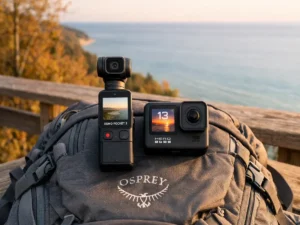
After running both cameras through Northern Michigan trails, forest conditions, and the kind of weather that tests what outdoor gear actually means in practice, the conclusion is the same one the spec sheet points toward — these are not competing for the same shooter.
The DJI Osmo Pocket 3 is the camera for outdoor content creators who prioritize footage quality above all else. The 1-inch sensor, the mechanical gimbal, the DJI Mic 2 in the Creator Combo — everything about it is designed to produce footage that looks intentional and professional. On the Manistee River Trail in good light, the footage it produces is genuinely in a different class from what any action camera delivers.
If you create outdoor content for an audience — YouTube hiking channels, wildlife documentation, trail guides, social media nature content — and you shoot in conditions where you can protect the camera from moisture, the Pocket 3 is the right investment. Pair it with the power coverage covered in our best portable power stations guide and you have a complete field production kit.
The GoPro Hero 13 Black is the camera for outdoor adventurers who need a tool that survives whatever the trip demands. Waterproof without a housing, mounting ecosystem that covers every conceivable outdoor scenario, and a proven platform with a decade of accessories, software refinement, and real-world validation behind it. The price point makes it accessible without compromising on capability for its core use cases.
If you kayak the Manistee River, mountain bike Pigeon Creek trails, trail run in the rain, or need a camera that goes where the action goes without requiring a dry bag, the Hero 13 is the correct tool. For the full comparison of DJI’s action camera lineup against GoPro, our Osmo Action 5 Pro vs GoPro Hero 13 comparison covers the action-camera-to-action-camera matchup directly.
Ready to Choose Your Outdoor Camera?
🎬 Pocket 3: ⭐ 4.6/5 • 5,456 Reviews • #1 Best Seller | 🔵 Hero 13: ⭐ 4.5/5 • 1,933 Reviews • Amazon’s Choice
This comparison was last updated in February 2026 with verified specifications and field testing notes. Tested in Northern Michigan by Outdoor Tech Lab.
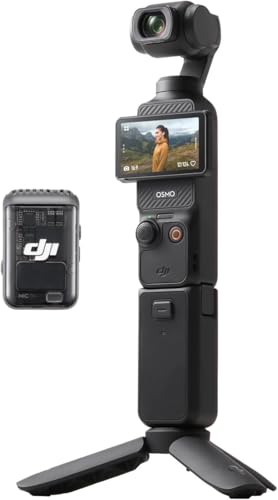
- Capture Stunning Footage – This vlogging camera features a 1-inch CMOS sensor and records in 4K resolution at an impress…
- Effortlessly Frame Your Shots – Get the ideal composition with Osmo Pocket 3’s expansive 2-inch touch screen that rotate…
- Ultra-Steady Footage – Say goodbye to shaky videos. Osmo Pocket 3’s advanced 3-axis mechanical stabilization delivers su…

- Best-in-class 5.3K60 video and legendary durability combine with new HB-Series Lenses1 and a more powerful battery to ma…


Leave a Reply