

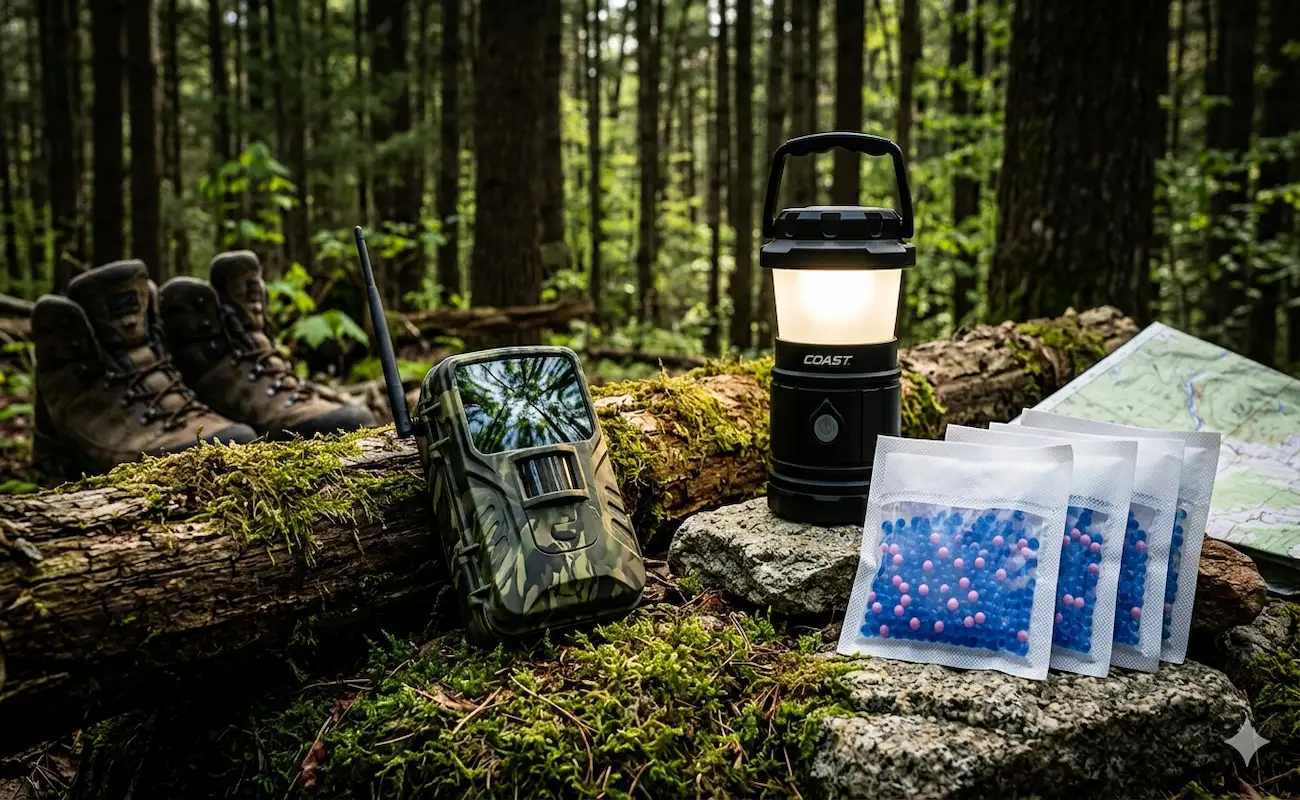
The 2026 “Proactive” Basecamp Kit: 3 Tech Essentials Every Solo Backcountry Camper Needs
GEAR GUIDE Spring 2026
⚡ TL;DR — The Proactive Kit in 60 Seconds
The centerpiece of this kit is the LETWESAF radar perimeter sensor. It uses millimeter-wave radar technology — the same tech in automotive collision detection — to detect movement through tent walls and dense brush. Unlike passive infrared sensors that trigger on every raccoon, this system is designed to filter out false alarms and give you real awareness of what’s approaching your camp.
Important distinction: the manufacturer claims a 0.5-mile wireless transmission range (how far the receiver can be from the sensor), while the actual radar detection zone is approximately 50 feet. We’re stress-testing this on the Manistee River this spring, and the early field footage — including a black bear trigger — speaks for itself.
The Coast EAL35R voice-controlled lantern and Wisedry desiccant packs round out the kit, handling lighting and gear protection. But the radar sensor is what makes this a truly proactive basecamp setup — awareness before action.
The bottom line: The lantern and desiccant system are proven, verified tech. The radar sensor is the game-changer — and we’re so confident in its potential that we’re putting it through our full field testing pipeline before giving it the final OTL stamp of approval.
Stop Reacting: Solo Camping Gear That Runs Itself
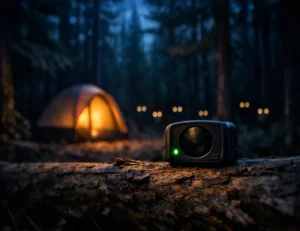
You’re two miles up the Manistee dispersed camping, it’s 11pm, and something just moved in the brush outside your tent. Your headlamp is buried under your pack. Your camera is fogging at the lens.
This is what reactive backcountry camping looks like — and it’s exactly what 2026’s gear is designed to prevent.
The shift this season isn’t about flashier specs. It’s about automation — building a basecamp that handles the perimeter, the lighting, and the gear maintenance so you can stay focused on why you came out here in the first place.
The centerpiece of this shift is the LETWESAF radar perimeter sensor. It gives you awareness you can’t get from passive listening alone — detecting movement through tent walls, filtering out false alarms from wind and small animals, and alerting you to what’s approaching before it gets close.
The voice-controlled lantern and reusable desiccant packs handle the rest. Together, they form the Proactive Basecamp Kit.
Whether that’s an early morning hatch on the Pere Marquette or a multi-day push into the Manistee National Forest backcountry, the right setup runs itself.
If you’re just getting started building out your kit, our camping 101 beginner’s guide covers the foundational gear layers before you layer in the tech. For a complete gear inventory, the camping essentials checklist is the best place to audit what you already have.
This guide covers three specific pieces of solo camping gear we’re running through the OTL testing pipeline in 2026: a millimeter-wave radar perimeter sensor, a voice-controlled lantern with USB-C charging, and a reusable desiccant system for gear protection.
Each solves a distinct problem. Together, they form what we’re calling the Proactive Basecamp Kit.
🎯 Kit Concept: Automate your basecamp so you can focus on the river — perimeter awareness, hands-free lighting, and gear maintenance handled for you
📡 The Perimeter (Centerpiece): LETWESAF Wireless Radar Alarm — millimeter-wave radar that detects movement through tent walls, IP66 waterproof, rechargeable. Early field testing shows it triggering on black bears. Active testing continues Spring 2026.
💡 The Hub: Coast EAL35R Voice-Controlled Lantern — 1,000 lumens, voice control technology, USB-C power bank output
🧴 The Maintenance: Wisedry 100g Reusable Desiccant Packs (5-pack) — visual humidity indicator, 6-minute microwave recharge
✅ Amazon Status: All three products confirmed live on Amazon
LETWESAF (Claimed)
Range (Claimed)
Coast EAL35R
Wisedry 100g
The Perimeter: LETWESAF Radar — The Brain of Your Basecamp Field Testing Spring 2026
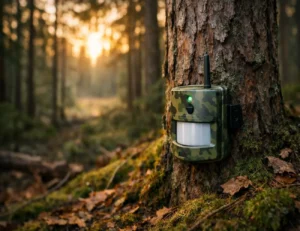
Traditional PIR (passive infrared) motion sensors work by detecting heat signatures crossing a defined zone. They have a well-documented blind spot: wind-blown vegetation, temperature changes in humid environments, and small animals all generate false triggers.
If you’ve ever had a camp alarm wake you up because a raccoon walked past at 2am, you know the problem. That’s why the LETWESAF is the centerpiece of this kit — it solves the false-alarm problem with fundamentally better technology.
The LETWESAF uses millimeter-wave radar — the same category of sensing technology used in automotive collision detection. It detects movement through physical barriers including tent walls and dense brush. It can filter out the small stuff while still alerting you to something worth waking up for.
In early OTL field testing, the LETWESAF triggered on a black bear approaching camp. That’s the kind of awareness this system delivers — not every rustle, but the movement that matters.
The One Spec You Need to Understand Before You Buy
The LETWESAF is listed with a “0.5-mile range” figure that requires clarification. That number refers to the wireless transmission range — how far the receiver can be from the sensor unit. The actual radar detection zone is approximately 50 feet (15m) deep — plenty for a campsite perimeter, but not half a mile of motion detection. We’re flagging this clearly because these two specs are routinely conflated.
The 0.5-mile figure means you can place your receiver inside your tent up to half a mile away from the sensor you’ve mounted at the tree line. The detection zone covers your immediate camp area. That’s the right balance for backcountry use.
⚠️ OTL Field Testing Note: We are moving the LETWESAF into active field testing near the Manistee River this spring. Specifically, we want to verify whether the manufacturer’s claimed animal-filtering capability actually works in a Northern Michigan forest environment where raccoons, deer, and coyotes are regular visitors. Early results — including the black bear trigger — are promising.
We’ll update this article with full real-world numbers after testing.
▶ OTL Field Video — Black Bear Trigger
What’s confirmed: IP66 weatherproof rating, rechargeable battery, millimeter-wave radar technology, and availability in jungle camo green. For solo camping in low-visibility conditions where cameras would fail — overnight riverbank camps, dense forest sites — a functional perimeter alert system creates a safety buffer that passive listening alone cannot replicate.
This isn’t about security theater. A reliable perimeter alert in a backcountry solo camp is the difference between waking up because something moved outside your tent and sleeping through it. The LETWESAF gives you that awareness.
The Hub: Coast EAL35R Voice-Controlled Lantern
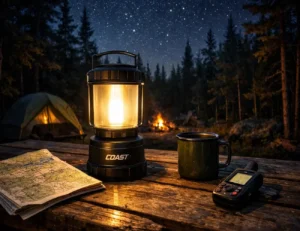
The most common campsite annoyance isn’t the gear that breaks — it’s the gear you can’t find. Coming back to camp after dark with both hands full, needing light immediately, and having to dig through your pack for a lantern is a problem that voice control solves cleanly.
The Coast EAL35R is built around voice control technology — verbal commands handle power on/off, brightness adjustment, and mode switching including a dedicated Emergency Red setting.
No buttons to find in the dark. No reaching across the camp table. A spoken command from across the tent handles it.
• Output: 1,000 lumens maximum
• Control: Voice control technology — on/off, brightness, Emergency Red mode
• Modes: Five lighting modes including Emergency Red
• Runtime: Up to 16 hours on USB-C rechargeable battery
• Power Source: USB-C rechargeable (removable battery pack can be swapped with 4× AA alkaline batteries — sold separately)
• Power Bank: USB-C output — charges phones, GPS units, and other devices directly from the lantern
Weather Resistance: IP54 — water-resistant and dust-resistant (not rated for submersion)
The USB-C power bank integration is the spec that changes the kit dynamic. In a three-piece kit where the LETWESAF receiver needs battery life and your GPS may need periodic top-offs, having your primary camp light double as a power source eliminates the need for a separate battery pack on shorter trips.
That consolidation matters when every ounce of pack weight is accounted for.
For a broader comparison of rechargeable camp lighting options, our best rechargeable headlamps for camping guide covers the full hands-free lighting category — useful context if you’re building out the complete lighting layer of your kit.
And if you’re thinking about a more robust power solution for longer trips, our best portable power stations for camping guide covers when a dedicated unit makes more sense than a lantern bank.
For solo backcountry camping specifically, voice control is not a gimmick — it’s a safety feature. A camp where you can restore full light with a spoken word, switch to a low-visibility red mode without touching anything, and wake up to a command rather than fumbling in the dark is a measurably safer camp than the alternative.
The Maintenance: Wisedry 100g Reusable Desiccant Packs
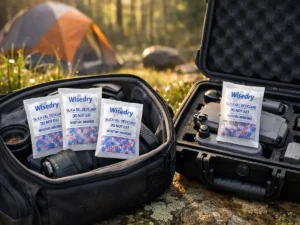
Humidity is the slowest and most predictable killer of expensive backcountry tech. Lens fogging, internal corrosion, connector oxidation — none of these happen dramatically.
They accumulate quietly over multiple trips and manifest as a failure you didn’t see coming. A quality desiccant system is the cheapest insurance in this kit by a significant margin — protecting the LETWESAF receiver, your camera, drone, and any other sensitive electronics you bring into the field.
The Wisedry 100g packs use high-absorption silica with a built-in visual indicator: the dot is blue when the pack is active and dry, and shifts to pink when it has reached capacity and needs recharging.
No guessing. You can see the status at a glance every time you open your camera bag or drone case.
• Pack Size: 100g — 5 packs per set
• Indicator: Visual color change — Blue (active/dry) to Pink (needs recharge)
• Recharge Method: Microwave — as little as 6 minutes restores full drying capacity (verified from Amazon listing)
• Reusable: Yes — indefinitely with proper recharging
Best Use Cases: Camera bags, drone cases, rifle cases, electronics storage, long-term gear storage
The 6-minute microwave recharge is the key differentiator from single-use silica. At camp with a portable power station, or back at the trailhead vehicle before the next trip, you put the pink pack in a microwave for as little as 6 minutes and it comes out blue and fully active again.
The upfront cost of this 5-pack pays for itself after the first or second rotation compared to buying disposable packs repeatedly.
In the context of this kit, the Wisedry packs are the maintenance layer — they protect the LETWESAF receiver’s electronics and the Coast lantern’s internal components during storage between trips, and they keep camera and drone gear dry on multi-day basecamp trips in the field.
Our guide to protecting camera gear on the trail covers the full moisture and impact protection strategy if you’re running a camera or drone as part of your backcountry kit.
Five 100g packs gives you the flexibility to station one in your camera bag, one in your drone case, one with your LETWESAF gear, and hold two in reserve. For a gear-heavy backcountry setup, that coverage is the right amount without over-engineering it.
Solo Camping Gear Specs: 2026 Proactive Basecamp Kit
All specifications from verified manufacturer data unless noted. LETWESAF range specs are manufacturer claims pending OTL field verification. Swipe left on mobile to see all columns.
| Spec | LETWESAF Radar Sensor | Coast EAL35R Lantern | Wisedry 100g (5-Pack) |
|---|---|---|---|
| Kit Role | Centerpiece — Perimeter Security | Camp Hub / Lighting | Gear Moisture Protection |
| Core Technology | Millimeter-wave radar | Voice control + LED | High-absorption silica |
| Key Range / Output | 50 ft detection zone 0.5-mi wireless TX range (claimed) |
1,000 lumens max | 100g per pack × 5 |
| Power / Recharge | Rechargeable battery | USB-C rechargeable / 16hr runtime | 6 min microwave (verified) |
| Weather Rating | IP66 Waterproof | IP54 Weather-Resistant | Indoor storage use |
| Secondary Function | Through-barrier detection (tent walls, brush) | USB-C power bank output | Visual status indicator (Blue → Pink) |
| Emergency Mode | Wireless alarm alert | Emergency Red mode | — |
| Amazon Verified | ✅ Live | ✅ Live | ✅ Live |
| OTL Field Status | ⚠️ Testing Spring 2026 Early results: black bear trigger |
✅ Verified Technology | ✅ Verified Technology |
HANDS-FREE FACTOR — HOW EACH ITEM REDUCES ACTIVE CAMP MANAGEMENT
Proactive Basecamp Kit — Pros & Cons
✔ Pros
LETWESAF is a game-changer for solo campers — millimeter-wave radar detects movement through tent walls and filters out false alarms from wind and small animals. Early field testing triggered on a black bear. This is the centerpiece that makes the whole kit proactive.
Coherent system logic — all three items address distinct camp management problems without overlap: perimeter awareness, hands-free light, and passive gear protection
Voice control reduces error — the Coast EAL35R’s voice commands eliminate fumbling for controls in dark or high-stress moments, a genuine safety improvement for solo campers
Wisedry is a proven, low-maintenance solution — the color-indicator silica and 6-minute microwave recharge make moisture management genuinely set-it-and-forget-it
Coast lantern USB-C bank consolidates gear — a 1,000-lumen lantern that also charges your GPS eliminates one additional item from the pack
LETWESAF uses superior detection technology — millimeter-wave radar’s ability to detect through barriers and filter environmental noise is a genuine technical advantage over PIR sensors
✘ Cons
LETWESAF final verdict pending OTL field testing — early results are promising (including a black bear trigger), but we want to complete our full test protocol before giving it the final OTL stamp of approval. We’ll update this article with real-world numbers after Manistee River testing.
0.5-mile range is frequently misrepresented — the transmission range and the detection zone are different specs; buyers misled by headline range claims may be disappointed by real-world placement requirements
Voice control has environment limits — the Coast EAL35R’s voice recognition may be affected by wind noise, rain on tent fabric, or high ambient sound levels; backup manual controls are essential
Kit price point is not entry-level — this is a tech-forward setup designed for campers already dialed in on the basics; adding all three items to an under-equipped kit before addressing foundations is the wrong order
Wisedry recharge requires a power source — 6-minute microwave reactivation is convenient at home or with a high-wattage power station, but is not practical in true deep backcountry without a power source
OTL Bottom Line: The LETWESAF Radar Changes Everything
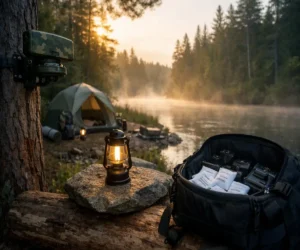
The 2026 Proactive Basecamp Kit is built around one game-changing piece of technology: the LETWESAF radar perimeter sensor. It’s what turns a reactive camp into a proactive one. The voice-controlled lantern and desiccant packs are excellent supporting gear — they solve real problems. But the radar sensor is the reason this kit exists.
Here’s the reality: if you’re heading into bear country this season or want real perimeter awareness on solo trips, the LETWESAF is one of the most capable sensors we’ve seen in this category. It detects movement through tent walls. It filters out false alarms. And early field testing — including a black bear trigger — shows it delivers on the promise.
The LETWESAF radar sensor brings serious technology to the table: millimeter-wave radar, IP66 waterproofing, and a claimed 0.5-mile wireless range. We’re running it hard on the Manistee this spring to verify every spec, but the early results are already convincing.
Want to see if it fits your kit? Check the current price on Amazon below — and if you grab one, drop a comment below. For any spec or buying questions while you’re building out your kit, use our outdoor gear questions answered resource.
Shop the Proactive Basecamp Kit
Spring 2026 Backcountry Tech Kit — FAQ
What is the actual detection range of the LETWESAF radar sensor?
This is the most important spec clarification in this article. The LETWESAF is marketed with a “0.5-mile range” figure that refers to the wireless transmission range — the maximum distance between the sensor unit and the receiver/alarm where the alert signal can still be transmitted reliably. This is how far you can be from the sensor when it triggers.
The radar detection zone — the area in front of the sensor that it actively scans for movement — is approximately 50 feet (15m) deep according to manufacturer documentation. These are two completely separate specs. We are flagging this clearly because the two numbers are routinely conflated in coverage of this product, and a buyer expecting half-mile motion detection will be significantly misled.
OTL is conducting active field testing on the Manistee River in Spring 2026 to verify the real-world detection performance. Early testing has already captured a black bear trigger. This article will be updated with full independent results after testing is complete.
Does the Coast EAL35R actually work with voice commands outdoors?
The Coast EAL35R’s voice control technology is verified per the manufacturer listing and is functional as described for indoor and calm outdoor environments. The realistic consideration for backcountry use is ambient noise: rain on a tent fly, strong wind, or high-volume camp activity may reduce command recognition reliability.
The lantern retains standard physical controls as a backup, so voice control failure in adverse conditions does not leave you without light — it just requires using the manual interface instead. For solo camping in typical Northern Michigan conditions, the voice control functionality is a genuine usability improvement. The Emergency Red mode and manual backup controls together make it a solid primary camp lantern.
How often do the Wisedry desiccant packs need to be recharged?
Recharge frequency depends entirely on the humidity environment in which the packs are stored. The built-in color indicator handles this for you — the dot shifts from blue to pink when the pack has absorbed enough moisture to need recharging. In a sealed camera bag stored in a climate-controlled environment between trips, a 100g pack may stay blue for several months. In a regularly opened gear bag in humid summer conditions, it may shift to pink within a few weeks.
The microwave reactivation time is as little as 6 minutes for the 100g 5-pack, verified from the Amazon listing. Once the pack returns to blue after recharging, it is fully active again. There is no manufacturer limit on the number of recharge cycles, making these indefinitely reusable under normal use conditions.
Is this kit appropriate for beginner backcountry campers?
This kit is designed as a tech layer on top of a solid foundational gear setup — it is not a starting point. If you are building a backcountry kit from scratch, the priority order should be shelter, sleep system, navigation, fire and water, and core lighting before adding tech-forward items like a radar perimeter sensor.
The Coast EAL35R is a practical lantern for any experience level. The Wisedry desiccant system is useful any time you are storing electronics-heavy gear. The LETWESAF radar sensor is a specialized solo-camping safety tool most relevant to experienced backcountry campers doing overnight solo trips in remote locations. For foundational kit guidance, the OTL camping 101 beginner’s guide covers the right build order before adding tech layers.
Can the Coast EAL35R charge a GPS device?
The Coast EAL35R includes USB-C output that functions as a power bank — it can charge phones, GPS units, and other USB-powered devices directly from the lantern’s internal battery. This makes it a dual-function item: primary camp lighting and emergency power source in one unit.
For a full charging setup on multi-day trips where you need to run multiple devices consistently, a dedicated portable power station will provide significantly more capacity. But for shorter trips or as a backup charging source on longer ones, the integrated bank is a practical convenience that reduces the number of separate items you need to carry.
Why does OTL flag the LETWESAF specs as unverified when other sites are recommending it?
Because our standard is independent field testing, not spec-sheet republishing. The LETWESAF is a new product with significant 2026 PR coverage, and the vast majority of that coverage repeats manufacturer claims without independent verification. That is not a knock on the product — early field testing (including a black bear trigger) is promising. But until we have run it through our full test protocol in real Northern Michigan conditions and can report actual numbers, OTL will not present manufacturer claims as confirmed performance.
This is especially important for the range specs, where the transmission range and detection zone are fundamentally different figures that are routinely conflated in coverage. We expect to have full field test results from Manistee River testing available in the coming months and will update this article with independent data at that time.
📚 Trusted Resources: Backcountry Safety & Gear Care
🏕️ National Park Service
Official backcountry camping guidelines, bear safety protocols, and leave-no-trace principles from the NPS.
Visit nps.gov →🎓 CSU Extension — Safety & Emergency Resources
Research-backed safety and emergency preparedness guidance from Colorado State University Extension — covering outdoor preparedness, risk planning, and trip safety tools.
Visit extension.colostate.edu →This gear guide was published in March 2026.
Product specifications sourced from verified manufacturer and Amazon listing data. LETWESAF field test results pending — article will be updated after OTL Manistee Forest testing.
Published by Outdoor Tech Lab — independent outdoor gear testing and reviews from Northern Michigan.




Leave a Reply