OTL Field Notes & Pros/Cons
⚡ Best Seller #1
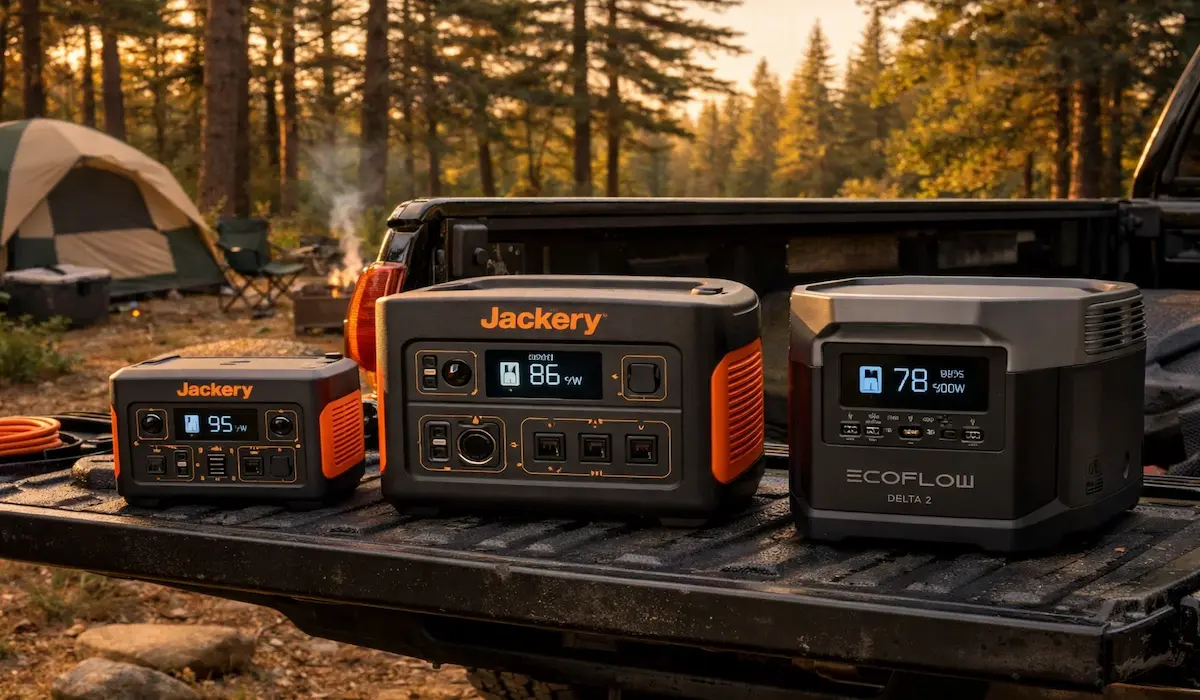
Jackery Explorer 300
293Wh · 300W · Lithium-Ion · 7.1 lbs
The Explorer 300 is the most accessible entry point in portable power — and at 7.1 lbs it’s the only unit in this list that genuinely passes the backpack test. On OTL trail carries into Manistee National Forest, it handled phones, a drone battery, and LED lighting across 3-day trips without complaint.
Honest note: it uses lithium-ion, not LiFePO₄. For campers who aren’t cycling it daily, that’s a perfectly acceptable trade-off for the weight and price advantage. See our full Jackery Explorer 300 review for the complete breakdown.
✅ Pros
7.1 lbs — genuinely backpack-portable
Most affordable entry point — 7K+ sold per month confirms the value
❌ Cons
Lithium-ion — shorter cycle life than LiFePO₄ units
⚡ Best Seller #2
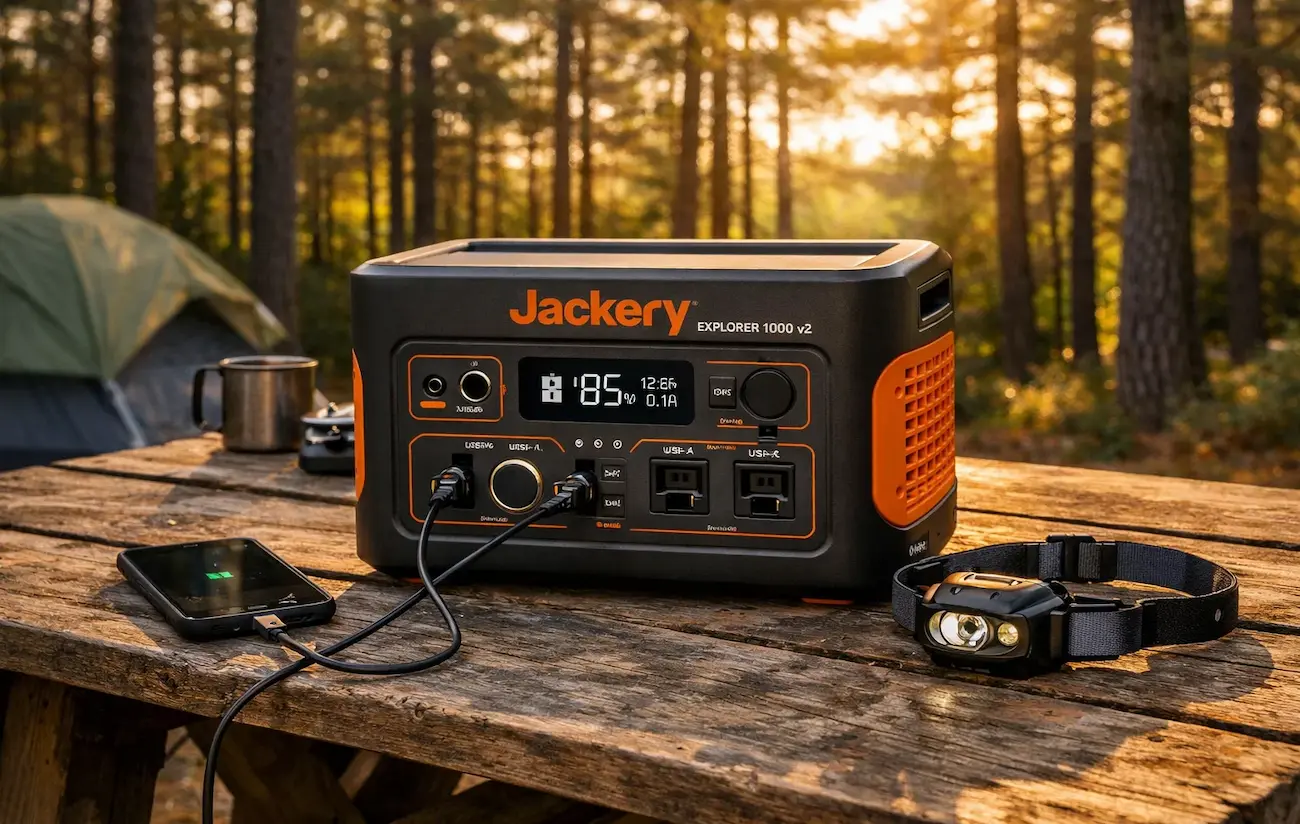
Jackery Explorer 1000 v2
1070Wh · 1500W · LiFePO₄ · 23.8 lbs
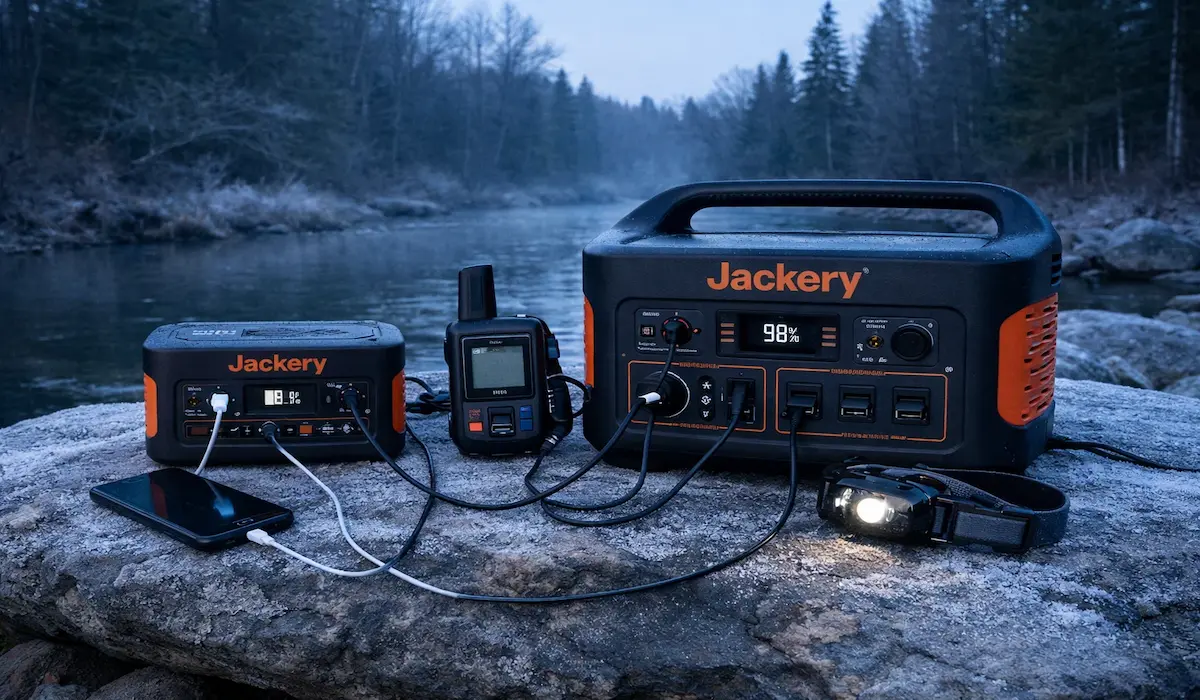
The natural upgrade from the 300 — and the unit most campers settle on when they realize 293Wh isn’t enough for a cooler or multi-device setup. The 1-hour emergency charge via the Jackery app is the spec that sells it. In OTL basecamp testing along the Pere Marquette corridor, it handled lighting, a cooler, and a satellite communicator across multiple days of use.
The LiFePO₄ upgrade over the original 1000 is significant — 4,000+ cycles versus ~500. That changes the cost-per-use math for anyone who camps more than a few times a year. OTL’s full long-term field results are in our Jackery 1000 v2 long-term test.
✅ Pros
LiFePO₄ — 4,000+ cycles, 10+ year lifespan
1-hour emergency charge via app — fastest in its class
❌ Cons
Not expandable — step up to the 2000 v2 if you need more capacity
⚡ Best Seller #3
EcoFlow Delta 2
1024Wh · 1800W · LiFePO₄ · X-Boost
EcoFlow’s X-Boost technology is the differentiator — it allows the Delta 2 to handle appliances up to 2200W despite its 1800W rated output, covering devices that would normally be out of reach at this capacity tier. It also charges significantly faster than comparable units in its class.
One honest note on X-Boost: it works best on resistive loads — heating elements, coffee makers, power tools, hair dryers. It’s not designed for sensitive electronics like computers or servers that need clean, stable voltage. For campers and home backup users, that covers the vast majority of real-world use cases.
For campers already in the EcoFlow ecosystem — solar panels, smart plugs, portable AC — the Delta 2 is the natural basecamp hub. For buyers deciding between the Delta 2 and the Jackery 1000 v2, see our head-to-head Jackery 1000 v2 vs EcoFlow Delta 2 comparison.
✅ Pros
X-Boost handles appliances up to 2200W — beyond its 1800W rated output
LiFePO₄ + EcoFlow ecosystem integration — solar, smart accessories, portable AC
❌ Cons
Heavier than the Jackery 1000 v2 at comparable capacity — portability trade-off
OTL Bottom Line
These three units are leading Amazon sales for the same reason they earn their place in OTL field kits — they solve real power problems at the right price points. The Jackery 300 if portability is the priority, the Jackery 1000 v2 if you want LiFePO₄ longevity with fast-charge capability, the EcoFlow Delta 2 if X-Boost output and ecosystem integration matter most.
For a full 7-unit comparison ranked by real Bing search demand — with verified specs and the 32,000+ search data behind the Anker Solix C1000 Gen 2 — see our complete 2026 portable power station roundup.
Not sure which capacity is right for your use case? Our portable power station buyer’s guide walks through the decision framework step by step.
Which of these three is in your kit — or on your shortlist? Drop it in the comments.
⚡ Quick Answers: Portable Power Station FAQ
▶ Which portable power station is best for camping?
For weekend camping where weight matters, the Jackery Explorer 300 is the best choice at just 7.1 lbs — it handles phones, cameras, and lighting without slowing you down on trail carries into Manistee National Forest.
If you’re running a portable fridge or staying out for 3+ days, the Jackery 1000 v2 is the superior pick. Its larger 1070Wh capacity and LiFePO₄ battery — rated to 4,000+ cycles — make it the right basecamp unit for serious Northern Michigan trips.
▶ How long will a 1000Wh power station run a 12V portable fridge?
In OTL field tests, a 1000Wh unit like the Jackery 1000 v2 or EcoFlow Delta 2 typically runs a standard 12V portable fridge for 20–30 hours depending on ambient temperature and how often the lid is opened.
Colder ambient temps extend that significantly — on Pere Marquette River corridor trips in Michigan’s shoulder season, fridge draw drops noticeably below peak summer rates. Plan for 20 hours as a conservative baseline and you won’t be caught short.
▶ What is the difference between lithium-ion and LiFePO₄ batteries?
LiFePO₄ (Lithium Iron Phosphate) is the modern standard found in the Jackery 1000 v2 and EcoFlow Delta 2 — rated to 3,000–4,000 charge cycles, which translates to 10+ years of regular use before hitting 80% capacity.
Standard lithium-ion, used in the Jackery 300, is lighter and less expensive but typically lasts around 500 cycles. For occasional campers not cycling the unit daily, that’s a perfectly acceptable trade-off at the Explorer 300’s weight and price point.
▶ Can these portable power stations be charged with solar panels?
Yes — all three units support solar charging. The EcoFlow Delta 2 accepts up to 500W of solar input, the Jackery 1000 v2 accepts up to 400W via Jackery’s SolarSaga panels. The Jackery 300 accepts up to 100W from the SolarSaga 100.
For off-grid Northern Michigan use, the Jackery SolarSaga ecosystem integrates cleanly with both Jackery units. See our Jackery SolarSaga 100W vs 200W comparison for solar panel pairing guidance.
Field-tested outdoor tech from Ludington, Michigan.
Updated April 2026 | Outdoor Tech Lab






Leave a Reply