

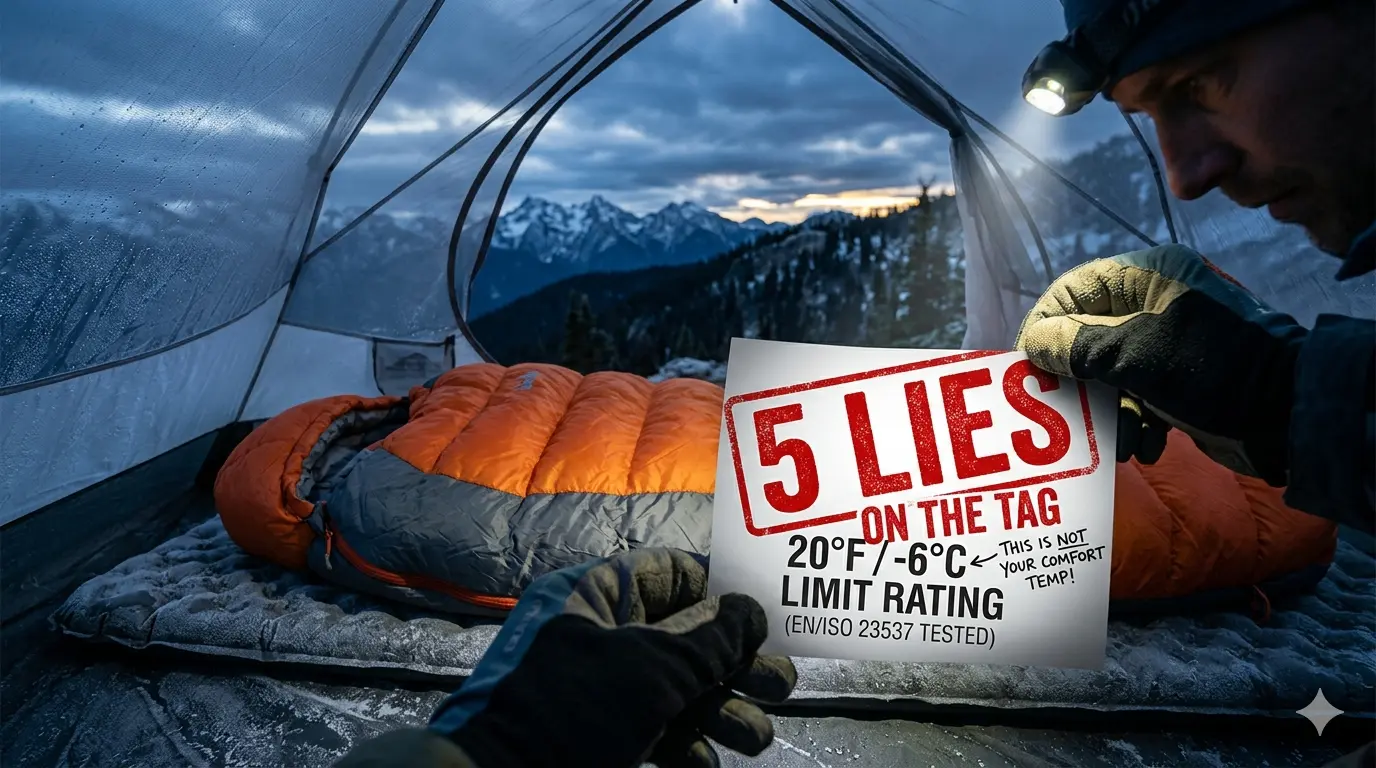
Don’t Buy a Sleeping Bag Until You Read This — The Number on the Tag Was Earned in a Lab, Not the Field
FIELD TESTED The ISO Rating Truth | April 2026
⚡ The 30-Second Version
The temperature rating on your backpacking sleeping bag was earned by a heated manikin in a climate-controlled lab — not a tired, calorie-depleted backpacker on a humid Northern Michigan night.
Before you trust that number with your comfort and safety, you need to understand what the ISO test actually measured, and what it completely ignored.
The single most important fact: Most men’s bags are labeled with the Limit rating — the temperature at which a warm-sleeping man curled in a ball is just barely not shivering.
That is not a comfortable night’s sleep. It is the absolute minimum threshold before things go dangerously wrong.
You bought a backpacking sleeping bag rated to 20°F. You camped at 28°F and woke up shivering at 2am.
The bag didn’t fail — the number on the tag did exactly what it was designed to do. It told you the truth about a laboratory. It just had nothing to say about the actual woods.
After years of testing sleep systems across Northern Michigan — from Manistee National Forest to exposed Pictured Rocks ridgelines — the pattern is always the same. Backpackers trust the hang tag number, buy accordingly, and get cold.
Not because the bag is defective, but because the ISO rating system has five structural assumptions baked into every test that simply do not exist in the backcountry.
This guide breaks down what backpacking sleeping bag temperature ratings actually measure, what they ignore, and how to use the real-world adjustment table below to buy the right bag the first time.
For a broader look at what to pack around your sleep system, see our backcountry beginner’s gear guide.
📋 Jump to Section
Lie 1: “The Test Simulates Real Camping Conditions”
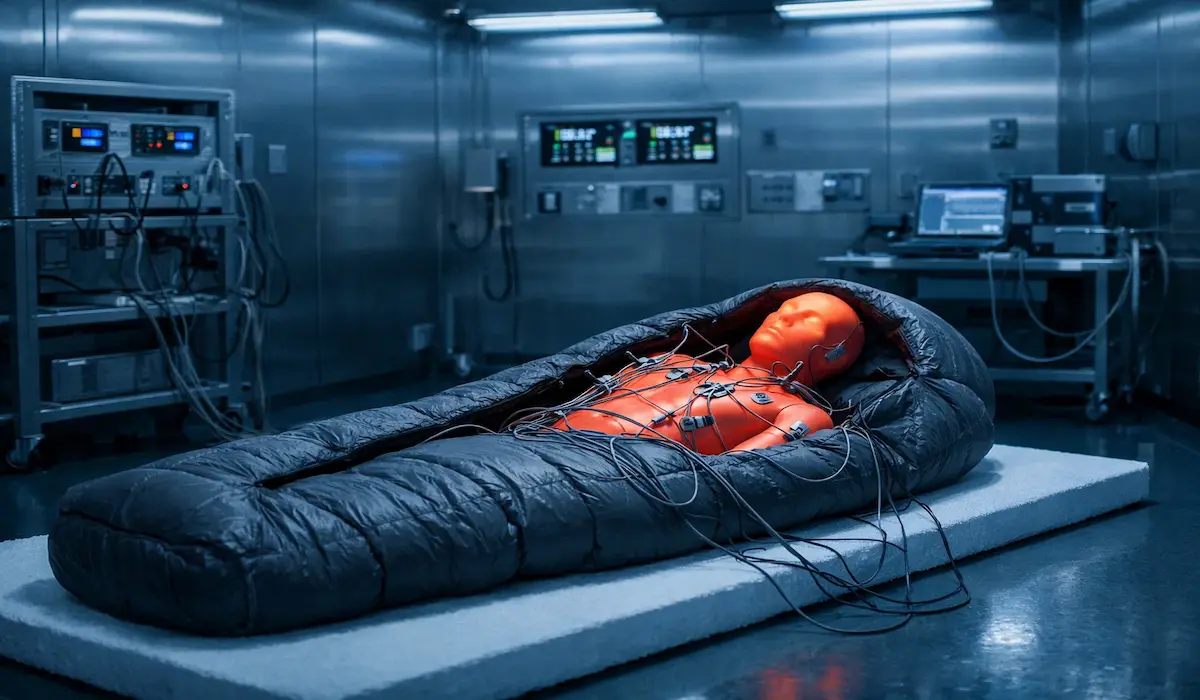
The ISO 23537 test — the international standard behind every temperature rating on a backpacking sleeping bag — uses a heated electronic manikin dressed in thin base layers, placed inside the bag on a standardized foam pad, in a perfectly controlled climate chamber.
The room cools at a precise, measured rate. Wind is minimal. Humidity is controlled. The manikin does not sweat, shiver, or move.
Sensors measure how much electrical energy it takes to maintain the manikin’s temperature as the chamber gets colder.
That energy measurement is converted into temperature ratings through calibrated formulas. The test runs until conditions reach equilibrium.
What the Lab Controls That the Backcountry Doesn’t
✅ Controlled in the lab — ❌ Absent in the woods
The ISO test controls for air temperature, humidity level, wind speed, ground insulation, clothing, and starting conditions.
Every one of these variables is fixed inside the lab. Every one of them varies dramatically in real backcountry conditions.
⚠️ What “Comfort” and “Limit” Actually Mean
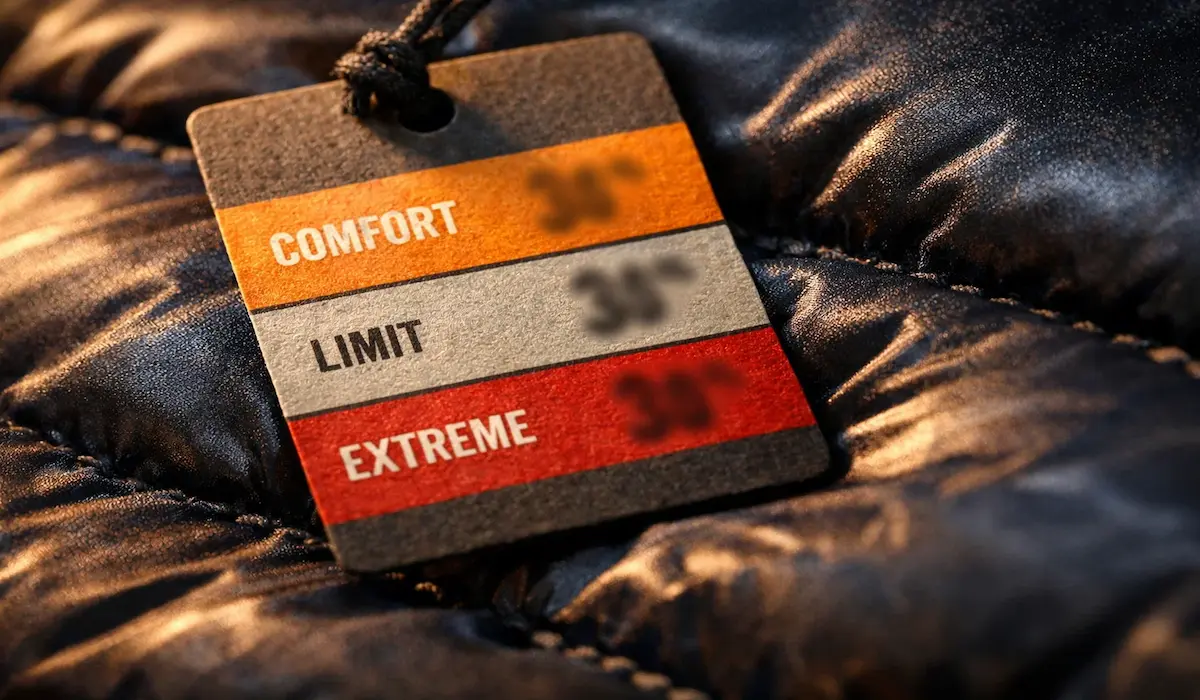
The ISO test produces three numbers. The Comfort rating is the temperature at which a “standard woman” can sleep in a relaxed position without feeling cold.
The Limit rating is where a “standard man” curled in a ball is just barely maintaining thermal equilibrium — not comfortable, right on the edge.
The Extreme rating is a survival threshold only — six hours without hypothermia risk, with significant health damage possible. It is never appropriate to plan a camping trip around the extreme rating.
Lie 2: “The Tag Number Is Your Comfort Temperature”
This is the most consequential misunderstanding in sleeping bag selection — and it costs backpackers comfortable nights thousands of times every season.
Walk into any gear shop or scroll through any online listing. The prominent number on a men’s sleeping bag — the one in the product name, the one on the hang tag — is almost universally the Limit rating, not the Comfort rating.
The Limit rating is the temperature at which a warm-sleeping man curled in a fetal position is just not shivering. That is not a comfortable night of sleep. That is the minimum survivable scenario before discomfort becomes dangerous.
The Rating Gap That Catches Everyone
🌡️ Comfort vs Limit: The Real Difference
The gap between a bag’s Comfort rating and its Limit rating is typically 10 to 15°F.
That means a bag marketed as a “20°F sleeping bag” has a Comfort rating somewhere around 30–35°F. If you plan a trip with overnight lows of 25°F and buy that bag, you are at the Limit — not the Comfort. A cold sleeper will wake up cold. Full stop.
👩 Why Women’s Bags Use a Different Rating
Women’s bags are labeled with the Comfort rating rather than the Limit rating — because research has consistently shown that the average woman runs colder than the average man.
This means a women’s 20°F bag and a men’s 20°F bag are not equivalent. The women’s bag is meaningfully warmer because its “20°F” is the Comfort number, while the men’s “20°F” is the Limit number.
If you run cold regardless of gender, always shop by the Comfort rating.
⭐ The Simple Rule
If you are a cold sleeper, always shop by the Comfort rating, not whatever number is in the product name.
If the brand doesn’t list both ratings clearly, contact them and ask which number is on the tag — or add 12°F to any men’s bag rating as a working estimate of its true Comfort temperature.
Lie 3: “Down Keeps You Warm in Wet Conditions”
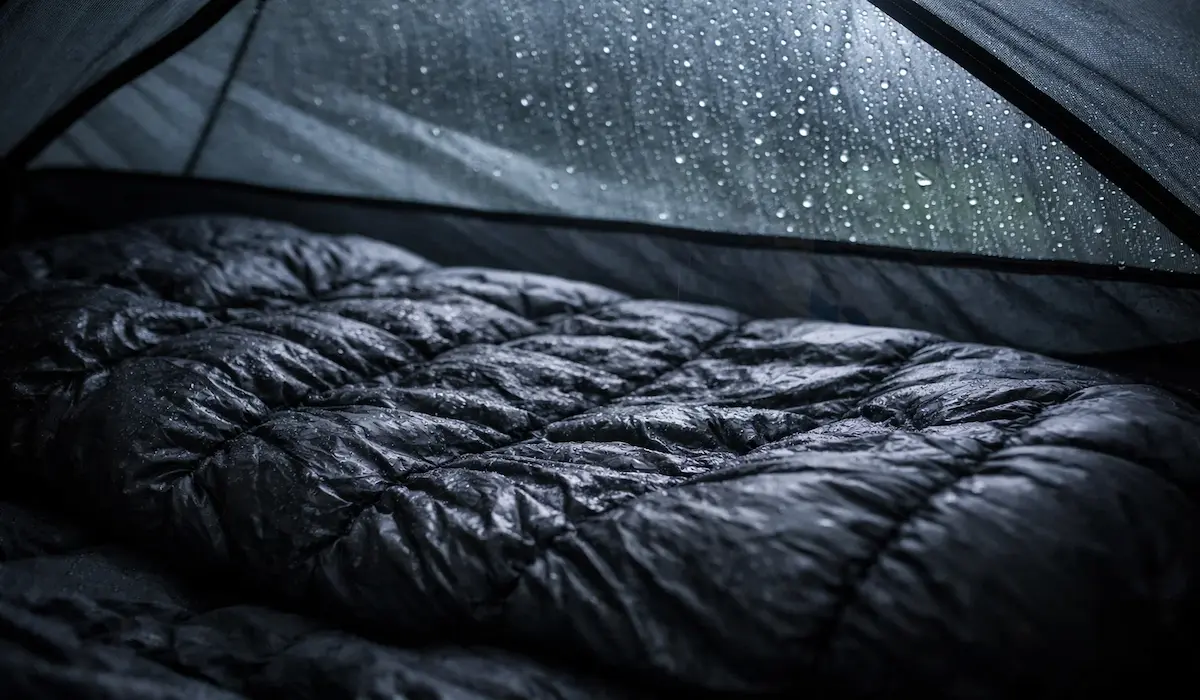
The ISO test uses a fully lofted, bone-dry sleeping bag every single time. Real backcountry trips involve humidity, condensation, sweat, rain fly contact, and damp ground.
And nothing in your sleep system is more sensitive to moisture than down insulation.
The Down Moisture Problem
💧 What Moisture Does to Down
Down insulates by trapping warm air in thousands of tiny loft clusters. When those clusters get wet, they clump together and collapse.
A down bag that absorbs moisture from a humid sleeping environment, tent wall condensation, or even brief rain contact can lose a significant portion of its insulating power — in severe cases approaching total loft failure.
🌧️ The Great Lakes Humidity Problem
Spring and fall nights in Northern Michigan are routinely humid. The air itself carries moisture that slowly penetrates sleeping bag shells and degrades loft over multi-day trips — even without direct rain contact.
High ambient humidity effectively makes your bag perform as if temperatures were 5 to 10°F colder than the actual air temperature by accelerating heat transfer away from the insulation.
⚖️ Down vs Synthetic — The Honest Trade-off
Down advantages: Superior warmth-to-weight ratio when dry, better compressibility, longer lifespan when properly cared for.
Synthetic advantages: Retains meaningful insulating ability when wet, dries faster, lower cost, better for humid or rainy conditions.
For multi-day Michigan backcountry trips with rain probability above 30%, synthetic or water-resistant down treated with hydrophobic coating is worth the weight penalty. Check our gear waterproofing guide for how water resistance ratings work across outdoor equipment.
📉 The Loft Degradation Nobody Warns You About
The ISO test always uses a brand-new bag at peak loft. Your three-season-old down bag is not that bag. Skin oils transferred through the shell compress down clusters over time, and storing a bag stuffed in its stuff sack — instead of loosely in a large storage sack — permanently damages loft over multiple seasons.
A bag that was a true 20°F bag when you bought it may only perform to 35°F today if it hasn’t been properly washed and stored. The tag still says 20°F. The bag no longer is.
The fix: Wash your down bag once per season with a down-specific wash, dry it fully with tennis balls to re-open the clusters, and store it uncompressed in a large breathable cotton sack.
A well-maintained down bag holds its rating for years. A neglected one loses it quietly, one camping trip at a time.
Lie 4: “The Rating Accounts for Your Sleeping Pad”
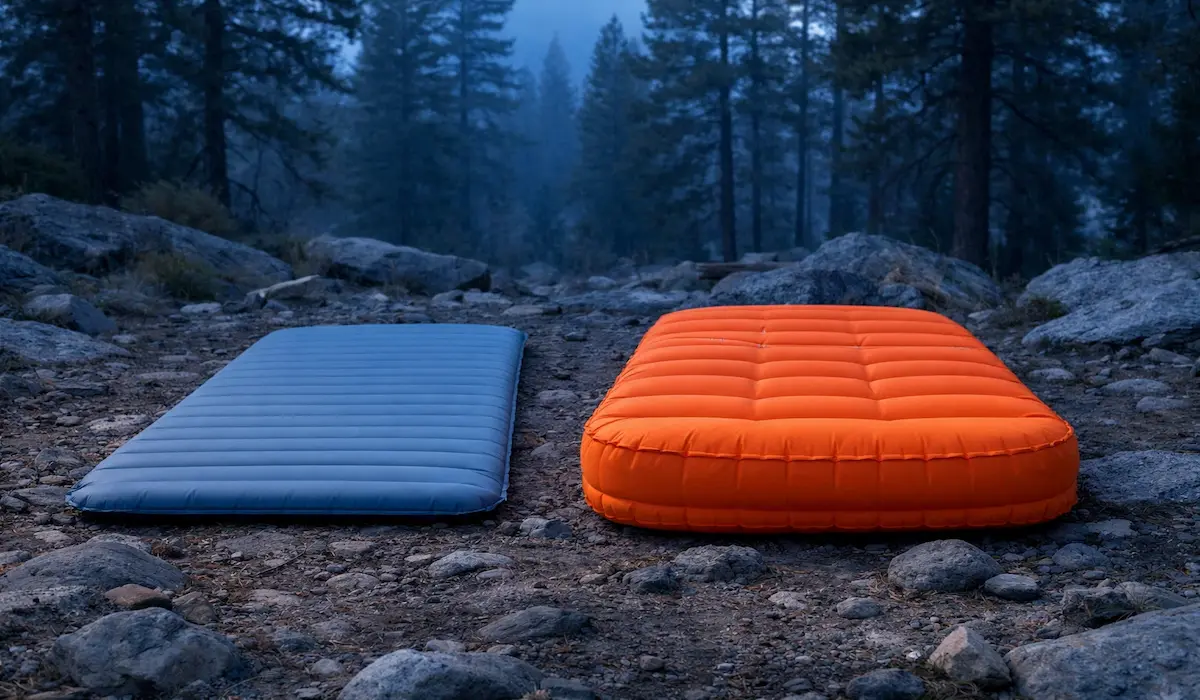
This is the sleeping bag lie that almost nobody talks about — and it may be responsible for more cold nights than any other single factor.
The ISO 23537 manikin test uses a standardized foam sleeping pad with an R-value of approximately R-5.3. That is a full winter-grade pad.
Most 3-season backpackers are carrying pads in the R-2 to R-4 range. The temperature rating on your sleeping bag was calibrated for a pad you probably don’t own.
R-Value and Ground Heat Loss
🛏️ Why the Ground Matters More Than Most Backpackers Think
The ground conducts heat away from your body far more aggressively than cold air does. A sleeping bag insulates through trapped air — but compressed insulation under your body weight does almost nothing.
Your sleeping pad is your only thermal barrier against ground conduction, and its R-value determines how much heat you lose through the floor of your shelter every hour of the night.
📊 Common Pad R-Values vs ISO Test Assumption
The ISO test assumes R-5.3. Here’s what most backpackers actually carry: lightweight summer inflatables typically run R-1.5 to R-2.5, popular 3-season inflatables run R-3 to R-4, and true 4-season pads start at R-5 and above.
If you’re using a summer pad with a 3-season bag, your effective sleep system is meaningfully warmer in the lab than in the field.
🔧 The Fix
Match your pad’s R-value to your bag’s temperature rating — not just to the season. For any overnight trip below 30°F, a pad rated at minimum R-4 is strongly recommended regardless of your bag’s rating.
When in doubt, carry a closed-cell foam sit pad as a supplemental layer under your inflatable — it adds R-value without meaningful weight penalty and provides a backup if your inflatable punctures in the field.
Lie 5: “One Temperature Rating Works for Everyone”
The ISO manikin is a fixed, standardized object. It has the same metabolism on night one and night seven of a backpacking trip.
It never gets tired, never runs a calorie deficit, and its body temperature regulation is perfectly consistent across every test run.
Humans are not manikins. Your personal thermogenesis — the rate your body produces heat — is dramatically affected by factors the ISO test cannot simulate.
Every one of the variables below will shift the temperature at which you sleep comfortably, sometimes by 15°F or more.
Personal Factors the ISO Test Ignores
🔋 Calorie Deficit
Your body generates heat by burning calories. After a 15-mile day with aggressive elevation gain, most backpackers end the day in a calorie deficit.
When that happens, your body deprioritizes heat generation to preserve core metabolic functions. Day 3 of a multi-day trip is when the cold creeps in — even though nothing about the bag or the weather changed.
😴 Accumulated Fatigue
Fatigue compounds calorie deficit. A tired body is a cold body — thermogenesis is one of the first non-critical functions your physiology scales back under physical stress.
The longer the trip, the more buffer you need built into your sleep system rating.
🏔️ Altitude
Temperature drops approximately 3 to 5°F for every 1,000 feet of elevation gain — an effect the sea-level lab test doesn’t account for at all.
A bag rated to 25°F at trailhead elevation may not keep you comfortable at 25°F on an exposed ridgeline 2,000 feet higher.
💨 Wind
The ISO test uses minimal, controlled airflow. Exposed camping sites — open meadows, lake shorelines, ridgelines along the Pictured Rocks corridor — experience wind that drives heat away from tent walls and sleeping bag shells at a rate the lab never simulates.
A well-sheltered forest campsite and an exposed shoreline site can feel 10°F different at identical air temperatures.
Site selection is part of your sleep system. For a complete cold-weather camping framework, see our winter camping essentials guide.
The Real-World Sleeping Bag Adjustment Table
Quick Reference: Real-World Comfort by Sleeper Type
The ISO test uses a standardized male and female profile at rest. If you don’t match those profiles — or you’re tired, underfueled, or using a light pad — these are the temperatures your bag will actually keep you comfortable to. Using this table? You’re welcome to embed it with credit — contact us for the embed code.
| Bag Tag Rating | Real Comfort — Warm Sleeper (Men) | Real Comfort — Cold Sleeper (Women) | Minimum Pad R-Value |
|---|---|---|---|
| 0°F (Deep Winter) | 10°F to 15°F | 20°F to 25°F | R-5 or above |
| 20°F (3-Season) | 30°F to 35°F | 40°F or above | R-4 to R-5 |
| 40°F (Spring/Summer) | 45°F to 50°F | 55°F or above | R-2 to R-3 |
Comfort ranges based on ISO 23537-1:2022 Comfort vs Limit rating gap (typically 10–15°F) applied across common bag ratings. “Cold sleeper” column adds an additional 10–15°F adjustment. Pad R-value recommendations assume standard tent shelter with no additional layers. Individual results vary — use the detailed adjustment table below for your specific conditions.
Detailed Real-World Adjustment Table
Each factor below represents a documented real-world variable that shifts the effective temperature of your sleep system. Add these adjustments to the bag’s Limit rating to find the temperature you should actually be shopping for.
| Factor | Add to Limit Rating | Why It Matters | Field Context |
|---|---|---|---|
| Cold sleeper | +10 to +15°F | Limit rating is for warm-sleeping men. Cold sleepers need the Comfort rating, which is typically 10–15°F warmer than Limit | Most common cause of 2am wake-ups — and the easiest to fix at purchase |
| High humidity / damp air | +5 to +10°F | Moisture in air accelerates heat loss from insulation and skin — lab conditions are dry and controlled | Spring and fall in Northern Michigan and Great Lakes region routinely exceed 80% relative humidity overnight |
| Wet down insulation | +15 to +25°F | Down loses significant insulating power as loft clusters collapse from moisture absorption — lab bag is always dry | Multi-day trips with rain probability above 30% — consider synthetic or hydrophobic down treatment |
| Low R-value sleeping pad (R-1 to R-2) | +10 to +15°F | ISO test assumes R-5.3 (winter-grade) pad — lightweight summer pads provide significantly less ground insulation | Most common gear mismatch — 3-season pads paired with cold-rated bags |
| Moderate R-value pad (R-3 to R-4) | +3 to +7°F | Still below the ISO test assumption — even popular 3-season pads fall short of the R-5.3 lab standard | Common 3-season backpacking pad range — often overlooked in system planning |
| Calorie deficit | +5 to +10°F | Body heat generation drops when under-fueled — thermogenesis is deprioritized under caloric stress | Day 3+ of multi-day trips — also relevant for ultralight hikers pushing daily miles |
| Accumulated fatigue | +5°F | Physical fatigue reduces your body’s ability to maintain core temperature — the lab manikin never gets tired | Multi-day hunts, thru-hiking, and any trip where daily mileage compounds physical stress |
| Altitude (per 1,000 ft gain) | +3 to +5°F | Temperature drops with elevation — lab tests at controlled conditions, not at elevation | UP backcountry destinations with ridge camping above 1,500 ft — compounds with wind exposure |
| Wind (exposed campsite) | +5 to +10°F | ISO test uses minimal airflow — exposed sites drive heat away from tent walls and bag shell significantly | Lake shorelines, open meadows, and ridgeline sites — site selection is part of your sleep system |
Adjustment ranges based on ISO 23537-1:2022 test methodology, peer-reviewed insulation research, and OTL field testing across Northern Michigan. Factors are cumulative — a cold sleeper on a humid night with a summer pad after a long day faces combined adjustments of 30°F or more. Always build a safety buffer into your bag selection; the backcountry does not offer do-overs.
Shop Field-Tested Backpacking Sleeping Bags
⭐ The OTL Field Rule: How to Actually Buy the Right Bag
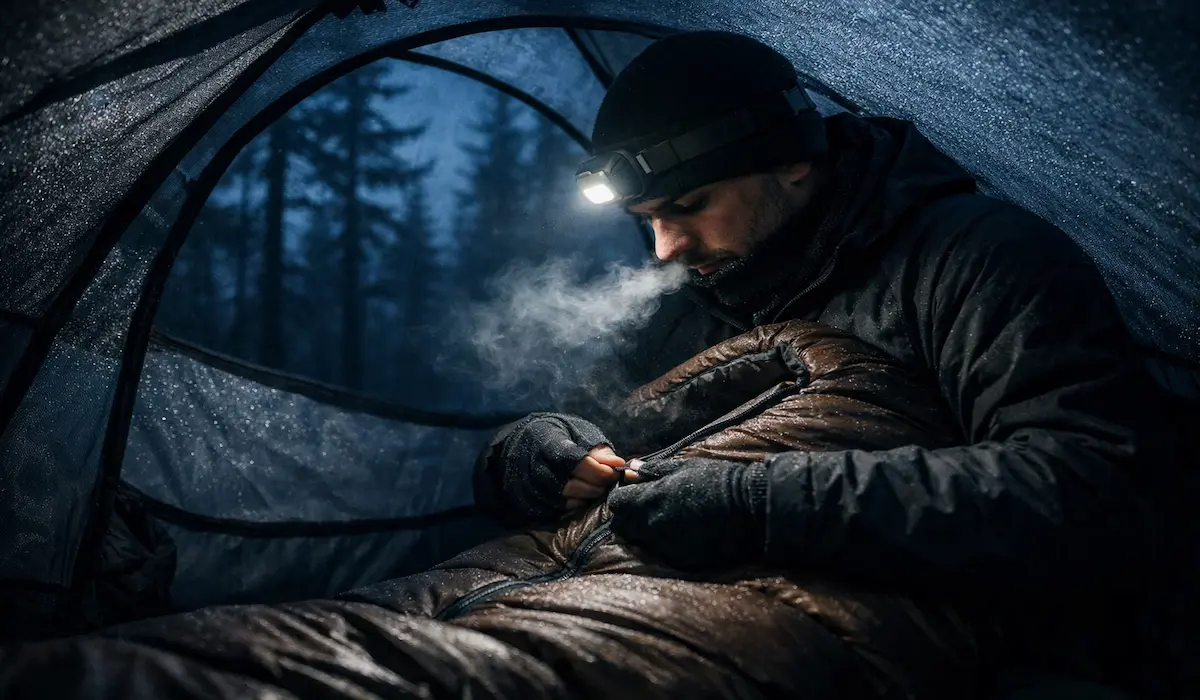
After years of testing sleep systems across the Pere Marquette River corridor, Manistee National Forest, and UP backcountry destinations, here is the practical framework that consistently works:
Step 1 — Start with the Comfort rating, not the Limit rating.
Ask the brand which number is on the hang tag. If they list a single number on a men’s bag, add 12°F to estimate the Comfort rating. Shop to that number.
Step 2 — Find the coldest temperature you expect to encounter.
Not average overnight lows. The coldest realistic night of your planned trip. Check historical weather data, not just the forecast.
Step 3 — Add 15°F as a base safety buffer.
This accounts for the lab-to-field gap under normal conditions — moderate humidity, reasonable pad, average fatigue. Fifteen degrees is the minimum buffer for any conditions that aren’t perfect.
Step 4 — Add personal factors from the adjustment table above.
Cold sleeper? Add 10–15°F. Multi-day trip? Add 5–10°F for fatigue and calorie deficit. Summer pad? Add 10°F. Each factor stacks.
The result is the temperature rating you should actually be shopping for — not the number on the hang tag, but the number that accounts for your body, your gear, and your conditions. A bag that feels “too warm” on a mild night costs you nothing.
A bag that is too cold on a remote ridgeline costs you the trip — or more.
For a complete multi-day backcountry kit built around your sleep system, see our best solo camping gear guide and our tested best power banks for backpacking — keeping devices charged matters as much as staying warm on extended trips.
Frequently Asked Questions: Backpacking Sleeping Bag Ratings
▶ What is the difference between comfort and limit temperature ratings on a sleeping bag?
The Comfort rating is the temperature at which a cold-sleeping “standard woman” can sleep in a relaxed position without feeling cold. The Limit rating is the temperature at which a warm-sleeping “standard man” curled in a fetal position is just barely not shivering — it is not a comfortable sleep, it is a minimum threshold.
The gap between Comfort and Limit is typically 10 to 15°F. Most men’s bags are marketed and labeled with the Limit rating.
If you are a cold sleeper, always shop by the Comfort rating or buy a bag rated 12 to 15°F warmer than the coldest temperature you expect to encounter.
▶ Why did I wake up cold in a backpacking sleeping bag rated for colder temperatures?
The most common causes in order of frequency: you are a cold sleeper shopping by the Limit rating instead of the Comfort rating; your sleeping pad has a lower R-value than the R-5.3 assumed by the ISO test; ambient humidity was high, reducing insulation effectiveness.
Additional factors: calorie deficit or fatigue from the day’s hike reducing your body’s heat generation; camping at elevation or in an exposed site with wind the lab never simulates.
In most cases the bag performed exactly as the test said it would — but the test conditions didn’t match your actual situation. Use the adjustment table in this article to calculate a realistic target rating for your next purchase.
▶ What sleeping pad R-value do I need with my backpacking sleeping bag?
The ISO 23537 sleeping bag test assumes a sleeping pad with an R-value of approximately 5.3 — a full winter-grade pad. For summer camping above 40°F, R-2 to R-3 is generally adequate. For 3-season camping down to 20°F, R-4 to R-5 is recommended. For winter and sub-zero conditions, R-5 or above is necessary.
As a practical rule: your pad’s R-value should increase as your bag’s temperature rating decreases.
A warm bag on a cold night with a thin pad will leave you colder than a colder-rated bag on a proper winter pad — ground heat loss is one of the most underestimated factors in backcountry sleep systems.
▶ How much warmer does a sleeping bag liner make a bag?
A quality sleeping bag liner adds approximately 5 to 15°F of effective warmth depending on the liner material and weight. Silk liners add roughly 5°F, fleece liners add 10–15°F.
Liners also protect your bag’s insulation from skin oils and sweat that degrade loft over time, extending the bag’s usable life significantly.
For backpackers who own a single 3-season bag and want to extend it into colder conditions without purchasing a new bag, a quality fleece liner is the most cost-effective performance upgrade available. Combine a liner with a higher R-value pad and your effective sleep system rating drops substantially.
▶ Is down or synthetic insulation better for backpacking sleeping bags?
Down wins on warmth-to-weight ratio, compressibility, and long-term durability when properly cared for — making it the preferred choice for ultralight backpackers and dry conditions.
Synthetic wins when moisture is a factor: synthetic insulation retains meaningful warmth when wet and dries significantly faster than down. For multi-day Great Lakes backcountry trips with realistic rain probability, synthetic or hydrophobic down-treated bags reduce the risk of catastrophic loft loss from moisture.
Hydrophobic down treatment is a strong middle-ground — it adds meaningful water resistance without the full weight penalty of synthetic fill. For fair-weather summer trips and ultralight priorities, quality down is hard to beat.
▶ What does the extreme temperature rating on a sleeping bag mean?
The Extreme rating — sometimes called the Survival rating — is the temperature at which a person can survive for approximately six hours without dying from hypothermia, but with significant risk of health damage.
It is not a comfort rating, not a sleep rating, and not a planning temperature. No camping trip should ever be planned around a bag’s Extreme rating. It exists as a reference for emergency scenarios only.
When shopping for a backpacking sleeping bag, ignore the Extreme number entirely and focus exclusively on the Comfort and Limit ratings relative to your planned conditions.
▶ How do I know if I’m a cold sleeper or a warm sleeper?
Cold sleepers consistently feel chilly at night regardless of conditions — they pile on blankets, sleep curled up, and often wear layers to bed even at moderate temperatures. Warm sleepers run hot, kick off covers, and sleep comfortably in light clothing in cool conditions.
A simple test: if you’ve ever woken up cold in a bag that your camping partner found comfortable, you are a cold sleeper.
Women are statistically more likely to sleep cold, as are older adults, people with lower body weight, those with circulation issues, and anyone who is fatigued or under-fueled. Cold sleepers should always add 10 to 15°F to any sleeping bag’s Limit rating when evaluating its real-world suitability.
▶ Should I buy a backpacking sleeping bag rated for exactly my coldest expected temperature?
Never. A bag rated to exactly your coldest expected temperature puts you at the absolute edge of the system — with no buffer for unexpected weather, higher elevation, wind, humidity, fatigue, or calorie deficit.
The standard recommendation is to buy a bag with a Comfort rating at least 15°F below the coldest temperature you realistically expect to encounter, then add personal adjustment factors from the table above.
For a Northern Michigan fall trip with overnight lows around 35°F, you want a bag with a Comfort rating of at minimum 20°F — and if you are a cold sleeper or using a light pad, lower still. Erring on the side of warmth costs you ounces. Erring on the side of cold costs you the trip. For more on building a complete backcountry sleep system, see our Northern Michigan backcountry gear testing overview.
📚 Official Resources: Cold Weather Safety & Backcountry Preparation
For authoritative guidelines on hypothermia prevention, cold weather safety protocols, and backcountry preparation:
- CDC NIOSH Cold Stress & Hypothermia Prevention — Official guidelines on cold weather exposure, body temperature regulation, and hypothermia risk factors from the Centers for Disease Control and Prevention
- National Park Service: Backcountry Camping Safety — Official NPS guidelines for backcountry camping preparation, gear testing, emergency protocols, and safe wilderness practices
- OTL Camping Safety Tips — Field-tested safety protocols for backcountry camping across Northern Michigan, including sleep system failure prevention and cold weather preparedness
Sleep system failure is one of the most preventable causes of backcountry hypothermia incidents. Understanding your equipment’s real-world limitations — not just the hang tag — is the first line of defense.
OTL Bottom Line: Backpacking Sleeping Bag Temperature Ratings
The ISO 23537 standard is genuinely useful — it creates an apples-to-apples comparison between bags from different manufacturers that didn’t exist before 2005.
Without it, every brand could claim any rating they wanted. The standard solved a real problem.
What it didn’t solve is the gap between the lab and the field. A manikin on an R-5.3 pad in a controlled chamber has nothing to say about your third night on the North Country Trail after a 22-mile day in a humid October rain.
That’s where the adjustment table in this article closes the gap.
The single most important backpacking sleeping bag decision most people get wrong: buying a men’s bag by the Limit rating and sleeping cold all night on every trip because the Comfort rating was 12°F warmer and nobody told them which number was on the tag.
For backcountry trips where sleep system failure is a genuine safety risk, pair your sleep system planning with a satellite communicator — so that if conditions deteriorate beyond your gear’s capability, you have a way out.
Have you woken up cold in a bag you thought was rated warm enough? Drop it in the comments — we’re building a real-world sleep system failure database for our next long-term gear test, and your field data is more valuable than any lab result.
Shop OTL-Recommended Backpacking Sleeping Bags
Field tested by JC Courtland across Northern Michigan — Manistee National Forest, Pictured Rocks National Lakeshore, and Pere Marquette River corridor.
Updated April 2026 | Outdoor Tech Lab | Ludington, Michigan




Leave a Reply