If you purchase using links on our site we may earn an affiliate commission, but at no extra cost to you.
Don’t Submerge Your New Action Cam Until You Do These 3 Things
FIELD TESTED The Truth About “Waterproof” Ratings | April 2026
⚡ The 30-Second Version
Most action camera waterproof features fail in the field for one reason — physics, not manufacturing defects. Before your camera ever touches the water, you need to equalize internal pressure, inspect the rubber seals for debris, and understand the difference between static and dynamic pressure ratings.
The critical fact no box tells you: That “33-foot waterproof” claim was earned in a perfectly still lab tank. It was not earned during a cliff jump, a surf session, or a fast river run. This guide fills that gap.
You just dropped real money on a new flagship action camera. The spec sheet says waterproof to 33 feet. You jump off the dock, film ten minutes of footage — and the screen fogs over and the unit won’t turn on.
What happened? In most cases it wasn’t a defective camera. After extensive field testing of the DJI Osmo Action 5 Pro and GoPro Hero 13 Black across the rivers and open water of Northern Michigan, three pre-submersion steps consistently separate cameras that stay dry from cameras that don’t.
For a full breakdown of the top-rated options on the market right now, see our tested best waterproof action cameras guide. But getting the most out of action camera waterproof features starts with these three steps — before your camera ever touches the water.
Step 1: Master the “Burp” — Solving Internal Pressure
The single most common cause of a mid-session leak isn’t a faulty gasket — it’s the air trapped inside your camera. This one physics concept, once understood, will protect your camera better than any housing upgrade.
The Problem
When you snap your battery door shut in a warm room, you seal in air at that room’s specific pressure and temperature. When that camera hits cold water, the air inside contracts — creating a partial vacuum that actively pulls water past even perfectly functional rubber seals.
🔧 The Fix: The Burp
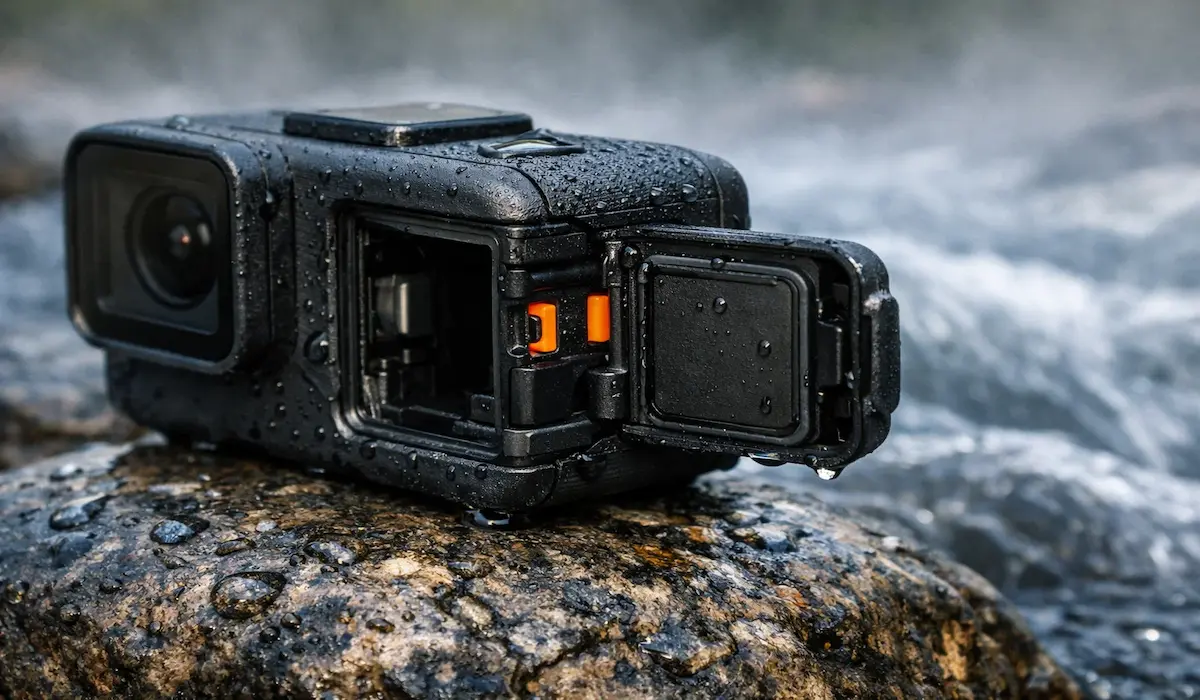
Before you submerge, open and firmly re-close your battery and USB port doors in the actual environment where you’ll be filming. On a cold lake? Do it at the water’s edge. This equalizes the internal pressure to match your shooting conditions and eliminates the vacuum effect before it starts.
⭐ Pro Tip: Verify the Seal Visually Before Every Dive
On the DJI Osmo Action 5 Pro, check that the orange security indicators on the latches are completely hidden after closing — any orange showing means the door is not fully seated. On the GoPro Hero 13 Black, listen and feel for a distinct audible click when the battery door closes. No click means no seal.
🌡️ The Spring/Midwest Problem: Temperature Shock
This one catches Great Lakes shooters every spring. Your camera has been sitting in a warm car at 70°F. You walk to the water and drop it into a 45°F Michigan river. The air sealed inside contracts almost instantly — far faster than the Burp technique alone can compensate for — creating a vacuum spike that can draw water past seals before you’re even at depth.
The Fix — The 5-Minute Acclimate: Before any submersion, set the camera outside and let it sit in the ambient air for five minutes with the doors closed. This lets the internal temperature equalize to the outdoor environment before you Burp and submerge. Cold water + warm camera = a pressure differential your seals weren’t designed to handle. Five minutes eliminates it entirely.
Step 2: The Macro Seal Audit
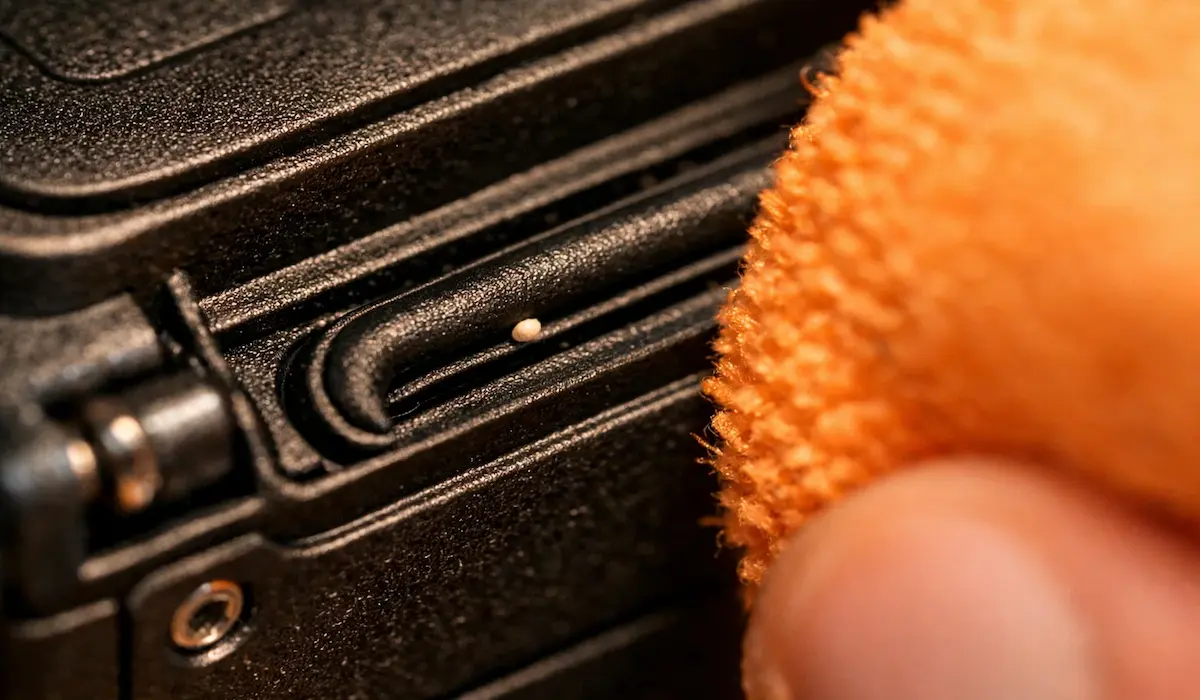
A single human hair or a grain of sand on a gasket is all it takes to create a leak path. At depth, water pressure is actively searching for any microscopic gap — and debris on a seal gives it exactly that opening.
The Science
Modern silicone gaskets are engineered to be extremely soft and pliable so they conform perfectly to the mating surface under pressure. That same softness is what makes them act like lint rollers — attracting grit, sand, and fibers from pockets, bags, and dry towels. Understanding how to protect camera gear in the field starts with the gasket.
🔧 The Fix: The Pre-Dive Wipe
Before every water session, use a clean microfiber cloth to wipe both the rubber gasket and the mating surface — the groove or ledge where the gasket seats. Even if the camera looks clean, do it anyway. A single nylon fiber invisible to the naked eye is enough to break the seal under pressure.
⭐ Pro Tip: The Lick Test
It sounds odd, but experienced underwater shooters and dive instructors often lightly moisten the rubber seal with a small amount of fresh water — or simply lick it — before closing the door. The thin layer of moisture helps the rubber seat evenly into the mating surface without pinching or folding. Always use fresh water only; never salt water, sunscreen, or lip balm.
Step 3: Respect Dynamic Pressure — The Belly Flop Factor
This is the single most important action camera waterproof feature gap that never makes it onto the box, the spec sheet, or most gear reviews. It’s also the most common cause of sudden, catastrophic failures for active shooters.
The Truth About Waterproof Ratings
A 33-foot (10m) waterproof rating is a static pressure rating. The camera was submerged in a controlled lab tank at that depth and held perfectly still. It passed. Engineers documented it. The certification went on the box. That’s the entire test.
⚠️ The Real-World Problem: Dynamic Pressure
If you’re kiteboarding at 30 mph, cliff jumping from 15 feet, or surfing a fast-breaking wave, the impact velocity when you hit the water creates dynamic pressure — a sudden force that can far exceed the camera’s static rating even when you’re only two or three feet below the surface. The camera was never tested for this scenario, and the warranty rarely covers it.
🔧 The Fix: Match Housing Choice to Activity
For calm water, pool use, and easy snorkeling within the rated depth, your naked-rated camera is fine if you’ve completed Steps 1 and 2. For anything involving high-speed water entry — surfing, cliff jumping, wakeboarding, jet skiing, or whitewater — use the dive housing regardless of your camera’s rated depth. DJI’s own documentation for the Action 5 Pro states the housing is recommended for “environments with high water impact pressure” — the manufacturer is telling you the naked rating has limits. For a detailed real-world waterproof performance breakdown by camera, see our Northern Michigan field test.
Estimated Water Impact Pressure by Activity
Pressure ranges calculated using fluid dynamics formula (q = ½ρv²) based on typical activity velocities. These are physics-based estimates, not lab-measured values — real-world impact varies with angle, contact area, and wave conditions. Provided as a field reference framework. Using this table? You’re welcome to embed it with credit — contact us for the embed code.
Activity
Estimated Impact Pressure
Equivalent Static Depth
Naked Camera Safe?
Snorkeling — calm water
~0.5–1.5 psi
~1–3 ft static
✅ Yes — all rated cameras
Jumping from dock (5 ft)
~2–4 psi
~5–9 ft static
✅ Yes — if Burp completed
Cliff jump (15 ft)
~6–9 psi
~14–21 ft static
⚠️ DJI 20m safe — GoPro borderline
Surfing — wave face impact
~8–15 psi
~18–35 ft static
❌ Housing required for all
Waterskiing fall (30 mph)
~10–13 psi
~23–30 ft static
❌ Housing required for all
Jet ski wipeout (50+ mph)
~20–30 psi
~46–70 ft static
❌ Housing required — exceeds all ratings
Pressure estimates based on q = ½ρv² (fluid dynamics). Impact velocity derived from standard free-fall and sport speed data. “Equivalent static depth” shown for comparison to manufacturer depth ratings — actual seal stress during impact differs from static submersion. Always use a dive housing for any high-speed water entry activity.
2026 Action Camera Waterproof Features: Power Rankings
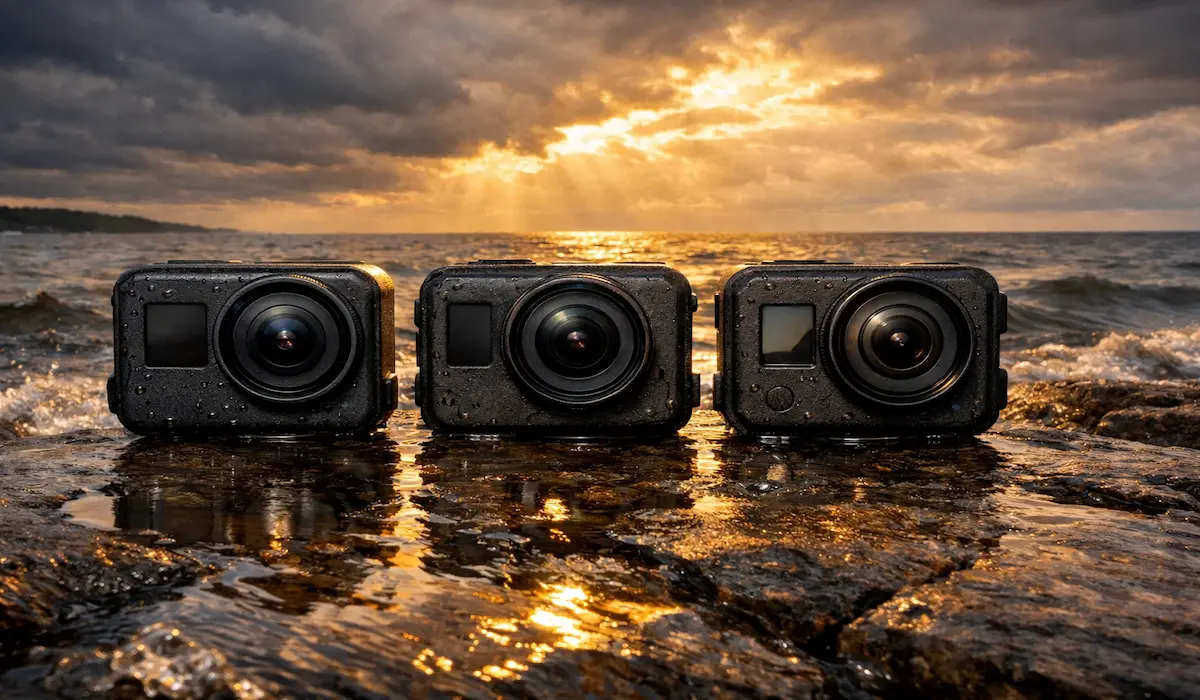
Native depth ratings for the three current flagship action cameras — no housing required. These are manufacturer-specified static pressure ratings. See Step 3 above for critical context on high-impact and dynamic water use.
Camera
Naked Depth Rating
Best Waterproof Use Case
DJI Osmo Action 5 Pro
20m (66 ft) — 2026 Class Leader
Recreational scuba, freediving, surf, and open-water filming without housing
Insta360 Ace Pro 2
12m (39 ft)
Heavy rain, splashes, shallow snorkeling, and casual pool use
GoPro Hero 13 Black
10m (33 ft)
Snorkeling, surface water sports, and pool filming — housing required for depth
⚠️ All ratings reflect controlled static pressure lab testing. Dynamic pressure from high-speed water impact can exceed these specifications at shallow depth. See Step 3 above before relying on naked ratings for active water sports.
🌫️ Bonus: The “Internal Fog” Myth — It’s Not Always a Leak
Condensation on the inside of your lens after a water session doesn’t automatically mean your seal failed. There’s a simple, fixable cause that most camera owners never consider — and it’s completely avoidable.
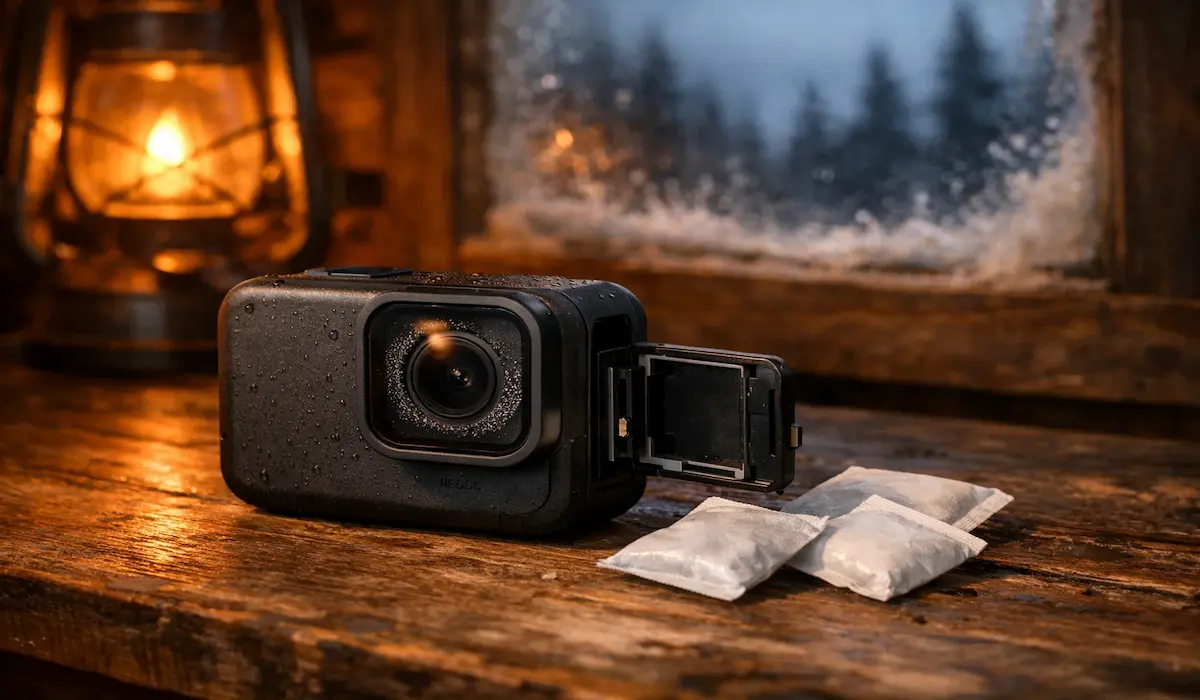
If you closed your camera in a warm, humid environment — a July morning on the Pere Marquette, a steamy car, a heated ice fishing shelter — and then submerged it in cold water, the moisture already trapped inside the air condenses on the inner glass. The seal never failed. The camera just sealed in humid air.
The Fix: The night before any water trip, store your camera with the battery door open inside a sealed dry bag or container with two or three silica desiccant packets. Overnight, the desiccant pulls residual moisture out of the internal air — so there’s nothing left to condense when you hit cold water. Same principle photographers use for long-term lens storage, applied specifically to underwater action camera use. The DJI Diving Accessory Kit includes anti-fog inserts specifically for this — they sit inside the housing during submersion and absorb any residual moisture before it can reach the lens.
Frequently Asked Questions: Action Camera Waterproof Features
What does a waterproof rating actually mean on an action camera?
A waterproof rating — such as 10m or 20m — is a static pressure rating earned under controlled lab conditions. The camera is submerged to the rated depth and held perfectly still until it passes. It tells you the camera can handle the hydrostatic pressure at that depth during calm submersion. It does not account for dynamic pressure created by high-speed water entry such as cliff jumping, surfing, or fast river currents — forces that can exceed the rating at much shallower depths.
Which action camera has the best waterproof features in 2026?
The DJI Osmo Action 5 Pro leads the 2026 class with a 20m (66-foot) native waterproof rating — double the GoPro Hero 13 Black’s 10m without a housing. For most divers, snorkelers, and surfers, the DJI’s depth eliminates the need for a separate bulky housing. For a full feature-by-feature breakdown across all categories, see our DJI vs GoPro head-to-head comparison.
Do I actually need a dive housing for my action camera?
It depends on your activity. For calm water, pool use, and snorkeling within the camera’s rated depth — with the pre-submersion steps above completed — naked use is appropriate. For surfing, cliff jumping, jet skiing, whitewater, or any high-speed water impact activity, a dive housing is strongly recommended regardless of your camera’s rated depth. Dynamic pressure from impact can exceed a 10m static rating at depths of two to three feet. The housing is inexpensive compared to the cost of the camera.
How do I know if my action camera’s rubber seal is still good?
Inspect the gasket visually before every water session. Look for cracks, flat spots, areas where the rubber has compressed unevenly, or any debris sitting on the seal. A healthy gasket should look pliable, slightly glossy, and evenly seated all the way around its channel. If the rubber looks dull, hard, or cracked in any section, replace the gasket before any submersion. Most manufacturers recommend annual gasket replacement for cameras used regularly in water — check your model’s service documentation for the specific schedule.
Does cold water affect how waterproof my action camera is?
Yes, in two important ways. First, cold water causes the trapped air inside your camera to contract — creating a vacuum that can pull water past seals — which is exactly what the Burp technique in Step 1 above addresses. Second, very cold temperatures cause rubber gaskets to stiffen and lose flexibility, reducing how well they conform to the mating surface. For sub-zero conditions common to Great Lakes ice fishing and winter use in Northern Michigan, completing the Burp in the cold environment before submersion becomes even more critical than in summer use.
Are there waterproof action cameras beyond the traditional form factor?
Yes — the waterproof action camera market has expanded well beyond the standard rectangular body. Compact wearable cameras and hybrid form factors bring their own waterproof ratings and unique use cases for underwater shooting. For a look at how the newer compact options stack up against traditional action cameras for water use, see our breakdown of the Insta360 GO Ultra vs DJI Osmo Pocket 3.
Why did my waterproof action camera leak?
The four most common causes — in order of frequency — are: debris on the rubber gasket (a single grain of sand or hair breaks the seal), internal pressure differential from temperature shock (warm camera entering cold water contracts the internal air, creating a vacuum), dynamic pressure from high-speed water impact exceeding the static rating, and a worn or cracked gasket that needed replacement. A manufacturing defect is the least likely cause. Before assuming your camera is defective, inspect the gasket for debris, check that the doors seated with a click, and consider whether your activity involved high-impact water entry that exceeded the static rating.
When should I replace my action camera’s rubber gasket?
Most manufacturers recommend replacing the battery door gasket annually if the camera is used in water regularly — roughly every 50 to 75 water sessions, or sooner if the rubber shows any visual cracking, flat spots, or loss of flexibility. For saltwater use, accelerate that schedule: salt crystals left on or in the seal groove accelerate gasket degradation significantly. Always rinse with fresh water after ocean or brackish water use. Replacement gaskets are inexpensive and available directly from DJI, GoPro, and Insta360 — the cost is trivial compared to a water-damaged camera body.
📚 Official Resources: Diving Safety & Underwater Camera Use
For authoritative guidelines on diving safety protocols, depth limits, and camera use in protected waterways:
NOAA Scientific Diving Program — Official diving safety standards, depth protocols, and equipment guidelines from the National Oceanic and Atmospheric Administration
National Park Service Photography Guidelines — Regulations for filming and photography in national parks and protected waterways, including Great Lakes shorelines and Pictured Rocks National Lakeshore
Always verify local filming regulations before entering protected waters. Many Great Lakes waterways and national recreation areas have specific rules for underwater photography and camera equipment.
OTL Bottom Line: Action Camera Waterproof Features
Your action camera’s waterproof rating is real — but it was earned under conditions that don’t reflect how most people use their cameras in the field. The three steps above close that gap before it costs you a camera.
Equalize the pressure before you submerge. Wipe the seals before every water session. And when your activity involves high-speed water entry, use the housing. The combination of those habits will protect your camera more reliably than any spec sheet ever could.
Among the cameras in this guide, the DJI Osmo Action 5 Pro’s action camera waterproof features lead the 2026 class — the 20m native rating alone eliminates the housing requirement for most recreational diving and surf shooting. But the rating only matters if the seal is clean and the pressure is equalized before you go in.
Have you had a camera leak on you? Drop it in the comments — we’re tracking real-world seal failure reports for an upcoming long-term test, and field data from actual shooters is always more valuable than lab specs.
JC Courtland, Outdoor Gear Expert Courtland is the founder of Outdoor Tech Lab with 20+ years of backcountry experience and formal wilderness safety training. Based in Ludington, MI, he personally tests all gear featured on the site to provide honest, real-world insights for outdoor enthusiasts. JC holds certifications in Wilderness First Aid and has professional experience as a satellite communications specialist.
To provide the best experiences, we use technologies like cookies to store and/or access device information. Consenting to these technologies will allow us to process data such as browsing behavior or unique IDs on this site. Not consenting or withdrawing consent, may adversely affect certain features and functions.
Functional
Always active
The technical storage or access is strictly necessary for the legitimate purpose of enabling the use of a specific service explicitly requested by the subscriber or user, or for the sole purpose of carrying out the transmission of a communication over an electronic communications network.
Preferences
The technical storage or access is necessary for the legitimate purpose of storing preferences that are not requested by the subscriber or user.
Statistics
The technical storage or access that is used exclusively for statistical purposes.The technical storage or access that is used exclusively for anonymous statistical purposes. Without a subpoena, voluntary compliance on the part of your Internet Service Provider, or additional records from a third party, information stored or retrieved for this purpose alone cannot usually be used to identify you.
Marketing
The technical storage or access is required to create user profiles to send advertising, or to track the user on a website or across several websites for similar marketing purposes.




Leave a Reply