

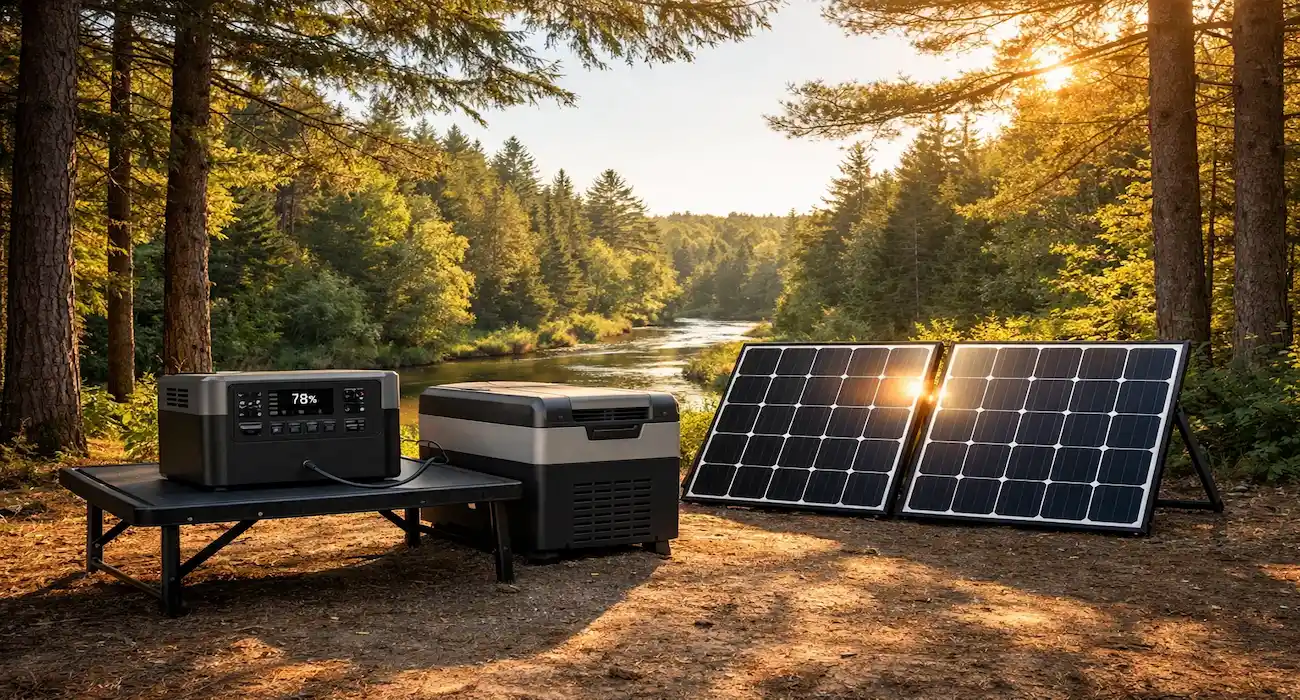
The No-Fluff Guide to Building a 2026 Off-Grid Solar Hub: 3 Things You Actually Need (and 2 You Don’t)
⚙️ OFF-GRID GUIDE Updated April 2026
The best off-grid solar power setup in 2026 is cheaper and simpler than most gear sites want you to believe. The problem isn’t access to good equipment — it’s that the market is flooded with solar-powered tents, flexible adhesive panels, and gadgets that look capable in product photos and fail in actual field conditions.
After more than 20 years running basecamp and remote cabin power setups across the Manistee National Forest and Pere Marquette River corridor — where a failed power system isn’t inconvenient, it’s a safety issue — the OTL answer is three components.
Not sure how to size a power station to your specific load before you commit? Our portable power station buyer’s guide walks through the capacity math in full.
Why Trust This Guide
JC Courtland has run off-grid power setups across the Manistee National Forest, Pere Marquette River corridor, and Northern Michigan’s Upper Peninsula for 20+ years — multi-day basecamp operations, remote cabin setups, kayak expedition support, and winter storm backup scenarios.
No free products accepted. No fabricated specs. Every recommendation here is built from equipment tested in real Michigan field conditions — 48-hour rain events, sub-zero winters, and locations where the nearest power outlet is two days away.
⚡ OTL Verdict — The 2026 Off-Grid Solar Hub
You need exactly three things: a LiFePO₄ power station, rigid monocrystalline solar panels, and a 12V compressor fridge. Everything else — solar-integrated apparel, flexible stick-on panels, high-wattage induction burners running off a sub-2000Wh station — is either a niche tool or a gear-store impulse buy that doesn’t survive Michigan weather.
Build this if: You run multi-day basecamp setups, remote cabin weekends, kayak expedition support, or need reliable off-grid power that won’t collapse in a 48-hour Manistee rain event.
Not the right guide if: You’re looking for an ultralight day-hike solution or a whole-home generator alternative — those are different tools for different jobs.
✅ The Must-Haves: The Foundation of Every Capable Setup
These three components form the complete off-grid solar hub. Buy all three, set them up once correctly, and you have a system that runs reliably for years. The math is simple; the execution is straightforward. Here’s why each one earns its place.
🔋 Must-Have #1: A LiFePO₄ Power Station
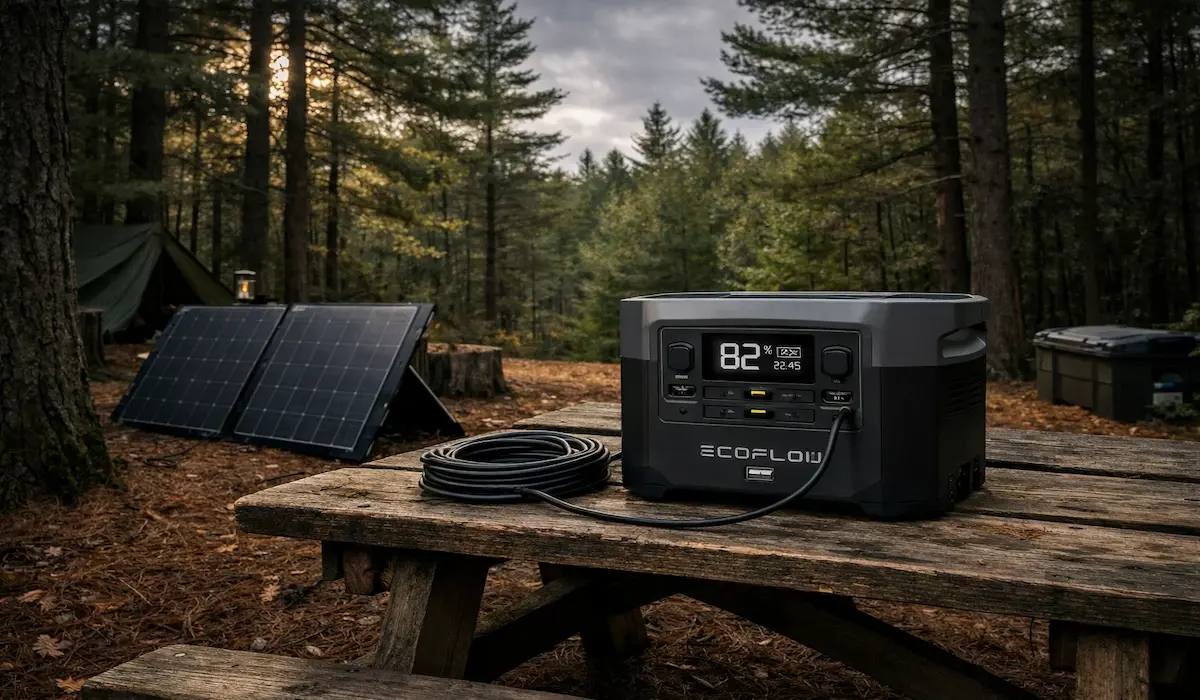
When comparing LFP vs lithium-ion (NMC) power stations for off-grid use, the cycle life difference alone settles the debate: 3,000+ charge cycles from LFP versus the 500–800 you get from older NMC units. At one full cycle per day, LFP delivers over eight years of daily use before meaningful capacity degradation.
For Michigan off-grid conditions specifically, LFP’s thermal stability matters as much as its cycle count. NMC chemistry is more sensitive to temperature extremes — cold Northern Michigan nights and hot July basecamp afternoons both degrade performance. LFP handles both ends of that range with significantly more stability.
What capacity do you actually need? The quick formula is at the bottom of this guide, but the short version: for a weekend setup running a 12V fridge plus lighting, comms, and device charging, a minimum of 1,000Wh gets you through. For 3-day-plus setups without reliable solar recharging, 1,500–2,000Wh is the real-world floor.
Factor in lighting, charging, and comms gear and you’re looking at a full day of realistic load — enough to bridge to a sun window, but not enough to go complacent. Our basecamp setups in this territory run a minimum of 1,500Wh for any trip where weather is a variable. That buffer is what keeps the setup reliable rather than anxious.
| Battery Cycles | LFP: 3,000+ vs. NMC: 500–800 |
| Thermal Stability | LFP: Excellent across temp range | NMC: More temp-sensitive |
| Discharge to Empty | LFP: Tolerates deeper DoD with less long-term damage |
| Self-Discharge Rate | Both low — LFP holds charge well in storage |
| Weight per Wh | NMC slightly lighter | LFP increasingly competitive in 2026 |
For a full breakdown of Bluetti’s LFP lineup across all capacity tiers, see our Bluetti power station guide.
☀️ Must-Have #2: Rigid Monocrystalline Solar Panels
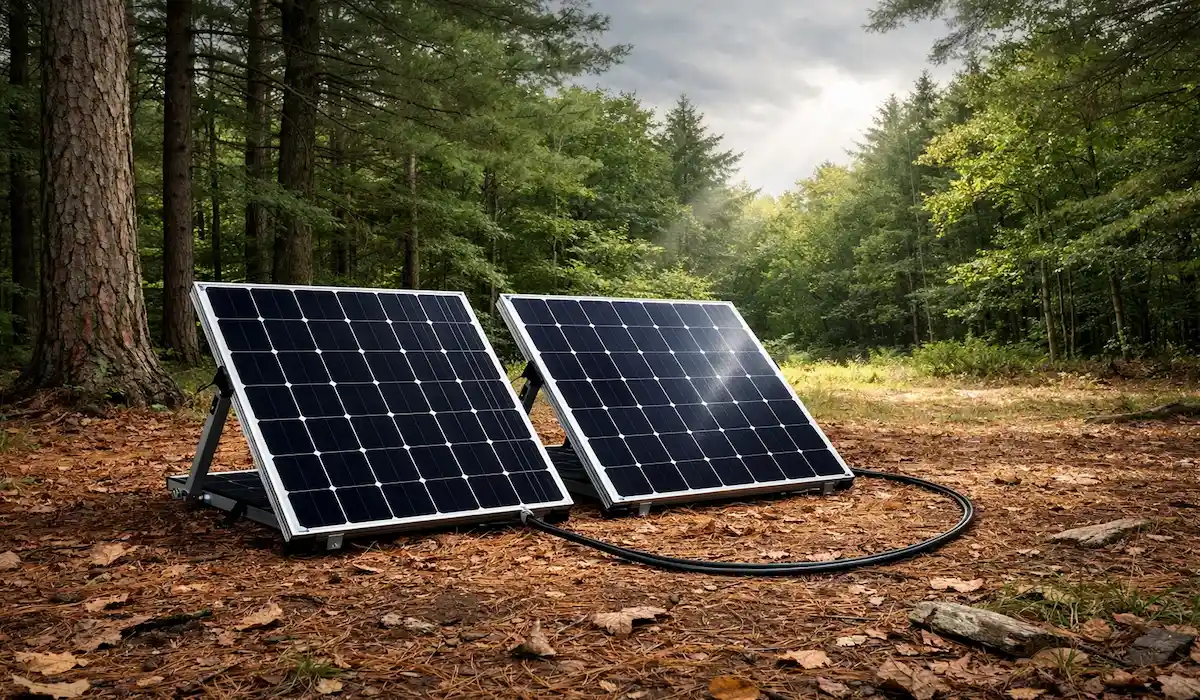
Foldable panels dominate the Instagram feed. They’re lightweight, they fold neatly into a bag, and they photograph beautifully next to a tent. They also degrade faster, overheat more easily, and — this is the one that matters for Northern Michigan — they don’t survive real weather.
Rigid monocrystalline panels have been the standard in permanent off-grid solar installations for decades because the physics work in their favor: better efficiency per square foot, dramatically better durability in wind and precipitation, and a longer service life that justifies the slightly higher upfront cost.
For a basecamp solar hub setup, one to two 100W–200W rigid monocrystalline panels are the right choice for charging a 1,000–2,000Wh LFP station in adequate sun. They’re consistently the best rigid solar panels for camping durability — match panel VOC voltage and wattage to your station’s solar input spec before purchasing.
Foldable panels have thinner glass, more vulnerable junction boxes, and laminate layers that delaminate after repeated wet/dry cycles. Rigid panels survive real weather.
Buy rigid if: You’re setting up a stationary basecamp, have vehicle transport, and want gear that lasts 5+ years.
Buy foldable only if: Weight and packability are the absolute primary constraint — backpacking, kayak portaging. They’re a compromise with known trade-offs, not a like-for-like substitute.
❄️ Must-Have #3: A 12V Compressor Fridge
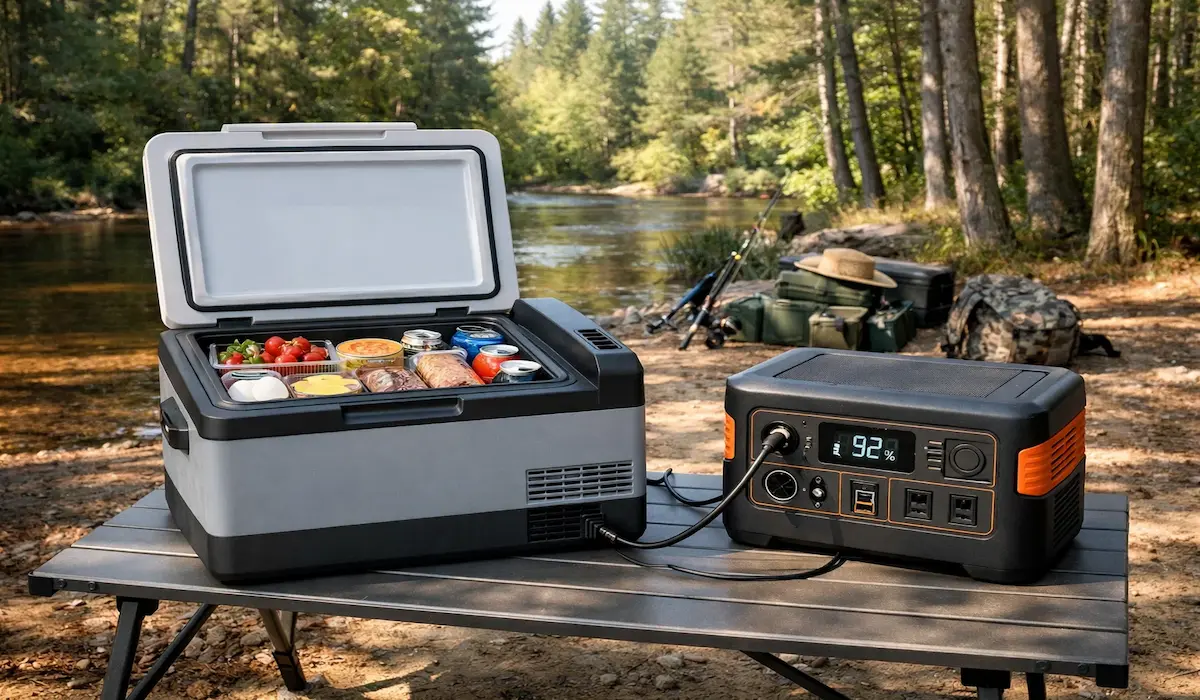
A quality 12V compressor fridge — from brands like ICECO, Dometic, or BougeRV — draws an average of roughly 30–60W depending on ambient temperature and thermostat setting. Compare that to a standard household fridge running 150–400W and you understand immediately why the 12V fridge is a cornerstone component, not a luxury item.
The efficiency math is simple: lower average draw means your stored battery lasts dramatically longer. On a 1,000Wh station, a 12V fridge averaging 45W gives you roughly 20+ hours of operation.
A standard dorm fridge at 150W average gives you 6–7 hours. That gap determines whether your food system is reliable or a constant anxiety source.
Beyond efficiency, compressor fridges maintain temperature far more consistently than coolers with ice. For fishing trip food storage on the Pere Marquette — where you’re keeping a day’s catch fresh through warm July afternoons — consistent temperature control matters. Ice coolers fluctuate. Compressor fridges don’t.
What’s the best 12V fridge for off-grid power stations? For most basecamp setups, a 20–40 quart unit from ICECO, Dometic, or BougeRV hits the sweet spot. Look for a variable-speed SECOP compressor (most efficient), removable basket, and digital temperature display. Avoid thermoelectric coolers marketed as “12V fridges” — they draw 2–3× more power and can’t actually refrigerate below 40°F below ambient temperature.
For fishing and hunting trips, dual-zone models that run fridge and freezer simultaneously are worth the premium if you’re keeping fresh catch on-site.
🚫 The Hype Traps: What to Skip in 2026
These two product categories are hitting Discover feeds hard this year. Both have legitimate niche applications. Neither belongs in a capable off-grid solar hub. Here’s the honest breakdown.
⛔ Skip: Solar-Integrated Tents, Backpacks & Apparel
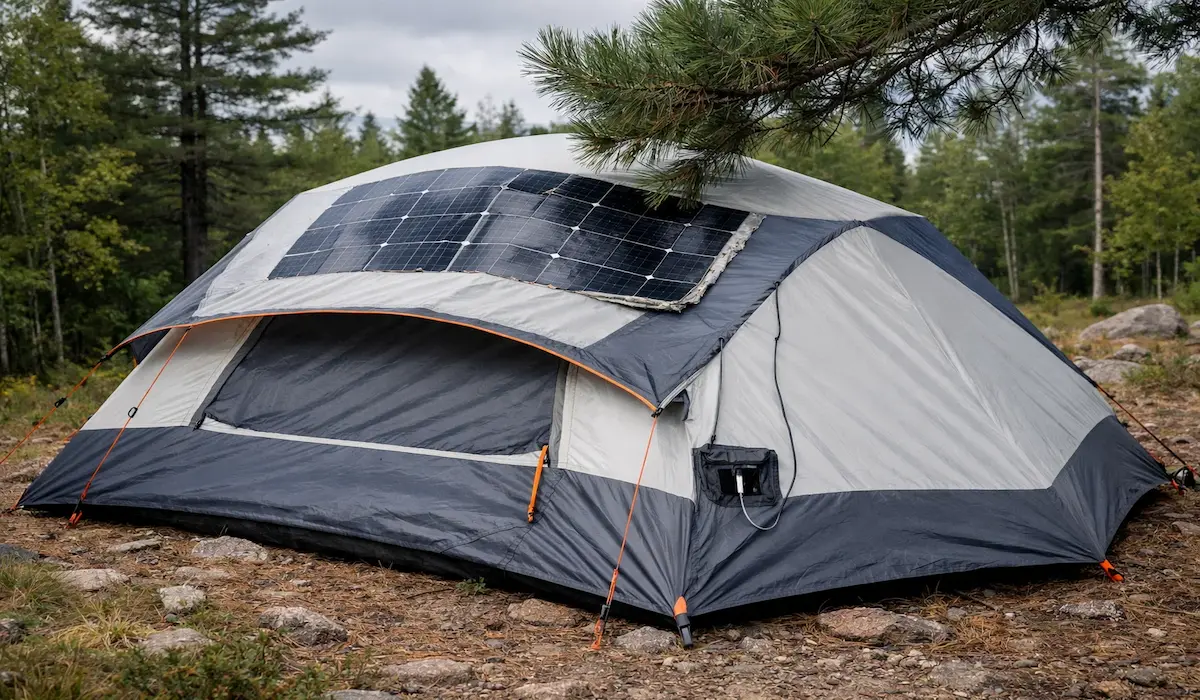
The pitch is elegant: your gear charges itself while you use it. The reality is a shelter or pack with a fragile electrical system built into a product that gets staked into the ground, stuffed into a car trunk, and soaked in rain.
When the panel tears — and integrated panels do tear — you haven’t just lost a solar panel. You’ve compromised a shelter or pack that now needs to be replaced entirely.
The output problem is equally important: integrated panels on tents and backpacks typically produce 5–20W under ideal conditions — enough to top off a phone, not enough to meaningfully charge a power station.
For the price premium these products carry, you’re paying significantly more per watt than a standalone rigid panel and getting far less flexibility in panel placement — which is the primary variable in solar output.
OTL Position: Keep your power source separate from your shelter. If the integrated panel fails in the backcountry, you want one problem, not two.
⛔ Skip: Flexible “Stick-On” Solar Panels for Basecamp Use
Flexible adhesive solar panels have a genuine use case: stealth van builds and sailboat installations where flat surface mounting is the primary constraint and airflow is limited by design. For those applications, the trade-offs are known and accepted going in.
For off-grid basecamp use, those trade-offs become liabilities. Flexible panels generate heat at the panel surface because they sit flush with no airflow gap underneath. Heat degrades solar cell efficiency permanently over multiple high-output days.
Rigid panels, mounted with a small air gap, dissipate that heat. Flexible panels don’t have that option by design.
OTL Position: Flexible panels have their place. A stationary basecamp solar hub in Northern Michigan isn’t it. Buy rigid panels, angle them correctly, and they’ll outlast the vehicle they’re mounted on.
📐 The OTL Rule of Thumb: Stop Over-Calculating
The most common question we get: how much battery capacity do I actually need for off-grid camping? The sizing formulas online get overcomplicated fast. For a field-practical off-grid solar hub, here is the only calculation you need:
OTL Off-Grid Capacity Formula
Total Capacity (Wh) ≥ Daily Fridge Draw (Wh) × 3
The 3x multiplier covers lighting, device charging, comms gear, and a buffer for cloudy-day solar gaps — without building a spreadsheet.
⚡ Formula in Practice: Michigan Weekend Scenarios
| Fridge averaging 45W / 300Wh per day | You need: 1,000Wh station minimum |
| Fridge averaging 60W / 400Wh per day (warm July) | You need: 1,200Wh station minimum |
| Fridge + power tools + extra devices | Bump to 1,500–2,000Wh — don’t cut it close |
| 3-day trip, limited sun recharging | 2,000Wh+ is the practical floor — plan for clouds |
Size your station to cover your load for 24–36 hours without any solar input, then treat solar as a recharge bonus rather than a primary supply. That mindset eliminates the anxiety of watching a cloud bank roll in off Lake Michigan.
🏆 OTL Picks: The LFP Power Stations We Recommend
Every power station recommendation on OTL is LFP in 2026. Here are our two picks across the entry-level and mid-tier capacity ranges — chosen for field reliability, LFP chemistry, solar input compatibility, and value at their respective price points.
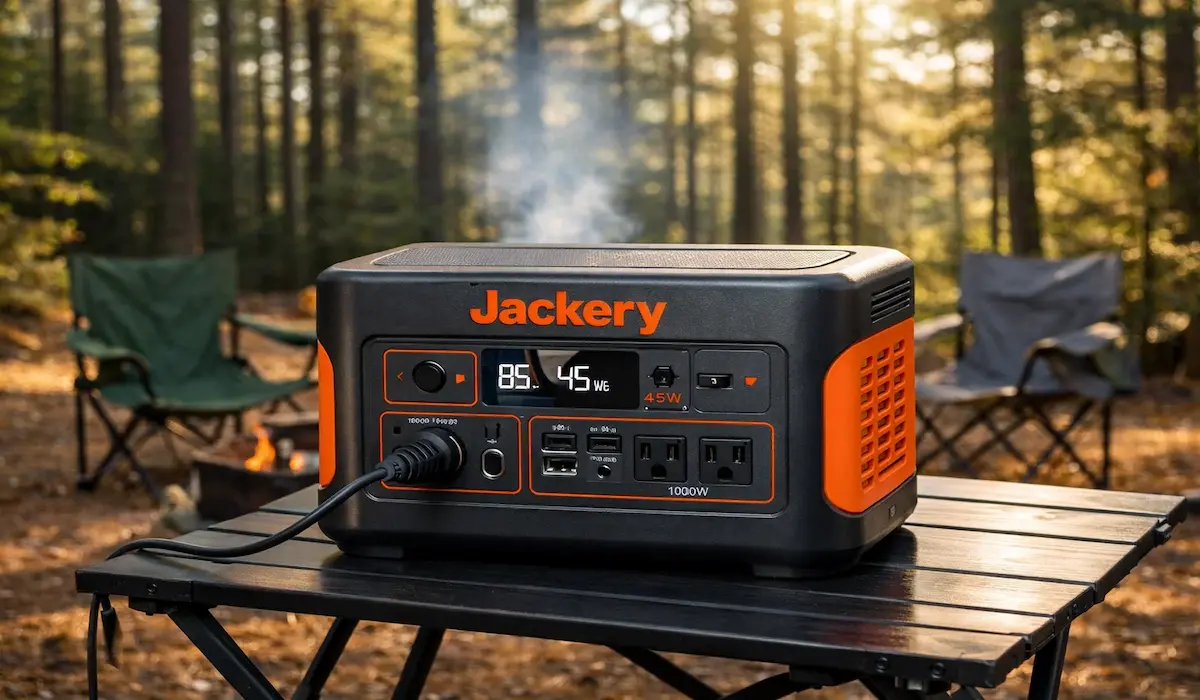
⚡ Entry Pick: Jackery Explorer 1000 v2 — The Weekend Warrior
The Jackery Explorer 1000 v2 is the unit we’ve run the most hours on across OTL field testing — it’s the subject of our long-term real-world test for a reason. For the formula above, it sits at the right capacity tier for a weekend basecamp with a 12V fridge, lighting, and standard device charging. LFP chemistry, solid solar input, and a form factor that actually fits in a vehicle without rearranging everything.
It’s not the pick if you’re running a 3-day-plus setup with limited sun windows or running power tools alongside the fridge. For that use case, step up to the mid-tier pick below. For one to two nights in the field where you’re managing your load intelligently, the Explorer 1000 v2 is the right tool at the right price.
⚡ Step-Up Pick: Bluetti AC200L — The 3-Day Off-Grid Floor
The Bluetti AC200L moves up to the 2,000Wh LFP tier — which is the capacity floor for any setup running beyond two days without reliable solar recharging in Michigan cloud conditions.
At this tier, you’re running the 12V fridge continuously, charging batteries for cameras, GPS devices, and comms gear, running LED camp lighting at night, and still have buffer capacity for unexpected draws like running a portable pump or power tool.
The AC200L’s solar input compatibility covers the most common panel configurations, and its AC output handles everything in a standard off-grid basecamp loadout. For remote cabin and off-grid property use, this is also the tier where a dedicated solar security camera pairs cleanly — the AC200L has more than enough capacity to run cameras, lighting, and the fridge simultaneously without load management anxiety.
Verify current specs and pricing on the Amazon listing before purchasing — all specs should be confirmed against the Bluetti product page at time of purchase.
📊 Complete Setup: Pros, Cons & OTL Ratings
✅ Why This Setup Works
- LFP chemistry delivers 3,000+ cycle longevity
- Rigid panels survive Michigan weather — wind, rain, and temperature swings
- 12V fridge runs 4–5× more efficiently than household fridges
- Three-component simplicity means fewer failure points
- Modular — upgrade capacity or panels independently
- Silent operation, no fumes, indoor and enclosed-space safe
- Solar recharging during the day extends runtime indefinitely in good sun
⚠️ Real Trade-Offs to Know
- Rigid panels require vehicle transport — not a backpack solution
- Upfront cost is higher than a gas generator at the same runtime
- Michigan cloud cover limits solar recharging on multi-day setups
- 12V fridge requires a dedicated power source — can’t share a circuit with high-draw tools
- Station capacity limits are fixed — plan your load before you buy
📊 OTL Setup Component Ratings
❓ Off-Grid Solar Hub FAQ
What size power station do I need for an off-grid setup with a 12V fridge?
Use the OTL formula: Total Capacity (Wh) ≥ Daily Fridge Draw (Wh) × 3. A 12V compressor fridge averaging 45W draws roughly 300Wh per day — meaning you need a minimum 1,000Wh station for a weekend setup.
Add power tools, extended trips, or limited sun windows and bump to 1,500–2,000Wh. The 3× multiplier accounts for lighting, device charging, communications gear, and a buffer for cloudy-day solar gaps — so you’re not doing math at the trailhead.
Are flexible solar panels okay for off-grid camping?
Flexible solar panels have genuine use cases — stealth van builds and sailboat installations where flush surface mounting is the primary design constraint. For stationary basecamp and off-grid hub use, they carry real trade-offs.
They sit flush with no airflow gap, which causes heat buildup that permanently degrades cell efficiency over time. In Northern Michigan field conditions — sustained wind, full rain events, temperature swings — rigid monocrystalline panels are significantly more durable and maintain consistent output across years of use.
If packability is the overriding constraint, foldable panels are an acceptable compromise. They’re not a like-for-like substitute for rigid panels in a stationary setup.
Is a 12V compressor fridge worth it compared to a regular ice cooler?
For multi-day off-grid setups, yes — the efficiency advantage is significant. A quality 12V compressor fridge averages 30–60W depending on ambient temperature. A standard household fridge draws 150–400W average. That gap directly determines how long your stored battery capacity lasts per charge cycle.
Beyond energy use, compressor fridges maintain temperature consistently regardless of ambient heat — critical for food safety on summer fishing trips on the Pere Marquette where the cooler may sit in a sun-exposed vehicle for hours.
The upfront cost is higher than an ice cooler, but ice costs add up fast on multi-day trips, and you eliminate the logistics of sourcing ice in remote Northern Michigan locations.
Why does OTL only recommend LFP power stations in 2026?
LiFePO₄ chemistry offers 3,000+ charge cycles versus 500–800 for older NMC lithium-ion units. That’s the headline number, but the supporting factors matter equally for off-grid use.
LFP has better thermal stability across temperature extremes — it performs more predictably in cold Michigan winters and hot July basecamp conditions. It also tolerates deeper discharge with less long-term capacity degradation.
NMC units that need replacing after 2–3 years of regular use are not a bargain regardless of their lower initial price. For a power station you’re running hard across multiple seasons, the total cost of ownership math strongly favors LFP.
Can I run a CPAP machine off-grid with this solar setup?
Yes — CPAP users do this successfully. Most CPAP machines draw 30–90Wh per night depending on pressure settings, humidity, and whether you use a heated tube. A 1,000Wh power station runs a typical CPAP for 10–30 nights on a single charge.
Critical efficiency tip: Use the 12V DC adapter instead of running through the AC inverter. The inverter adds 10–20% power loss. Most CPAP manufacturers sell a 12V adapter for exactly this purpose — it pays for itself in extended runtime within one trip.
For Michigan winter use: keep the station inside your tent or sleeping area during charging. LFP batteries won’t recharge below 32°F — they’ll still power the CPAP, but you won’t be able to top up until the unit warms up.
How many solar panels do I need for an off-grid hub in Michigan?
For a 1,000–2,000Wh LFP station, one to two 100W–200W rigid monocrystalline panels is the practical range for Michigan conditions. Northern Michigan averages 3–4 peak sun hours on clear days in shoulder seasons, dropping significantly on overcast days.
A single 200W panel in full sun generates roughly 600–800Wh on a good Michigan day — enough to meaningfully recharge a 1,000Wh station while you’re running your fridge. Two 200W panels cover your daily load and rebuild reserve capacity simultaneously in adequate sun.
Always verify the solar input specifications (VOC voltage and wattage max) for your specific power station before buying panels — exceeding those limits can damage the charge controller.
What’s the best complete off-grid solar setup for camping in 2026?
The OTL answer is three components: a LiFePO₄ power station (1,000Wh minimum for weekend use), rigid monocrystalline solar panels (100–200W per panel), and a 12V compressor fridge. That’s the complete off-grid solar hub — everything else is optional or a niche add-on.
For most campers and basecamp setups in Northern Michigan, the Jackery Explorer 1000 v2 handles weekend trips cleanly. For three or more days, or any setup with power tools and cameras alongside the fridge, step up to a 2,000Wh unit like the Bluetti AC200L.
The key rule: size your station to run your daily load for 36 hours without any solar input, then treat solar recharging as the bonus — not the primary supply plan. Michigan cloud cover will test any setup that assumes consistent sun.
📚 Resources
The Manistee National Forest doesn’t care about your gear list. It cares whether your system works at 2 a.m. when the temperature drops and you’re two days from the nearest town. Three components. Built right. That’s the off-grid solar hub.
Building out the rest of your basecamp loadout around this power hub? Our best solo camping gear guide covers the full kit — tested in the same Northern Michigan territory.
Guide last updated April 2026. Product specs and availability should be verified against current manufacturer listings before purchase.


Leave a Reply