Camping is surging in 2026—but so are the incidents that come with it. According to the National Park Service, roughly 400,000 camping-related injuries occur in the U.S. every year, the majority of them preventable.
As the spring and summer seasons open access to campgrounds across the country, outdoor safety experts and land managers are issuing the same consistent message: preparation is everything.
Here are the seven most critical camping safety tips for 2026—drawn from field experience, current land-management guidelines, and the kind of hard-won lessons that only come from actually sleeping outside.
The single most effective camping safety measure happens at home, days before you arrive at a trailhead. A careless booking decision or a missed weather alert is how routine camping trips turn into search-and-rescue operations.
🗺️ Your Pre-Trip Research Checklist
Before finalizing any camping destination for 2026, confirm the following:
Fire restrictions: Wildfire risk is not uniform. Check your target area’s current fire ban status via your state’s DNR or forest service website before packing a single match.
Weather forecast: Look at the full multi-day forecast, not just the day of arrival. Afternoon thunderstorms, dropping overnight lows, and incoming front systems can all rewrite your safety plan.
Health advisories: Many bodies of water carry seasonal health warnings—blue-green algae, harmful bacteria levels, or rodent-borne illness alerts (hantavirus in some western states). Check your state health department.
Campground conditions: Read recent reviews and check with the managing agency. Washed-out roads, downed trees, and closure orders appear with little notice.
Cell coverage: Identify dead zones on your route in advance. If you’re heading into areas with no signal, consider a satellite communicator. Our Garmin inReach Mini 2 vs. Mini 3 comparison is a solid starting point.
Solo trip prep: Going out alone raises the stakes on every safety decision. Our best solo camping gear guide covers the proactive tech—perimeter sensors, hands-free lighting, and gear protection—that makes backcountry solo camping significantly safer.
OTL Field Note: In Michigan’s Manistee National Forest, fire restrictions can shift mid-week during dry stretches. We check the USFS site the morning of departure—not the day we book the site.
2 Build a Real Emergency Kit — Not a Glorified Band-Aid Box
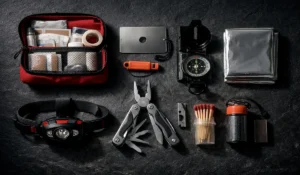
Most store-bought first aid kits are a start—but a genuine camping emergency kit goes significantly further. The goal is to handle the most common wilderness injuries and buy time until professional help is available.
🎒 Two-Tier Emergency Kit Framework
Tier 1 — Medical First Aid
Adhesive bandages (assorted), sterile gauze pads, medical tape
Antiseptic wipes and antibiotic ointment
Antihistamines (for allergic reactions to stings and plants)
Pain relievers (ibuprofen and acetaminophen)
Blister treatment (moleskin or gel pads)
Tweezers (for splinters and tick removal)
Thermometer and cold pack
Sterilized wound-wash saline packets
Personal medications with extra supply
Tier 2 — Emergency Survival Items
Signal mirror (or a spare CD — both work for attracting rescue attention)
Loud emergency whistle (at least 100dB)
Compact emergency bivy or mylar blanket
Waterproof compass
Small multi-tool (with blade, pliers, and scissors)
Duct tape (wrapped around a water bottle to save space)
Glow sticks or signal flares
OTL Field Note: Inspect and restock your kit at the start of every season. Expired medications, corroded batteries, and depleted antiseptic are among the most common kit failures we see in the field.
For a full packing audit before any trip, run through our camping essentials checklist—it covers shelter, kitchen, lighting, safety, and navigation in one printable list.
3 Arrive at the Campsite Early — Daylight Is a Safety Tool
Arriving at your campsite with two or more hours of daylight remaining is not about convenience—it’s a safety decision. Setting up camp in the dark is one of the most avoidable ways to get hurt or make a poor placement decision.
🌅 Site Arrival Protocol
Upon arrival, before unloading a single piece of gear, do a walking sweep of your site:
Scan for hazards: Broken glass, sharp metal stakes left by previous campers, large ant beds, ground wasp nests, and exposed roots all pose real injury risks.
Check overhead: Look for dead limbs or “widow-makers” above any potential tent zone. Wind can bring them down overnight without warning.
Identify plants: Poison ivy, poison oak, and wild parsnip are present across much of the Great Lakes region and beyond. If you don’t recognize it, don’t touch it.
Note water drainage: Identify where rainwater will flow through or around your site. Pitching in a low point that looks flat in dry conditions can become a puddle by 2 a.m.
Locate emergency exits: Know the nearest road, ranger station, and the fastest route back to your vehicle.
4 Pitch Your Tent on a Safe, Smart Spot
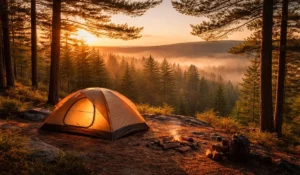
Tent placement is where camping safety and comfort intersect. Where you put your shelter determines your exposure to flooding, fire risk, wildlife traffic, and injury from falls.
⛺ Tent Placement Rules
Elevation matters: Pitch on slightly elevated, level ground. Even a modest slope helps rainwater drain away from your tent floor.
Distance from fire: Keep your tent at least 10–15 feet from the campfire ring. Embers travel. Tent fabric, even when treated, is not fireproof.
Flame-resistant tent: Not all tent fabrics carry the same fire-resistance ratings. Check your tent specs and avoid using open-flame devices or candles inside the tent under any circumstances.
Zip it every time: Keep the tent zipped when you enter and immediately upon exiting. This single habit keeps out the vast majority of insects, spiders, and small wildlife.
Guy lines at night: Stake out guy lines before dark. A tent that shifts or collapses in a night windstorm is a miserable (and potentially dangerous) situation.
OTL Field Note: At Ludington State Park and Nordhouse Dunes, we always confirm any nearby designated fire rings are at least 15 feet from the tent. On sandy terrain, drive stakes at an angle for maximum hold.
5 Brief Every Member of Your Group — Especially Kids
A safety briefing before your trip begins is not overkill—it’s a basic requirement, especially when children are involved. Most camping emergencies stem from a lack of shared awareness within the group.
👨👩👧 Group Safety Briefing Agenda
Whistles for everyone: Issue a whistle to each member of your group—especially children. Establish a clear signal: three short blasts means emergency, stop and respond immediately.
Water from nature is not safe: No matter how clear a stream or river looks, it is not safe to drink untreated. Explain this to children without exception. Giardia, cryptosporidium, and other pathogens are invisible.
Plant identification: Show the group images of poison ivy, poison oak, and any other hazardous plants common to your specific destination.
Meeting point: Establish a clear rally point at the campsite. If separated on a trail, everyone knows exactly where to return to and who to contact if someone doesn’t come back.
Buddy system on trails: No solo hiking for children. Adults should check in at regular intervals when splitting up the group.
Wildlife rules: Cover what to do if they see a bear, snake, or other wildlife before it happens—not after.
6 Campfire Safety Is Non-Negotiable in 2026
Wildfires driven by human campfire error continue to devastate forests and communities across the country. In 2026, with drought conditions impacting large portions of the western and upper Midwest regions, fire safety is more urgent than ever.
🔥 The Campfire Safety Framework
Check restrictions before you build: Fire bans can be issued within 24 hours due to shifting weather conditions. Verify with your campground or the relevant land management agency on the day of your trip.
Wind is a disqualifier: If sustained wind is present, don’t build a fire. Full stop. Embers in wind conditions create spot fires faster than any human can respond.
Stay in the ring: Only use designated fire rings or established fire pits. Never build a new fire pit on untouched ground.
Never leave it unattended: An unattended campfire is not a camping tradition—it’s a liability. Even stepping away for five minutes during windy conditions is enough time for an ember to escape.
Clear the perimeter: Remove leaves, dry grass, and twigs from at least a 3-foot radius around the fire ring before lighting.
No open flame inside the tent: This includes candles, small propane devices, and any battery-heated gear with exposed elements. Carbon monoxide buildup in an enclosed tent can be lethal in minutes. Use a rechargeable headlamp for in-tent lighting instead—zero flame, zero fumes, and far more practical.
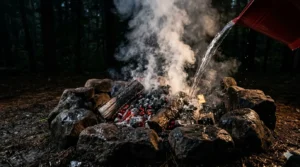
Drown it before you sleep: Pour water slowly over all coals until the hiss stops completely and you can hold your hand safely over the ring. Stir, add more water, repeat. If you can’t touch it, it isn’t out.
7 Wildlife Awareness — Don’t Feed the Problem
The single most effective wildlife safety measure available to any camper is clean food storage. The vast majority of negative wildlife encounters at campsites—bears, raccoons, coyotes, and rodents alike—are driven by food odor.
🐻 Wildlife Camp Safety Protocol
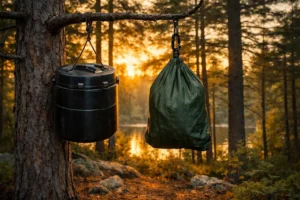
The triangle method: Separate your sleeping area, your cooking/eating area, and your food storage area by at least 100 feet (roughly 30 meters) in all directions. In active bear country, extend that to 200 feet.
Bear-resistant storage: Use a bear canister, bear box, or your locked vehicle. This covers not just food—but toothpaste, sunscreen, lip balm, and any scented toiletry.
Never cook in your sleepwear: Cooking smells absorb into fabric. The clothing you cook in should not be what you sleep in. Store it with your food, not in the tent.
Keep a clean fire ring: Don’t burn food scraps or trash in your campfire. Bears and other wildlife are drawn to fire rings where half-burned food residue lingers. The NPS documents this repeatedly as a primary cause of human-wildlife conflict.
Carry bear spray in active habitat: In any area with confirmed bear activity, bear spray should be accessible on your person—not buried in a pack. A canister at camp is not the same as one on your hip.
Know the difference: Black bears and brown/grizzly bears require different responses in a confrontation. Black bears respond to assertive noise and making yourself appear large. With grizzlies, play dead face-down with hands protecting the back of your neck. Know your region before you go.
OTL Field Note: Black bears are common throughout Northern Michigan’s national forest land, including the Manistee. We hang food and keep a clean camp on every backcountry outing. The odds of an attack are extremely low—roughly 1 in 2.1 million per camper—but proper food storage protects both you and the bear from a preventable encounter.
🛒 Essential Safety Gear: Top Picks
These are the safety-specific items that directly support the seven tips above. All are available on Amazon and represent the category leaders for their use case.
🩺
Adventure Medical Kits Mountain Series
Comprehensive backcountry first aid kit with trauma pad, SAM splint, and full medication pack. Built for extended trips.
What are the most important camping safety tips for beginners?
For beginners, the foundation is three things: plan before you go, build a proper emergency kit, and arrive at the campsite in daylight. Researching your destination for fire restrictions, weather, and health advisories takes 20 minutes and prevents the most common trip-ending scenarios. Packing a genuine emergency kit—not just a basic first aid kit—ensures you can handle cuts, allergic reactions, blisters, and navigation failures. And arriving early gives you time to assess the campsite safely before conditions change.
How do you properly extinguish a campfire before bed?
The correct method is to drown, stir, and confirm. Pour water slowly and steadily over the entire fire, including all visible coals. Stir the ash and coal mixture with a stick to expose any buried embers, then pour more water. Repeat until the hiss of steam is completely gone and you can hold your bare hand 6 inches above the fire ring without feeling heat. If you can’t comfortably do that, it is not out. Never bury hot coals—oxygen can revive them hours later.
Is bear spray necessary for camping in the Midwest?
In most established Midwest campgrounds, bear spray is not required—but it is a reasonable precaution for any backcountry camping in areas with documented black bear populations, including Michigan’s Upper Peninsula and parts of the Manistee National Forest. The more universally applicable defense is clean food storage: use your locked vehicle or a bear-resistant container for all food, garbage, and scented toiletries. A camper who manages food odor correctly dramatically reduces the likelihood of any wildlife interaction.
What should every camping emergency kit include?
A complete camping emergency kit covers two categories. Medical: adhesive bandages, sterile gauze, antiseptic wipes, antibiotic ointment, antihistamines, pain relievers, blister treatment (moleskin), tweezers, thermometer, and any personal medications. Survival signaling and tools: signal mirror, loud whistle (100dB+), emergency mylar blanket or bivy, waterproof compass, multi-tool, and duct tape. Inspect and replenish the kit at the start of every camping season—expired medications and depleted antiseptic are the most common kit failures.
Camping in 2026 is more accessible—and more popular—than at any point in recent memory. The gear is better, the information is more available, and the campgrounds are more connected.
None of that changes the fundamental equation: preparation is what separates a great trip from a dangerous one.
Follow these seven rules, build your kit before you need it, and treat every campfire like it’s your responsibility—because it is. For a deeper gear dive, explore our full Camping 101 Beginner’s Guide.
Stay safe, stay prepared. See you out there. 🏕️✨
This article was published by Outdoor Tech Lab on and reflects current land-management guidelines and field-tested recommendations.
OutdoorTechLab.com Disclaimer: Based on 20+ years of backcountry experience across Northern Michigan. Always verify fire restrictions, health advisories, and local wildlife conditions with your managing land agency before departure.
JC Courtland, Outdoor Gear Expert Courtland is the founder of Outdoor Tech Lab with 20+ years of backcountry experience and formal wilderness safety training. Based in Ludington, MI, he personally tests all gear featured on the site to provide honest, real-world insights for outdoor enthusiasts. JC holds certifications in Wilderness First Aid and has professional experience as a satellite communications specialist.
To provide the best experiences, we use technologies like cookies to store and/or access device information. Consenting to these technologies will allow us to process data such as browsing behavior or unique IDs on this site. Not consenting or withdrawing consent, may adversely affect certain features and functions.
Functional
Always active
The technical storage or access is strictly necessary for the legitimate purpose of enabling the use of a specific service explicitly requested by the subscriber or user, or for the sole purpose of carrying out the transmission of a communication over an electronic communications network.
Preferences
The technical storage or access is necessary for the legitimate purpose of storing preferences that are not requested by the subscriber or user.
Statistics
The technical storage or access that is used exclusively for statistical purposes.The technical storage or access that is used exclusively for anonymous statistical purposes. Without a subpoena, voluntary compliance on the part of your Internet Service Provider, or additional records from a third party, information stored or retrieved for this purpose alone cannot usually be used to identify you.
Marketing
The technical storage or access is required to create user profiles to send advertising, or to track the user on a website or across several websites for similar marketing purposes.




Leave a Reply