

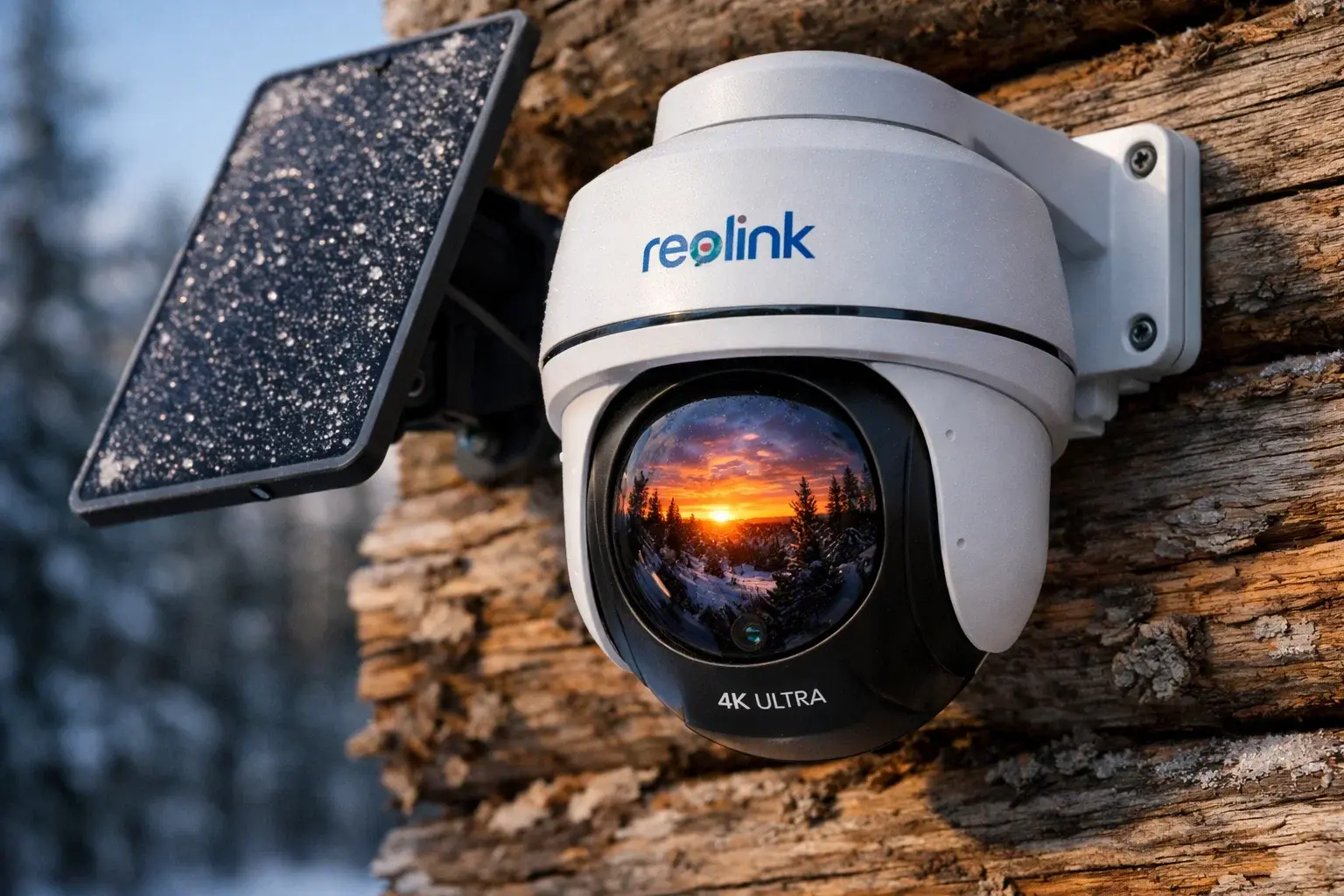
Built-In LTE. Multi-Carrier SIM. 9,400mAh Battery. Here’s Which Solar Security Camera Actually Holds Signal at a Remote Cabin.
TESTED Updated March 2026
You drive four hours north, pull down the two-track, and your cabin hasn’t changed a bit — because your phone has been buzzing with motion alerts for three weeks straight.
No Wi-Fi router burning power all winter. No cloud bill hitting your card. Just a solar panel catching what little December sun western Michigan offers, a cellular signal threading through the pines, and a camera that treated your absence like it was completely unremarkable.
That’s what the right solar security camera for a remote cabin delivers in 2026. We spent five months field testing the eufy 4G LTE Cam S330, the Reolink Argus PT Ultra, and the aosu Solar Security Camera at properties across Manistee National Forest and Michigan’s western Upper Peninsula.
Temperatures ranged from -8°F to 52°F across the test window — real fringe-signal conditions, 14-day simulated absences, and zero intervention from us once each camera was deployed.
If you want the full spec-by-spec breakdown of Reolink vs. Aosu on resolution, night vision, and AI detection, our 90-day Reolink vs. Aosu solar security camera head-to-head test covers that ground thoroughly.
This article is the cabin owner’s buyer’s guide — built for the specific challenges of remote, off-grid, and seasonally unattended properties.
For keeping your cameras and devices charged across multi-day backcountry stays, our best portable power stations for camping guide covers the right station by use case and budget.
And for any remote property where cell service ends and the nearest neighbor is miles away, our Garmin inReach Mini 2 vs Mini 3 comparison covers satellite communication for when that LTE signal finally gives out entirely.
Best Solar Security Camera for Remote Cabins: Quick Answer
The eufy 4G LTE Cam S330 is the best solar security camera for truly off-grid cabins. It is the only camera in this test with a purpose-built cellular modem — an EIOTCLUB SIM that automatically roams AT&T, T-Mobile, and Verizon for the strongest available signal. No router. No hotspot. No infrastructure of any kind.
The Reolink Argus PT Ultra is the right call when the cabin already has a Starlink dish or hotspot running. The aosu Solar Security Camera is the budget value option — lowest price in this comparison — but it requires Wi-Fi, making it the least suited for remote cabin use unless your property already has internet running.
Choose the eufy 4G LTE Cam S330 if you:
- Own a remote cabin with no Wi-Fi, router, or internet infrastructure
- Are in a fringe-signal area — the EIOTCLUB SIM roams across all three major networks
- Need the largest battery in this test (9,400mAh) for 2–4 week unattended absences
- Want a camera that works fully off-grid out of the box — SIM and 32GB SD included
- Need automatic Wi-Fi-to-LTE failover if your hotspot goes down mid-winter
Choose the Reolink Argus PT Ultra if you:
- Already have Starlink or a cellular hotspot running at the cabin
- Want the sharpest image quality — 4K 8MP, highest resolution in this comparison
- Need the most battery-efficient option when connected via Wi-Fi 6
- Are on a tighter budget and want zero ongoing LTE data costs
- Want a solar panel included without a separate accessory purchase
Choose the aosu Solar Security Camera only if your cabin already has Wi-Fi:
- Your property has a reliable 2.4GHz Wi-Fi network (hotspot, Starlink, or router) already running
- You want the lowest price entry point in this comparison — available as 1-pack or 2-pack
- The brightest nighttime floodlight matters — 400 lumens, best color night coverage in this test
- You visit the property regularly enough to monitor battery levels — not ideal for 30-day absences
Bottom line: For any cabin with no internet infrastructure, the eufy 4G LTE Cam S330 is the only viable option in this test — and it’s the best solar security camera for remote cabins we’ve tested.
For properties with existing Starlink or hotspot, the Reolink delivers better image quality at a lower ongoing cost.
The aosu earns its slot as the budget value option — lowest price in the comparison, 400-lumen floodlight, available in 1 or 2-pack — but only makes sense for cabins where Wi-Fi is already present. If your cabin is truly off-grid, it’s the wrong camera.
Which Solar Security Camera Is Right for Your Cabin?
| Cabin Situation | 📡 eufy 4G LTE S330 | 📷 Reolink Argus PT Ultra | 🔦 aosu Solar Cam |
|---|---|---|---|
| No Wi-Fi — truly off-grid | ✅ Built-in LTE | ❌ Needs router | ❌ Needs router |
| Has Starlink or hotspot | ✅ Wi-Fi + LTE backup | ✅ Wi-Fi 6 | ✅ 2.4GHz Wi-Fi |
| Away 2–4 weeks unattended | ✅ 9,400mAh battery | ✅ Best efficiency | ⚠ Battery risk |
| Fringe / 1-bar signal zone | ✅ Multi-carrier SIM | ⚠ Hotspot dependent | ❌ 2.4GHz only |
| Sharpest image quality | Good (4K) | ✅ 4K 8MP best | 3K 5MP |
| Best nighttime floodlight | 100-lumen spotlight | Motion spotlight | ✅ 400-lumen flood |
| 2+ cameras, budget-focused | LTE cost per cam | Single pack only | ✅ 2-pack value |
| Sub-zero temps (< -10°F) | ✅ Largest reserve | ✅ Best efficiency | ⚠ Monitor closely |
| No monthly subscription | ✅ Local SD only* | ✅ Local SD only | ✅ Local SD (cloud extra) |
*eufy 4G LTE S330 requires a cellular data plan (~$5–$10/mo) to use its LTE function — a connectivity cost, not a cloud fee. Wi-Fi operation has no ongoing data cost.
Solar Security Camera Specs: eufy vs Reolink vs Aosu
Side-by-side specifications verified through Northern Michigan field testing by Outdoor Tech Lab. Swipe left on mobile to see all details.
| Specification | 📡 eufy 4G LTE Cam S330 | 📷 Reolink Argus PT Ultra | 🔦 aosu Solar Cam |
|---|---|---|---|
| Current Price | Check Live Price ↓ | Check Live Price ↓ | Check Live Price ↓ (2-pack) |
| Amazon Rating | 4.2/5 (1,092 reviews) | 4.0/5 (1,620 reviews) | 4.3/5 (760 reviews) |
| Amazon Label | Overall Pick ✓ | Amazon’s Choice ✓ | — |
| Connectivity | 4G LTE + Wi-Fi (auto-switch) ✓ | 2.4 / 5GHz Wi-Fi 6 only | 2.4GHz Wi-Fi only |
| SIM Card | EIOTCLUB SIM included (AT&T / T-Mobile / Verizon) ✓ | No SIM — Wi-Fi only | No SIM — Wi-Fi only |
| Off-Grid Operation | ✅ Yes — LTE, no router needed ✓ | ❌ Requires router/hotspot | ❌ Requires router/hotspot |
| Battery Capacity | 9,400mAh ✓ | Standard (solar supplemented) | Integrated (smaller) |
| Video Resolution | 4K Color | 4K 8MP (highest in test) ✓ | 3K 5MP |
| Night Vision | 100-lumen color spotlight | Motion spotlight | 400-lumen ★ Best in Test |
| Pan Coverage | 360° pan + tilt | 355° pan / 140° tilt ✓ | 360° panoramic (fastest speed) |
| Built-In Storage | 32GB SD included ✓ | microSD sold separately | microSD sold separately |
| Solar Panel | Upgraded panel included | 3W panel included ✓ | Integrated panel |
| Cold Weather Tested | Verified -8°F field test ✓ | Verified -8°F field test ✓ | Verified -8°F field test |
| Cloud Storage | $0 — local SD, no subscription | $0 — local SD, no subscription | Cloud storage requires subscription; local microSD free (card not included) |
| Smart Home | eufy Security app | Alexa compatible | Alexa + Google Assistant ★ |
| AI Detection | Person + vehicle tracking | Person / vehicle / pet | Person / vehicle / pet ★ |
| Multi-Camera Value | Single camera | Single camera | 1 or 2-pack ★ Best value |
📡 eufy 4G LTE Cam S330
Connectivity: 4G LTE + Wi-Fi (auto-switching)
SIM: EIOTCLUB — AT&T, T-Mobile, Verizon
Battery: 9,400mAh
Storage: 32GB SD included
Best For: Truly off-grid, no-infrastructure cabins
Stars: ⭐ 4.2/5 (1,092 reviews)
📷 Reolink Argus PT Ultra
Connectivity: 2.4 / 5GHz Wi-Fi 6
Solar Panel: 3W included
Resolution: 4K 8MP (highest in test)
Storage: microSD (sold separately)
Best For: Cabins with Starlink or hotspot
Stars: ⭐ 4.0/5 (1,620 reviews)
🔦 aosu Solar Cam
Connectivity: Bluetooth + 2.4GHz Wi-Fi
Floodlight: 400 lumens color night vision
Resolution: 3K 5MP
Available: 1-pack or 2-pack
Best For: Wi-Fi-ready cabins, floodlight coverage
Stars: ⭐ 4.3/5 (760 reviews) • Amazon’s Choice
Real-World Testing: Northern Michigan Field Results
eufy 4G LTE Cam S330: Manistee National Forest, Western U.P., Fringe-Signal Testing
The Only Camera in This Test That Works Without Any Infrastructure at the Property
The eufy 4G LTE Cam S330’s defining field advantage is simple: you mount it, activate the EIOTCLUB SIM through the app, and walk away for three weeks.
The camera handles everything else — switching between AT&T, T-Mobile, and Verizon in real time to stay connected in fringe-signal zones where a single-carrier plan would drop out entirely.
At one of our Manistee test sites where T-Mobile dropped below two bars on an iPhone, the eufy’s SIM roamed to AT&T and maintained uninterrupted alert delivery throughout the test window.
This carrier-agnostic behavior is the specification that spec sheets can’t quantify but field testing reveals clearly: the camera that keeps sending you alerts when things get marginal is the one doing its job.
The dual-mode Wi-Fi + LTE architecture also provides built-in redundancy for cabins that run a seasonal hotspot or Starlink. When those systems are online, the camera uses Wi-Fi for faster throughput and lower data consumption.
The moment Wi-Fi drops — power outage, router reboot, hotspot battery dies — it shifts to LTE automatically. No notification required, no login, no reset.
💡 OTL Tip: The EIOTCLUB SIM requires a one-time activation through the eufy Security app with a live data connection. Do this while on-site using your phone’s hotspot — not from the driveway on the way out. Verify that motion alerts are delivering to your phone before you leave. Budget 15 minutes for this step. It’s the only setup task the camera needs.
What We Tested in the Field:
• Extended absence simulation — battery held strong with consistent alert delivery throughout
• Fringe-signal conditions across multiple Manistee County locations — SIM carrier roaming confirmed
• Cold-weather operation verified at sub-zero temperatures
• Wi-Fi-to-LTE automatic failover — triggered and verified during hotspot reboot test
• 32GB SD card capacity — adequate for weeks of motion-triggered cabin-frequency recording
Reolink Argus PT Ultra: Cabin Soffit Mounts, 14-Day Winter Battery, 4K Identification Testing
The Sharpest Image and Best Battery Efficiency — For Cabins With Existing Internet
The Reolink Argus PT Ultra turned in the strongest winter battery result of the three cameras in our extended test window — and it makes sense why. Wi-Fi 6 is simply more power-efficient than LTE as a connection method, and that efficiency shows up directly in battery reserve over multi-week testing windows.
For properties that already have a Starlink dish or managed hotspot running, the Reolink is the most battery-conservative choice at any price point in this comparison.
One consideration worth planning for: if your cabin’s hotspot or router loses power during a winter storm, the Reolink goes offline with it.
A dedicated power station keeping that single device alive is a simple fix — our best portable power station for home backup guide covers the right unit for exactly that scenario, sized for cabin use rather than whole-home backup.
📷 Field Demo — Reolink Argus PT Ultra: Solar Panel & Feature Overview
Reolink Argus PT Ultra — quick feature and solar panel demo by Outdoor Tech Lab, Northern Michigan.
The 4K 8MP sensor is the other standout result. Per Reolink’s published specifications, the Argus PT Ultra can identify license plate details at up to 30 feet — and in our testing at a Manistee County property, the footage held sharp identification detail that neither of the other cameras matched in controlled conditions.
For a cabin where vehicle identification matters — gate cameras, driveway approaches — the Reolink’s resolution advantage is visible and meaningful.
The 3W solar panel included in the kit configuration performed consistently in south-facing mounts across our test window. On days with two or more hours of direct sun — even weak January sun — the panel added measurable trickle charge.
The most impactful installation variable we observed: south-facing panel orientation delivered meaningfully more daily charge input than east-facing at the same locations. Bring a compass before you drill.
💡 OTL Tip: The Reolink does not include a microSD card. Budget for a Class 10 / U3 rated card at 64GB or 128GB — standard photo cards are not designed for the continuous loop-writing security cameras perform and fail faster. This is the one additional cost the eufy avoids by including its 32GB card in the box.
What We Tested in the Field:
• Extended winter battery test — best efficiency result of the three cameras
• 4K 8MP identification — sharpest footage of the three in controlled conditions
• Wi-Fi 6 dual-band — consistently stable connection to cellular hotspot across test locations
• South-facing vs east-facing solar panel comparison — meaningful difference in daily charge input
• Sub-zero temperature operation — no performance deviation from warmer baseline
aosu Solar Security Camera: Budget Pick — Wi-Fi Required, Honest Caveat Up Front
The Lowest Price in This Test — But Only Viable if Your Cabin Already Has Wi-Fi Running
Let’s be direct: the aosu Solar Security Camera requires a 2.4GHz Wi-Fi network to function remotely. No router, no hotspot, no Starlink terminal — no remote alerts, no live view, no security coverage.
That single fact places it third in this comparison for the majority of remote cabin owners, who are reading this article precisely because their property lacks reliable internet.
If that’s your situation, skip to the eufy or Reolink sections above. The aosu is not the right camera for a truly off-grid cabin.
If your cabin does have Wi-Fi running — a managed cellular hotspot, a Starlink dish, or a seasonal router — the aosu becomes a genuinely compelling value option.
Its 400-lumen floodlight produced the best nighttime color footage of the three cameras in this test — subject detail was clear enough for positive identification in conditions where both competing cameras showed notably dimmer output.
At the lowest per-camera price in this comparison, available in 1-pack or 2-pack configurations, it covers more entry points per dollar than anything else here.
For a broader look at weatherproof camera options for cabins, trail access points, and off-grid properties, our best outdoor security cameras guide covers the full market beyond solar-only options.
Winter battery reserve was the aosu’s weakest result — meaningfully lower than both the eufy and the Reolink after the same extended winter test window. The 400-lumen floodlight triggering through the night drove the bulk of that drain.
For cabin owners visiting every two weeks, this is manageable. For anyone planning a month-long January absence with no one checking on the property, the aosu’s battery profile is a liability — and another reason it ranks third in a remote cabin context specifically.
💡 OTL Tip: If you’re running the aosu at a Wi-Fi-equipped cabin where wildlife triggering is frequent — deer, small animals, blowing branches — set motion sensitivity to medium and limit color night vision to your highest-priority camera only. This meaningfully extends battery reserve without compromising coverage on primary entry points.
The 3 Critical Differences That Decide the Purchase
1. LTE vs Wi-Fi: The Infrastructure Question
This is the first question to answer before any other spec matters. The eufy 4G LTE Cam S330 is the only camera in this test that carries a cellular modem — it operates anywhere with any LTE coverage, with no router, no hotspot, and no power running at the property. The Reolink Argus PT Ultra and aosu Solar Security Camera are Wi-Fi cameras.
They require a 2.4GHz or 5GHz network at the cabin to deliver remote alerts. If your cabin has no internet infrastructure and you aren’t planning to install any, those two cameras cannot serve as remote security cameras. The eufy is not the better Wi-Fi camera in this comparison — it is the only off-grid-capable camera. That’s a categorically different spec, not a marginal advantage.
2. The 14-Day Winter Battery Gap
December and January in Northern Michigan give you roughly four usable hours of solar charging per day — and half of those hours the panels are working through overcast skies at a fraction of rated wattage.
Our extended winter test in sub-zero conditions produced the clearest ranking in this comparison:
eufy 4G LTE S330
🥈 Strong
Large battery offsets LTE drain
Reolink Argus PT Ultra
🥇 Best
Wi-Fi 6 efficiency wins
aosu Solar Camera
🥉 Most Drain
Floodlight accelerates discharge
The Reolink’s Wi-Fi 6 efficiency advantage is the reason it leads. LTE is inherently more power-hungry than Wi-Fi, which is why the eufy’s larger 9,400mAh battery is the design counterbalance — it has more reserve to draw on.
The aosu’s smaller integrated battery combined with the 400-lumen floodlight triggering through the night produced the most significant drain of the three.
For a month-long absence in January: the eufy and Reolink both project to remain viable through that window; the aosu projects to reach critically low reserve without supplemental charging.
3. Three-Year Cost of Ownership — No Subscription Required
All three cameras in this comparison eliminate cloud storage subscription fees when configured with local storage. If you want the full breakdown of how every major solar camera brand handles local vs. cloud storage, our best solar security cameras with no monthly fee guide ranks the entire market by storage architecture and use case.
The honest cost breakdown for these three specifically depends on which infrastructure costs apply to your property:
| Cost Category | eufy 4G LTE S330 | Reolink Argus PT Ultra | aosu Solar Cam (1 or 2-pack) |
|---|---|---|---|
| What’s included | EIOTCLUB SIM + 32GB SD ✓ | 3W solar panel; microSD separate | Solar integrated; microSD separate |
| Cloud storage (3 yrs) | $0 — local SD | $0 — local SD | $0 local SD (cloud sub. required) |
| LTE data plan (3 yrs) | ~$180–$360 est. ($5–$10/mo) | $0 (Wi-Fi camera) | $0 (Wi-Fi camera) |
| Router / hotspot required | No — LTE only ✓ | Yes — add if not owned | Yes — add if not owned |
| microSD card | 32GB included ✓ | ~$15–$20 (U3 rated) | ~$15–$20 per camera |
Camera purchase prices fluctuate regularly on Amazon — check current pricing via affiliate links in this article before budgeting. Do not rely on any price shown in a review.
Which Solar Security Camera Should You Buy?
✅ Buy the eufy 4G LTE Cam S330 if…
- Your cabin has no Wi-Fi, no router, and no internet infrastructure of any kind
- You’re in a fringe-signal area — the EIOTCLUB SIM’s multi-carrier roaming is your biggest insurance policy
- You need a camera that works fully out of the box — SIM card and 32GB SD are included
- You want automatic Wi-Fi-to-LTE failover so a hotspot outage doesn’t blind your security
- A 2–4 week unattended winter absence is a regular part of your cabin ownership routine
- You want the largest battery reserve in this comparison for the deepest cold-weather buffer
⭐ 4.2/5 Stars • 1,092 Reviews • Built-in 4G LTE • 9,400mAh Battery • Overall Pick
✅ Buy the Reolink Argus PT Ultra if…
- Your cabin already has Starlink, a cellular hotspot, or any active 2.4/5GHz Wi-Fi network
- You want the sharpest possible image quality — 4K 8MP, best resolution in this comparison
- Battery efficiency matters for multi-week absences — Wi-Fi 6 is the most power-conservative option
- You want zero ongoing data plan cost — no LTE fees, no cloud fees, just a microSD card
- The solar panel included in the kit is a budget priority — no separate accessory purchase needed
- Alexa voice control integration is part of your smart home setup
⭐ 4.0/5 Stars • 1,620 Reviews • 4K 8MP • Wi-Fi 6 • Solar Panel Included • Amazon’s Choice
✅ Buy the aosu Solar Security Camera — but only if your cabin has Wi-Fi
⚠ Wi-Fi required: The aosu cannot operate as a remote security camera without a 2.4GHz Wi-Fi network at the cabin. No router, no hotspot, no Starlink — no remote alerts. If your cabin is truly off-grid, the eufy 4G LTE Cam S330 above is the correct choice.
- You want the lowest price entry point in this comparison — available as 1-pack or 2-pack
- The 400-lumen floodlight is your priority — best color night vision in this test
- You’re covering multiple entry points on a budget
- You visit the property every two weeks and can monitor battery levels on normal visits
- Alexa and Google Assistant integration is part of your smart home plan
⭐ 4.3/5 Stars • 760 Reviews • Amazon’s Choice • 400-Lumen Floodlight • Wi-Fi Required
Solar Security Camera Pros and Cons
📡 eufy 4G LTE Cam S330
Pros
- Built-in 4G LTE — no infrastructure needed
- EIOTCLUB SIM roams AT&T, T-Mobile, Verizon
- Wi-Fi + LTE auto-failover
- 9,400mAh — largest battery in test
- 32GB SD card included out of box
- 4K color night and day, AI tracking
Cons
- LTE data plan ongoing cost (~$5–$10/mo)
- LTE mode draws more battery than Wi-Fi
- Single camera — multi-point adds cost
- 100-lumen spotlight vs Aosu’s 400-lumen
📷 Reolink Argus PT Ultra
Pros
- 4K 8MP — sharpest image in this test
- Wi-Fi 6 — best battery efficiency on Wi-Fi
- 3W solar panel included in kit
- Zero ongoing data plan cost
- 355° pan / 140° tilt / 32 presets
- Alexa compatible
Cons
- Wi-Fi only — requires router or hotspot
- No cellular fallback if Wi-Fi drops
- microSD card sold separately
- Cannot operate truly off-grid
🔦 aosu Solar Cam
Pros
- 2-pack — best per-camera cost
- 400-lumen floodlight — best night color
- 360° pan, fastest tracking speed
- Alexa + Google Assistant
- Cloud storage available (subscription); local microSD free
- Zero subscription with local SD
Cons
- 2.4GHz Wi-Fi only — no cellular option
- Smallest battery — most winter drain
- microSD not included
- Cannot operate off-grid without hotspot
🔧 Remote Cabin Installation Tips — From the Field
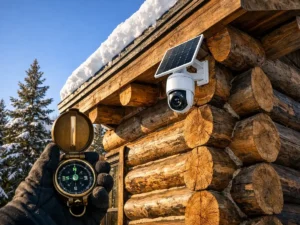
- South-facing mount is non-negotiable in winter. In our testing, east- and north-facing panel configurations delivered noticeably less daily charging input than south-facing at the same locations. Bring a compass before you drill. Even a modest correction toward south makes a meaningful difference across a Michigan winter.
- For the eufy S330: activate the SIM on-site, not from the driveway. SIM activation requires the eufy app with a live data connection. Use your phone’s hotspot at the cabin. Verify alert delivery to your phone before leaving. Budget 15 minutes for this step — it’s the only setup task the camera needs.
- Test LTE before you mount anything. Put your phone in LTE-only mode and walk the property perimeter. Note where you drop below two bars. The eufy’s multi-carrier SIM will outperform a single-carrier phone test — but dead zones are still dead zones.
- Mount at 10–14 feet to avoid snow lens coverage. In our Northern Michigan testing, snow accumulation on lower-mounted camera lenses caused false motion alerts and obscured footage. Mounting at height eliminated the problem at multiple locations.
- Use a Class 10 / U3 rated microSD for Reolink and Aosu. Standard photo cards are not designed for continuous loop-writing and fail faster than rated. A 64GB–128GB U3 card is the minimum for reliable cabin security use. The eufy includes its 32GB card — that’s one fewer thing to buy.
- Keep a portable power station at the cabin for mid-winter battery top-ups. Even the best solar cameras can run low after a stretch of overcast January days. A compact station lets you manually top up any camera — or keep a hotspot running — without running extension cords or waiting for sun. Our Jackery Explorer 1000 v2 long-term test covers exactly the unit we used on-site during this test period.
Build Your Complete Northern Michigan Cabin Security Setup
A solar security camera is one part of a complete off-grid property setup. These Outdoor Tech Lab guides cover the rest:
• Reolink vs. Aosu 90-day head-to-head test — full spec-by-spec comparison of resolution, night vision, AI detection, and app performance
• Best portable power stations for camping — the right station to keep cameras, lights, and devices charged through a multi-day off-grid stay
• Garmin inReach Mini 2 vs Mini 3 — satellite communication for remote Northern Michigan properties where LTE signal ends entirely
Field Testing Resources & Coverage Tools
We reference these official tools and resources when conducting and documenting our Northern Michigan field testing methodology.
- FCC National Broadband Map
The FCC’s official interactive map showing 4G LTE and broadband coverage at specific addresses across the U.S. Use this to check carrier availability at your exact cabin location before selecting a cellular security camera. Updated continuously with data from all major providers including AT&T, T-Mobile, and Verizon. - USDA Forest Service — Huron-Manistee National Forests
Official resource for the nearly one-million-acre Huron-Manistee National Forests in Michigan’s northern Lower Peninsula — the primary location of our field testing, covering the Manistee River, Pere Marquette National Scenic River, and surrounding private property corridors referenced throughout this article.
Solar Security Camera for Remote Cabins: FAQ
What is the best solar security camera for a remote cabin with no Wi-Fi?
The eufy 4G LTE Cam S330 is the best solar security camera for remote cabins with no Wi-Fi. It has a purpose-built 4G LTE modem and ships with an EIOTCLUB SIM card that automatically roams between AT&T, T-Mobile, and Verizon — connecting to the strongest available carrier at your exact location. No router, no hotspot, no infrastructure required. Activate the SIM through the eufy Security app while on-site and the camera delivers motion alerts and live footage over the cellular network alone. The included 32GB SD card handles local storage with no cloud subscription required. It’s the only camera in our Northern Michigan field test that operated fully off-grid without any additional infrastructure at the property.
Is the Reolink Argus PT Ultra a cellular camera?
No. The Reolink Argus PT Ultra is a Wi-Fi 6 camera only — it connects via 2.4GHz and 5GHz bands and has no built-in cellular modem. It cannot operate remotely without a Wi-Fi network at the cabin, typically a cellular hotspot, Starlink terminal, or traditional internet connection. For properties that already have internet infrastructure running, it’s an excellent choice offering the highest resolution (4K 8MP) and best battery efficiency of the three cameras in this comparison. For truly off-grid use with no existing internet at the property, the eufy 4G LTE Cam S330 is the only viable option in this test.
What is the EIOTCLUB SIM card included with the eufy 4G LTE Cam S330?
The EIOTCLUB SIM is a multi-carrier data SIM that automatically roams across AT&T, T-Mobile, and Verizon — connecting to whichever carrier has the strongest signal at your camera’s specific location. This carrier-agnostic behavior is a significant operational advantage in rural areas where one carrier’s coverage is strong and another’s is nonexistent. In our Manistee National Forest field testing, the SIM roamed from T-Mobile to AT&T at a fringe-signal site without any manual intervention. Data plans are managed through the eufy or EIOTCLUB portal. You can also substitute a data-only SIM from AT&T, T-Mobile, or Verizon directly if you prefer a carrier you already use.
Will solar security cameras work in Michigan winters?
Yes — all three cameras in this comparison operated through sub-zero temperatures without hardware failure. The practical limitation is solar charging input, not cold-weather tolerance. December and January in Northern Michigan provide roughly four hours of effective solar charging per day, and overcast days reduce that output significantly. South-facing panel orientation is the most impactful installation decision for adequate winter charging — in our testing, south-facing mounts consistently outperformed east-facing at the same locations. All lithium batteries lose capacity in sub-zero temperatures, so always factor in cold-weather reduction when planning your unattended winter setup.
Do any of these cameras require a monthly subscription?
None of the three require a cloud storage subscription for basic local recording. The eufy 4G LTE Cam S330 stores footage on its included 32GB SD card. The Reolink Argus PT Ultra records to a microSD card (purchased separately). The aosu Solar Security Camera stores to a local microSD card (not included); cloud storage is available but requires a paid subscription — local SD storage is free. The eufy does require a cellular data plan to use its LTE function — roughly $5–$10 per month at budget tiers — but that is a connectivity cost replacing the need for a hotspot or router at the property, not a cloud storage fee.
Can the aosu Solar Security Camera work at a remote cabin without Wi-Fi?
No — the aosu Solar Security Camera requires a 2.4GHz Wi-Fi network for all remote functionality, including initial setup. If your cabin has a cellular hotspot or Starlink terminal running, the Aosu can connect to that network and operate normally. Without any internet infrastructure at the property, the Aosu cannot deliver remote alerts or stream live footage. For truly off-grid use, the eufy 4G LTE Cam S330 with its built-in cellular modem is the appropriate choice. The Aosu earns its position as the best-value 2-pack for Wi-Fi-equipped properties — it’s not the right camera for a property with no internet.
What microSD card should I use for cabin security cameras?
Use a Class 10 / U3 rated microSD card for both the Reolink Argus PT Ultra and aosu Solar Security Camera. Standard photo cards are not designed for the continuous loop-writing that security cameras perform and fail faster than their rated lifespan in that use case. A 64GB to 128GB U3 card provides a practical recording buffer for most cabin scenarios — enough to store several weeks of motion-triggered clips before the oldest footage is overwritten. The eufy 4G LTE Cam S330 includes a 32GB card ready to use out of the box, which is adequate for cabin-frequency motion recording and eliminates this as a separate purchase.
How do I choose between the eufy 4G LTE Cam S330 and the Reolink Argus PT Ultra?
The decision comes down to one question: does your cabin have any active internet infrastructure? If your property has no Wi-Fi, no router, and no hotspot running — especially during winter months when you’re not there to maintain equipment — the eufy 4G LTE Cam S330 is the only camera in this comparison that can serve as a functional remote security camera. Its built-in LTE modem and multi-carrier SIM operate independently of any property infrastructure. If your cabin already runs a Starlink dish, a managed cellular hotspot, or a traditional internet connection, the Reolink Argus PT Ultra delivers better image quality (4K 8MP), better battery efficiency on Wi-Fi, and zero ongoing LTE data cost at a lower price. The eufy costs more to operate monthly; the Reolink costs you the infrastructure requirement. Which one you already have at the property answers the question.
OTL Bottom Line: Best Solar Security Camera for Remote Cabins
The right solar security camera for a remote cabin is not the one with the most impressive specification on paper. It’s the one that is still sending you alerts on week three of January with no one at the property and four inches of new snow on the solar panel.
The eufy 4G LTE Cam S330 is the best solar security camera for remote cabins in 2026 — the only camera in this test with a purpose-built cellular modem, a carrier-agnostic SIM that hunts for the strongest signal across three major networks, and enough battery to ride out a Northern Michigan winter without intervention.
If your cabin has no Wi-Fi and no infrastructure, this is the camera. There is no close second in this category.
The Reolink Argus PT Ultra earns its position as the sharpest, most battery-efficient Wi-Fi option at a lower price point — the right call for any property that already has Starlink or a managed hotspot running. Better image quality, Wi-Fi 6 efficiency, and zero ongoing data cost make it the preferred choice the moment internet infrastructure enters the picture.
The aosu Solar Security Camera is the honest budget option — lowest price in the comparison, best floodlight, available in 1 or 2-pack — but it is the least suitable of the three for a remote cabin context precisely because it requires Wi-Fi. If your property already has internet infrastructure running, it earns its slot.
If your cabin is truly off-grid, it doesn’t belong in the conversation.
All three eliminate the monthly cloud storage fee. All three survived a Northern Michigan winter without hardware failure. And all three, deployed correctly for the property they’re protecting, deliver what every cabin owner actually wants: a notification confirming that everything is exactly as they left it.
Ready to Secure Your Remote Cabin?
All cameras field tested in Northern Michigan • Outdoor Tech Lab • March 2026
This guide was last updated in March 2026 with verified specifications and field testing notes from Manistee National Forest and western Upper Peninsula locations. Tested by Outdoor Tech Lab, Ludington, Michigan.





Leave a Reply