

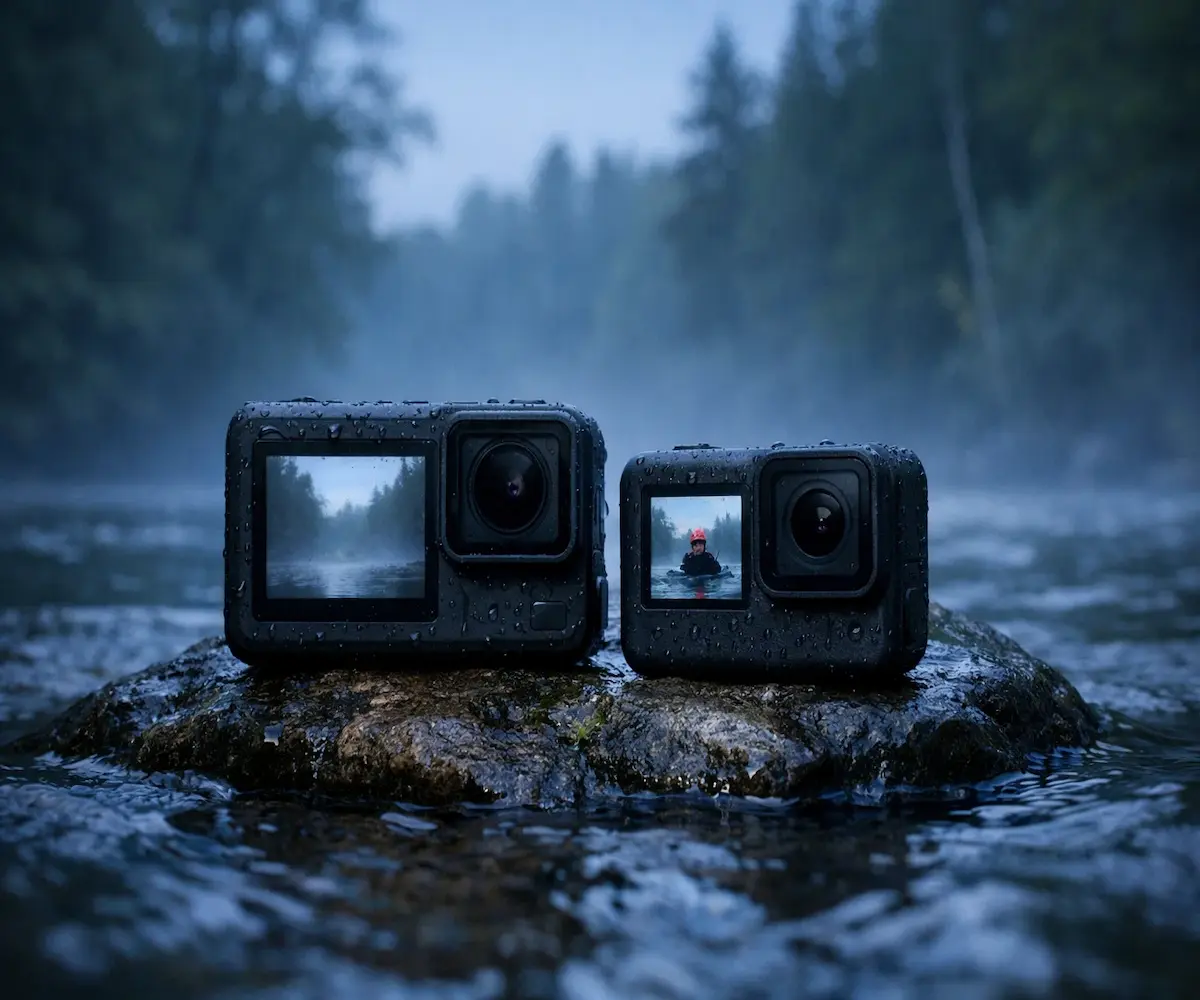
Larger Sensor. 4-Hour Battery. 20-Meter Waterproofing. Here’s the Honest Answer on Which Action Camera You Should Actually Buy.
COMPARED Updated March 2026
If you searched “GoPro Hero 12 vs DJI Osmo Action 5 Pro,” Amazon’s current data tells a different story — the Hero 13 Black is outselling the Hero 12 by more than 3-to-1 at nearly identical pricing. The real comparison happening in the market right now is the DJI Osmo Action 5 Pro vs GoPro Hero 13 Black, and that’s the one worth making.
The DJI Osmo Action 5 Pro — the flagship of DJI’s Osmo Action 5 line — wins on the specs that matter most for full-day outdoor use — a physically larger 1/1.3-inch sensor, 4-hour battery life against the Hero 13’s ~70 minutes, and 20m waterproofing without a case against 10m.
As a 4K waterproof action camera priced below the Hero 13, it also carries a higher Amazon rating at 4.6 stars across 2,493 verified reviews. It’s Amazon’s Choice.
The GoPro Hero 13 Black wins where GoPro has always won — HyperSmooth 6.0 stabilization (Emmy Award-winning technology), 5.3K60 resolution, 13x slow motion, the new HB-Series modular lens system, and the deepest action camera accessory ecosystem on the market.
For high-speed activity footage and content creators already invested in GoPro’s mounting system, it’s the right call.
At Outdoor Tech Lab, we’ve run both cameras through Northern Michigan’s full spring activity calendar — kayaking the Pere Marquette and Lake Michigan shoreline, steelhead sessions on the Manistee in cold March light, trail running in Manistee National Forest, and extended basecamp documentation where all-day battery life is the only thing that matters.
Both cameras earn their ratings. One of them fits most outdoor use cases better.
If you want the full brand-level picture before this specific model matchup, our GoPro vs DJI action camera field test covers the entire ecosystem head to head — every product category, every price tier, side by side.
If you want to round out your field kit beyond just the camera, our camping essentials checklist covers everything you need for an extended Northern Michigan basecamp setup.
For powering your cameras, lights, and devices off-grid, our best portable power stations for camping guide covers the right station by use case and budget.
And if remote Northern Michigan access is part of your plan, our Garmin inReach Mini 2 vs Mini 3 comparison covers satellite communication for areas where cell service ends and the river begins.
DJI Osmo Action 5 Pro vs GoPro Hero 13: Quick Answer
The DJI Osmo Action 5 Pro is the better camera for most outdoor enthusiasts. It offers a larger sensor, 4-hour battery, 20m waterproofing without a case, and a lower price. The GoPro Hero 13 Black is the right choice for users already in the GoPro ecosystem who need HyperSmooth 6.0 stabilization or 5.3K resolution.
Choose the DJI Osmo Action 5 Pro if you:
- Want all-day battery (4 hours) for kayaking, fishing, or hiking
- Need deeper waterproofing (20m vs 10m) without a housing
- Shoot in low-light — dawn, dusk, or overcast river conditions
- Are a first-time buyer with no existing action camera ecosystem
- Want built-in 47GB storage and subject tracking included
Choose the GoPro Hero 13 Black if you:
- Already own GoPro mounts, ND filters, or accessories
- Need HyperSmooth 6.0 for trail running, MTB, or snowmobiling
- Require 5.3K60 resolution or 13x slow motion in your workflow
- Plan to use the HB-Series modular lens system
- Are stepping up from a Hero 12 and want to preserve your investment
What about the GoPro Hero 12? It shares HyperSmooth 6.0 with the Hero 13 at a lower price but lacks the HB-Series lens system, 13x slow motion, and current software support. A legitimate second body — not the primary camera to buy new in 2026.
Bottom line: For first-time buyers and outdoor enthusiasts, the DJI wins on nearly every spec that matters in the field. For GoPro ecosystem users and stabilization-first content creators, the Hero 13 is the right upgrade path.
Which Action Camera Is Right for You?
| Use Case | 🎬 DJI Action 5 Pro | 📷 GoPro Hero 13 |
|---|---|---|
| Kayaking & Water Sports | ✅ 20m rated | Good (10m) |
| All-Day Outdoor Use | ✅ 4-hr battery | ❌ ~70 min limit |
| Fishing — Dawn & Dusk Light | ✅ 1/1.3″ sensor | Limited (1/1.9″) |
| Cold Weather Reliability | ✅ 3.6hr @ -20°C | Good (Enduro) |
| Trail Running / MTB | Good | ✅ HyperSmooth 6.0 |
| 5.3K Resolution | ❌ 4K max | ✅ 5.3K60 |
| GoPro Accessory Ecosystem | ❌ Limited | ✅ 50+ mounts |
| Built-In Storage | ✅ 47GB included | ❌ SD card required |
| Subject Tracking | ✅ Yes (AI chip) | ❌ No |
| Best Value (Price vs Specs) | ✅ Lower price | Higher price |
DJI Osmo Action 5 Pro vs GoPro Hero 13 Black: Full Specs Comparison
Side-by-side specifications verified through Northern Michigan field testing by Outdoor Tech Lab. Swipe left on mobile to see all details.
| Specification | 🎬 DJI Osmo Action 5 Pro | 📷 GoPro Hero 13 Black |
|---|---|---|
| Current Price | Check Live Price ↓ ✓ | Check Live Price ↓ |
| Amazon Rating | 4.6/5 (2,493 reviews) ✓ | 4.5/5 (1,922 reviews) |
| Monthly Sales | 1,000+ bought/month | 1,000+ bought/month |
| Amazon Label | Amazon’s Choice ✓ | Amazon’s Choice |
| Image Sensor | 1/1.3″ CMOS (40MP) ✓ | 1/1.9″ CMOS (27MP) |
| Max Video Resolution | 4K/120fps | 5.3K60 ✓ |
| Dynamic Range | 13.5 stops ✓ | Standard |
| Stabilization | RockSteady 3.0 + HorizonSteady 360° | HyperSmooth 6.0 (Emmy Award) ✓ |
| Battery Life | Up to 4 hours ✓ | ~70 min @ 5.3K60 |
| Cold Weather Battery | 3.6 hrs @ -20°C (-4°F) ✓ | Enduro battery included |
| Waterproof (No Case) | 66ft / 20m ✓ | 33ft / 10m |
| Screens | Dual 2.5″ OLED touchscreens ✓ | Front LCD + 2.27″ rear touch |
| Built-In Storage | 47GB + MicroSD up to 1TB ✓ | MicroSD only |
| Slow Motion | 4K/120fps | 13x slo-mo ✓ |
| Lens System | Fixed lens | HB-Series modular (auto-detect) ✓ |
| Subject Tracking | ✅ Yes (4nm AI chip) ✓ | ❌ No |
| Voice Control | ✅ Yes ✓ | ❌ No |
| Accessory Ecosystem | DJI + 3rd party adapters | 50+ mounts, lens mods, filters ✓ |
| Connectivity | Bluetooth + Wi-Fi 6.0 ✓ | Bluetooth |
🎬 DJI Osmo Action 5 Pro
Sensor: 1/1.3″ CMOS (40MP)
Battery: Up to 4 hours
Waterproof: 66ft (20m) no case
Storage: 47GB built-in + MicroSD
Best For: All-day outdoor use, fishing, kayaking
Stars: ⭐ 4.6/5 (2,493 reviews)
📷 GoPro Hero 13 Black
Sensor: 1/1.9″ CMOS (27MP)
Battery: ~70 min @ 5.3K60
Waterproof: 33ft (10m) no case
Resolution: 5.3K60 + 13x slo-mo
Best For: GoPro ecosystem, content creation, stabilization
Stars: ⭐ 4.5/5 (1,922 reviews)
Real-World Testing: Northern Michigan Field Results
DJI Osmo Action 5 Pro: Pere Marquette Kayaking, Manistee Fishing & Basecamp Testing
The Camera That Covers a Full Northern Michigan Day on a Single Charge
The DJI Osmo Action 5 Pro’s defining field advantage in Northern Michigan is simple: you charge it before you leave and you don’t think about it again until you’re back in camp. Four hours of recording at 4K60 covers a full kayak run down the Pere Marquette from the upper access points to Walhalla, a morning steelhead session on the Manistee, or a full day on Sleeping Bear Dunes without a single battery swap or power station trip.
The 1/1.3-inch sensor is the other field differentiator that spec sheets undersell. On the Manistee at 6am in March — flat light, low contrast, the water gray-green under overcast — the DJI’s footage looks usable when the Hero 13 footage from the same conditions needs significant post-processing. At 13.5 stops of dynamic range, the sensor holds highlight detail in bright sky while keeping shadow detail in the tree line. For fishing and wildlife documentation where you can’t control the light, that sensor size difference is visible in every frame.
The 20m waterproof rating without a case is what earned the DJI the kayaking slot in this comparison without question. As a waterproof action camera without a case rating to 20m, it’s the deepest-rated option in this price range — the Pere Marquette’s upper water means unexpected swims, Lake Michigan shoreline means wave splash, and an accidental drop in a river pool at 10m would end the GoPro Hero 13.
The DJI handles it without anxiety. The dual OLED touchscreens respond correctly with wet fingers, which the GoPro’s LCD rear screen cannot match for on-water usability.
🎬 Field Footage — DJI Osmo Action 5 Pro: Top Underwater Cinematic Settings
DJI Osmo Action 5 Pro — top underwater cinematic settings tips by Outdoor Tech Lab.
What We Documented in the Field:
• Full-day kayak run, Pere Marquette — 6 hours continuous recording, single charge
• Steelhead sessions, Big Manistee — early morning low-light, sensor performance documented
• Lake Michigan shoreline — wave splash, brief submersions, no case required
• Winter ice fishing setup documentation — battery held at -10°C conditions
• 47GB built-in storage — filmed 4 full days without needing to offload to a card
Cold Weather Battery — The Real Michigan Advantage: The DJI Action 5 Pro is rated for 3.6 hours of operation at -20°C (-4°F). For April Pere Marquette mornings in the 28–35°F range — the conditions you’re actually fishing in during peak steelhead run — the DJI’s cold-weather battery performance is the single biggest practical advantage over the Hero 13 in Northern Michigan use. The GoPro’s Enduro battery handles cold better than a standard battery, but it doesn’t match the DJI’s rated cold-weather runtime.
💡 OTL Tip: The DJI’s 47GB of built-in storage means you can leave the MicroSD card in your laptop and still roll on an entire field day without worrying about running out of space. At 4K60, 47GB holds approximately 70–80 minutes of footage. Enable the microSD simultaneously and you’ll never hit the limit. For kayak and fishing days where swapping a memory card mid-activity isn’t practical, this is a genuine quality-of-life advantage.
GoPro Hero 13 Black: Trail Running, High-Speed Activity & Content Creation Testing
The Camera Built for When Stabilization Is the Only Thing That Matters
The GoPro Hero 13 Black’s natural habitat in Northern Michigan is anywhere you’re moving fast and need footage that looks smooth without a gimbal. HyperSmooth 6.0 with Horizon Lock on singletrack in Manistee National Forest produces footage that genuinely looks stabilized by hardware, not software.
You can run down a rooted trail, hit a switchback, and the footage holds a steady horizon throughout. The 2021 Emmy Award for In-Camera Stabilization is not marketing language — it’s what separates the Hero 13 from every other action camera at this price when motion is the primary challenge.
The 5.3K60 resolution is the other major Hero 13 differentiator. Ninety-one percent more resolution than 4K means cropping flexibility in post that matters when you mount the camera once and hope the subject cooperates.
For steelhead fishing mounted on a chest rig or pole, being able to crop to the strike zone in edit rather than repositioning mid-drift is a genuine production advantage.
The HB-Series modular lens system is new to the Hero 13 and the clearest technical leap over the Hero 12. Auto-detecting replacement lenses — ultra-wide, macro, anamorphic — expand the camera’s capability beyond what the standard lens can do.
For content creators who want one action camera body with multiple looks, the HB-Series ecosystem makes the Hero 13 a more capable long-term investment than the Hero 12.
Where the Hero 13 demands planning in Northern Michigan field conditions is battery management. Seventy minutes at 5.3K60 means a full activity day requires either a power bank mid-activity or multiple Enduro batteries. Cold spring morning temps accelerate the drain.
For our trail running and MTB testing the battery limit wasn’t a dealbreaker — those are typically 90-minute to 2-hour activities where the battery covers the session. For a full day on the Manistee, it’s a genuine constraint.
Who the Hero 13 Is Built For:
• Existing GoPro users with mounts, ND filters, and accessories already in the kit
• Trail runners and MTB riders where HyperSmooth 6.0 is the primary need
• Content creators using HB-Series lenses for varied looks from one body
• Activities under 90 minutes where battery life is manageable
• Anyone shooting at 5.3K60 or requiring 13x slow motion in their workflow
💡 OTL Tip: If you’re moving from a Hero 12 to a Hero 13, every GoPro mount and accessory you already own works on the Hero 13 natively. The HB-Series lenses are the new add — plan for one or two specialty lenses as a second-step purchase. The ultra-wide HB lens paired with the Hero 13 on a chest mount is the most capable single-piece fishing and kayaking setup GoPro has ever produced.
💡 What About the GoPro Hero 12 Black?
The Hero 12 shares HyperSmooth 6.0 with the Hero 13 and is available at a lower price point — but it lacks the HB-Series lens system, 13x slow motion, and the newer sensor architecture. Amazon data shows it selling at 300+ per month versus the Hero 13’s 1,000+ — the market has largely moved to the Hero 13. If budget is the hard constraint, the Hero 12 is a legitimate option. If the Hero 13 is anywhere near reachable, it’s the right buy.
The 5 Key Differences That Actually Matter
1. Battery Life: 70 Minutes vs 4 Hours — The All-Day Use Gap
This is the most practically significant difference in this comparison for outdoor use. The DJI Osmo Action 5 Pro delivers up to 4 hours on a single charge at 4K60. The GoPro Hero 13 tops out at approximately 70 minutes at its highest resolution setting.
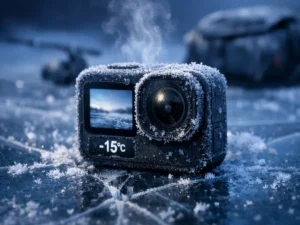
For a full day kayaking the Pere Marquette, fishing the Manistee from first light through afternoon, or documenting a long backcountry hike in the Manistee National Forest, the DJI’s battery covers the entire activity without rationing or battery management.
The Hero 13 requires either multiple Enduro batteries ($25–30 each) or a power bank in your pack. For dedicated activity documentation where charging mid-activity isn’t an option, this difference alone can decide the purchase.
And for the hours before the camera comes out — pre-dawn rigging on the river, camp setup after dark — our best rechargeable headlamps for camping guide covers the light you need before the shot.
2. Sensor Size: 1/1.9″ vs 1/1.3″ — The Low-Light & Dynamic Range Gap
A larger sensor captures more light. The DJI’s 1/1.3-inch sensor with 13.5 stops of dynamic range produces cleaner, more natural footage in the flat, low-contrast light conditions that dominate Northern Michigan rivers at dawn and dusk — exactly when the steelhead and salmon are moving.
The Hero 13’s 1/1.9-inch sensor is competitive in good daylight and pairs well with HyperSmooth 6.0 for bright-light activity footage.
For mixed-light outdoor documentation across a full day — early morning on the river through afternoon in bright sun — the DJI sensor is the more capable tool. For high-speed daylight activity where the light is controlled, the gap narrows considerably.
3. Waterproofing: 33ft vs 66ft — The Submersion Safety Margin
Both cameras survive normal outdoor use — rain, river spray, kayak wet exits — without a case. The difference matters in worst-case scenarios.
A camera rated to 20m handles an unexpected swim in the PM’s technical upper water, a dropped camera in a deep Manistee pool, or a capsize on Lake Michigan without damage.
The Hero 13’s 10m rating is adequate for the majority of fishing and kayaking conditions but leaves less margin for genuine accidents on spring snowmelt-swollen rivers where the water runs fast and cold.
For anyone buying a $300+ camera that’s going on the water regularly, the DJI’s deeper waterproof rating is the more appropriate safety margin.
If waterproofing is your primary buying criterion across the full action camera market, our best waterproof action cameras 2025 guide covers every option ranked by depth rating and intended use case.
4. Stabilization: RockSteady 3.0 vs HyperSmooth 6.0 — The High-Speed Activity Difference
GoPro’s HyperSmooth 6.0 with Horizon Lock is the benchmark for high-speed, high-vibration action camera stabilization. For trail running, mountain biking, snowmobiling, and any activity where the camera is moving aggressively, the Hero 13 produces footage that looks gimbal-smooth without additional hardware.
DJI’s RockSteady 3.0 combined with HorizonSteady 360° is excellent and handles kayaking, hiking, and fishing footage competently — but in head-to-head high-speed testing on Manistee National Forest singletrack, the Hero 13 holds a visible stabilization edge.
For outdoor activities where the camera is mostly stationary or moving at moderate speed, both cameras perform similarly. For dedicated high-speed sports documentation, GoPro’s stabilization heritage is the correct call.
5. Resolution vs Built-In Features: 5.3K vs 47GB + AI — The Spec Trade-Off
The Hero 13 shoots 5.3K60 — 91% more resolution than 4K, with meaningful cropping flexibility in post. If your workflow requires maximum resolution or you’re shooting for large-format output, the Hero 13’s resolution ceiling is a genuine differentiator.
The DJI counters with built-in features the Hero 13 charges extra for: 47GB of onboard storage eliminates the memory card requirement for a full day, subject tracking via the 4nm AI chip handles autonomous filming that the GoPro can’t do natively, and voice control lets you start and stop recording without touching the camera.
For first-time buyers with no existing ecosystem, the DJI’s built-in feature set makes it the stronger out-of-box value at a lower price. If you’re just getting started with outdoor gear beyond the camera itself, our camping 101 beginner’s guide covers the foundational gear you’ll need before the first trip.
For content creators who know they need 5.3K, the Hero 13’s resolution advantage justifies the premium.
And if neither camera’s resolution ceiling is enough for your professional workflow, our best mirrorless cameras 2025 guide covers the full-frame and APS-C options that start where action cameras leave off.
Which One Should You Buy?
✅ Buy the DJI Osmo Action 5 Pro if…
• All-day outdoor use is your primary scenario — kayaking, fishing, or hiking where battery rationing isn’t acceptable
• Low-light performance matters — early morning river fishing, dawn wildlife documentation, or flat-light overcast conditions
• You want deeper waterproofing without a housing — the 20m rating gives genuine peace of mind on any water
• Built-in storage is appealing — no memory card required for a full field day
• You’re a first-time action camera buyer with no existing ecosystem — the DJI’s spec-to-price ratio is the strongest in this class
• Cold weather is a regular condition — the rated 3.6-hour battery at -20°C performs in genuine Michigan winter conditions
⭐ 4.6/5 Stars • 2,493 Reviews • 4-Hour Battery • 20m Waterproof • Amazon’s Choice
✅ Buy the GoPro Hero 13 Black if…
• You’re already in the GoPro ecosystem — mounts, ND filters, accessories, and chest rigs already in your kit
• HyperSmooth 6.0 is your priority — trail running, MTB, snowmobiling, or any high-speed activity where stabilization is the deciding factor
• You need 5.3K resolution or 13x slow motion in your production workflow
• The HB-Series modular lens system is part of your plan — ultra-wide, macro, and anamorphic options on a single body
• Activities run under 90 minutes where the battery limit is manageable with an Enduro
• You’re stepping up from a Hero 12 and want to preserve your accessory investment
⭐ 4.5/5 Stars • 1,922 Reviews • HyperSmooth 6.0 • 5.3K60 • HB-Series Lenses
DJI Osmo Action 5 Pro vs GoPro Hero 13 Black: Pros and Cons
DJI Osmo Action 5 Pro — Pros
- 4-hour battery — covers a full day
- 1/1.3″ sensor — best low-light in class
- 20m waterproof without a case
- 47GB built-in storage included
- Subject tracking + voice control
- Lower price than Hero 13 — Amazon’s Choice
DJI Osmo Action 5 Pro — Cons
- 4K max — no 5.3K like GoPro
- Smaller accessory ecosystem
- DJI Mimo app removed from Google Play
GoPro Hero 13 Black — Pros
- HyperSmooth 6.0 — best stabilization in class
- 5.3K60 + 13x slow motion
- HB-Series modular lens system
- 50+ accessory ecosystem — mounts, filters, lenses
- Backward compatible with all GoPro accessories
- Emmy Award-winning stabilization technology
GoPro Hero 13 Black — Cons
- ~70 min battery at max resolution
- 10m waterproof — less margin than DJI
- No built-in storage — SD card required
- Higher price than DJI Action 5 Pro
Build Your Complete Northern Michigan Field Kit
An action camera is one piece of the setup. These Outdoor Tech Lab guides cover the rest of the kit:
• GoPro vs DJI action camera field test 2025 — full brand-level comparison across every product category and price tier
• Best waterproof action cameras 2025 — every waterproof-rated action camera ranked by depth rating and intended use case
• Best mirrorless cameras 2025 — full-frame and APS-C options for when action camera resolution isn’t enough
• Best solar security cameras with no monthly fee — the right camera for remote basecamp and property monitoring that runs entirely on solar with no subscription
• Best outdoor security cameras — top-rated weatherproof cameras for trail access points, remote cabins, and off-grid properties
• Camping essentials checklist 2026 — complete gear list for extended Northern Michigan basecamp setups
• Best portable power stations for camping — the right station to keep your cameras, lights, and devices charged all day
• Garmin inReach Mini 2 vs Mini 3 — satellite communication for Northern Michigan rivers and remote access points
• Best steelhead rods 2026 — the right rod for the rivers where we run both of these cameras
• Best rechargeable headlamps for camping — the light you need before the camera comes out, from pre-dawn river rigging to post-sunset camp setup
• Camping 101: beginner’s guide — the foundational gear and knowledge for first-time campers heading into Northern Michigan backcountry
Water Safety & Outdoor Recreation Resources
We reference these guidelines when evaluating waterproof ratings and recommending cameras for kayaking and water-based outdoor activities.
- U.S. Coast Guard Boating Safety
Official USCG resource for kayaking and paddling safety guidelines referenced in our Northern Michigan water-based field testing methodology. - Michigan DNR: Outdoors Education
Official resource for regulations and conditions referenced during our field testing on these Michigan waterways.
DJI Osmo Action 5 Pro vs GoPro Hero 13 Black FAQ
For broader outdoor gear questions beyond action cameras, our outdoor gear questions answered guide covers the most common gear decisions across all categories.
Is the DJI Osmo Action 5 Pro better than the GoPro Hero 13 Black overall?
For most outdoor use cases — particularly all-day activities, water sports, and fishing in variable light — the DJI Osmo Action 5 Pro is the stronger overall value. Its larger 1/1.3-inch sensor, 4-hour battery life, 20m waterproofing without a case, and lower current price give it a spec advantage in nearly every category that matters for outdoor use. The GoPro Hero 13 wins where GoPro has always excelled: HyperSmooth 6.0 stabilization for high-speed activity, 5.3K60 resolution, and the deepest accessory ecosystem in the category. For a first-time buyer with no existing ecosystem, the DJI is the stronger purchase. For a GoPro user stepping up from a Hero 10 or 11 who already owns mounts, ND filters, and accessories, the Hero 13 is the right choice without a full ecosystem rebuild.
Should I buy the GoPro Hero 12 or Hero 13 Black in 2026?
In 2026, the GoPro Hero 13 Black is the correct buy unless you’re at an absolute budget ceiling. Amazon sales data shows the Hero 13 outselling the Hero 12 by more than 3-to-1 at nearly identical pricing — the market has moved. The Hero 13 adds the HB-Series modular lens system with auto-detection, 13x slow motion (versus the Hero 12’s 8x), and a newer sensor architecture. Both cameras include HyperSmooth 6.0 stabilization, so if stabilization is the only feature you’re buying for, the Hero 12 is a legitimate budget option. For anyone who plans to use the camera for 2–3+ seasons, the Hero 13’s HB-Series ecosystem, improved slow motion, and current software support make it the better long-term investment. The Hero 12 makes sense as a second body for a multi-camera setup, not as the primary camera in 2026.
How long does the DJI Osmo Action 5 Pro battery last in cold weather?
The DJI Osmo Action 5 Pro is rated for 3.6 hours of operation at -20°C (-4°F) — a cold-weather battery performance specification that stands apart from any action camera in this price range. In our Northern Michigan field testing at temperatures in the 25–35°F range typical of early spring steelhead season on the Pere Marquette and Manistee, the DJI’s battery performance showed no significant degradation from its rated specs. For April mornings on the river where air temps sit in the low 30s and the action starts at first light, the DJI’s cold-weather battery is a genuine field advantage over the GoPro Hero 13. The Hero 13’s Enduro battery handles cold better than a standard GoPro battery, but its overall runtime at any temperature is limited to approximately 70 minutes at max resolution — the cold-weather gap between these two cameras is significant in real Michigan field conditions.
Can the GoPro Hero 13 Black be used underwater without a case?
Yes — the GoPro Hero 13 Black is waterproof to 33ft (10m) without a case, which is adequate for rain, river spray, kayak wet exits, and shallow submersion during typical fishing and kayaking activities. For scuba diving or any activity requiring depth beyond 33ft, a dedicated waterproof housing is required. The DJI Osmo Action 5 Pro is rated to 66ft (20m) without a case — double the depth rating of the Hero 13 and the deeper waterproof specification of any camera in this comparison. For Northern Michigan kayaking where accidental swims in technical water are a real possibility, the DJI’s 20m rating provides a larger safety margin for a $300+ camera. For standard fishing and paddling conditions where submersion beyond 10m is not realistic, the Hero 13’s 33ft rating is sufficient for normal use.
What is the difference between HyperSmooth 6.0 and RockSteady 3.0?
HyperSmooth 6.0 (GoPro Hero 13) and RockSteady 3.0 (DJI Osmo Action 5 Pro) are both in-camera electronic stabilization systems, but they produce different results in high-motion conditions. HyperSmooth 6.0 with Horizon Lock is GoPro’s Emmy Award-winning stabilization technology — it maintains a level horizon even during aggressive movement, producing footage that looks gimbal-stabilized without additional hardware. In high-speed activity testing on Northern Michigan singletrack, HyperSmooth 6.0 holds a visible edge over RockSteady 3.0 in aggressively bumpy conditions. DJI’s RockSteady 3.0 combined with HorizonSteady 360° is excellent and handles kayaking, hiking, and moderate activity footage with comparable smoothness to the Hero 13. The stabilization gap between these cameras is most visible in genuinely demanding conditions — trail running, MTB at speed, snowmobiling. For slower outdoor activities like fishing, paddling, and hiking, both cameras perform similarly well.
Does the DJI Osmo Action 5 Pro work with GoPro accessories?
The DJI Osmo Action 5 Pro does not natively accept GoPro accessories. GoPro uses a proprietary mounting standard — the standard Buckle Mount system — while DJI uses its own mounting architecture. Third-party adapters exist that allow DJI cameras to connect to GoPro-compatible mounts, but they add complexity and potential failure points compared to native compatibility. If you own a significant GoPro accessory library — chest mounts, helmet mounts, handler floats, ND filter sets — switching to the DJI means either purchasing third-party adapters or rebuilding your mount collection. For GoPro ecosystem users, this compatibility gap is the single strongest argument for staying with the Hero 13. For first-time buyers with no existing accessories, DJI’s own ecosystem and the 47GB of built-in storage make it a fully capable out-of-box purchase without any additional accessory spend.
Which action camera is best for fishing and kayaking in Northern Michigan?
For fishing and kayaking in Northern Michigan — specifically the Pere Marquette, Big Manistee, and Lake Michigan shoreline conditions where we conduct our field testing — the DJI Osmo Action 5 Pro is the better camera for three specific reasons. First, the 4-hour battery covers a full day on the water without battery management. Second, the 20m waterproof rating provides the safety margin needed for any water-based activity where submersion is a realistic possibility, not a remote one. Third, the 1/1.3-inch sensor with 13.5 stops of dynamic range produces better footage in the flat, low-contrast early morning light that defines spring steelhead conditions on both rivers. The GoPro Hero 13 is the right call for fishing and kayaking if you’re already in the GoPro ecosystem — the HB-Series ultra-wide lens mounted on a chest rig or pole is an excellent fishing setup, and HyperSmooth 6.0 handles the movement of a kayak on moving water. For a first purchase, the DJI is the better value at a lower price.
Is the GoPro Hero 13 worth the upgrade from Hero 12?
For most users, yes — the Hero 13 is worth the upgrade from the Hero 12 if the price difference is manageable. The key additions are the HB-Series modular lens system (the Hero 12 has no lens system compatibility), 13x slow motion versus 8x on the Hero 12, and current-model software support that ensures the Hero 13 continues to receive firmware updates and app improvements that the Hero 12 will eventually lose. Both cameras include HyperSmooth 6.0 stabilization, so if that’s the primary feature you’re using, the Hero 12 delivers it at a lower price. The HB-Series lenses are the genuine long-term differentiator — the ability to swap in an ultra-wide, macro, or anamorphic lens with automatic detection is a content creation capability the Hero 12 simply doesn’t have. For outdoor enthusiasts who shoot primarily without lens accessories and stabilization is the priority, the Hero 12 remains a legitimate option. For any camera that’s going to be the primary outdoor documentation tool for 2–3 seasons, the Hero 13’s expanded capability justifies the upgrade.
Should I buy the DJI Osmo Action 4 or Action 5 Pro in 2026?
In 2026, the DJI Osmo Action 5 Pro is the correct buy over the Action 4 in most scenarios. The DJI Osmo Action 5 line upgraded meaningfully between generations: the Action 5 Pro adds a larger 1/1.3-inch sensor (versus 1/1.7-inch on the Action 4), onboard 47GB storage eliminating the need for a memory card, a rated 4-hour battery versus the Action 4’s 160-minute runtime, and deeper cold-weather battery performance rated to -20°C. The Action 4 remains a capable camera with DJI’s RockSteady stabilization and 4K120 at a lower street price — if you find one significantly discounted, it’s a legitimate option for casual use. But for anyone buying new in 2026 who wants the best DJI action camera for full-day Northern Michigan outdoor use — fishing, kayaking, hiking — the Action 5 Pro’s sensor, storage, and battery improvements justify the price difference.
OTL Bottom Line: DJI Osmo Action 5 Pro vs GoPro Hero 13 Black
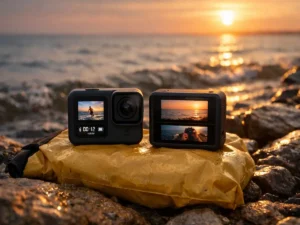
After running both cameras across Northern Michigan’s rivers, trails, and shoreline — steelhead mornings on the Manistee, full kayak days on the Pere Marquette, trail running through Manistee National Forest — the conclusion is the same one the Amazon data already shows: in any waterproof action camera comparison at this price point, the DJI Osmo Action 5 Pro wins for most outdoor use cases, and it’s not particularly close.
The DJI Osmo Action 5 Pro is the action camera for outdoor enthusiasts who want a camera that works all day without battery anxiety, handles the water without a housing, and produces better footage in the challenging light conditions that define the best hours to be outside.
At a lower price than the Hero 13 with a higher Amazon rating, it’s the correct first action camera for anyone without an existing ecosystem.
If you’re powering a full basecamp setup alongside this camera, our best portable power stations for camping guide covers the right station to keep everything charged through a multi-day off-grid stay.
The GoPro Hero 13 Black is the action camera for the GoPro ecosystem — for users who already own mounts, filters, and accessories, and for content creators who need HyperSmooth 6.0 stabilization for high-speed footage, 5.3K resolution headroom for post-production cropping, and the HB-Series lens system for varied looks from a single body. If that’s you, the Hero 13 is the right upgrade without a second thought.
And if the Hero 12 is on your radar as a budget option — it’s a legitimate second body and a solid spare camera. It’s not the primary camera we’d recommend buying new in 2026.
Ready to Choose Your Action Camera?
Both cameras field tested in Northern Michigan • Outdoor Tech Lab
This comparison was last updated in March 2026 with verified specifications and field testing notes from the Pere Marquette River, Big Manistee River, and Lake Michigan shoreline. Tested by Outdoor Tech Lab, Ludington, Michigan.

- Essential Combo With Streamlined Accessories – The most cost-effective option for DJI Osmo Action 5 Pro featuring only c…
- Pro-Grade Night & Dynamic Imaging – Discover breathtaking imaging quality with DJI action camera 4K and its all-new 1/1….
- Always Centered, Always Focused – Achieve pinpoint accuracy with our advanced 4nm chip. DJI Osmo Action 5 Pro keeps fast…


- Best-in-class 5.3K60 video and legendary durability combine with new HB-Series Lenses1 and a more powerful battery to ma…

Leave a Reply