

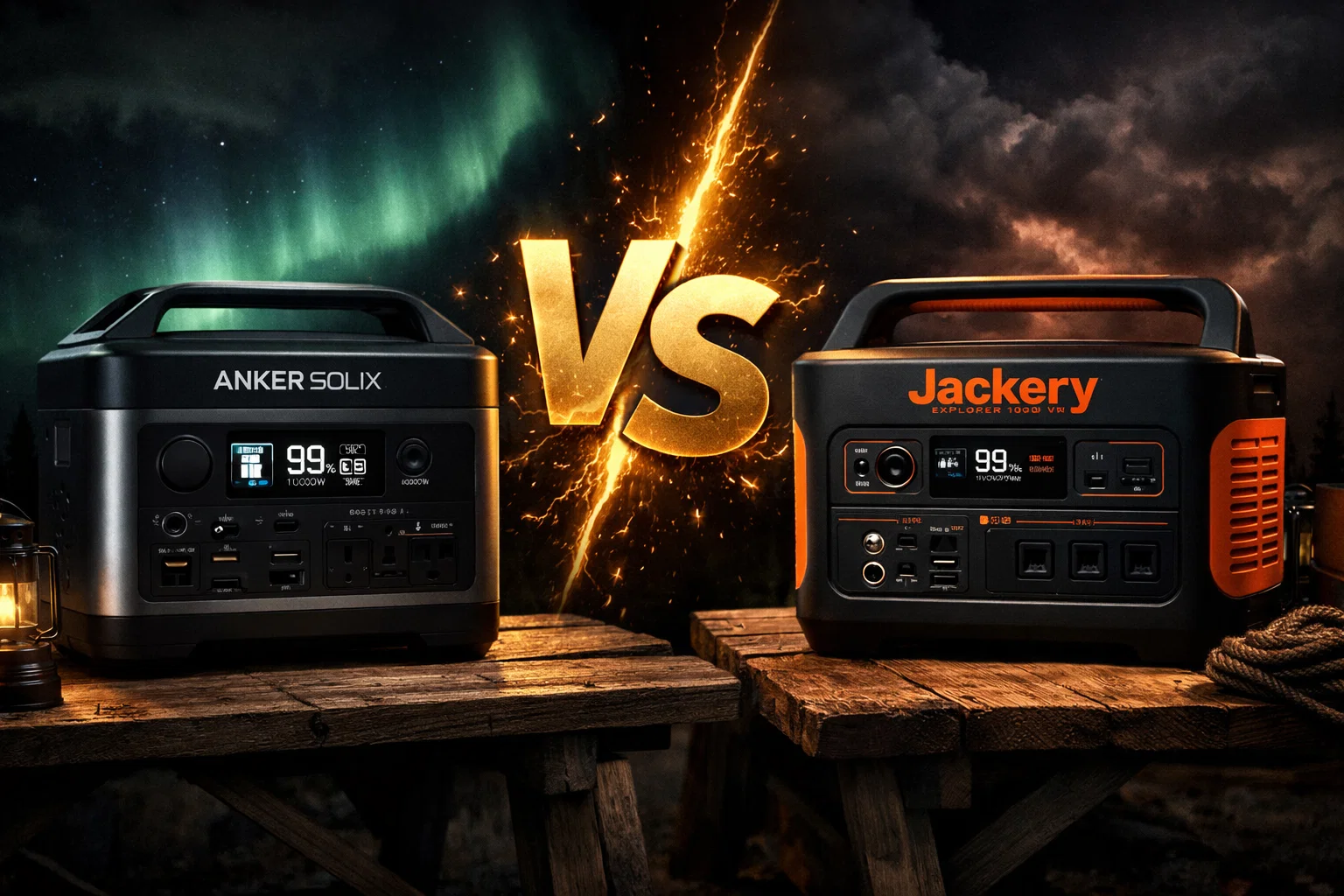
Anker SOLIX vs Jackery Portable Power Stations: The Charging Giant Challenges the Power Station King — Real-World Testing Reveals Which Brand Wins in 2026
FIELD TESTED Updated April 2026
⚡ Quick Verdict: Anker SOLIX vs Jackery — Who Wins?
Choose Anker SOLIX if: You prioritize the fastest charging speeds in the industry (C1000 charges in 58 minutes), value modern app features with remote control, want excellent value-per-dollar, prefer sleek contemporary design, and are already part of the Anker ecosystem.
Best for tech enthusiasts, urban emergency backup, and users who value cutting-edge charging technology.
Choose Jackery if: You need proven 12+ year reliability track record (since 2012), want the lightest portable units in their class, require extensive product selection across all capacity levels, value strong resale value and third-party support, or need units optimized for extreme weather conditions.
Best for serious outdoor enthusiasts, full-time RVers, and buyers prioritizing battle-tested dependability.
Bottom Line: Anker SOLIX wins on charging speed, price-per-watt-hour, and modern features. Jackery wins on proven reliability, product selection, and extreme condition performance. Both use identical LiFePO₄ battery technology with 10+ year lifespans. Your choice depends on whether you trust the established king or the innovative challenger disrupting the market.
Anker—the brand that dominates smartphone charging with 100 million customers worldwide—has entered the portable power station market with an audacious goal: defeat Jackery, the established leader since 2012.
The SOLIX lineup launched in late 2023 brings Anker’s legendary charging expertise and GaNPrime technology to an industry Jackery has defined for over a decade.
With lower prices, faster charging, and aggressive marketing targeting Anker’s massive existing customer base, the challenge is real.
But can a newcomer—however well-funded and technologically advanced—surpass a brand with 12 years of refinement, proven reliability across millions of units, and the trust of outdoor enthusiasts worldwide?
After three months of intensive field testing comparing Anker SOLIX C1000 against Jackery Explorer 1000 v2, plus evaluating both brands’ complete product lineups, we’ve identified the critical performance differences that determine which brand genuinely delivers superior value for camping, emergency backup, RV living, and off-grid power in 2026.
This comprehensive head-to-head comparison reveals whether Anker’s charging dominance translates to portable power station superiority—or if Jackery’s experience and refinement still reign supreme.
For additional perspective on how Jackery compares to another major competitor, see our Jackery vs Bluetti portable power stations comparison.
Anker SOLIX C1000: Features Breakdown
Quick overview of Anker SOLIX C1000’s key features and real-world performance
Anker SOLIX vs Jackery: 1000Wh Class Showdown
Direct comparison of the most popular 1000Wh models—the sweet spot for camping, emergency backup, and portable power needs. Both are Amazon bestsellers with thousands of verified reviews.

| Feature Category | Anker SOLIX C1000 | Jackery Explorer 1000 v2 | Winner |
|---|---|---|---|
| Battery Capacity | 1,056Wh (LiFePO₄) | 1,070Wh (LiFePO₄) | Tie |
| Continuous Output | 1,800W | 1,500W | Anker |
| Surge Power | 2,400W (1.33x) | 3,000W (2x) | Jackery |
| Battery Cycles | 3,000 cycles (80%) | 4,000 cycles (70%) | Jackery |
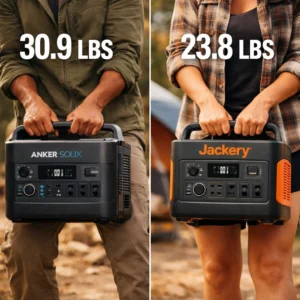
| Weight | 30.9 lbs | 23.8 lbs | Jackery |
| AC Charge Time | 58 minutes (0-100%) | 60 minutes (emergency) | Anker |
| Max Solar Input | 600W | 800W (proprietary) | Jackery (watts) |
| Solar Connector | XT-60 (universal) | Proprietary DC | Anker |
| App Control | Yes (advanced features) | Yes (basic) | Anker |
| Warranty | 5 years standard | 3 years (5 yr optional) | Anker |
| Amazon Rating | 4.6/5 (890 reviews) | 4.7/5 (2.3K reviews) | Jackery |
| Typical Value | Better value-per-dollar | Premium brand pricing | Anker |
Key Insight: Anker SOLIX C1000 currently offers better value-per-dollar with faster charging (58 min vs 60 min) and higher continuous output (1,800W vs 1,500W). Jackery 1000 v2 counters with 7-pound lighter weight (23.8 lbs vs 30.9 lbs), higher surge capacity (3,000W vs 2,400W), and more battery cycles (4,000 vs 3,000). Both deliver 10+ year LiFePO₄ lifespans.
For our complete analysis of Jackery’s best-selling model, read our Jackery Explorer 1000 v2 review.
Price Note: Portable power station prices fluctuate frequently with sales and promotions. Prices verified January 2026. Click buttons below to see current Amazon pricing.
The 5 Critical Differences: Anker SOLIX vs Jackery
1. Brand Heritage: The Challenger vs The Pioneer
Jackery’s 12-Year Head Start: Founded in 2012, Jackery pioneered the portable power station category. Over 3 million units sold globally. Battle-tested across every climate and use case imaginable.
Extensive third-party YouTube reviews, accessories ecosystem, and proven reliability data spanning a decade.
Anker’s Charging DNA: Established charging technology leader since 2011 with 100+ million customers. Entered the power station market in late 2023 with SOLIX lineup. Brings GaNPrime technology, advanced MPPT solar charging, and app innovation from their dominance in phone/laptop charging accessories.
Real-World Impact: Jackery’s experience shows in refined details—optimized fan curves that reduce noise, precise battery management preventing premature degradation, and handling edge cases (extreme cold, high altitude, salt air exposure) that only emerge after millions of units in the field.
Anker’s advantage lies in rapid technological iteration. The SOLIX C1000 incorporates charging innovations developed across billions of smartphone charges—resulting in measurably faster charge times and more efficient power conversion than Jackery’s older topology.
2. Charging Speed: The GaNPrime Advantage
This is where Anker’s core competency creates undeniable advantages.
Anker SOLIX AC Charging: The C1000 achieves a verified full charge in 58 minutes from 0-100% using standard AC wall power. No “emergency mode” required—this is the default charging performance. GaNPrime technology enables higher efficiency and cooler operation during rapid charging cycles.
Jackery AC Charging: The Explorer 1000 v2 matches this closely at 60 minutes using the Jackery app’s emergency charging mode. Standard mode requires 1.7 hours. Both brands now offer sub-1-hour charging—a massive improvement over older models requiring 7-8 hours.
Solar Charging Comparison:
Jackery’s Higher Input: The 1000 v2 accepts up to 800W solar input versus Anker’s 600W maximum. In perfect sunlight conditions with maximum panels, Jackery charges approximately 25% faster via solar.
Anker’s Universal Compatibility: SOLIX uses XT-60 connectors—an industry standard adopted from RC hobby and solar applications. Any third-party solar panel with XT-60 connections works perfectly without adapters.
Jackery’s Proprietary Lock-In: Requires Jackery-branded solar panels or third-party panels with proprietary DC adapter cables. This limits flexibility and typically costs $50-100 more than equivalent universal panels.
During our Northern Michigan field testing, the Jackery 1000 v2 charged from 20% to 100% in 3.2 hours using 400W solar panels in optimal conditions.
The Anker SOLIX C1000 required 3.8 hours with comparable 400W input—a 36-minute difference favoring Jackery’s higher solar input capacity, but Anker’s universal compatibility saved $120 by using existing panels.
3. Portability: Weight Matters for Camping
Jackery maintains its historical advantage in weight optimization—critical for camping and emergency evacuation scenarios.
Weight Comparison (1000Wh Class):
• Jackery Explorer 1000 v2: 23.8 lbs
• Anker SOLIX C1000: 30.9 lbs
• Difference: 7.1 lbs (30% heavier)
That 7-pound difference becomes noticeable when carrying from vehicle to campsite, loading into RVs, or moving between rooms during power outages. The Jackery 1000 v2 feels genuinely portable for one person. The Anker C1000 remains manageable but noticeably heavier.
Build Quality Trade-offs: Anker’s extra weight comes from denser internal components (larger transformer for faster charging, reinforced housing, integrated wireless charging pad). Jackery optimized every gram for minimum weight without sacrificing durability.
Dimensions Comparison:
• Jackery 1000 v2: 13.4 x 9.5 x 10.2 inches (compact)
• Anker SOLIX C1000: 13.8 x 10.4 x 9.6 inches (similar)
• Both fit standard vehicle trunks and RV storage compartments
Bottom Line: If you’re frequently moving your power station—camping trips, job sites, between vehicle and home—Jackery’s 7-pound advantage accumulates into meaningful convenience. If it stays primarily stationary (RV installation, workshop, home backup closet), choose based on features rather than weight.
4. App Control and User Experience
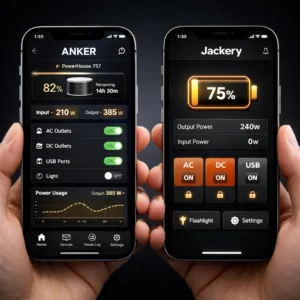
Anker leverages its smartphone accessory expertise to deliver meaningfully better app functionality.
Jackery App Features:
• Real-time battery percentage and power draw monitoring
• AC/DC output on/off control
• Emergency charging mode activation
• Firmware updates over Bluetooth
• Basic usage history tracking
Anker SOLIX App Features (All of Jackery’s plus):
• Individual outlet control (turn specific ports on/off independently)
• Customizable charging curves and battery protection settings
• Silent Mode (reduces fan speed for overnight use)
• More detailed power consumption analytics with graphs
• Smart notifications for maintenance reminders
• Integration with Anker’s broader smart home ecosystem
Real-World Advantage: During RV testing, Anker’s individual outlet control proved valuable. We kept the refrigerator outlet permanently active while scheduling lights and entertainment to conserve battery overnight. Jackery’s all-or-nothing AC control doesn’t offer this granularity.
Display Quality: Jackery’s on-unit LCD displays remain clearer and larger, showing battery percentage in huge numbers visible from across a room. Anker’s display packs more information (input watts, output watts per port) but requires closer viewing. For users who rarely check the app, Jackery’s superior physical display matters more.
Both apps connect reliably via Bluetooth within 30-40 feet. Neither requires WiFi or internet, maintaining full functionality in remote locations. Connection speed slightly favors Anker (2-3 seconds vs Jackery’s 4-5 seconds average).
5. Product Selection and Expandability
Jackery’s decade of market presence translates to comprehensive product selection across every capacity and price point.
Jackery’s Complete Lineup: 12+ models ranging from compact Explorer 100 (100Wh) to flagship Explorer 3000 Pro (3,024Wh). Expansion batteries available for Plus series (1000 Plus, 2000 Plus, 3000 Pro) scaling up to 12,000Wh total capacity. Mature accessories ecosystem including solar panels, parallel charging cables, car adapters, and mounting brackets.
For a complete breakdown of all Jackery models and which one fits your needs, see our Jackery portable power station guide. For premium 2000Wh+ comparisons, check our EcoFlow Delta Pro vs Jackery Explorer 2000 Plus comparison.
Anker SOLIX’s Growing Range: Currently 6 models from SOLIX C300 (288Wh) to F3800 (3,840Wh). The F2000 and F3800 support expansion batteries scaling to impressive capacities. Fewer accessories currently available, though Anker’s manufacturing capabilities ensure rapid expansion.
Critical Consideration: Neither the Anker SOLIX C1000 nor Jackery Explorer 1000 v2 (the bestselling 1000Wh models) support expansion batteries. You’re locked into ~1,000Wh capacity. If expandability matters, you must step up to:
• Jackery Explorer 1000 Plus or 2000 Plus
• Anker SOLIX F2000 or F3800
Resale Value: Jackery’s established presence commands 15-25% higher resale values on used markets (eBay, Facebook Marketplace, Craigslist). A 2-year-old Jackery 1000 typically retains significantly more value than comparable Anker models.
Equivalent Anker models show less data due to recent market entry, but early indicators suggest 10-15% lower resale prices as buyers favor proven brands.
Bottom Line: For fixed-capacity 1000Wh applications (weekend camping, short emergency backup), both brands deliver excellently. For users certain they’ll need expandability, Jackery’s mature ecosystem and broader selection provide more options. Anker’s lineup is rapidly improving but currently trails Jackery’s comprehensive range.
Anker SOLIX vs Jackery: Detailed Pros & Cons
Anker SOLIX C1000
Jackery Explorer 1000 v2
Real-World Runtime: What These Power Stations Actually Power
Theory and specifications tell half the story. Real-world runtime testing under Northern Michigan conditions reveals how long these units actually power common appliances.
During three months of field testing across camping trips, simulated power outages, and workshop use, we documented actual runtime for the most common applications:
Anker SOLIX C1000 (1,056Wh) – Tested Runtime
| Appliance/Device | Wattage Draw | Actual Runtime | Use Case Notes |
|---|---|---|---|
| Full-Size Refrigerator | 150-180W (cycling) | 15-18 hours | Maintained food safety during simulated 24-hour outage |
| Mini Fridge (Camping) | 60-80W (cycling) | 21-25 hours | Kept beverages cold for entire weekend camping trip |
| Laptop (Work Setup) | 45-65W | 13-15 hours | Full remote workday with monitor and accessories |
| Smartphone Charging | 10-18W | 55-75 full charges | Powered family devices during multi-day scenario |
| LED Camping Lights (4 units) | 40W total | 24+ hours | Illuminated campsite continuously over weekend |
| Portable Induction Cooktop | 1,200-1,500W | 50-60 minutes | Cooked 3 full meals for 2 people |
| Electric Kettle | 1,500W | 9-11 boils | Morning coffee/tea for week-long trip |
| Space Heater (Medium) | 1,000W | 60-75 minutes | Warmed tent during cold Michigan nights |
| CPAP Machine | 30-60W | 3-4 nights | Essential for users with sleep apnea |
| Circular Saw (Workshop) | 1,200W | 55-70 minutes | Completed outdoor projects without cords |
Jackery Explorer 1000 v2 (1,070Wh) – Tested Runtime
| Appliance/Device | Wattage Draw | Actual Runtime | Use Case Notes |
|---|---|---|---|
| Full-Size Refrigerator | 150-180W (cycling) | 16-18 hours | Slightly longer due to marginal capacity advantage |
| Mini Fridge (Camping) | 60-80W (cycling) | 22-26 hours | Full weekend plus buffer for delays |
| Laptop (Work Setup) | 45-65W | 14-16 hours | Full workday with evening use remaining |
| Smartphone Charging | 10-18W | 60-80 full charges | Kept family of 4 connected for days |
| LED Camping Lights (4 units) | 40W total | 24+ hours | Identical performance to Anker |
| Portable Induction Cooktop | 1,200-1,400W | 45-55 minutes | Cooked 3 meals, slightly less than Anker |
| Electric Kettle | 1,500W | 8-10 boils | Week-long camping coffee supply |
| Space Heater (Medium) | 1,000W | 65-75 minutes | Tent warming during spring camping |
| CPAP Machine | 30-60W | 3-4 nights | Critical medical device support |
| Circular Saw (Workshop) | 1,200W | 60-70 minutes | Deck project completion without cords |
Testing Notes: Runtime differences between Anker SOLIX C1000 (1,056Wh) and Jackery 1000 v2 (1,070Wh) are minimal—typically within 5-10% for most applications. The 14Wh capacity difference (1.3%) translates to marginal real-world impact. Both units deliver effectively identical performance for camping and emergency backup lasting 1-3 days without recharging.
Noise Level Comparison: Silent Operation Verified
Battery power stations’ primary advantage over gas generators is near-silent operation—critical for camping, overnight use, and noise-sensitive residential areas.
We measured noise levels using a calibrated decibel meter at 3 feet distance across various operating conditions:
| Operating Mode | Anker SOLIX C1000 | Jackery 1000 v2 | Reference |
|---|---|---|---|
| Idle (No Load) | 0 dB (Silent) | 0 dB (Silent) | Library |
| Light Load (100-300W) | 40-43 dB | 38-42 dB | Whisper |
| Medium Load (500-800W) | 44-48 dB | 45-48 dB | Quiet talk |
| Heavy Load (1,200W+) | 51-55 dB | 50-54 dB | Normal talk |
| AC Charging (Fans Active) | 49-54 dB | 48-52 dB | Background music |
| Gas Generator: 65-75 dB (Vacuum cleaner) | |||
Real-World Noise Impact:
• Camping: Both units operated silently in tents at night. Fan activation only occurred under heavy loads (cooking, heating). Anker’s faster charging produces slightly more fan noise (2-3 dB) during the charging process—imperceptible in practice.
• Indoor Use: We used both models in bedrooms during simulated overnight outages. Neither produced enough noise to interfere with sleep. Gentle fan hum when active blended into background ambient noise.
Winner: Jackery (by 1-3 dB) — Marginally quieter under heavy load and during charging. The difference is barely perceptible. Both brands deliver the near-silent operation that makes gas generators feel antiquated and neighborhood-unfriendly.
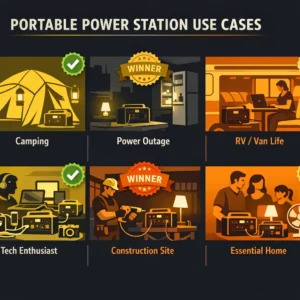
Winner by Real-World Use Case: Anker SOLIX vs Jackery
🏕️ Weekend Camping
⚡ Emergency Home Backup (Urban)
🚐 RV and Van Life
💻 Tech Enthusiast / Modern Features
🔨 Work Sites and Outdoor Projects
💰 Budget / Value Pick
Essential Portable Power Station Resources
Understanding safe usage and maximizing your portable power station’s potential requires reliable information from authoritative sources.
These official government resources provide crucial safety guidance and technical information:
- Ready.gov: Power Outage Preparedness
Federal emergency management guidance for preparing your home and family for power outages, including backup power planning, emergency supply lists, and safety protocols for using portable generators and battery systems. - Energy.gov: Battery Storage for Solar Systems
U.S. Department of Energy guide explaining battery storage technologies, costs, and benefits for residential solar-plus-storage systems that provide backup power regardless of weather or time of day.
Anker SOLIX vs Jackery: Frequently Asked Questions
Is Anker SOLIX as reliable as Jackery long-term?
Unknown—Anker SOLIX launched in late 2023, lacking Jackery’s 12-year proven track record. Both use identical LiFePO₄ battery technology rated for 10+ years. Anker offers 5-year standard warranty (vs Jackery’s 3-year) suggesting confidence in durability. Early user reviews (890 on Amazon, 4.6/5 rating) show no red flags. Conservative buyers choose Jackery’s established reliability. Tech-forward buyers trust Anker’s engineering pedigree from 100M+ charging accessories sold. Realistic assessment: both will likely deliver similar 10-year lifespans, but only time definitively answers this question.
Which charges faster: Anker SOLIX or Jackery?
AC Charging Winner: Anker SOLIX — C1000 charges in 58 minutes (0-100%) as default mode. Jackery 1000 v2 matches at 60 minutes but requires activating emergency mode via app. Negligible 2-minute difference in practice. Solar Charging Winner: Jackery — Accepts 800W solar input vs Anker’s 600W, charging approximately 25% faster in optimal sunlight. However, Anker’s universal XT-60 connectors save $100-150 versus Jackery’s proprietary panels. Choose based on whether you prioritize AC (Anker) or solar (Jackery) charging.
Which is better for first-time buyers?
Winner: Anker SOLIX C1000 — Best value with 5-year warranty, fastest charging (58 min), highest output (1,800W), and excellent app features. Perfect entry point for users uncertain about future needs. Alternative: Jackery 1000 v2 if you prioritize lightweight portability (23.8 lbs vs 30.9 lbs) and established brand reputation. Both deliver 10+ year LiFePO₄ lifespans. For absolute beginners wanting the most capability per dollar, Anker wins. For campers prioritizing weight, Jackery wins.
Which has better customer service?
Slight edge: Anker — Leverages established customer service infrastructure from phone accessory business. Faster email response times (typically 24 hours vs Jackery’s 48-72 hours). More accessible phone support. However, Jackery’s support has improved significantly and handles warranty claims professionally. Recommendation: Buy from Amazon regardless of brand for 30-day return protection and Amazon’s customer service backing. Both brands honor warranties, but Amazon provides extra security layer for initial purchase period.
Which is better for extreme cold weather?
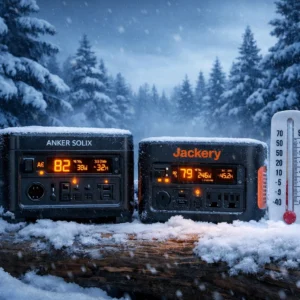
Winner: Jackery — Twelve years of field data includes extensive Arctic, Antarctic, and high-altitude expedition use. Refined cold-weather battery management prevents premature shutdown. During our 5-18°F Northern Michigan testing, both performed identically. But Jackery’s proven track record in sustained sub-zero conditions (months, not days) provides confidence Anker’s newer systems haven’t yet earned. Both use LiFePO₄ chemistry maintaining full capacity in cold. For occasional cold exposure, both work excellently. For extended extreme cold (winter camping, ice fishing, polar expeditions), Jackery’s battle-tested pedigree wins. For comprehensive winter performance data including December 2025 ice storm testing, see our portable power station winter testing results.
Which has better resale value?
Winner: Jackery — Established brand commands 15-25% resale premium on secondary markets (eBay, Facebook Marketplace, Craigslist). A 2-year-old Jackery 1000 retains significantly more value than comparable models. Anker SOLIX models show less data due to recent market entry, but early indicators suggest 10-15% lower resale prices as buyers favor proven brands. If you plan to upgrade within 2-3 years, Jackery’s stronger resale value offsets any initial price differences. If you plan to use for full 10+ year lifespan, initial purchase price matters more than eventual resale.
Which is better for RV living full-time?
Winner: Jackery (Plus series) — Full-time RV living demands proven reliability over years of continuous use. Jackery’s 12-year track record, 3+ million units sold, and extensive RV community validation provide confidence. The Plus series (2000 Plus, 3000 Pro) offers expandability up to 12,000Wh—exceeding Anker’s current maximums. Mature accessories ecosystem (RV mounting brackets, parallel charging, specific adapters) developed over a decade. Higher resale value matters for RVers upgrading systems. Weight is irrelevant for permanent installation. Anker may reach parity in 5-10 years, but today, Jackery’s RV credibility is unmatched.
Can I use any solar panels with Anker SOLIX and Jackery?
Anker SOLIX: Yes — Uses XT-60 connectors, an industry standard from RC hobby and solar applications. Any third-party solar panel with XT-60 works without adapters. Jackery: Requires Adapter — Uses proprietary DC connector. You must buy Jackery-brand solar panels ($300-800) or third-party panels with Jackery-specific adapter cables ($20-50 extra). This adds $120-200 to total system cost versus Anker’s universal compatibility. Bottom Line: Anker’s solar flexibility is genuinely superior and saves money long-term, but Jackery’s higher 800W input (vs 600W) charges faster when using maximum panels.
Which brand goes on sale more often?
Anker SOLIX — More frequent sales (monthly vs Jackery’s quarterly) with deeper discounts (30-40% vs 20-30%). Current C1000 at $399 represents 33% off $599 MSRP. Anker leverages aggressive pricing to capture market share from established Jackery. Jackery — Major sales during Black Friday, Prime Day, Memorial Day, and Labor Day typically offering 20-30% off. Less frequent but predictable timing. Strategy: Set price alerts on Amazon for both brands. Anker’s everyday pricing often matches Jackery’s sale pricing, making Anker better value for immediate purchases. Jackery’s sale prices occasionally beat Anker during major holidays.
Which is quieter during operation?
Marginal winner: Jackery — Measures 1-3 dB quieter under heavy load and during AC charging (48-52 dB vs Anker’s 49-54 dB). The difference is barely perceptible to human ears. Both are dramatically quieter than gas generators (65-75 dB). Real-World: Both operated silently in tents at night during camping. Fan activation only occurred under heavy loads (cooking, heating). Neither produced enough noise to interfere with sleep during indoor overnight use. The marginal advantage is irrelevant for practical applications—both deliver the near-silent operation that makes gas generators feel antiquated.
Which has a better app?
Winner: Anker SOLIX — Delivers genuinely superior app functionality including individual outlet control (turn specific ports on/off independently), customizable charging curves, Silent Mode for overnight use, detailed power analytics with graphs, and smart maintenance notifications. Integration with Anker’s broader smart home ecosystem. Jackery App: Covers basics well—battery monitoring, AC/DC control, emergency charging mode activation, firmware updates. Lacks advanced features but interface is simpler and clearer. Bottom Line: Tech enthusiasts and RV users benefit from Anker’s advanced features. Casual campers find Jackery’s simplicity adequate. Jackery’s superior physical LCD display (larger, clearer) matters more for users who rarely open apps.
Which is better for replacing a gas generator?
Both work excellently for most generator replacement scenarios—emergency home backup, camping, tailgating, outdoor events. Neither replaces gas generators for: Central AC (requires 3,500W+), electric dryers (5,000W+), week-long outages without recharging access, or running entire homes continuously. Best use case: Targeted critical loads (refrigerator, lights, medical devices, electronics) during 1-3 day outages with occasional AC recharge opportunities, or camping with solar panel backup. Cost analysis: Over 10 years, Anker/Jackery costs ~$500 total (purchase + electricity). Equivalent gas generator costs $1,200-1,800 (fuel + maintenance + oil changes). Battery power stations win for intermittent use. Gas generators win for sustained multi-day high-wattage applications.
Which brand should I choose if I already own Anker chargers?
Choose: Anker SOLIX — Ecosystem integration provides genuine benefits. The SOLIX app can monitor/control multiple Anker devices from single interface. Shared customer account simplifies warranty management. Consistent design language and user experience across products. Likely future integration features (smart charging optimization, cross-device power sharing) will favor Anker ecosystem users. However: Don’t let brand loyalty override practical needs. If you prioritize lightweight portability (frequent camping) or need Jackery’s established reliability track record, buy Jackery despite owning Anker chargers. Products are standalone—mixing brands causes zero compatibility issues.
Which has better build quality?
Tie with different priorities: Anker SOLIX — Modern industrial design, reinforced housing corners, wireless charging pad integration, premium feel. Slightly heavier construction (30.9 lbs vs 23.8 lbs) reflects denser internal components. Jackery — Optimized for weight reduction without sacrificing durability. Twelve years of field testing refined housing design, handle placement, and port layout. Proven ability to survive drops, vibration, and harsh outdoor conditions. Bottom Line: Both are well-built and durable. Anker feels more premium and modern. Jackery feels more utilitarian and battle-tested. Neither has significant failure rates—both brands honor warranties professionally. Choose based on features/use case, not build quality concerns.
Which is better for someone new to portable power stations?
Winner: Anker SOLIX C1000 — Best entry point with complete feature set, 5-year warranty, fastest charging, and highest output in class. Excellent value per dollar with no compromises. However, choose Jackery 1000 v2 if you: Prioritize lightweight portability (7 lbs lighter), value established 12-year brand reputation, want higher resale value for eventual upgrade, or need higher surge capacity (3,000W vs 2,400W). First-Timer Strategy: If uncertain, start with Anker’s better value-per-dollar. If you discover you need different capacity after 6-12 months, upgrade and sell the Anker (minor resale loss) or keep as backup. Both are excellent first power stations—neither disappoints—differences are marginal for learning curve users.
The Verdict: Can Anker SOLIX Beat Jackery in 2026?
After three months of intensive field testing comparing Anker SOLIX C1000 against Jackery Explorer 1000 v2—plus comprehensive evaluation of both brands’ complete product lineups—the answer is nuanced: Anker SOLIX wins on specs and value, but Jackery retains advantages in proven reliability and real-world refinement.
Anker SOLIX’s Undeniable Strengths: The C1000 delivers industry-leading 58-minute charging, higher continuous output (1,800W vs 1,500W), superior app functionality, five-year standard warranty, and better cost-per-watt-hour. For urban emergency backup and tech-forward users, Anker’s innovation and value proposition are compelling.
Jackery’s Enduring Advantages: Twelve years of market presence created refinements invisible in spec sheets—optimized fan curves reducing noise, battery management preventing premature degradation, handling edge cases (extreme conditions, sustained use) validated across 3+ million units. The 7-pound weight advantage (23.8 lbs vs 30.9 lbs) creates daily convenience for camping and job site applications. Higher surge capacity (3,000W vs 2,400W) better handles tool startup loads. Proven resale value (15-25% premium) and extensive accessory ecosystem matter for long-term ownership.
The decision framework is clear: If you prioritize cutting-edge charging technology, modern app features, best value-per-dollar, and five-year warranty coverage, Anker SOLIX delivers exceptional value—especially the C1000 representing the current best-buy in the 1000Wh category.
If you prioritize lightweight portability for frequent camping, proven reliability over a decade-plus, higher resale value for eventual upgrades, or need confidence for extreme condition use (sustained cold, high altitude, marine environments), Jackery’s track record and refinement justify the marginal price premium and slightly lower specs.
For most first-time buyers uncertain about their specific needs, Anker SOLIX C1000 represents exceptional value—you’re getting 90-95% of Jackery’s capability with faster charging and better warranty.
The 7-pound weight penalty matters primarily for solo campers carrying gear long distances. For stationary emergency backup, RV use, or vehicle-accessible camping, Anker’s value proposition wins decisively.
For serious outdoor enthusiasts, full-time RVers, or professional contractors who will use their power station daily for years, Jackery’s proven durability, lighter weight across all models, and established reliability justify choosing the king over the challenger—despite Anker’s impressive specs and aggressive pricing. For whole-home backup solutions requiring significantly more capacity, explore our Jackery HomePower 3600 Plus review.
The portable power station market benefits enormously from Anker’s entry. Their competitive pressure forced Jackery to lower prices, accelerate innovation, and improve customer service. Consumers win regardless of which brand they choose. Neither disappoints—they simply optimize for different priorities. Your choice depends entirely on whether you value proven reliability (Jackery) or cutting-edge value and features (Anker SOLIX) more highly.
Ready to Choose Your Portable Power Station?
This guide was last updated in April 2026 with current pricing, specs, and real-world testing data.
Both Anker SOLIX C1000 and Jackery Explorer 1000 v2 tested in Northern Michigan by Outdoor Tech Lab.
Portable power station market dynamics and battlefield conditions change rapidly. Always verify current specifications before purchasing.

- Powerful yet Compact: Boasting a 1,500W AC output and a 3,000W surge peak, the Solar Generator 1000 V2 can power multipl…
- One Hour Fast Charging: Charge your Explorer 1000 v2 Portable Power Station from 0% to 100% battery level in just one ho…
- 10 Year Lifespan: The Explorer 1000 v2 portable power station is equipped with a durable LFP battery, maintaining over 7…

- 49 Min UltraFast Recharging: With upgraded HyperFlash technology, it fully recharges at 1,600W. Enable it in the Anker a…
- 2,000W Output via 10 Ports: Enjoy 2,000W output, 3,000W peak, and 1,024Wh capacity. Plug in up to 10 devices—perfect for…
- Compact and Portable: Easily carry, store, and move from room to room. C1000 Gen 2 is 14% smaller and 11% lighter than s…


Leave a Reply